Separating identity from execution: designing safe action layers for agentic systems.
By Sumant Thakur
Published: 2026-04-03
URL: https://sumantthakur.substack.com/p/identity-is-not-enough-why-agentic
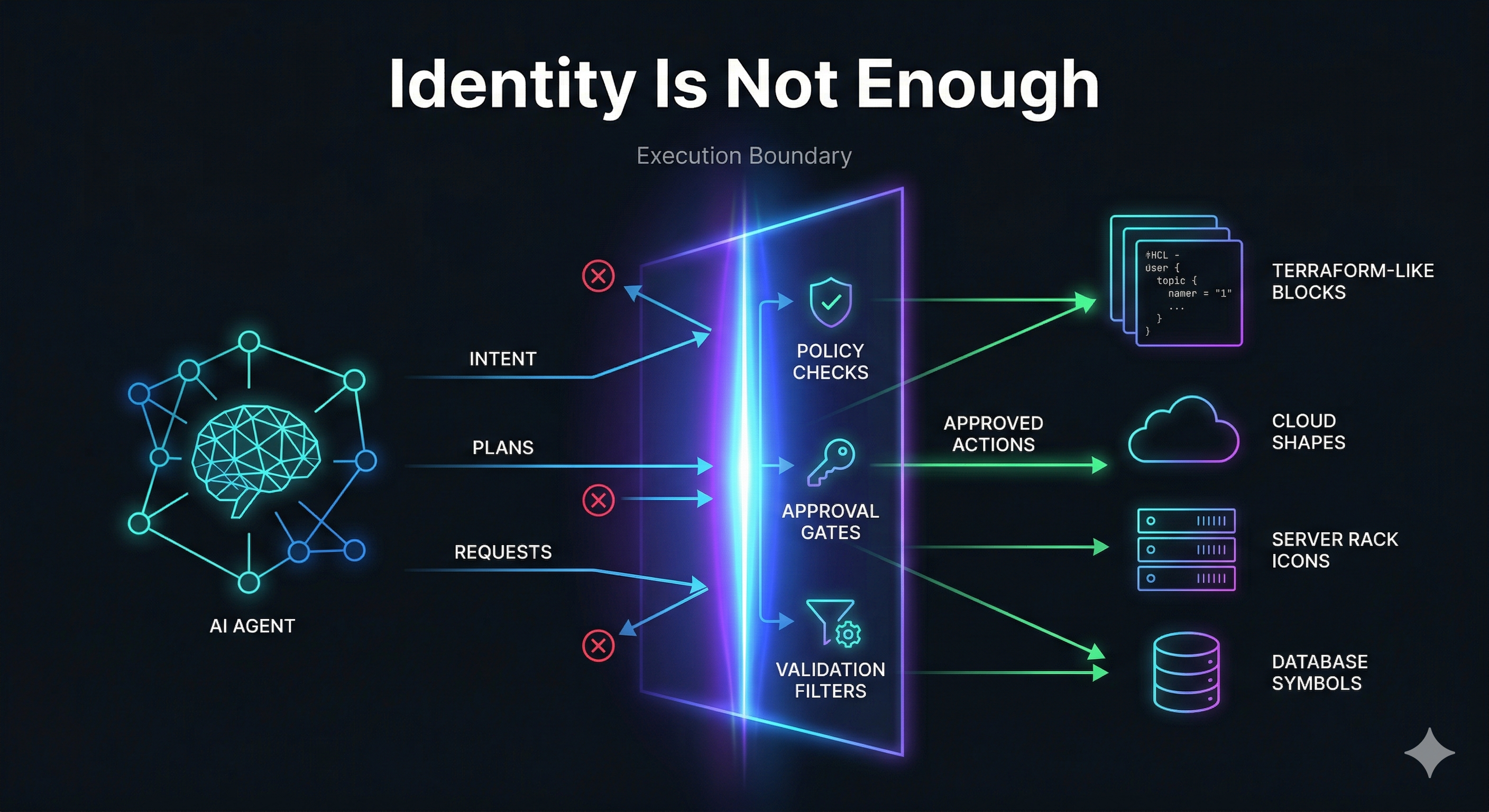
An agent with a valid identity can still wreck your infrastructure.
That is the part most people miss.
Thanks for reading Autonomous AI Architect! Subscribe for free to receive new posts and support my work.
We have spent a lot of time talking about giving agents the right credentials, the right tokens, the right scopes, and the right auth model. Good. Necessary. But it is not enough. Identity tells you who is acting. It does not tell you whether what they are about to do is safe.
That is the real problem.
A production agent does not fail only when it is unauthorized. It fails when it is authorized to do the wrong thing.
That is why agentic systems need an execution boundary.
Identity is not the same as control
This is where a lot of agent architecture discussions go soft.
People hear “agent identity” and assume the hard part is solved. It is not. Identity gives you authentication and authorization. It tells the system that the request came from a recognized actor and that the actor has some level of permission.
That is useful, but it is only the first gate.
A valid agent identity can still:
- delete the wrong resource
- apply changes in the wrong environment
- leak context it should never have seen
- chain together several harmless actions into one dangerous outcome
- make a correct change at exactly the wrong time
That is the point.
Authorization is not the same thing as safety.
The execution boundary
The execution boundary is the line between reasoning and mutation.
Inside that boundary, the agent can inspect, plan, simulate, and propose. Outside that boundary, it cannot touch real state until policy, context, and risk checks say it can.
That boundary needs to answer a few hard questions:
What can the agent read? What can it propose? What can it simulate? What can it execute? What needs approval? What gets blocked automatically? What gets logged? What can be rolled back?
If you cannot answer those questions clearly, you do not have an agent platform. You have a chat interface with tool access.
Why this matters in infrastructure
Infrastructure is where the cost of bad judgment becomes very real.
A wrong action can affect availability, compliance, cost, secrets, downstream workloads, and deployment integrity. That means infra agents cannot behave like casual assistants. They need boundaries, not just credentials.
A model can understand the intent of a change and still miss the operational risk.
It can be directionally right and productionally wrong.
That is why the control plane matters more than the prompt.
What the execution boundary should include
A real execution boundary is not just a permission check. It is a system.
It should include:
A read boundary so the agent only sees the state it is supposed to see.
A planning boundary so reasoning is separated from mutation.
A validation layer so every proposed action is checked against policy, ownership, dependencies, and blast radius.
An approval layer for changes that are high-risk or high-impact.
A sandboxed execution layer so the agent does not write directly to production state without guardrails.
An audit layer so every step can be reconstructed later.
A rollback path so recovery is part of the design, not an afterthought.
That is what makes an agent usable in production.
The dangerous assumption
The dangerous assumption is this:
If the identity is valid, the action is safe.
It is false.
A human with root access still uses reviews, dry runs, change windows, and rollback plans. An agent needs the same discipline, but stricter. It can move faster, repeat mistakes faster, and chain actions without hesitation.
That means the execution boundary has to be more conservative than the identity layer.
Identity answers: who are you? Execution boundary answers: what are you allowed to do, right now, in this context, at this risk level?
Those are different problems.
What I would not do
I would not let an agent:
- mutate production directly from a free-form prompt
- infer its own permission scope
- escalate privileges because the task sounds urgent
- skip validation because the model is confident
- hide a messy execution chain behind a polished final answer
That last one matters.
A lot of agent systems look safe because the final response is neat. But the danger is always in the chain that produced it.
The right architecture
A production agent should flow like this:
Authenticate the agent. Resolve the environment and policy context. Generate a plan. Validate the plan. Escalate if needed. Execute in a constrained environment. Capture the full trace. Support rollback or remediation.
That is the minimum.
Anything less is optimism wearing a systems diagram.
Why this is the next layer after identity
Your identity post answered one important question: how do we stop agents from being anonymous API-key-shaped blobs?
This post answers the next question:
How do we stop a valid agent from doing the wrong thing?
That is the execution boundary.
Identity is the key. Execution boundary is the lock.
Final view
Agentic systems will not become trustworthy because they are more autonomous.
They will become trustworthy because they are more constrained.
That is the part worth building.
Not more freedom.
More control over where freedom is allowed.
That is how you make agents useful in production without making them dangerous.
Thanks for reading Autonomous AI Architect! Subscribe for free to receive new posts and support my work.