Turn your lived experience into income with mini memoirs
By Solo Shannon
Published: 2026-03-31
URL: https://soloshannon.substack.com/p/write-like-a-polaroid
The first time I saw a dead body was at the kitchen table.
The tablecloth had lemons on it and a fuzzy flannel backing that made it stay put on the glossy maple surface of my mother’s prized dining set. Little white flowers adorned the lemons on a backdrop of baby blue. The woman with her head in the oven was also wearing baby blue.
This is the cold opening of a mini-memoir I’m working on. My goal was to drop the reader straight into the scene and spark an immediate need-to-know. I imagined it like an old Polaroid — I walked into my memory bank and took a snap shot of a story from the past.
I’ve always found writing a novel length book completely overwhelming. Call it life sprinkled with neurospice, but I just can’t get my brain to stay on a project for that long. And if we’re honest, most readers aren’t looking for a 300 page life story from someone they’ve never heard of before.
So, I did what I do and I researched it. You’re not going to believe what I found.
The memoir market has changed drastically in recent years and now is the perfect time for unknown authors to break in. Readers in 2026 want to consume true stories the same way they do fiction — voracious binges of immersive experience. Amazon has taken notice and is actively recruiting writers to meet the demand.
Issa Rae’s Series on Amazon
Amazon’s best seller chart in the memoir sub-category is dominated by media and political figures, in other words — famous people.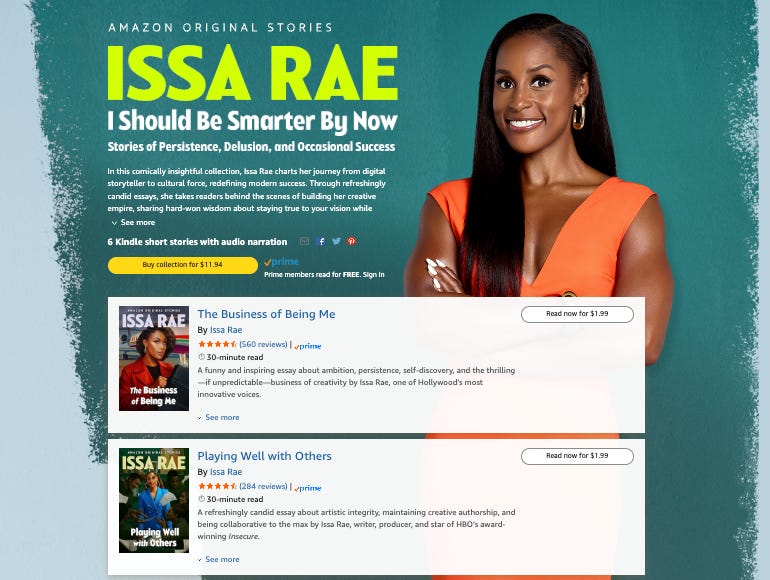
Issa Rae is one of them, but I noticed something interesting about her recently published memoirs. She partnered directly with Amazon Original Stories and released 6 short reads instead of one book, a completely different format than her first memoir traditionally published in 2015 (which was very successful).
Themed Short Reads
Issa’s stories are grouped into 22-35 page short read books around a common theme: I should be smarter by now. Every book gives us a Polaroid moment and humorously explores how she’s fallen short of the theme’s expectation i.e. being smarter by now.
The books are not chronological, and this is the point. Decouple yourself from a timeline and start thinking thematically.
Write Mini-Memoirs, Not a Magnum Opus
Sort your dirty laundry into piles to write from.
A Polaroid is a single, brightly lit flash of a specific moment. Your mini-memoir is the same. Pick one and let’s flesh it out.
-
One Snapshot, One Emotion: A Polaroid doesn’t capture the whole vacation; it captures the moment the tent collapsed in the rain and all you can see is your brother’s feet sticking out of the heap. Pick one defining moment or lesson.
-
The White Border: The white border of a Polaroid is the boundary. Once the specific story is told and the “lesson” is delivered, the book is done. No filler or rambling backstory.
-
Instant Development: Just like a Polaroid develops in minutes, a mini-memoir can be written, edited, and published in a matter of days/weeks, not months/years. This completely eliminates the burnout that kills most aspiring authors (myself included!).
You aren’t abandoning your life story; you’re just publishing it one picture at a time.
Here’s what it looks like in practice. Let’s say you want to write about divorce for women over 50. Instead of a big book, let’s create a mini-series.
-
Book 1: Divorce looks different after 30 years of marriage.
-
Book 2: Navigating the grief of losing your social circle.
-
Book 3: The messy truth about how adult children handle divorce vs teens/younger kids.
-
Book 4: Discovering the freedom of being alone
-
Book 5: When you’re ready to explore new relationships
Each book finds its specific audience through Amazon’s search algorithm. Then, at the end of the series, you bundle all 5 Polaroids into a “Photo Album” (a complete memoir bundle).
This is how you turn your lived experience into passive income.

The Polaroid Process
1. The Cold Open: Do not start with “I was born in...” or “A few years ago, I decided...” Start right in the middle of the conflict, the embarrassing moment, or the crisis. If the essay is about a failed business, start on the day your bank account went negative. Grip the reader instantly.
2. The Stakes: Once your reader is hooked, zoom out briefly. Explain why this moment matters, show them who the woman is with her head in the oven. Did she do this to herself? Is there someone else in the room? This is where you establish the “need to know” and gain the reader’s investment in the outcome.
3. The Messy Middle: This is the core of your “lived experience.” Unpack your mistake baggage, the bad decision, betrayal or the trial-and-error process. It’s not about looking like a success at the end, it’s about being honest with the struggle (even if you failed). This is the part that holds a mirror up to the reader, they see themselves in your struggle.
4. The Pivot: How did this change you? What did you learn? The resolution doesn’t have to be complete or even favorable. The conclusion can be “I’m still a hot mess, but I’m smarter than I was yesterday.” It provides a satisfying emotional payoff without feeling contrived.
I got a story for you Girl Scouts. Once upon a time there was a magical place where it never rained. The end. ~ Mr. Sir
Polaroid Pacing
Pacing in a short read is all about momentum and eliminating friction for the reader.
-
Micro-Chapters: Even within a 30-page short read, break the text up using subheadings or micro-chapters. Give the reader frequent visual breaks. Short sections make them feel like they’re flying through the story.
-
Conversational Tone: The pacing should mirror a late-night conversation with a smart friend. Short sentences with punchy paragraphs are the norm. If a sentence feels like you’re trying to impress or over-explain, cut it.
-
One Theme Per Book: Traditional books juggle multiple subplots and themes. A short read must ruthlessly stick to one central idea. No side tangents or back story! Save it for the next book or thematic series.
You’re sitting on incredible life lessons, but you freeze up when you sit down to write because you think you need to sound like a philosopher or worse, a therapist.
The most profitable short reads on Amazon sound like a story told over coffee catching up with an old friend. Start at the worst part of the story, show us how much it hurt, tell us how you messed up, and explain how you survived it so we can too.
The 5K Word Polaroid Challenge
April is mini-memoir month. [Not really, I made it up. Just go with it and maybe it will become a thing.]
I’m writing a series of short reads this month that I’ll be publishing on Amazon KDP in both Kindle and print format. I’ll be documenting the whole journey on my YouTube channel, including weekly write-with-me sessions, category & keyword selection, publishing and promotion. We can do this together!
Pick one Polaroid moment and write a 5K word mini-memoir with me.
If you love it, just keep writing along with me. At the end I plan on having 5 short reads of 5-10K words each and I’ll be showing you step-by-step exactly how I publish them as a series from my KDP dashboard.
What’s your first snapshot story?
Want to turn their lived experience into income?
Let’s dig into the market data for your niche & help you find exactly the right category, keywords & topic angle to monetize your writing (or YouTube channel), I’ve got a few spots left for April.
If you haven’t read about my March zine experiment click below.