Author interview for She Writes AI Everywhere, Vol. 3, Chapter 4, Neurodivergent AI Design: Reducing Unmeasured Cognitive Tax.
By Farida Khalaf
Published: 2026-10-02
URL: https://shewritesai.substack.com/p/ai-everywhere-author-interview-48-hodman-murad-farida-khalaf
Welcome to the She Writes AI interview episodes covering our second book collaboration stream for the AI Everywhere series. For this new cohort, we are exploring the personal journeys and professional expertise of 32 authors from 18 countries worldwide who are redefining our relationships with machine intelligence.
If you’re new to SheWritesAI, welcome! We’re a free, inclusive community of 780+ women and nonbinary writers in 60+ countries worldwide, with a focus on AI and data. Allies of all genders are welcome.
Learn more: About | Books | Categories | Directory | Digests | Donate | Herstory | Join | Subscribe | Updates | Welcome | World Map
For more insights from interviewer Farida Khalaf, see her Lights On by Farida newsletter or youtube.com/@faridakhalaf25.
About My Guest: Hodman Murad
Today I (Farida Khalaf) am joined by Hodman Murad, a Toronto-based data scientist, founder of Asaura AI, and writer exploring the intersection of cognitive science, decision theory, and applied machine learning. Diagnosed with ADHD as a teenager, Hodman was supported by parents who treated the diagnosis not as a character defect, but as useful information about how her brain worked. In her thirties, as an entire generation of high performers (particularly late-diagnosed women) began recognizing that their lifelong burnout was the result of masking and structural friction rather than personal failure, Hodman set out to build software that reflects how neurodivergent brains actually function. Through Asaura AI, she designs AI-orchestrated workflows that treat executive function as an architectural challenge, creating systems that provide structure and traction during moments of task paralysis. Covers and subtitles for Volumes 2, 3, and 4 will be revealed soon. Stay tuned!
In this interview for our second book collaboration, Hodman Murad exposes the invisible “unmeasured cognitive tax” charged by modern AI productivity software. She explains how most AI tools are engineered for a “default user” who reads linearly, possesses predictable working memory, and maintains constant energy throughout the day. When interfaces reshuffle layouts dynamically or present single, overconfident hallucinations, they spike Mental Demand — a core dimension of the NASA Task Load Index (NASA-TLX) — triggering dual-task overload in neurodivergent users whose working memory is already a bottleneck.
To eliminate this hidden drain on human energy, Hodman presents four concrete AI engineering rules:
-
Return Probability, Skip Certainty: Replace single deterministic guesses with ranked next steps and user override controls (’Too Big’ / ‘Too Small’).
-
Stabilize Output Shape, Vary Output Content: Lock the structural schema (a predictable 6-field layout: title, intent, first physical action, checkpoint, stopping condition, success signal) so users only learn the interface once.
-
Treat Productivity Data As Disability Data: Adopt a posture of Disability Data Stewardship, saving local task state so accidental tab closes don’t wipe out working memory, and scoping data tightly.
-
Enforce Stopping Rules: Program active stopping prompts that interrupt users when engagement hits diminishing returns
Live Session With: Hodman Murad
Below is a summary of Hodman Murad’s live video interview with Farida Khalaf on her chapter: Neurodivergent AI Design: Reducing Unmeasured Cognitive Tax.
Intended Audience: Engineers, designers, product managers, and AI leads building software tools, as well as neurodivergent professionals and high performers seeking AI systems that support cognitive dynamism rather than forcing linear compliance.
“A lot of AI productivity tools assume a default user who reads from top to bottom, remembers what's on the previous screen, and brings the same energy to work at 5 pm as at 10 am. Designing for that user inadvertently, while neglecting others, results in abandonment and burnout.” - Hodman Murad
Points discussed in the video
-
The Invisible Tax: You argue that AI productivity tools charge a “tax” that traditional dashboards can’t see. Who is paying this tax, and how does it lead to “abandonment and burnout” for users whose wiring is treated like a bug?
-
Measuring Mental Demand: You use the NASA Task Load Index (NASA-TLX) to evaluate cognitive workload. Why is the “Mental Demand” dimension — the effort required for thinking, deciding, and remembering — so much higher for neurodivergent users when they encounter unpredictable AI interfaces?
-
The Cost of Hallucination: Design Rule 1 is “Return Probability, Skip Certainty”. Why is a single “confident” AI hallucination more “expensive” for an ADHD user who has already spent significant executive effort just to engage with the suggestion?
-
Stability over Novelty: You state that an ADHD brain has a smaller short-term memory store, making “re-orienting” to new layouts a heavy burden. How does stabilizing the structural shape of AI output help a user find traction during their hardest moments?
-
Productivity as Disability Data: Why do you argue that an AI’s record of a user’s “task paralysis patterns” or “avoided tasks” should be treated as disability data rather than just ordinary user analytics?
-
The Danger of Engagement: Most productivity tools optimize for maximum engagement, but you argue this can be physically harmful for someone in a state of hyperfocus. How can “good design” supply the “brake” that a neurodivergent user’s own inhibitory control might lack?
-
Engineering Discomfort: You’ve noted that engineers often find the idea of a “stopping prompt”, which actually blocks the user’s path to encourage a break, uncomfortable. Why is it necessary to challenge the industry’s obsession with “plateau-less” engagement metrics?
-
The “Masking” Epidemic: You built Asaura AI after watching friends —especially women — spend decades “masking” and blaming themselves for issues that were actually related to their neurological wiring. How does moving from “personal failure” to “architectural fix” change a user’s relationship with their work?
-
Design Rule 2: is about keeping the shape of output stable so a user learns it once. How does building Asaura as deterministic tools take that principle as far as it can go?’
-
The “General User” Fallacy: Your design checklist asks if a product has been tested with neurodivergent users specifically. If a product lead has only ever tested with “general users,” what critical “performance breakdowns” are they likely missing?
“Unpredictable interfaces push Mental Demand higher every time the user sees them... When working memory is the bottleneck, every new layout and every reshaped interface costs more than it would for a neurotypical user.” - Hodman Murad
A Word from **
If you’re interested in Asaura AI, have a look at this demo
And I will ask you to start with these articles:
-
Build a Pre-Mortem Bot in Claude that finds out why you keep avoiding a task and gets you to start it before you close the chat.
I Know Exactly What I Should Be Doing. I Just Don’t Do It.
-
Run your weekly review in ten minutes with one prompt that gives you your top priorities and a thirty-second first step for each.
For ADHD Brains: Using Claude and ChatGPT To Plan Your Week
-
Build a decision agent that plans tomorrow the night before, so you sit down in the morning with your first task already picked.
For ADHD Brains: Build the AI Agent That Preserves Executive Function
-
Build a PARA Sorter that files your notes in Notion every Monday and writes a Drift Report on the projects you’ve let slip.
How to Build an AI Second Brain Using Claude + Notion
Why This Matters
Hodman Murad’s perspective highlights the importance of inclusion.
-
Measuring the Invisible Tax: Using the NASA Task Load Index (NASA-TLX), Hodman demonstrates how unpredictable layouts and high-confidence AI hallucinations force constant re-orientation, causing performance breakdown through dual-task overload.
-
Calibrated Probability over Determinism: Instead of presenting a single “confident” AI guess that risks hallucination, interfaces should return ranked options paired with simple overrides (‘Too Big’ / ‘Too Small’) to build user trust and lower cognitive friction.
-
Structural Predictability (WCAG 2.2): Neurodivergent users start the day with smaller working memory capacity; locking output into a stable 6-field schema (title, intent, first physical action, checkpoint, stopping condition, success signal) means the user learns the layout once and absorbs content in seconds.
-
Disability Data Stewardship: Records of avoided tasks, energy drops, and task paralysis patterns reveal an individual’s executive function profile. AI products must treat productivity logs as sensitive disability data, saving state locally to prevent catastrophic re-starts if a tab is accidentally closed.
-
Active Stopping Rules: Infinite engagement metrics harm users. Responsible AI design includes automated stopping prompts that detect diminishing returns and interrupt the workflow, inviting the user to step away and preserve their well-being.
Thank you, Hodman Murad, for this deeply necessary, pragmatic, and groundbreaking field guide to human-centered AI engineering. For every builder striving to create accessible software and every neurodivergent professional looking for tools that honor their brain’s true wiring, her chapter in AI Everywhere is an essential blueprint for the future of productivity.
Hodman reminds us that designing for cognitive diversity isn’t a niche edge case, it is a core accessibility standard that makes technology better for everyone. I highly recommend exploring her work at Asaura AI and subscribing to her engineering essays in her newsletter Between Thinking and Doing. Between Thinking and DoingWhere neuroscience meets execution. BTD helps high performers and teams get traction on complex work through structured AI systems. Subscribe to get your free Friction Audit. By Hodman | How To Build With AI
And if you’re interested in more conversations like this, consider subscribing to She Writes AI. I’ll continue sharing insights from the voices shaping the future of AI, including contributors from new chapters in AI Everywhere from the book2 collaboration stream, where 32 women from across five continents explore how artificial intelligence is changing the world we live in, and how we can change it for the better.
References
For more insights on the book, see aiEverywhereBooks.com, our beautiful book series website created by Blessing Okpala, PhD (now updated with previews for Stream II):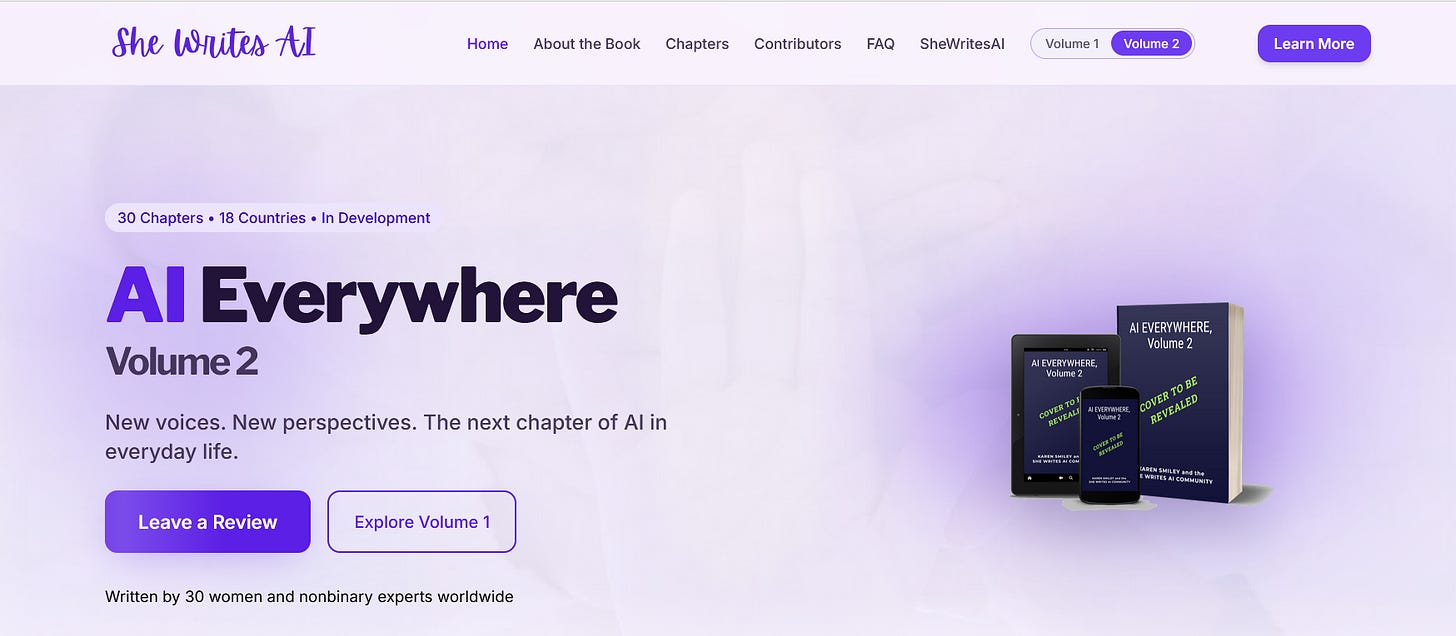
Where To Buy, How To Read and Listen, Ways To Review
-
Buy Volume 1 (now in ebook and print on Amazon, Gumroad, Lulu, Ingram Spark, and many reading platforms)
-
Tips from our publisher on how to buy an Amazon ebook from a country that isn’t a ‘KDP marketplace’, and how to read the ebook without a Kindle device (free)
-
Look for our new abridged audiobook edition!
-
Review links for Volume 1 (we’re on Amazon, Goodreads, and Storygraph)
Ways To Support
To help cover book-related costs (ISBNs, proof copies, etc.) as well as other SheWritesAI community services, we follow the ‘Wikipedia model’. We are now accepting donations (‘digital ink’) via one-time tips worldwide through Stripe or Gumroad. We can also accept paid subscriptions in some geographic regions (limited due to tax complications that Substack will be resolving on Dec. 1). All donation sizes are welcome and help keep these book authoring opportunities free for She Writes AI Community members worldwide! Patrons and Sponsors are acknowledged on our book site. Learn more.
Thanks as always for your support in every form. We appreciate it all. Hearts, shares, restacks, and comments are awesome!
Thank you *, , and many others for tuning into my live video with *! Join me for my next live video in the app. Get more from SheWritesAI in the Substack appAvailable for iOS and Android[](https://substack.com/app/app-store-redirect?utmcampaign=app-marketing&utmcontent=author-post-insert&utm_source=shewritesai)