Written interview with Alyssa and Natalie, the co-authors of AI Everywhere, Vol. 4, Chapter 1: What We Build When We Build Together
By Farida Khalaf
Published: 2026-09-29
Welcome to the next She Writes AI interview episode covering our second book collaboration stream for the AI Everywhere series. In this new cohort, we’re exploring the personal journeys and professional expertise of 32 authors from 18 countries worldwide who are redefining our relationships with machine intelligence. 
If you’re new to **, welcome! We’re a free, inclusive community of 780+ women and nonbinary writers in 60+ countries worldwide, with a focus on AI and data. Allies of all genders are welcome.
Learn more: About | Books | Categories | Directory | Digests | Donate | Herstory | Join | Subscribe | Updates | Welcome | World Map
For more insights from interviewer *, see her Lights On by Farida* newsletter or youtube.com/@faridakhalaf25.
About My Guests: Alyssa Fu Ward & Natalie Nicholson
Today I (*) am joined by Alyssa Fu Ward and , co-authors of the inspiring chapterWhat We Build When We Build Together*.
Alyssa Fu Ward is a Stanford Psychology PhD, data scientist, and founder of The HART Studio (Human-Centered AI Readiness and Transformation), based in Arizona. Drawing from her background in social psychology research and data science, Alyssa focuses on how AI can expand human potential without losing what makes us human.
* is an independent creator, Art Director, and author of the popular Substack The Off Hours*, based in Rhode Island. Working at the intersection of design, filmmaking, and emerging technology, Natalie brings a deeply creative perspective on how community transforms human-AI collaboration.
Together, they offer a compelling alternative to tech's standard "solo optimization" narrative, demonstrating that community is a powerful entry point into AI for women.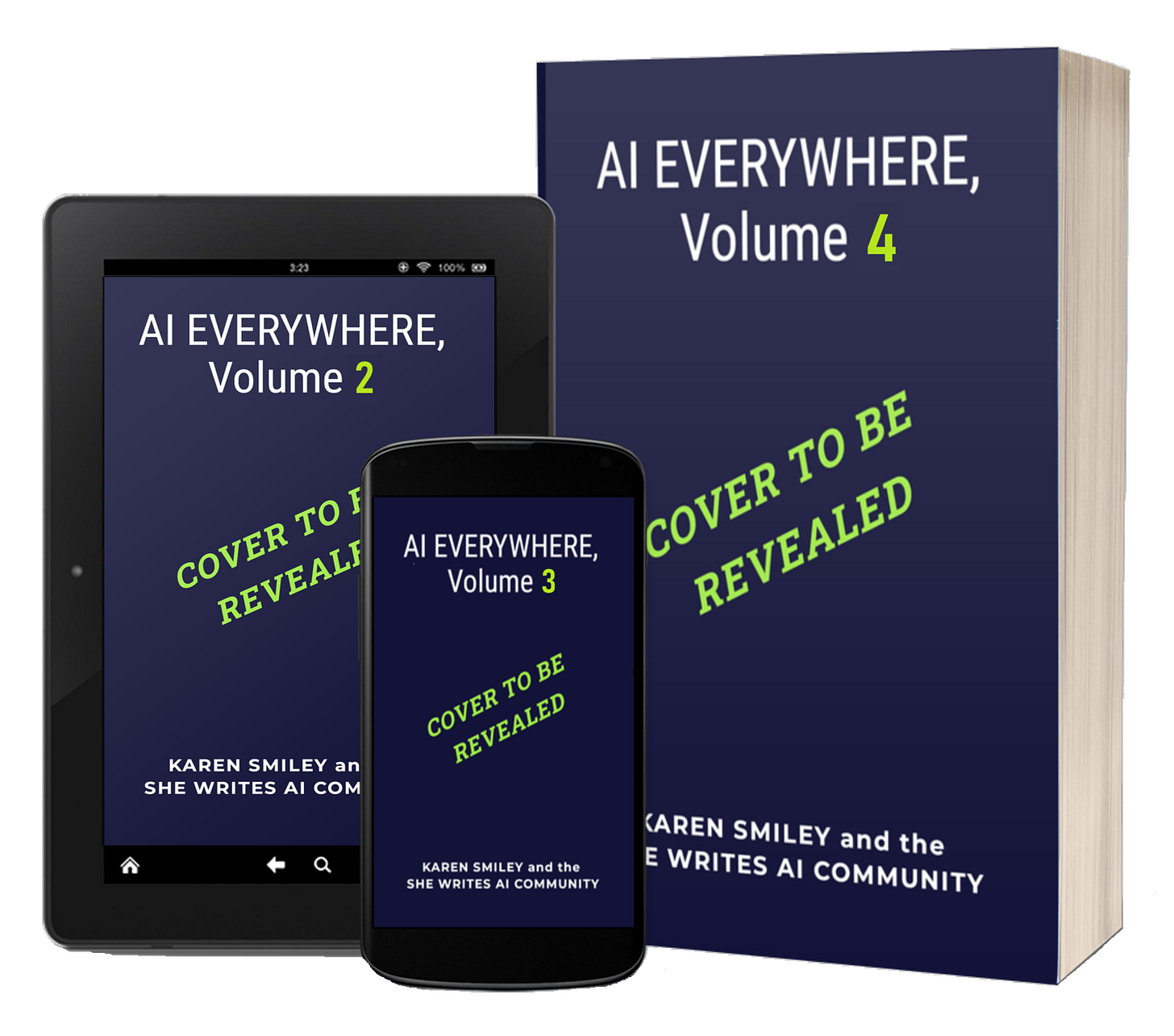 Covers and subtitles for Book2 (Volume 2, Volume 3, and Volume 4) will be revealed soon. Stay tuned!
In this interview and in their chapter, Alyssa Fu Ward and * confront the stark reality of the AI gender gap, where women globally adopt generative AI at a rate 25 percent lower than men. They dismantle the simplistic assumption that women are “fearful” or “behind the curve,” reframing women’s skepticism as pattern recognition* born from watching generations of technical systems promise efficiency while perpetuating bias and inequality. Alyssa and Natalie argue that the dominant tech narrative, framed around individual speed, solo optimization, and status, skips directly over the relational values that draw women in, such as trust, emotional support, and harmony.
Through two deeply personal lived experiences, the authors demonstrate how building in public within a supportive network expands what people believe they can achieve. Natalie shares her journey from burnout as an corporate “AI Girl” and surviving online vitriol to directing Rules We Made Up, an AI-assisted ‘claymation’ film co-created with 18 community members. Alyssa details her path from Silicon Valley data scientist to creating Open Room, an open-source project asking what social media would look like if built by women, which evolved into The HART Studio. Concluding with four practical principles for using community as an entry point, their chapter serves as a celebratory blueprint for women stepping into technical spaces together.
Interview With: Alyssa Fu Ward & Natalie Nicholson
Below is Alyssa Fu Ward and *’s full interview response to ’s questions on their chapter: What We Build When We Build Together.*
Intended Audience: Women who want to explore AI but are turned off by traditional tech narratives, as well as creatives, educators, leaders, and technologists seeking community-driven, human-centered approaches to emerging technology.
Questions:
The “Different Door”: You argue that the traditional tech narratives, centered on individual gain, speed, and personal productivity, actually miss what motivates many women. Why is community a more authentic “entry point” than the promise of optimization?
Alyssa: Women have been socialized to pay attention to others, to build up the communities. They’re the ones who are often looking out for the family, building relationships, and managing emotions.
So for women, when they think about themselves and what’s important to them, they’re less likely to think only of themselves. They’re more likely to think about how to bring along the people they’re connected to.
Not everyone is motivated by moving only themselves forward. There’s a reason why women are more likely to mention ethical concerns. It’s because they’ve been looking out for how situations affect the people in the room, and they’ve been trained and rewarded to do that their whole lives.
— She Writes AI —
Natalie: Because traditional tech narratives center on individual gain, it can feel isolating, competitive, and like you’re automatically behind. Especially if you don’t already see yourself as “technical,” it can make you feel like you’re not expert enough to belong in the conversation. I think entering into AI through community changes that dynamic.
When you start learning alongside others, you quickly realize that, no matter where someone is on the learning curve, everyone is still just trying to figure it out. It provides the kind of emotional support needed to learn out loud, while the collective knowledge of the group acts as a human guardrail.
The Burden of the “AI Girl”: Natalie, you transitioned from a creative team member to the official title of “Art Director, AI Integration,” but quickly felt burned out because you were treated like a “software rollout” rather than a relational partner. What can companies learn from your experience about avoiding the “solo expert” trap?
Natalie: Taking on the official title of “Art Director, AI Integration” sounded like a big win, but in practice, it was tacked onto my existing workload with intense pressure to integrate the technology fast: test a tool, decide it was useful, roll it out, teach people how to use it.
That led to burnout … fast. What I’m proud of, though, were the relational pieces, specifically the Lunch & Learns a colleague and I started. People could bring their own questions, experiment in a low-stakes environment, and openly discuss both the good and the bad.
For companies, I think the lesson is: give AI integration real time and resources, but don’t treat it like a software rollout, because it’s bigger than that. I noticed that once someone saw how AI could help with something in their own life, they started imagining how it could help them at work. So my goal became creating opportunities for people to simply get curious. Build enough curiosity, confidence, and ownership across teams that the knowledge spreads.
“The easy narrative is that women are risk-averse, fearful, or behind the curve. But what we saw, even in ourselves, was that skepticism wasn’t just about fear. It's pattern recognition. We’ve been around this track before.“
The Skepticism as Pattern Recognition: Globally, women adopt generative AI tools at a rate 25 percent lower than men. You argue this isn’t because women are “behind the curve,” but because of “pattern recognition” regarding systems that promise efficiency but deliver bias. How does community help women navigate this historical skepticism?
Alyssa: I think it’s related to trust, support, and signals of belonging.
If there are communities of women that demonstrate how to use AI in a way that is responsible, safe, and doesn’t exploit women, they may be more likely to trust that community and the work they’re doing.
By being in a community, women would then get support by that community. It would happen through storytelling, asking and answering questions, being able to share fears and concerns and feel like they’re being heard. I feel this in the HART Studio, a community I created where people, especially women, can learn how to build with AI together.
More importantly, being in a community, in the right community, can convey that women belong in that space. There’s social psychology research that shows when women are in a space decorated with stereotypically “geeky” objects like Star Trek or soda cans, their interest in computer science drops. The space itself tells them it’s not for them and they don’t belong there. When the space is covered with neutral objects like natural landscape art, their interest in technology increases. Who you’re around matters for how you interact with that domain.
— She Writes AI —
Natalie: We did so much research here — some of which didn’t even make it into the final chapter. And yes, the studies point to skepticism and lack of trust due to pattern recognition. And unfortunately, the skepticism is warranted.
One study found that when evaluators believed an engineer using AI was a woman, they rated her almost 9% less competent than a man producing the exact same output. Another found that women are 32% more likely to worry they’ll be perceived as cheating when they use AI, which is a direct reflection of the double standards they face at work.
This is where community becomes really important. It gives that skepticism somewhere productive to go. People can compare experiences, challenge claims, surface biases, and learn from what others are seeing. Trust doesn’t have to come from the technology or the companies selling it. It can be built through each other.
Communication over Code: Alyssa, despite being a data scientist, you weren’t hooked by technology-related use cases but by communication-related ones — like creating superhero stories for your kids. How did this shift your belief that AI is a “thinking and creative partner” rather than just a technical tool?
Alyssa: By definition, generative AI works through language. I had to learn how to talk to it to get the answers I was looking for. I learned that starting with a use case where there was a correct answer didn’t work well for an AI, especially in the early days. It just wasn’t reliable with precise answers, which is required when working in a technical space.
In a creative, thinking space, there was more room to have answers that weren’t necessarily “right.” There was room for interpretation and tweaking. So even if the answer the AI gave wasn’t exactly what I was expecting, I would work with it.
I started to see how one enormous benefit of working with AI is when the answers it gives you sparks new ideas in you. If AI only spat out exact answers like a Google search, I don’t think it would have been as sticky. It’s because it could adapt to and with you and help you create new ideas together, but ideas that were also an extension of you.
The “Rules We Made Up” Experiment: Natalie, you invited 18 people to create claymation characters for your film, which you described as the most challenging but rewarding part. How did building in public and inviting others in change the final “humanity” of that art piece?
Natalie: There are so many claims that creativity is dead, but that project made me realize just how creative we can still be with AI. I don’t think creativity ever comes from one single person. It comes from exchange, between past and present, between two seemingly unrelated ideas, between you and a tool, or between you and other people.
Inviting 18 people into the film meant giving up some control, and that’s exactly what made it feel more human. Every character carried someone else’s humor, taste, memories, and point of view. I never could have designed all of that myself.
Building in public turned the piece from something I made into something we made. The humanity came from all those little traces of other people inside it.
Open Room and Social Architecture: Alyssa, you created the Open Room project to ask: “What would social media look like if it was built by women and was community oriented?” How does AI-assisted coding allow women to reclaim the ability to build the digital spaces they actually want to interact in?
Alyssa: Because the barrier to building meaningful products and services isn’t technical expertise and experience any more.
I referenced this above, but there has been a major gap in interest in computer science between men and women, which then leads to the tech world being dominated by men. Sometimes women are in the room when technical decisions are made that can shape the experiences thousands, millions, sometimes billions of people have with a platform, but more often than not, it’s the men making the decisions.
But now, with AI, women can build products and services to fit their needs and the needs of the people around them.
One example comes from the HART Studio. One of the HART Builders doesn’t trust the social media companies, so she wants to build her own app that lets her kids talk with their friends. And she can do that now!
Another example comes from my daughter and a friend where they wanted to make a game with AI. Her friend, a boy, suggested making a game with swords. She shook her head and said she wanted to make something else. And they worked out being able to create a different game that suited both of them.
The products that get created in society carry the values and priorities of the needs mostly of the people who create them, whether they realize it or not. The women may not have been in the room when many of the products around us were made. But now they can make their own room.
“When I think of how I want to work with AI, it’s not in a dark room by myself, like in a stereotypical hacker movie. I want to work out in the open surrounded by other people, other women, who are curious, want to learn, and have fun while doing it.“
The HART Studio Philosophy: Your community, The HART Studio, stands for Human-centered AI Readiness and Transformation. Why is your goal not to turn everyone into an engineer, but to enable them to build services that matter to their families and society?
Alyssa: Ha, well I don’t know that we would need to turn everyone into an engineer!
But also like I said above, what an “engineer” is and who gets to be an engineer is not neutral. There are very specific associations and assumptions made about engineers, and they are less likely to include women or overlap with associations commonly made with women.
My whole career has been about balancing between the technical and the human. A lot of the time the friction happens because someone needs a product, a dashboard, a service made, and they have to wait for an engineer to build it for them. But they’re the ones that know what they need.
Now with AI, you don’t need to know all the inner workings of how code is created. You just have to have an idea and the ability to articulate it. And the ability to shift with a situation when it changes. In this case, that means when the AI gives you a response you weren’t expecting.
Women in general are very familiar with having to shift as a situation changes, to read the room, and manage the relationships and emotions of people in them.
That means they also see things or understand nuance in a different way than “engineers” do. The technology doesn’t operate like an engineer does any more. It responds to human communication.
The Permission to Fail: You mention that watching each other “learn out loud” gave you a kind of permission you hadn’t found elsewhere. Why is celebrating mistakes together a necessary part of overcoming “imposter syndrome” in the AI era?
Alyssa: I’ve observed over and over again how people discount themselves in the technical space. And it’s happening with AI too.
“I’ve done a little bit with AI, but pretend I know nothing.”
People say this to me, and I want to tell them — That’s not true! You know a lot!
It’s not a problem to make mistakes. It’s a problem if women see mistakes as a sign that they don’t belong. One of the best ways to counteract that sign is by sharing our experiences with each other.
There’s research that shows how powerful it can be to hear stories of struggle and recovery from people you trust. Specifically, when underrepresented minorities entering college are shown a video where a senior who comes from their group tells them that they also had a hard time but they made it through. The freshmen who heard that video performed better across their college years than if they hadn’t been told that message at all.
Everyone is new to AI. Even people who have studied AI in all its forms are surprised by how generative AI works. So mistakes are a given. How people react to them is what can make the difference. And especially for women, who have been surrounded by signals that they don’t belong in the technical space, it’s even more important to show them definitively, without question, they do belong, and they can figure out how to use this technology as well as anyone else.
— She Writes AI —
Natalie: AI moves so fast that no one really gets to be finished learning it. But when you’re figuring it out alone, every mistake can feel like proof that you’re bad at it. Learning out loud changes that.
You see other smart, capable people get stuck, ask basic questions, try something that fails, and keep going. Mistakes are part of the process.
That shared permission to be imperfect is incredibly powerful. It makes people more willing to experiment, ask questions sooner, and keep going long enough to feel less intimidated.
Vibe Coding and New Confidence: Natalie, you mentioned that Alyssa’s influence led you to try “vibe coding” and build your first digital whiteboard app. How does community expand the boundaries of what a non-technical person thinks they are “capable of”?
Natalie: Even two years ago, I wouldn’t have believed you if you told me I could build an app. I was already using AI in my creative workflows, but coding still felt too technical. There was all this new language around agents, connectors, APIs, MCPs, etc.
Watching Alyssa is what shortened the bridge between what I wanted to do and what I thought I was capable of. I watched her build out loud, creating apps for herself, with her mom, with her kids. That gave me the confidence to try. I had someone to bounce ideas off of, ask questions, and sanity-check whether AI was being overly encouraging or whether AI was actually putting me on the right track.
That’s one of the most powerful things community can do. It expands your sense of what’s possible by giving you real people to learn from, experiment alongside, and borrow confidence from.
The Future of the “Hacker” Narrative: You state you don’t want to work with AI in a “dark room by yourself, like in a stereotypical hacker movie”. If the future of AI is not a solo operator, but a cohesive and cooperative group, how does that change the way we judge the “success” of a project?
Alyssa: Ha, oh well, as a cultural psychologist who studied how constructs take very different forms across cultures, I’m a big fan of changing what concepts like “success” mean.
For example, in typical American cultural contexts, which often reflect white male middle- and upper-class cultural values and ideas, success is closely tied with being an individual, doing your own thing, using your own thoughts and beliefs, and making gains for yourself. A lot of AI narratives lean in this direction too.
But in many other cultural contexts — East Asian ones, working class American ones, women-influenced spaces — success is about helping the whole group succeed. Success means having harmony, helping each other out, contributing to the family and community.
By including more of those voices, my hope is that indirectly we’ll see more representations of AI usage and success that move away from individual gain to benefits for everyone.
A Word From :
You don’t have to understand all of AI before you’re allowed to participate in it. Find people you trust, stay curious, share what you’re learning, and let other people expand what you think you’re capable of. This technology is still being shaped, and I think there’s power in more of us showing up while that’s happening.
A Word From :
I wrote this article called “You have what you need to meet this moment.” It was a response to an article that went viral at the time on job loss due to AI. I describe in it my initial feeling of fear and despair, and then how I worked my way out of it. I share it to say: we’re in this together, and we, and you, have what you need to make this future with AI bright for everyone. Step Up Step TogetherYou have what you need to meet this momentQuick note: I originally shared this in podcast format. I’m reposting it here as a written essay with optional audio so you can choose how you want to experience it…Read more7 months ago · 33 likes · 13 comments · Alyssa Fu Ward, PhD
“Community doesn't just support what you're already doing. It expands what you think you're capable of... We give each other the permission, the contextual intelligence, and the courage to build something that goes beyond individual optimization and brings the whole room along.”
Why This Matters
Alyssa Fu Ward’s & ’s perspectives emphasize:
-
The 25% Adoption Gap: Women adopt generative AI tools 25% less than men globally, not out of fear, but because promised “efficiency” often masks systemic bias, and women are frequently penalized where men are praised as innovative.
-
Reframing the Entry Point: The tech industry’s emphasis on solo productivity and competitive speed ignores relational tendencies; centering on community, mutual disclosure, and emotional support creates an authentic entry point where women thrive.
-
“Rules We Made Up” Claymation Project: Natalie demonstrated how AI can be a tool rather than a replacement for human art by inviting 18 strangers — including Alyssa and three generations of her family — to contribute claymation characters to an animated short film.
-
“Open Room” & The HART Studio: Alyssa created an open-source project asking “What would social media look like if it was built by women and community-oriented?”, enabling non-engineers to vibe-code personalized digital rooms and build collective technical confidence.
-
4 Community Principles: The authors provide actionable strategies for AI adoption:
(1) Develop personal relationships that support you,
(2) Find a group to learn from,
(3) Start with what you already know, and
(4) Share your experiences in a trusted space.
Thank You, Alyssa Fu Ward & *, for this inspiring, practical, and deeply human guide to reshaping the future of technology. For every woman who has felt unwelcome in technical spaces or exhausted by the solo optimization race, their chapter in AI Everywhere* is an empowering reminder that we do not have to build alone.
Alyssa and Natalie remind us that when women build alongside each other, technology becomes a tool for collective flourishing rather than isolated output. I highly recommend following Natalie’s creative reflections on her Substack, The Off Hours, and joining Alyssa’s community at Step Up Step Together, where they continue to invite everyone to learn out loud and bring the whole room along. The Off Hours 🌙Essays from the off hours → on AI, Creativity and the Mind ✦ Creative collabs + community projects ✦ Come play! ✨By Natalie Nicholson
And if you’re interested in more conversations like this, consider subscribing to She Writes AI. I’ll continue sharing insights from the voices shaping the future of AI, including contributors from 30 new chapters in AI Everywhere where 32 women from across five continents explore how artificial intelligence is changing the world we live in, and how we can change it for the better.
References
For more insights on the books in Stream II, see aiEverywhereBooks.com — our beautiful book series website created by **: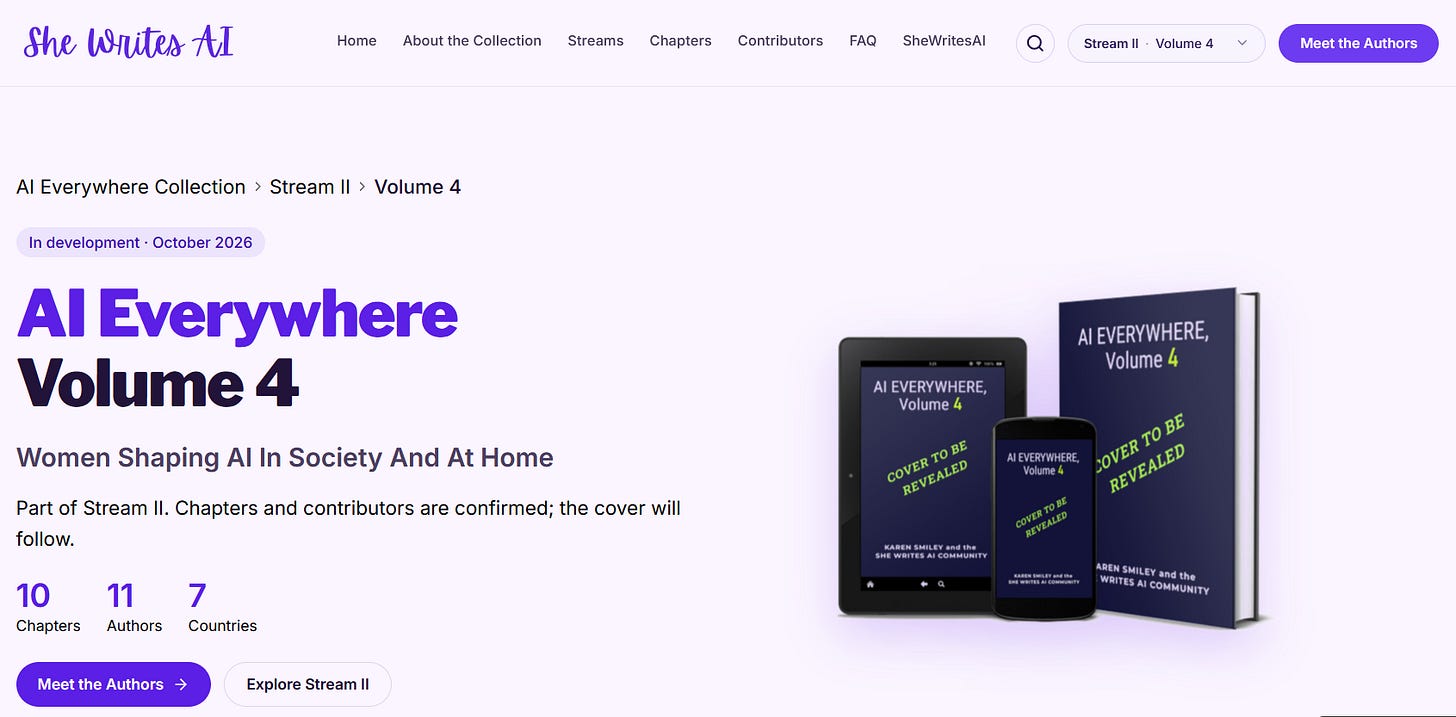
Where To Buy, How To Read and Listen, Ways To Review
-
Buy Volume 1 (now in ebook and print on Amazon, Gumroad, Lulu, Ingram Spark, and many reading platforms)
-
Tips from our publisher on how to buy an Amazon ebook from a country that isn’t a ‘KDP marketplace’, and how to read the ebook without a Kindle device (free)
-
Look for our new abridged audiobook edition!
-
Review links (we’re on Amazon, Goodreads, and Storygraph)
Ways To Support
To help cover book-related costs (ISBNs, proof copies, etc.) as well as other * community services, we follow the ‘Wikipedia model’. We can now accept donations worldwide via one-time tips (‘digital ink’) through Stripe or Gumroad. For now, paid subscriptions are only available in limited geographic regions (due to tax complications that we now expect Substack will resolve on Dec. 1, 2026). All donation sizes are welcome and help keep our services free for all women & nonbinary AI writers worldwide! Read more here*.
Donate to She Writes AI Community
Thanks as always for your support in every form. We appreciate it all. Hearts, shares, restacks, and comments are awesome!