How to build the system before running the playbook
By Sean Ellis
Published: 2026-09-24
URL: https://seanellis.substack.com/p/building-the-system-before-running
In school, I never read textbooks cover to cover. I had a really hard time building a mental model one word at a time. I had to guess the mental model first by looking at the section headers, diagrams, and pictures. Then the words were essentially filling in the mental scaffolding that I had constructed.
I approach growth for a company the same way. If I immediately start pouring through a startup’s data to eventually form a mental model, I’ll quickly get overwhelmed. So instead I start with a loosely held hypothesis about the product.
Growth with Sean Ellis is a reader-supported publication. To receive new posts and support my work, consider becoming a free or paid subscriber.
I’ve realized that when I talk about growth, people often assume I mean marketing. Sometimes they even think I mean financial growth. But I’ve always thought about growth much more as an interconnected system. How do people discover the product? What promise brings them in? When do they experience their first taste of must-have value? What causes them to keep coming back? What drives them to bring in other people? How do all of those pieces reinforce each other?
A key advantage of early-stage startups is that you can think about all of those pieces together. As companies get bigger, each part tends to become its own specialty. The individual functions get more sophisticated, but it becomes increasingly difficult for anyone to maintain a view of the whole system.
So what does this mean in practical terms? On day one, I make my best guess about how everything fits together. This is usually based on conversations with the founders. Maybe I’ll tie it back to an earlier role: “Oh, this is like Bounce because there is a direct sales element and a no-touch element.” Or I might think, “On the surface this looks like a network-effect business, but it really doesn’t seem to be.”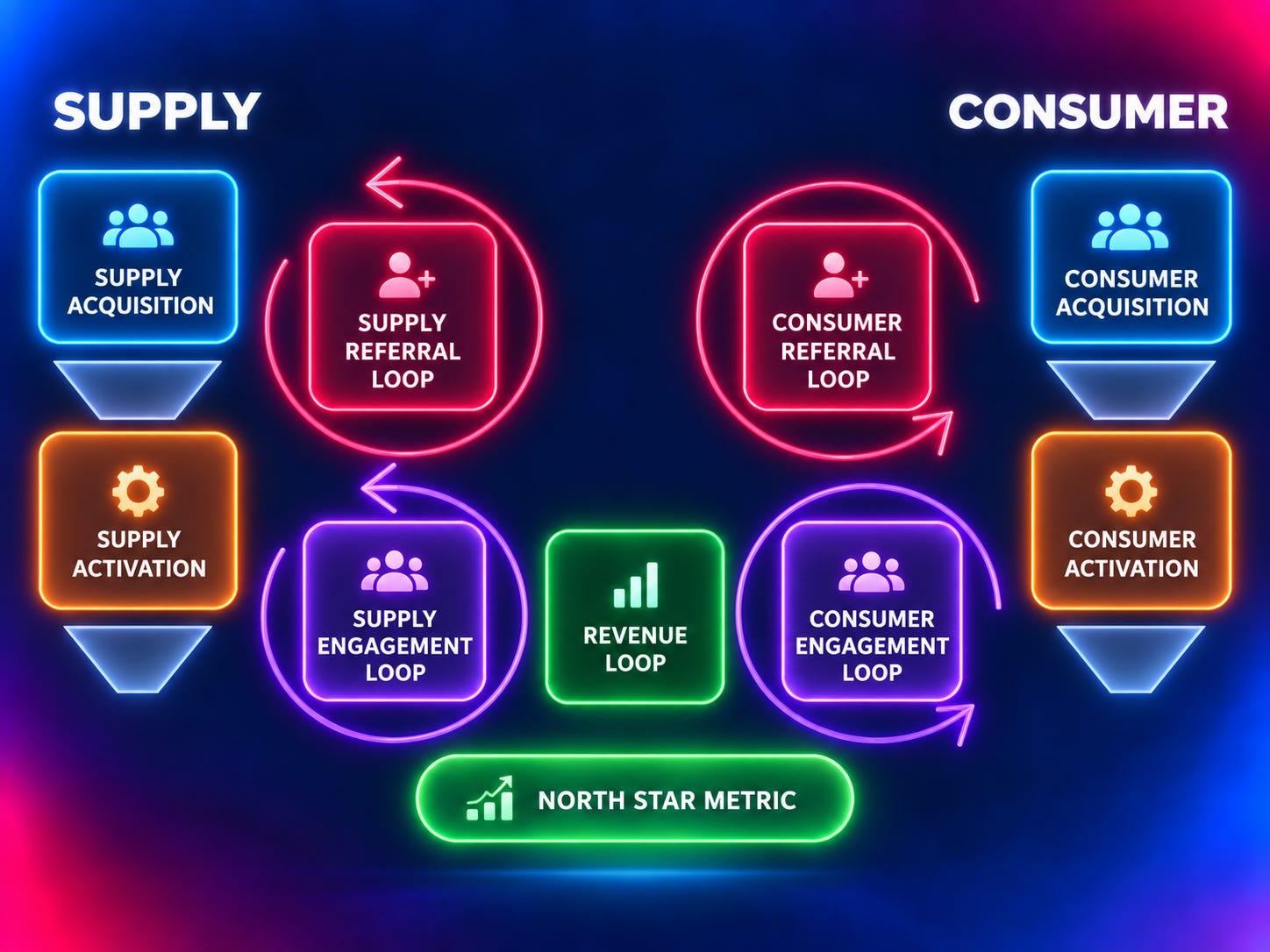
Over time, as I collect insights from data and surveys, I frequently update these assumptions until a more crystallized picture starts to emerge. These refinements are often driven by finding contradictory data. That could be frustrating for some people, but I find it exciting because it means I’ve found something unexpected and I’m getting closer to the truth. I don’t need the early view to be right. I just need something simple enough that the details have somewhere to go so I can evolve it.
Building a Growth Engine vs. Accelerating One
I recently wrote about the difference between building a growth engine and accelerating one that already works. This post applies to both, but it is probably more relevant when the growth engine already exists. In that situation, there is already something working that I can accidentally disrupt.
Before I start changing things, I want to understand why it is working. That is especially true when the company has meaningful growth already. The first job is to understand why it is working well enough that I don’t accidentally break it while trying to accelerate it.
Start With the Must-Have Value
The first thing I'm trying to validate is whether real product-market fit exists. If the PMF doesn't exist, then you don't have the foundation of a sustainable growth engine. From a due diligence perspective, that is obviously the most important component for me. If I have weak conviction that PMF exists, I can be a cash drain on the business, and our chances of success significantly decrease.
I wrote a full post recently about searching for where product-market fit is hiding, so I won’t repeat that process here. I’m trying to validate if must-have value even exists and, if so, for whom and when they realize it. The PMF search is critical because it informs all of the other work. That is the foundation for everything else in the growth system.
Diagnosing the Value Delivery System
Once I have a working hypothesis around PMF, I’m initially diagnosing the value delivery mechanism. Value delivery is really about connecting the promise to the aha moment and the habit-building loops. Then I’m looking at how all of these connect to whatever drives discovery. For network-effect businesses, these can often involve other users for both referral and improving the core value of the solution.Most companies see a big disconnect around onboarding. Marketing brings people in the door, and the product team is focused on improving the product for existing users. That leaves a gap around getting a new user from the promise to the actual value. If that gap is weak, the rest of the growth system is limited.
Activation is usually the biggest growth bottleneck because everything else is so dependent on it. Weak activation limits the power of referrals since too few people become enthusiastic users. It also limits the power of a massively scalable acquisition channel because you are pouring more people into a system where most never reach the value for which they’d pay. This limits the ROI from advertising and thus campaign scalability.
Initially, I’m trying to figure out what the aha moment actually is. Then I’m trying to figure out what prevents qualified people from reaching it. I can figure this out through surveys and usability tests, but also by going through the flow with empathy for a first-time user.
Looking for the Big Growth Accelerators
Over time, I’m also thinking about growth accelerators, essentially knobs that could be turned to accelerate growth. I like to work backwards from a massive increase in growth. If the NSM 10X’d in the next couple of months, where would the likely improvement come from?
It could be massive scaling in an acquisition channel, a big increase in the percentage of people who reach the aha moment, or an acceleration in referrals. Activation is usually the answer because everything else is so dependent on it. Weak activation limits both the power of referrals and the power of a scalable acquisition channel.
At LogMeIn, activation went from about 5% to 50% in only three months. This unlocked significant scale in paid campaigns in addition to significant word of mouth. It is a good example of why I think activation is often the highest-leverage part of the system, not just another conversion metric.
How I decide whether an area is high leverage is partly gut feeling across the team, but it can also be validated by modeling results. If we get a doubling of results here, what happens to our NSM? Does this fix bottlenecks in other parts of the engine?
Time-Boxing the Deep Dive
There is always pressure on a new growth leader to drive results quickly. In an early-stage startup, this pressure is often amplified by a limited runway before the company runs out of cash. For me personally, I try to avoid taking on a growth role in a startup with less than a year of runway. There is generally too much pressure to scale the engine before it’s really figured out. But it’s important to avoid paralysis by analysis. Regardless of the situation, the data deep dive shouldn’t take more than a few weeks.
The Alignment Session
Once I have a good handle on the insights, both qualitative and quantitative, it’s time to share these insights with the team and start making some key decisions. I do this in a full-day alignment session. I could easily present some pretty good answers along with the data, but the team is less likely to feel ownership over that plan. And the truth is, the plan is usually better when we take viewpoints from across the team into consideration.
I like to walk the founders through my findings in advance so there aren’t any surprises. If my findings are way out of alignment with the founders, I take that as a signal that I’m probably missing something important. At the very least, it drives me to gather more evidence to help the team align to unexpected realities.
Growth alignment starts with getting on the same page about PMF. That’s both understanding the market, the users who consider it a must-have, and the product, what makes it uniquely valuable. It’s also important to get on the same page about principles. The team should get used to using the language of hypotheses versus facts, understand the importance of testing to find a better way to do everything, and become data curious enough to take advantage of the democratization of data access.
There is another reason I care so much about alignment. Dharmesh Shah once shared advice Elon Musk gave him about scaling a company: “Every person in your company is a vector. Your progress is determined by the sum of all vectors.” I like that analogy because he explained that one of the biggest unlocks for growth is aligning the vectors across the team. When everyone is pointed in the same direction, they are no longer canceling out each other’s work.
By the end of an alignment session, everyone is much more on the same page about how growth works for their product and where the biggest opportunities for acceleration are. Another big benefit is that growth teams no longer need to convince everyone of the necessity to run experiments. That frees everyone up to collaborate about which experiment is most likely to move the needle.
The Deep Dive Is Also Due Diligence
The deep dive is also part of my due diligence. I’m assessing my fit as much as the company is assessing me. The main things I’m looking for are PMF validation, a small agile team, and a clear understanding of where I can potentially add value.
I can’t think of anything more enjoyable than working with the right team or more painful than working with a team that doesn’t gel. The right team is genuinely curious and collaborative. They focus on driving more customer impact and the company's success. When people are territorial or defensive, that’s a major red flag.
It’s almost inevitable that some of that shows up if a company gets big enough, which is one reason I favor early-stage small teams while the culture is still in its formation stages. It’s pretty easy for me to sense when a key team member doesn’t want me there. And that’s always my cue for a graceful exit. A full day working together makes all of this much easier to assess than interviews do.
And of course they may decide I’m not a good fit for their culture or I’m redundant to existing internal skills. So a full-day alignment session is a great opportunity for both sides to assess fit.
From Alignment to an Operating Rhythm
It’s a genuinely valuable session whether I stay on or not, but success is really defined by an improvement in the results. That is typically preceded by an effective growth operating rhythm. This habit takes time to build and is a little awkward at first, but within a couple of months most teams are humming.
An effective growth operating rhythm includes alignment around the best opportunities and the order in which the team will execute against them. It includes weekly planning and prioritizing of experiments, executing those experiments, analyzing the results, and using the new insights to plan the next round of experiments. It’s not a complicated process, but it’s difficult to kickstart because teams are often faced with existing long to-do lists.
In an effective startup, the to-do mentality gets replaced with a to-learn mentality. That’s one of the best reasons to keep me around after the deep dive because I can help push through some of the inertia of getting started.
Building the Model, Then Improving It
Once the operating rhythm becomes a habit, the team can keep improving it without me. My goal is not to create long-term dependence on me, but rather to have a well-functioning team executing a growth process around a deeply understood growth engine. Once that is achieved, I can step back and hand the reins to a longer-term growth leader.
But it all starts by forming a loosely held hypothesis of what that growth engine looks like. Contradictory data is what makes the model better. As the team deepens their understanding of the growth engine, they can work together to optimize and improve it. Working on the system will also yield more impact than one-off campaigns that aren’t based on addressing key constraints in the system.
Growth with Sean Ellis is a reader-supported publication. To receive new posts and support my work, consider becoming a free or paid subscriber.