How to prompt the new Fable 5.2, and when to hand off to Opus 5.5.
By Ruben Hassid
Published: 2026-11-13
URL: https://ruben.substack.com/p/prompt-52
So much news in a week.
And no, I am not talking about affairs, or the end of the world, or IPOs, or bubbles. This newsletter is not a tabloid. I only care about How to AI.
Here’s the rundown:
- How to prompt the new Claude, Fable 5.2, the smartest AI on the market.
- Claude goes multiplayer, with its own Excel (called Sheets), plus Whiteboards for design & Dashboards for data analysis.
- I am starting 3 live workshops every week on mastering Claude & Claude Code, as fast as possible (without watching 100 hours of videos).
Let’s dive in straight.
I - Fable 5.2, explained.
The new Claude Fable 5.2 is out, it’s the same old song again: best AI in the world, a bit expensive to use, better at everything. OK, cool.
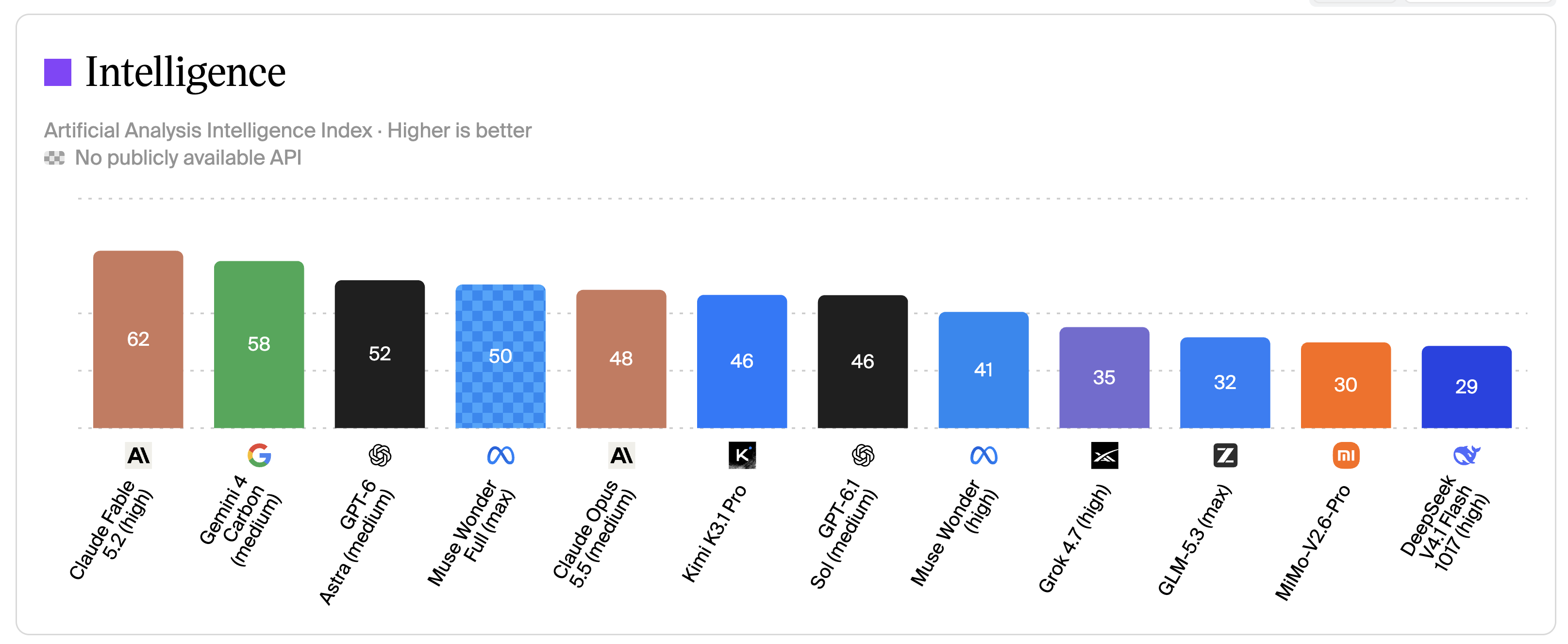
\+14 points smarter than Claude Opus 5.5.Massive jump.\
But there is a stat that no one cared to explain.
Fable 5.2 scores 41.3% on the Remote Labor Index.

\A score like this shows how good an AI model is.\
It’s testing Claude on paid freelance projects. And 41% of the time, Claude does better than humans who got paid for it. In two months, Claude went from 18% to 41%.
I don’t think you understand what is going on: a quarter of US jobs are done remotely. I did some maths and projections on when the benchmark will reach saturation (I think 90% is fair):
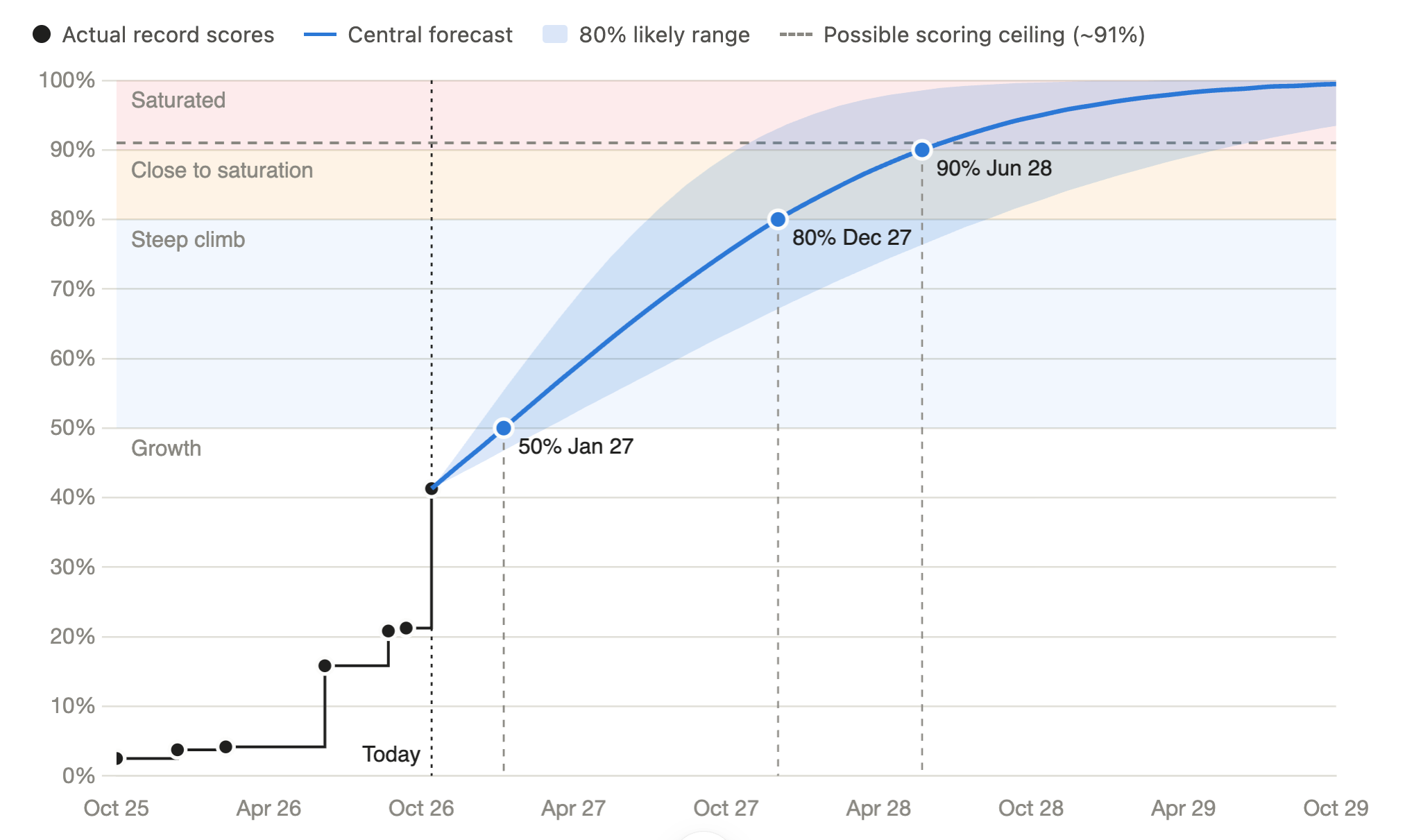
\In July 2028, 90% of remote work will be solved by Claude.\
I’ve taught Claude to thousands of people, and people keep making the same mistakes: You give Claude work that’s far too small.
The best AI, for one big job.
Fable burns your limits faster than any other Claude:

\From Anthropic’s help center.\
So: Opus 5.5 every day. Fable 5.2 for the one big job.
On Pro or a standard Team seat, Fable is included until Monday, November 16, up to half of your weekly limit:

\From Anthropic’s help center.\
After that, Fable runs on usage credits, if you’ve turned them on. So you must use this week on one big project. It’s your last few days with it.
Don’t switch in the chat.
Each model keeps its own copy of your chat, the cache. It’s how Claude rereads a long chat without burning your usage.
But if you switch from Fable to Opus, Opus rereads everything from zero:

\From Anthropic’s docs.\
And the other problem: Opus can’t read Fable’s thinking.

\From Anthropic’s “What’s new in Claude Fable 5.2”.\
The best way to use Fable is to start a project with it, and architect the entire “how”. Then Opus applies the plan.
So ask Fable first, with a prompt like:
Goal: a step-by-step plan for [your goal]. Don't build it yet.
Context: [what you have, what you want at the end, your limits: budget, deadline, what's off-limits]
If you need more context, ask me questions.
It looks like this:
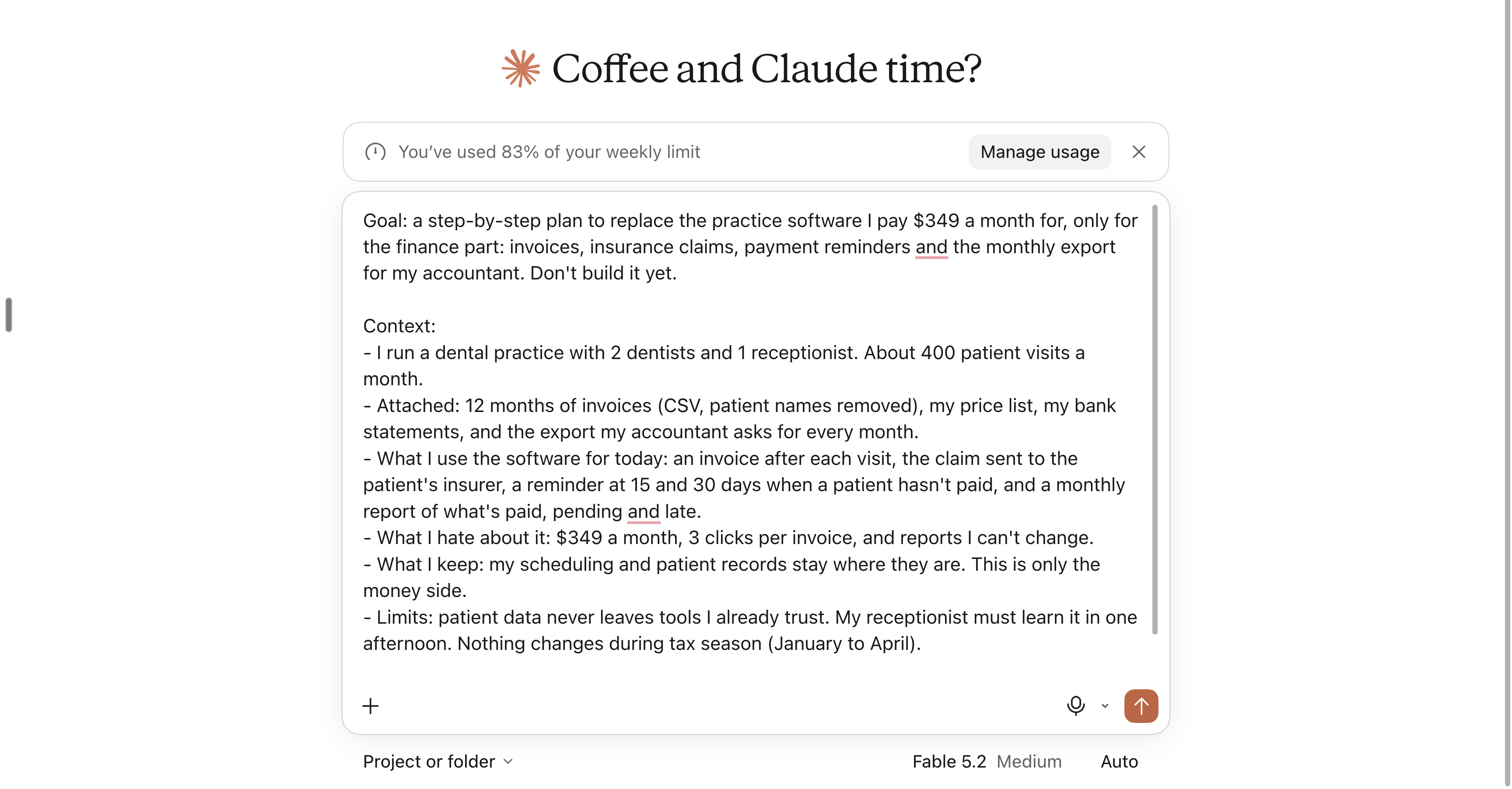
\First prompt, I go Fable 5.2 + Medium + Auto.\
Once done, we need to take Fable’s work and ask Opus to do it (because it’s much cheaper). So simply follow up with this prompt, still on Fable:
Write a brief so a new chat on Claude Opus 5.5 can take over this work. It won't see this chat or your thinking.
Write it for a smart reader who saw none of this. Plain words. Copy the exact names, numbers, dates, links and file names from this chat. Only the final version of anything we changed. Add nothing we didn't say.
Use these parts:
1. Goal: one sentence, then "Done when:" with the checks I'd use.
2. Next step: the first thing Opus should do. Pick one it can do without me.
3. Decided: each final decision, with its reason in a few words. Then what we rejected, and why.
4. Facts: everything the work depends on.
5. Done here: what we already finished, so it isn't redone.
6. Ask me first: what needs my OK, and why.
7. Open: only what we left undecided. No new questions.
8. Checklist: every step left, as boxes to tick.
9. For Opus: copy these lines as they are.

- Before you act, open every file and connected app that could matter, including ones this brief doesn't name, and use what you find.

- Work through the checklist and tick each box as you go. Don't end with a summary that announces the next step: take it. Don't offer to continue: continue.

- Stop only for what's under "Ask me first", or when you need a decision only I can make.

- Don't reopen what's under "Decided". If something you find contradicts it, tell me.

- End with a short recap: what you did, and what's next.
Make it as short as it can be while complete. Give me the brief in one block I can copy.
Now open a new chat on Opus 5.5 (Medium or High, I prefer High). Attach what Fable answered. And simply prompt it:
Take it from there.
The 7 changes.
Anthropic wrote a full guide on how to prompt Fable. It’s written for developers.
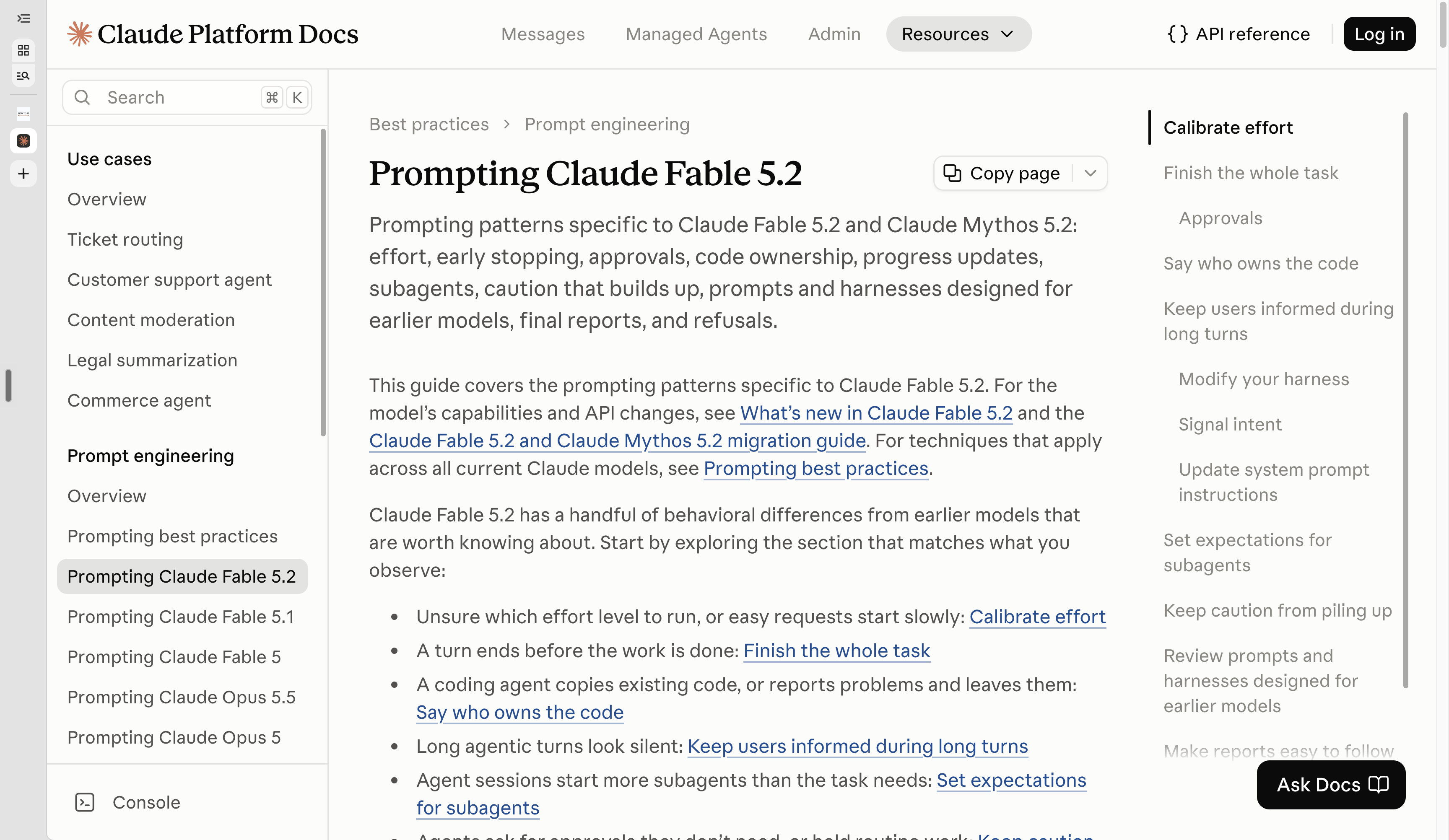
\I readthisso you don’t have to.\
Here’s every line that matters for us:
1. Swap “never” for “ask me first”. Fable obeys “never” to the letter, even after you say yes.

\From Anthropic’s prompting guide for Fable 5.2.\
Old: Never change my prices.
New: Ask me before you change a price: my clients have signed quotes.
Check your memory and instructions too. Remove the “always” and “never” if it’s a grey area.
2. Say what you approve. “Go” isn’t enough. Fable applies your words as written.
Old: Go.
New: Yes, rewrite the 3 welcome emails. Leave the invoice template alone.
3. Tell it to finish. You walk away, and Fable sometimes stops at “Want me to continue?” In Anthropic’s tests on coding sessions, a longer version of this text cut unfinished sessions in half:
Finish the whole job before you stop. Don't offer to continue: continue.
Ask me before you delete anything.
4. Make it the owner. Hand Fable the whole project, and it fixes more than what you pointed at. In Anthropic’s coding tests, it also made changes nobody asked for. So check what changed, and skip this line when you want the work touched as little as possible.
This onboarding is yours: how it's built is your call, and you'll keep building on it.
5. Ask for a report you can read. A little bonus is to ask it to use ASD-STE English for the report. It’s simplified English.
End with a recap for someone who saw none of the work: key points first, plain words.
6. Start at High. The effort setting (how hard Claude thinks) is said best at High, from Anthropic’s own words: “Most of the gain in capability is already present at high.”
7. Drop 2 old lines. A word cap on every sentence can make its writing choppy. So stop it with “in exactly this many words”. No one writes like this anyway.
II - Multiplayer Claude.
Claude is now multiplayer:
3 new Claude modes (Sheets, Whiteboards, Dashboards).
And my 3 prompts to test them today.
1. Whiteboards.
Use a dictation tool (I use Wispr Flow). And talk for 2 minutes about a project stuck in your head. Even Anthropic asks you to brain dump:

\From Anthropic’s help center.\
Start a whiteboard for the project I'm about to describe.
Put the steps in order, with the owners and dates I mention.
Then show me what's missing between the steps.
Here’s a prompt, and how it looks after:
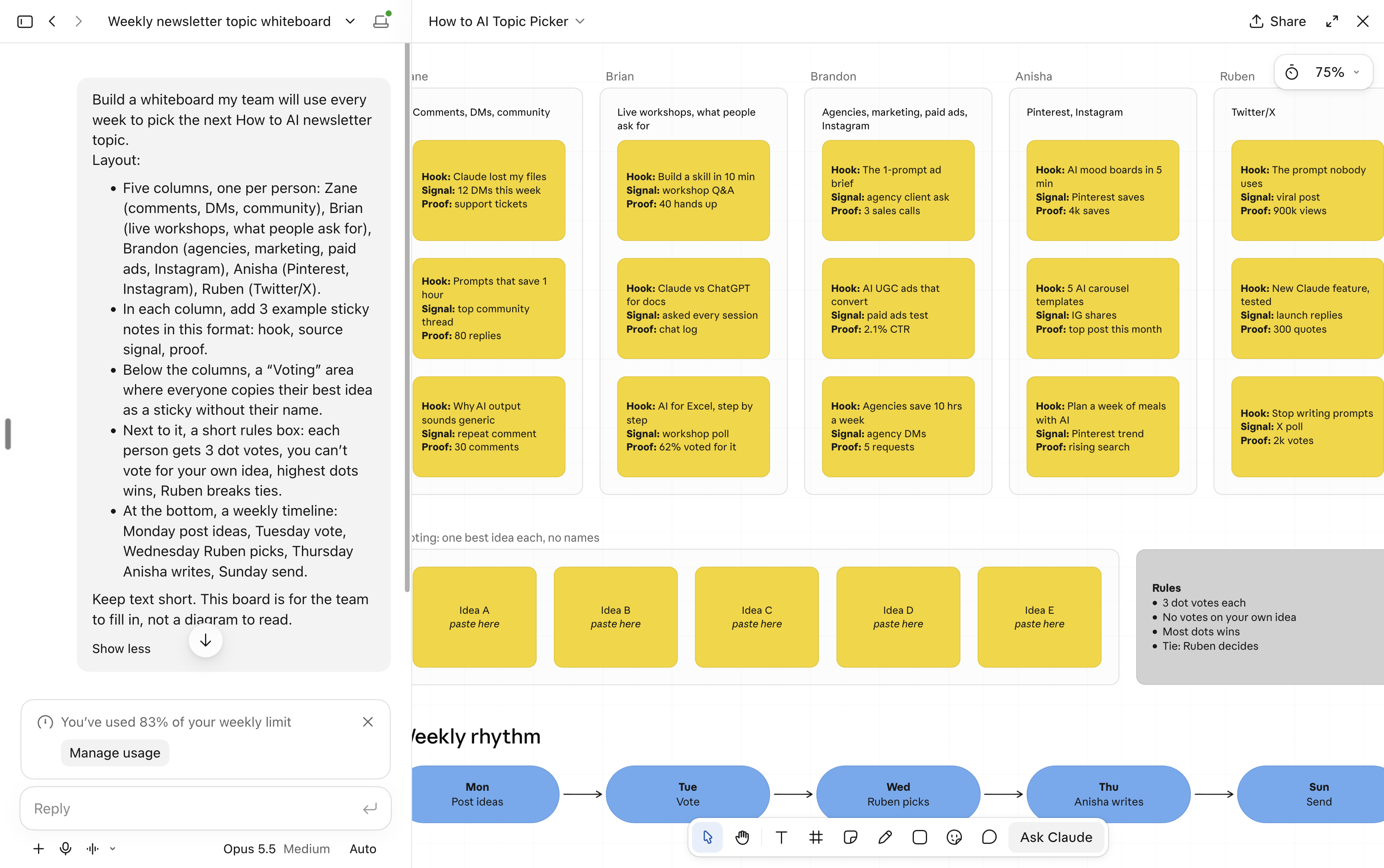
\Everyone on my team can jump in and interact with it.\
2. Sheets, for Excel.
Claude Sheets is their version of Google Sheets or Microsoft Excel.
Try this prompt template:
Build a sheet to [what it’s for: track / budget / forecast …], so I can see [the one answer I want at a glance].
What I track: [the columns: e.g. client, amount, due date, status].
My numbers: [paste them, or import a CSV, Excel or Google Sheet].
Rules: [what should happen: flag overdue in red, a status dropdown, totals per month on a second tab, a chart of …].
If you need more context, ask me questions before you build.
And once again, I am showing you an example:
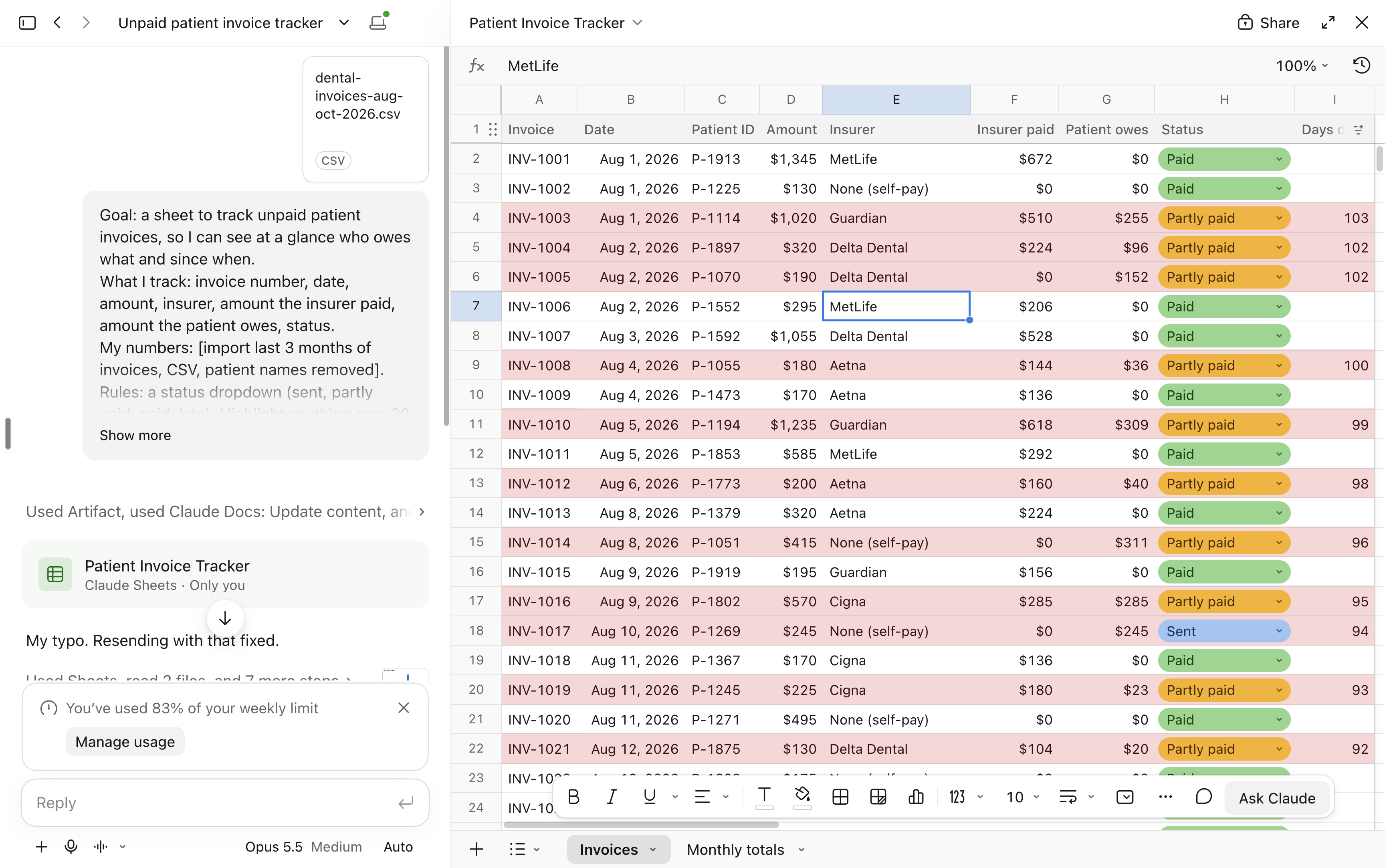
\I was surprised by the experience, quite pleasant.\
3. Data.
Data needs a source: your company’s database (a data warehouse), or an app you’ve connected to Claude. Anthropic’s example is Salesforce. If you have one:
Build a Claude Data. Using my [Salesforce] data, show new deals per week for the last six months, split by owner. Then write 5 lines on what changed, and what I should look at first.
I personally don’t use Salesforce. And we build custom CRM tools for our GPC clients. But I know some of you are part of a larger org, so simply connect it to your data!
Here’s how it looks like:
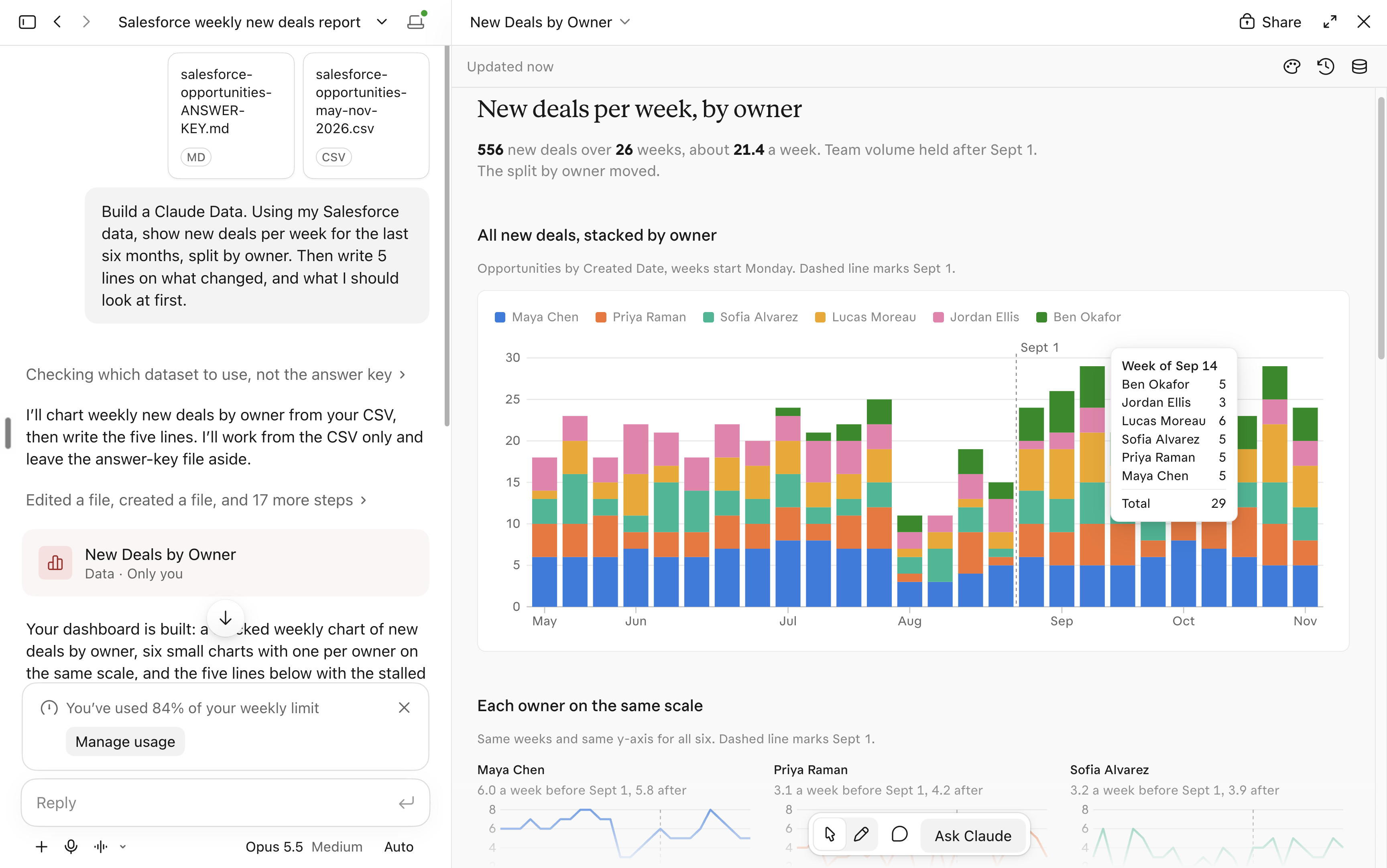
\Again, it’s multiplayer; I can invite my team.\
III - Double it.
On Sunday, my Substack paid subscription won’t be $200 a year but $400.
I am doubling the price, forever.
You have until Sunday to lock a $ 200-a-year price, also forever. I mean for as long as you stay loyal. My existing paid subscribers won’t see any price hike either.
Why am I doubling it?
- I went from one to two articles a week, with a much better paid section.
- I hired Brian and Brandon, and we all cover 3 live workshops, recorded.
- How to Claude is on Monday.
- How to Claude Code is on Wednesday.
- And every Friday, we go much deeper on a case study.
- I also negotiated $19,470 worth of AI discounts, so I know you’ll find at least $200 to make our subscription pretty much… free. I also connect with my paid members on Linkedin, and we are all part of a group chat to help each others.
But until Sunday 15 November at 11:59pm (ET), this link gets you $200 off, and you keep this price for as long as you stay.
I finished my newsletter: we covered the new Claude Fable 5.2, how to prompt it, and the three new Claude multiplayer modes.
Now I want to answer 2 questions today:
- Why only Claude? Am I paid by Anthropic? I am not. I can say whatever I want about any AI lab. I can’t let go of this freedom. Also, I strictly use the best, and right now Claude is the best. And I cover what I use every day. But by all means, if you prefer ChatGPT, use it. The principles stay the same.
- I am lost, should I read all of your newsletters? No. Start with this one, and read the next. A newsletter is about 10-20 minutes to read (and implement). You do this twice a week, every week, and you will be ahead of everyone in no time. The paid subscription gets you there even faster, but you can do it on your own, at your own pace!
Alright. Little break. I don’t care about news, but I’ve seen some cool stuff online I wanted to share with you. It’s a little dump of what is going on:
Claude Fable 5.2 is so good at gaming.
This was done by an Anthropic engineer on X:
You can play yourself here:claude.ai/artifact/BGY1SztrAYcJQHSsnHHGmp.
Here’s another game I found fascinating. You play inside the most famous painting of Van Gogh:
You can play yourself here: https://starrynightrider.com.
I am myself building a video game (a MOBA) because it’s so fun to push the limits of Claude. As soon as I get a fun result, I’ll make a newsletter on it.
AI videos are here to stay.
I don’t care about the news. I am no one to talk about the marital situation of Jensen (and I couldn’t care less). But wow, this is such a good AI video.
AI videos will never go away. They have become too culturally relevant, kind of like memes. Whatever happens to the debate bubble/no bubble, everyone is using AI every day. Just like the internet, it won’t go away (for better or worse).
If you’re into benchmarks…
I told you Claude Fable 5.2 is better.
But how much better?
Well, most of the things you do today with AI are using “agentic coding”. You don’t even feel it, but when you prompt an AI, it needs to code to answer (if it’s a complex task), and it uses its own agents (mini-AI) to do it simultaneously.
So, in any benchmark, agentic coding is key for pretty much everything else.
Look at the jump of Fable 5.2:
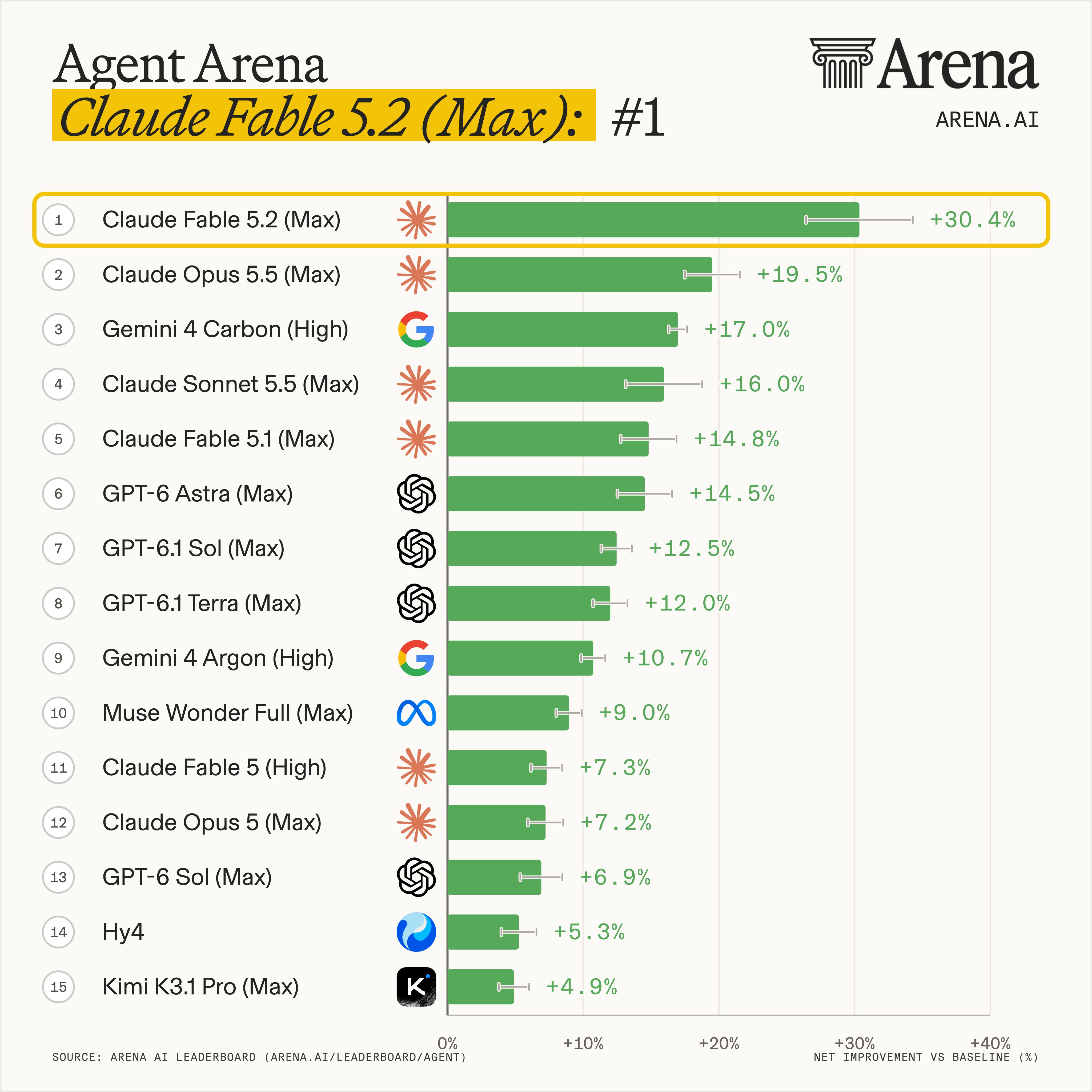
\+30% is like… several generations better.\
For pros.
You can ask Claude to use Fable to plan and Opus 5.5 subagents to execute, in one shot. But it requires a bit of practice:
- Use Claude Code only.
- Type /model and pick Fable 5.2.
- Set your sub-agents to Opus 5.5.
Here on the left, my prompt. On the right, my Opus 5.5 sub-agents:
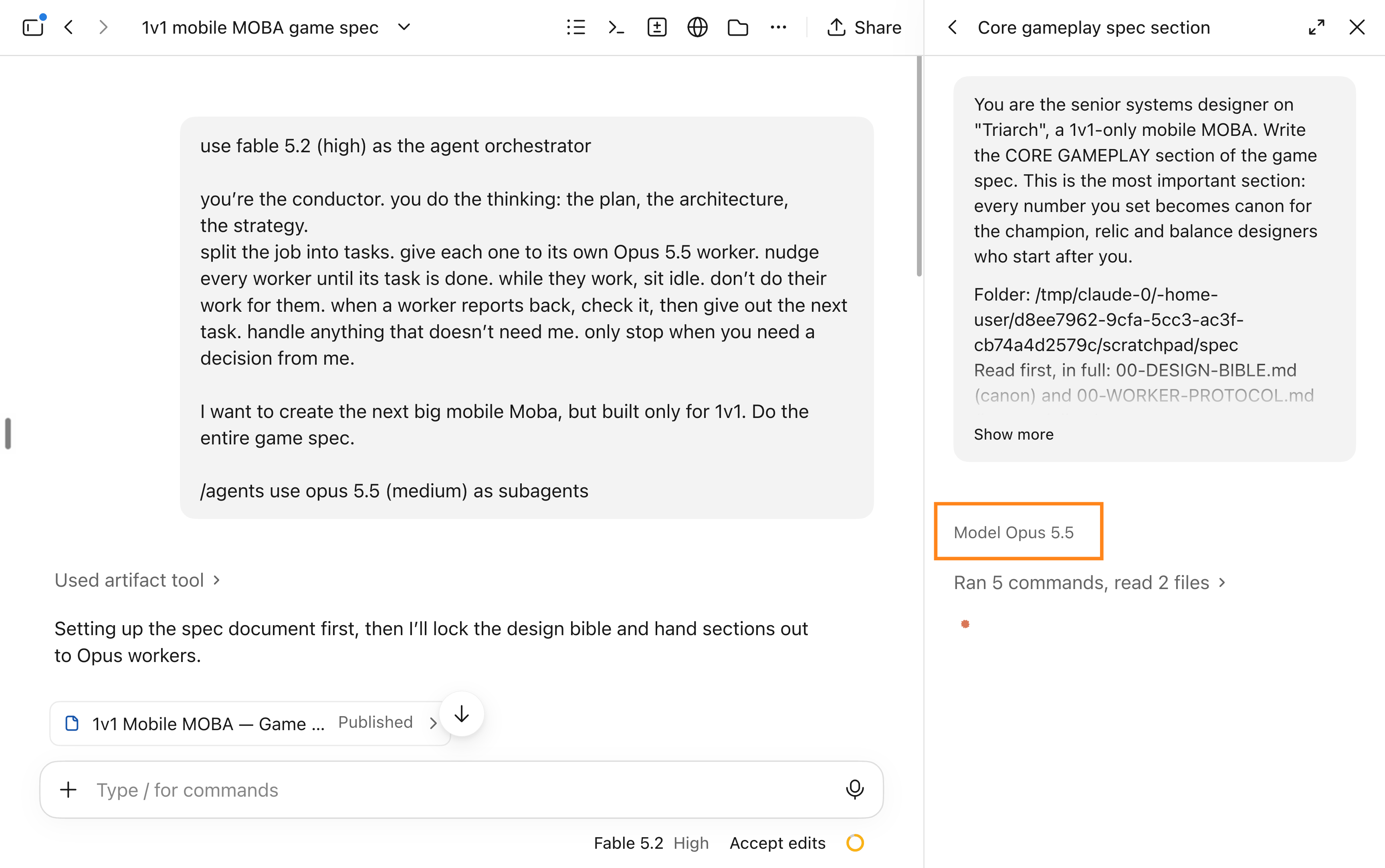
Copy and paste this:
use fable 5.2 (high) as the agent orchestrator
you’re the conductor. you do the thinking: the plan, the architecture, the strategy.
split the job into tasks. give each one to its own Opus 5.5 worker. nudge every worker until its task is done. while they work, sit idle. don’t do their work for them. when a worker reports back, check it, then give out the next task. handle anything that doesn’t need me. only stop when you need a decision from me.
I want to [goal]
/agents use opus 5.5 (medium) as subagents
What’s 1% of 1 billion?
I finished the newsletter, so let me be personal for a minute.
We are 8 billion humans.
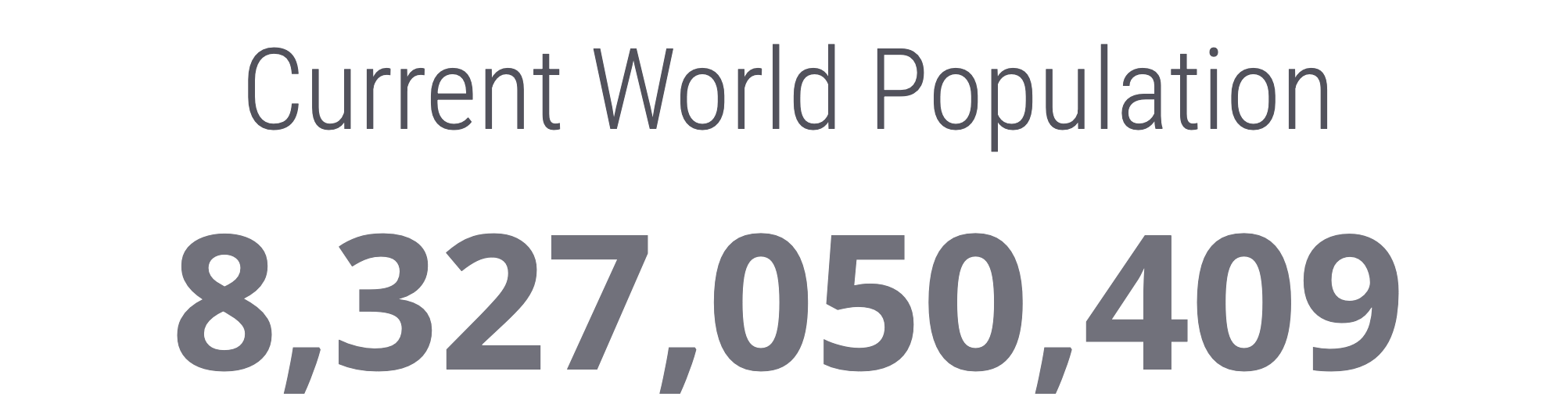
\8.3 billion exactly\\\
And about 1 billion of us can read English.
I want to help 1% of them get better or start with AI.
So 10 million people.
You probably don’t care about having 10 million people mastering AI. But having this many people connected to the internet brought up some good things.
And I believe bringing more people to correctly use AI will accelerate new cool things too. Scientific discoveries. New technology. Safe & abundant energy.
Or at least it will prevent them from losing their jobs, being replaceable, or not finding meaning in what they do.
So share this with someone you know will do wonders with AI:
Humanly yours,
Ruben!
PS: I celebrated 1 million subscribers with my friends. And a cake.

Very grateful to each and every one of you :)