By Mario G
Published: 2026-05-06
URL: https://realaivalue.substack.com/p/your-wiki-is-a-research-workbench
Lately, I’ve watched people pick up the LLM wiki pattern and reach for it as a dump-everything-here memory layer: meeting transcripts, working docs, project briefs, PRDs, decision notes, status updates, Slack threads, basically, anything text-shaped. This is a problem. The LLM wiki architecture is not designed to handle high-dimensional, sparse types of information the way a good implementation of a Second Brain is.
If you read my previous article as to how to extract value from an LLM wiki, you’ll know that the wiki compounds value in exactly two ways:
- Depth on individual concept pages
- Connections between concept pages
But both only work for stable abstractions like Concepts and Entities. The moment you try to use the wiki for time-varying, high-dimensional states, the compounding mechanism inverts, especially as the volume of documents increases.
Think about Wikipedia. Wiki pages tend to be high-signal, relatively stable information. There is only so much that could change about a concept like “entropy,” but if a concept is “weekly standups,” then the information included will become highly variable. Stack twenty-six entries of weekly standups on a single page and what you’ll get is a low-signal blur of every state the project has been in. Before moving on, I want to make it clear that this is by construction.
It is not a property of the data itself, but of the wiki architecture. There are appropriate ways to handle this type of data.
In this article, I want to make the case that LL wikis are better suited for research and are not to used as memory layer in the same way your average Second Brain implementation is. Then, I will introduce two new skills I’ve built on top of my personal LLM Wiki Build that operationilize one specific research-shaped job: writing articles from your wiki
The wiki is for research, not memory
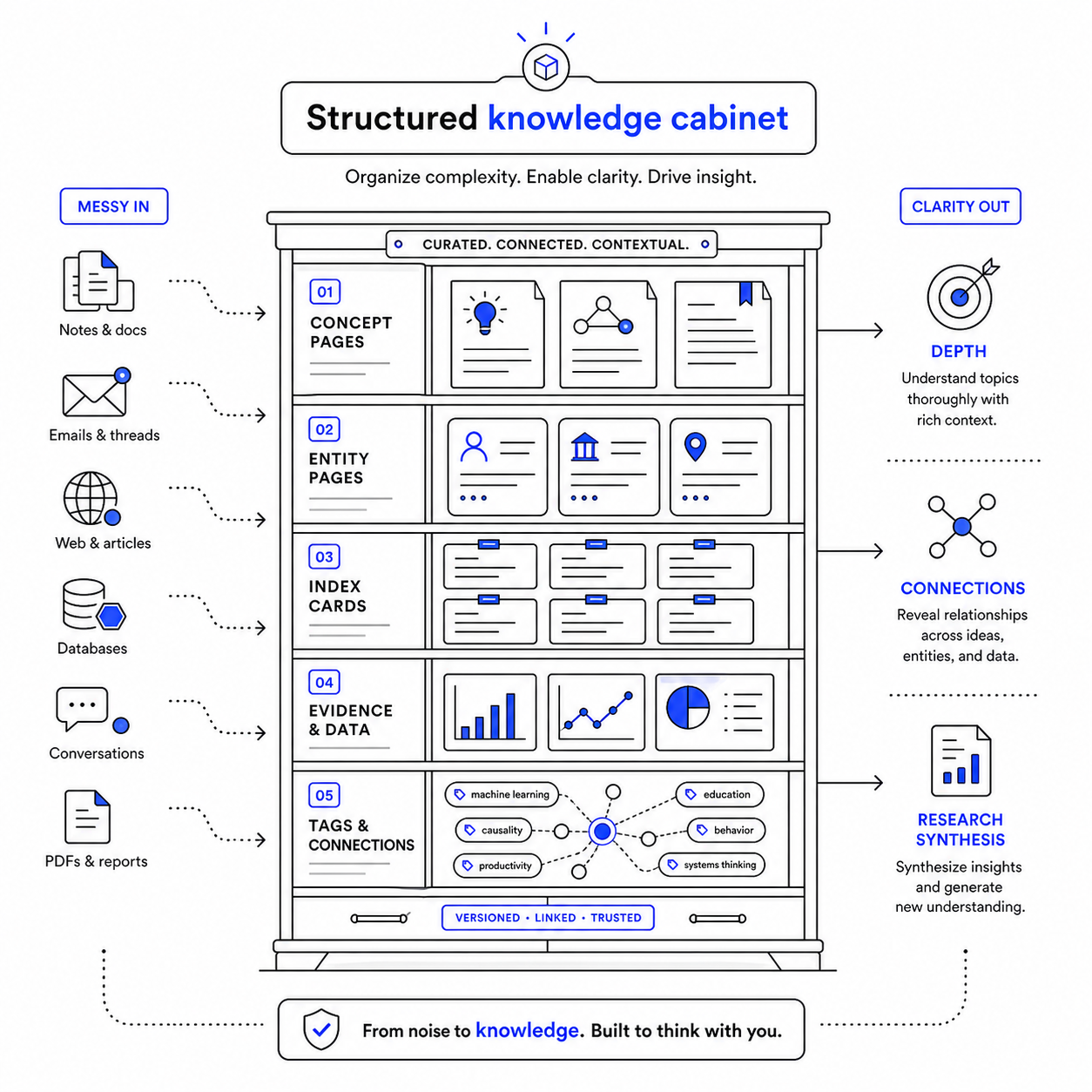
The compounding mechanisms of the Karpathy LLM wiki architecture, depth of and connections between pages, are not generic properties of “knowledge.” They’re properties of a particular data shape: durable abstractions that accumulate evidence over time without becoming noisy as the calendar moves forward.
Research inputs tend to have this shape because they are usually organized around claims, concepts, entities, mechanisms, definitions, and evidence. An article about agentic frameworks, a research paper about retrieval quality, or an opinion essay about AI workflows may be new, but the abstractions it touches are usually not disposable. They are part of a longer-running conversation.
Each new source adds evidence, pressure, nuance, examples, counterarguments, or stronger language to an existing idea.
Concept and entity pages are useful because they give that research material a stable place to accumulate. A page on agentic-frameworks gets richer every time you ingest another article on the topic.
Each wiki page becomes the foundation that new evidence layers onto. This is perfectly suited for information that challenges or contradicts a current concept or entity. The wiki wants contradictions when they appear, because a human or LLM process is required for adjudication, solving contradictions, and curating how to update positions based on challenging arguments.
On the ther hand, artifact that are produced on day to day basis as part of out core workflows, will not tend to have this durable abstraction. Consider two things people frequently incorrectly try to put in LLM-wiki systems:
- Meeting notes: A meeting is a snapshot. Tuesday’s standup talks about things Monday’s standup decided. If you ingest both as concept-shaped material, the wiki will treat the second one as a contradicting claim about reality and ask you to resolve it or solve it automatically. But there’s nothing to resolve. Those are two valid timestamps of an evolving situation. The information that has value here is the sequence.
- Project Notes: “April goal is X” was true two weeks ago. Now May goal is Y. A wiki resolving that contradiction picks one truth, demotes the other, or worse, merges them into a single, likely inaccurate truth. A project tracker or Second Brain preserves both because the history is the value. Wikis, on the other hand, accumulate towards a single source of truth.
More generally, an LLM wiki has several limitations that make it less than ideal for this type of sparse information. Acknowledging this allows us to understand what we can use this tool for:
- Querying for details is difficult: Asking an LLM wiki “what was the decision on March 7 about project X” requires the LLM to parse and search through markdown documents. The larger and sparser the wiki is, the more likely it is that the response is inaccurate or prohibitively expensive. A wiki is meant to be searched through a library index. Questions like, “what are the characteristics that define an LLM model?” are better suited, since we can simply find the concept page [[LLM models]] and read for an answer.
- There is a ceiling for scale: A few hundred concepts and entity pages might be manageable, but as more concepts and entities are written, the more likely you are to clog your context window and make searches token-expensive. Adding high-volume information like meeting notes will approach this ceiling at an exponentially higher pace.
- There is no formal schema enforcement: At ingestion time, it’s up to the LLM to decide how to name a concept it extracts from an article. For article A, it might decide to create the concept [[llm-wiki]]. If you run the same article again, it might decide to create the concept [[Karpathy-llm-wiki]]. The probabilistic nature of LLMs makes it so the same concept will be identified with different names and recorded in two different pages. My wiki implementation has a specific process to reduce this risk, but the higher the volume and sparsity of the information, the higher the likelihood that this occurs.
But now that we know what the wiki is not good at and what we shouldn’t ingest, then what can we actually do with an LLM wiki? I would suggest checking out my previous article for more of a conceptual approach to this, but in this article, I want to focus on a specific workflow that can leverage the wiki strengths.
Writing is a research-shaped job
The previous article gave examples of recurring jobs (newsletters, monthly briefs, standing research), but I wanted to expand on this and be more specific as to what type of writing can benefit from using an LLM wiki as one of its inputs:
- Opinion essays: You have accumulated positions across concept pages. Either directly through your own writing or indirectly from your research about certain concepts or entities. Extracting the concept will allow you to quickly synthesize your position and arguments.
- Framework-building pieces: Pulling four or five concept pages together to define a new abstraction is exactly what concept pages were designed to support.
- Explainer articles: Especially “what is X and why does it matter?” A mature concept page already encodes the structure of a clean explanation: definition, key claims, counterarguments, related concepts.
- State-of-X essay: If you’ve ingested a slice of the literature on a topic, you have the material for a survey. The wiki’s sources layer keeps the citations honest.
- Critique essay: You can only critique more credibly when you have priors to anchor against. The wiki gives you those priors in retrievable form.
The test is simple: does your draft use concepts you’ve built up over time, or positions you’ve accumulated? If yes, the wiki is your workbench.
This is the recurring job for me, since I typically write articles based on research for my clients, which is why I created two new skills on top of my LLM wiki build that help me create drafts that leverage the information on the wiki more easily.
Two Drafting Skills
Both skills take a markdown input, an outline, a brain-dump, a partial draft, or a one-sentence spark to compile it into a draft article whose claims are grounded in the wiki pages. One is fully automated and the other one is human-guided. Both of them are built on top of my personal LLM wiki build.
/kb-draft: autonomous
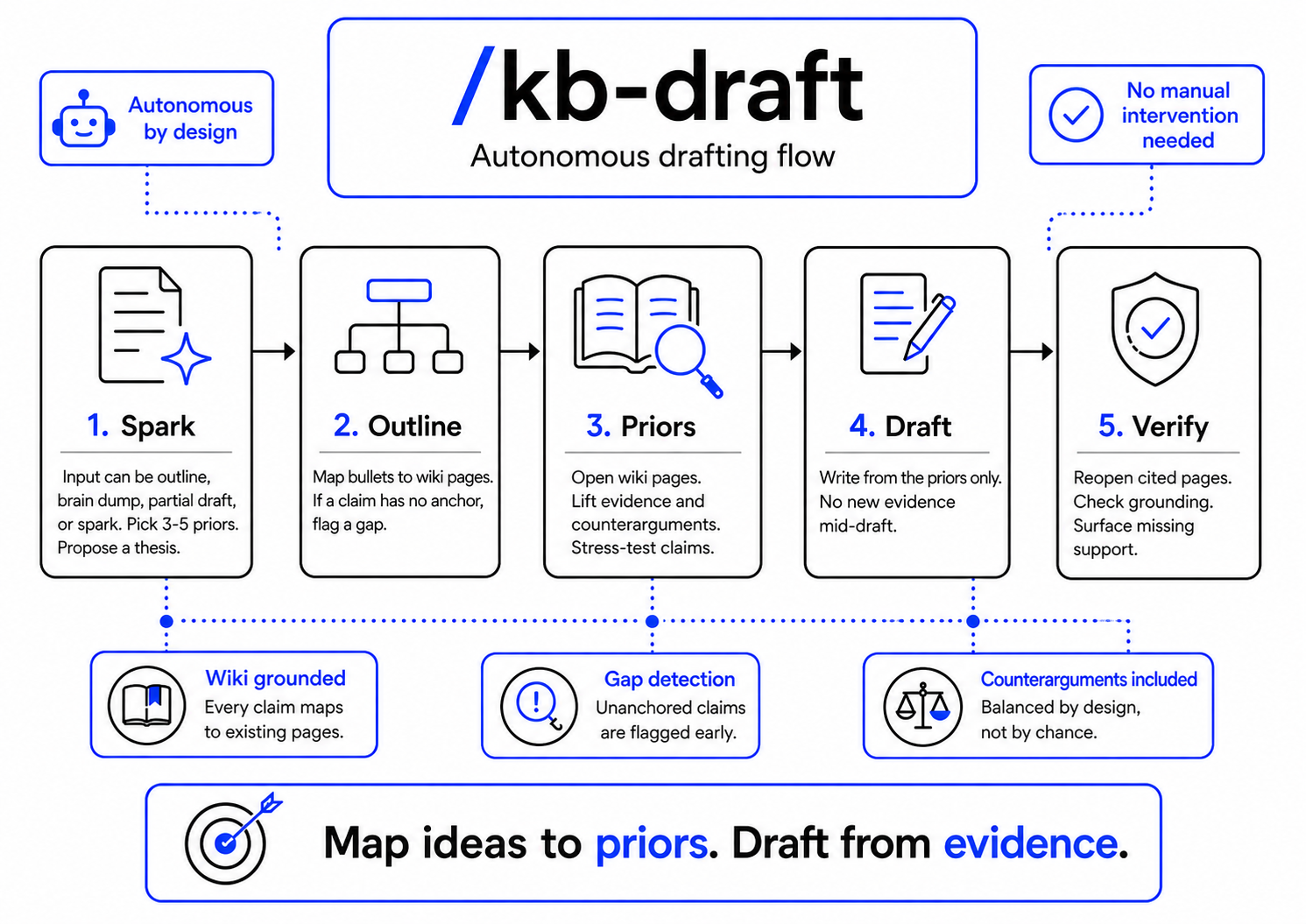
The intention here is to be able to quickly create a draft based on an unstructured or structured idea and see what it maps to in the wiki in terms of argumentative information or related concepts and entities (Priors). The skill uses a group of subagents that take the following steps:
- Spark. Detects whether the input is an outline, a partial draft, a brain-dump, or a single-sentence spark, then it picks 3-5 priors that bear on the topic and proposes a working thesis if you didn’t supply one.
- Outline. Maps every outline bullet to wiki pages via the index. If a stake-bearing bullet has no wiki anchor, meaning you’re asserting a position the wiki can’t back up, it gets flagged as a gap. Gaps are the signal to ingest more material or rephrase the claim.
- Priors. Opens the wiki pages, lifts verbatim and counterargument evidence. The counterargument scan is mandatory: if any wiki page has a qualification, hedge, or competing claim that touches the bullet, it surfaces. This is the “stress-test” mechanism for claims.
- Draft. Writes prose from the priors. The wiki goes dormant during this pass. No new claims, no fishing for fresh evidence mid-draft.
- Verify. Reopens every cited page and confirms the claim actually grounds in the page text and surfaces gaps.
As mentioned, the main intention here is to map and understand what is related to the concept / idea / angles you are exploring, not creating a working article. From here, I typically start querying the wiki to understand certain aspects / information in more detail that has been surfaced and start mapping what research gaps I might have.
/kb-draft-directed: human-directed
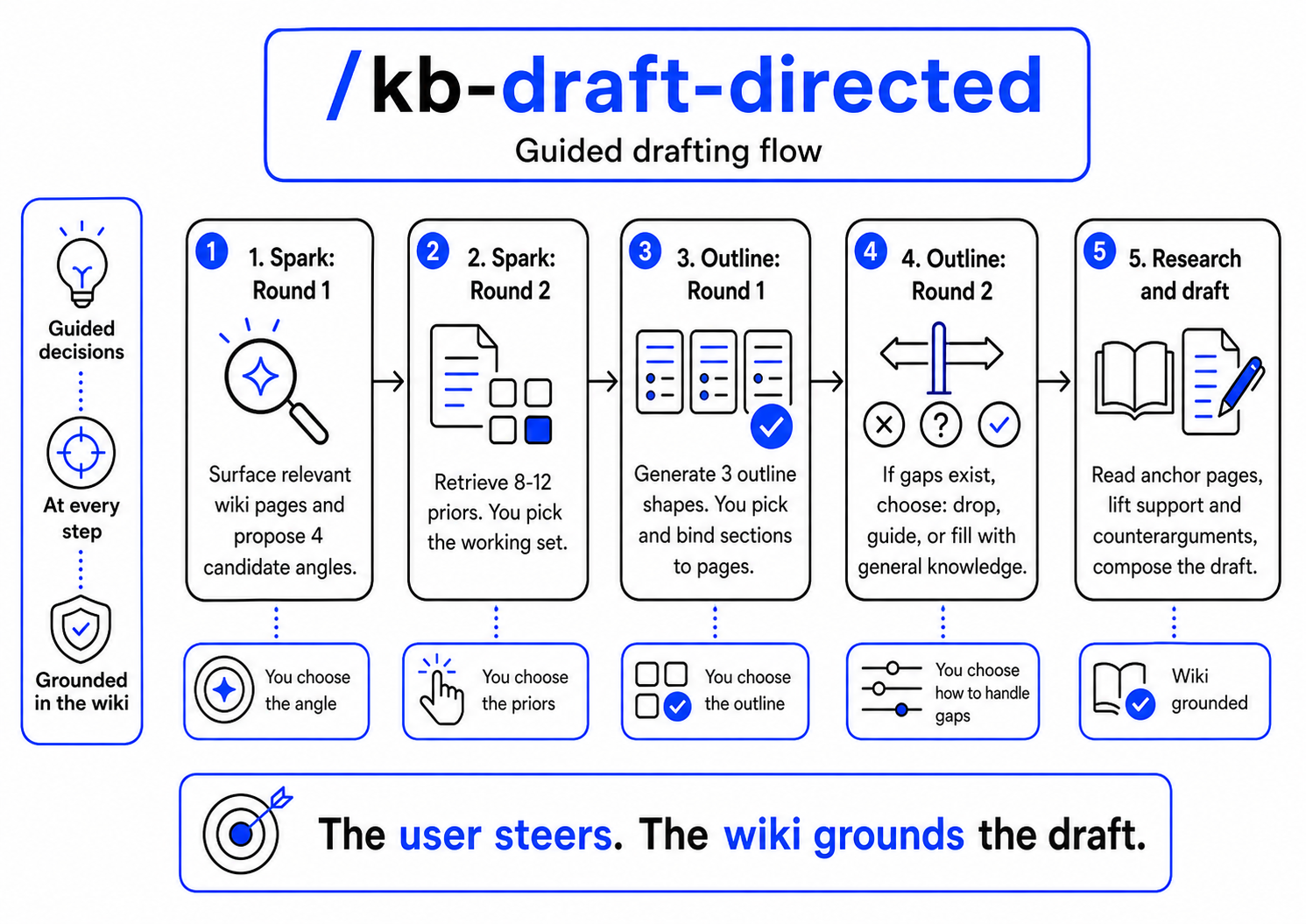
The goal here is for the user to make the creative calls when writing a draft. The recommendation here is to start with a topic you already are confident the wiki has the right or enough information, but you are perhaps not exactly sure where to take the article or what angle to take on it. This skill will discuss with you what direction to take while giving recommendations:
- Spark: Round 1. Agent reads your input and surfaces relevant wiki pages and generates 4 candidate angles. Each candidate has a thesis + audience + rhetorical move + rationale.
- Spark: Round 2. Agent retrieves 8-12 wiki page candidates as priors, given the locked angle. You pick the working set (typically 3-6 wiki pages).
- Outline: Round 1. Agent composes 3 candidate outlines with deliberately different rhetorical shapes: didactic, polemical, narrative. You pick one, then confirm the binding (which page backs which section of the article). You can rebind, drop, or reorder bullets before locking.
- Outline: Round 2 (conditional). Fires only if the locked outline has gaps. For each gap, you choose: drop the bullet, supply guidance prose, or let the LLM fill it with general knowledge (clearly marked in the final file).
- Research-and-draft. Mechanical. Reads anchor pages and their source summaries, lifts supporting and counterargument excerpts, composes prose inline.
Thanks for reading Real Agent Value! Subscribe for free to receive new posts and support my work.