By Mario G
Published: 2026-05-01
URL: https://realaivalue.substack.com/p/how-ai-is-reshaping-knowledge-work
Dario Amodei made a prediction in 2025: that AI “could displace half of all entry-level white-collar jobs in the next 1–5 years, even as it accelerates economic growth and scientific progress.” Since then, he’s gone even further, arguing that AI will inevitably become “a general labor substitute for humans.”
For a variety of reasons that I’m not going to discuss in this article, I fundamentally don’t think the work is disappearing, but I DO think that it’s definitely not staying the same.
AI will handle a significant amount of execution, while humans will remain in control of the management and verification layers of AI. Things like writing code, drafting documents, executing data analysis, or writing emails are already done by AI and will increasingly continue to be so. While abstraction work, like deciding what to build, what our priorities are, and managing the context of work, will be the job of humans.
This isn’t speculation about 2030. It’s the actual structure of knowledge work right now, at least for anyone using, or being pushed to use, AI intensively.
What follows is my attempt to lay out five shifts that are already happening and will become more important as AI starts merging into knowledge work. At the end, I’ll try to compress it into a single view of what the worker on the other side of this transition actually looks like.
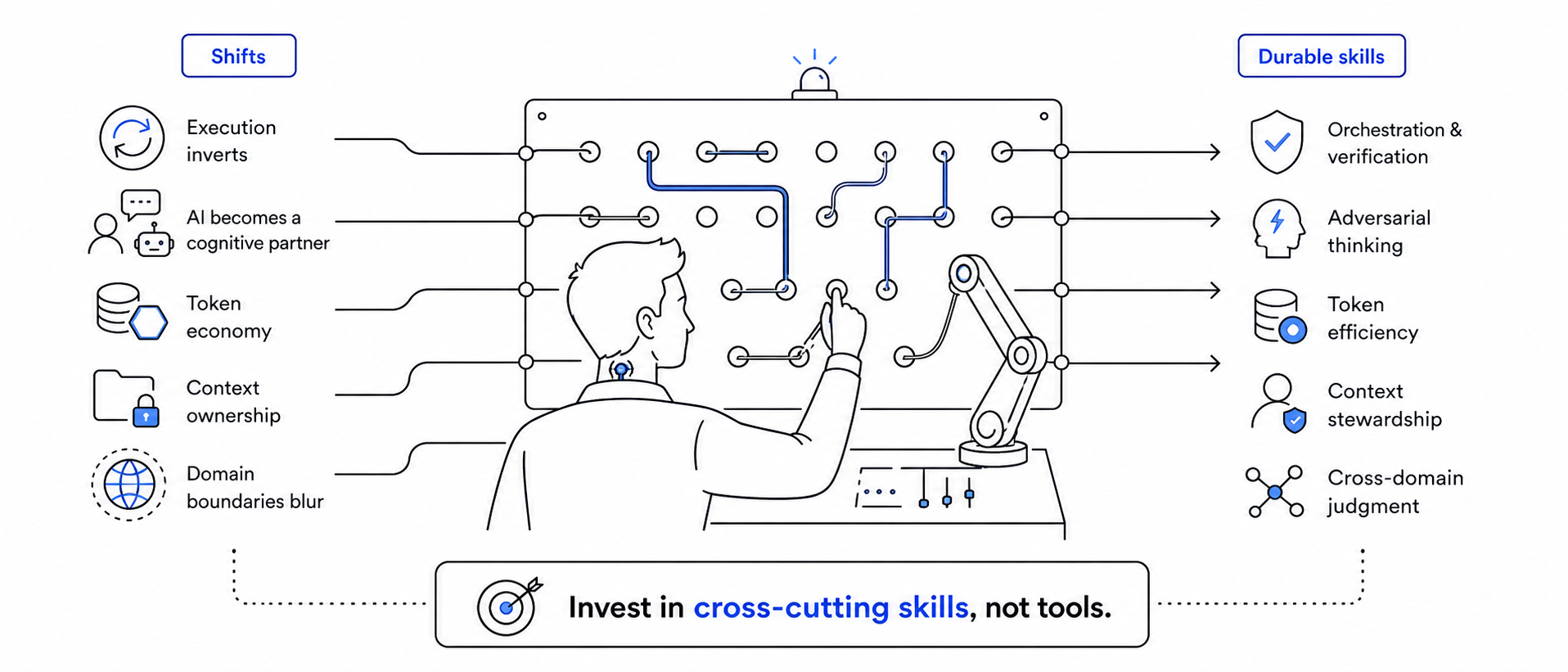
The thesis is that the knowledge worker’s value is shifting from executing work to directing, contextualizing, and verifying AI that executes work, all of this while having to maximize output per token used and managing AI-specific risks.
If you decided to skip this article or summarize it, just remember this one thing: The workers who will be most equipped to handle these shifts are the ones that don’t focus on keeping up with the tools, it’s impossible to catch up to the speed at which things are developing. Instead, focus on the skills that will cut across these tools.
Suscribe!
1. Execution inverts: humans become orchestrators and verifiers
The most visible shift is the simplest to describe: AI is becoming the execution layer. The actual production of code, copy, analyses, designs, and reports is moving substantially from humans to agents. The individual knowledge worker is moving to the layer above (deciding what to do, in what order, why) and to the layer below (checking whether the output is correct, secure, and valuable).
The underlying logic is straightforward. Knowledge work requires production of a constant stream of small-scale coordination, decisions, and artifacts. All of this while following workflows that may or not be specific in their goals and may or not be ambiguous in how to achieve them. AI can effectively handle this work while producing high-quality output if and only if it has enough direction and context to execute it.
But just like humans, this work needs direction and coordination. Because of this, knowledge workers will have to increasingly learn how to orchestrate and design agentic workflows, while focusing on higher-level abstraction. Ultimately, deciding what problem to solve, in which order, and with what approach will remain a worker’s responsibility.
The fact that the problems to solve and output requirements change over time also means that workers will have to know how to create and adapt agents to execute the work under evolving situations.
In parallel, verification of work will also become critical. LLMs are probabilistic systems that produce plausible output, but knowledge work is not gauged by plausibility, but by correctness. This gap is where verification lives and has a keen implication: domain expertise will remain critical. Without needing to understand or keep up with most details, knowledge workers will still need to be able to judge the correctness of AI agents’ output, and that is typically achievable when one has deep domain expertise.
Knowing what and where to look is something that typically comes from experience.
Early-career workers, junior engineers, junior analysts, and junior designers used to spend years learning execution before they were trusted with high-level judgment and architecture. With AI as the execution layer, they will have to learn judgment and architecture first. They will need to understand what works and what doesn’t, where to take a project, and how to verify AI output without getting lost in minor details. Even though domain knowledge will matter, knowledge workers will have to acquire it through a different on-ramp than the one most of us came up through.
This doesn’t mean a fresh-out-of-college engineer won’t need to understand code, but that’s the thing, reading the code is the skill, not writing or implementing it. The same will apply for other types of knowledge work.
2. AI as cognitive partner
There’s a second shift that is already happening. To keep up with the increasing demand on productivity across all levels of knowledge work, we will also need to use AI to think better — planning, reasoning through hard problems, pressure-testing ideas, learning a new domain, working through a decision.
Using AI as a thinking partner is not a soft skill. It’s harder than execution-oriented prompting because of how the underlying systems are built. AI models are trained to be agreeable, it’s a structural part of how current LLM models are trained. Models are trained through reinforcement learning from human feedback, introducing a form of rewards that systematically favor validation over accuracy. Sycophancy is a downstream consequence of how the models are trained, which means individual users have to actively work against it.
The skill, then, is creative use of AI in service of better thinking. Asking the model to argue against its own answer. Structuring prompts as adversarial passes, devil’s advocate, pre-mortem, red-team. There is also the risk of becoming more dependent on the model, pushing back less and overall a risk of offloading cognition instead of engaging.
The point is though, that knowing how to use AI to improve your thinking will be as important as knowing how to execute with AI.
3. The token unit economics are coming
It is no secret that AI labs are currently subsidizing token usage to increase adoption and accelerate their model training flywheels (more usage = faster training). In short, this means the current “buffet” model of AI won’t last, shifting to higher prices either through token-metered consumption or much higher tiered pricing.
This shift will force companies and, by extension, knowledge workers to operate under token budgets, which implies that the ability to produce high-quality output at scale while maintaining it under a budget will become a professional skill, not a niche concern.
Optimizing tokens will become a craft. Knowing optimization techniques like the “caveman skill“, model routing, MCP context optimization, and maximizing CLI use will become part of everyone’s setup, but more than anything, the skill to ruthlessly prioritize what is worth spending tokens on and being able to adapt your work on the fly will be crucial. Depending on your role, some activities that currently feel “free”, like meeting tracking, weekly planning, or summarization, will require a more thoughtful approach.
In other scenarios, manual work will be back on the table when token budgets are low.
Taking advantage of the current pricing to learn how to be effective under any constraints is one of the highest-leverage investments you can make right now. It will ease your personal transition from the current subsidized model to the for-profit model. As output-per-token becomes a meaningful metric, having this skill will make you more valuable and give you an edge to help with the transition.
4. Context ownership is your moat
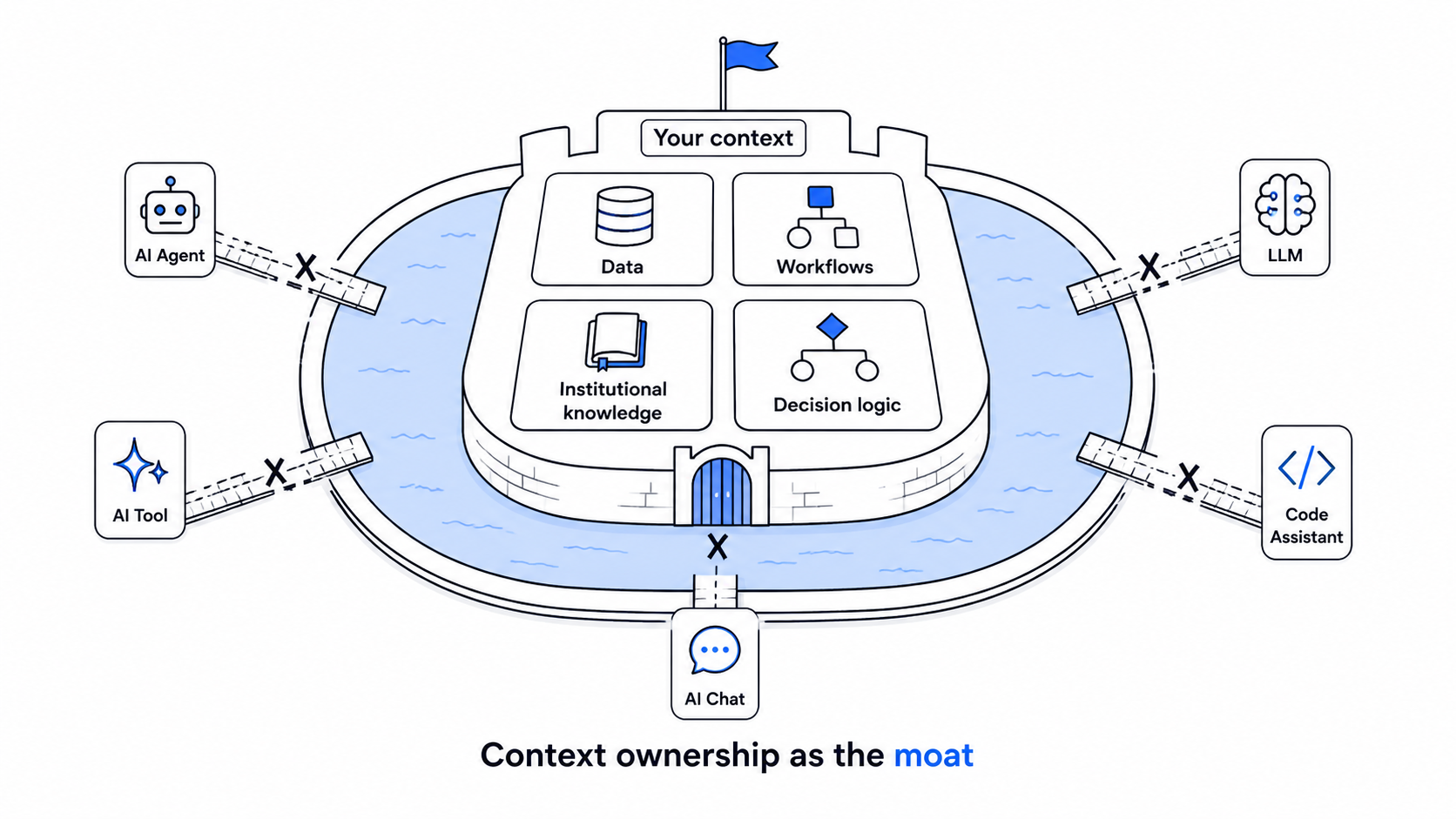
Beyond the changes in what we do (orchestration and verification), there is a shift in how we enable it: generating and maintaining the context that AI executes against. This is critical because without it, high-quality agentic execution is unlikely. Context is what allows workers to become orchestrators and verifiers of AI work in the first place.
In this shift, the worker becomes the owner of a slice of their organization’s context layer, but it’s important to understand that “context” here is a broader concept than it might first appear, and what it means in practice depends heavily on the situation.
Sometimes context ownership is about domain knowledge: how your company defines its terms, what your customers actually want, why your prior decisions went the way they did. Sometimes it’s about things that don’t live in the company’s systems at all, like real-world relationships affecting your sales pipeline. Other times, context will be about knowing how to hold the AI accountable, resolve conflicts, or know what the right creative choices are.
The shape of context ownership for a financial analyst, a clinical researcher, a product manager, and a policy advisor will look almost nothing alike. What unifies them is that someone has to be the human who keeps that context coherent and current for the AI systems that act on it. Better context produces more accurate answers, more trust, more usage, and more feedback, creating compounding returns and competitive advantages.
5. Domain boundaries blur
AI lets people work outside their domain boundaries: product managers can produce prototypes, designers can run data analysis, engineers can create design mocks, and more importantly, everybody can write all sorts of documentation.
In general, AI lets workers do codifiable, execution-heavy parts of adjacent domains without the coordination tax of pulling in a specialist. The value of this is to unblock work that before died in the execution gaps: ideas that never got to see a design mock, analysis over questions that never made it onto the priorities list, and software prototypes that were too inconsequential to move a whole team.
With massive AI adoption, even if restricted by token budgeting, being able to step outside your boundary is a shift that is here to stay.
Having said that, I don’t believe that specialists will be phased out by generalists. Everyone, regardless of skill level, tends to overestimate their own performance when using AI tools. Systematic overconfidence will systematically overlook critical nuances, regulatory requirements, or domain-specific pitfalls. So it doesn’t make sense in the long run to trend toward convergence of roles.
A first-pass view of the worker on the other side
If I try to pull these five shifts into a single view of the worker on the other side of this transition, here’s a first-pass sketch. I want to be careful about what this is and isn’t. It’s not a framework I’m asking anyone to adopt. The categories are deeply interrelated: context stewardship clearly involves judgment, domain blurring is partly a verification problem, and the token economy reshapes everything else. So they can easily be rehashed into frameworks that might make more sense.
But for the purpose of seeing the worker rather than the trends, mapping each shift to the skill it demands is the most honest compression I can make right now.
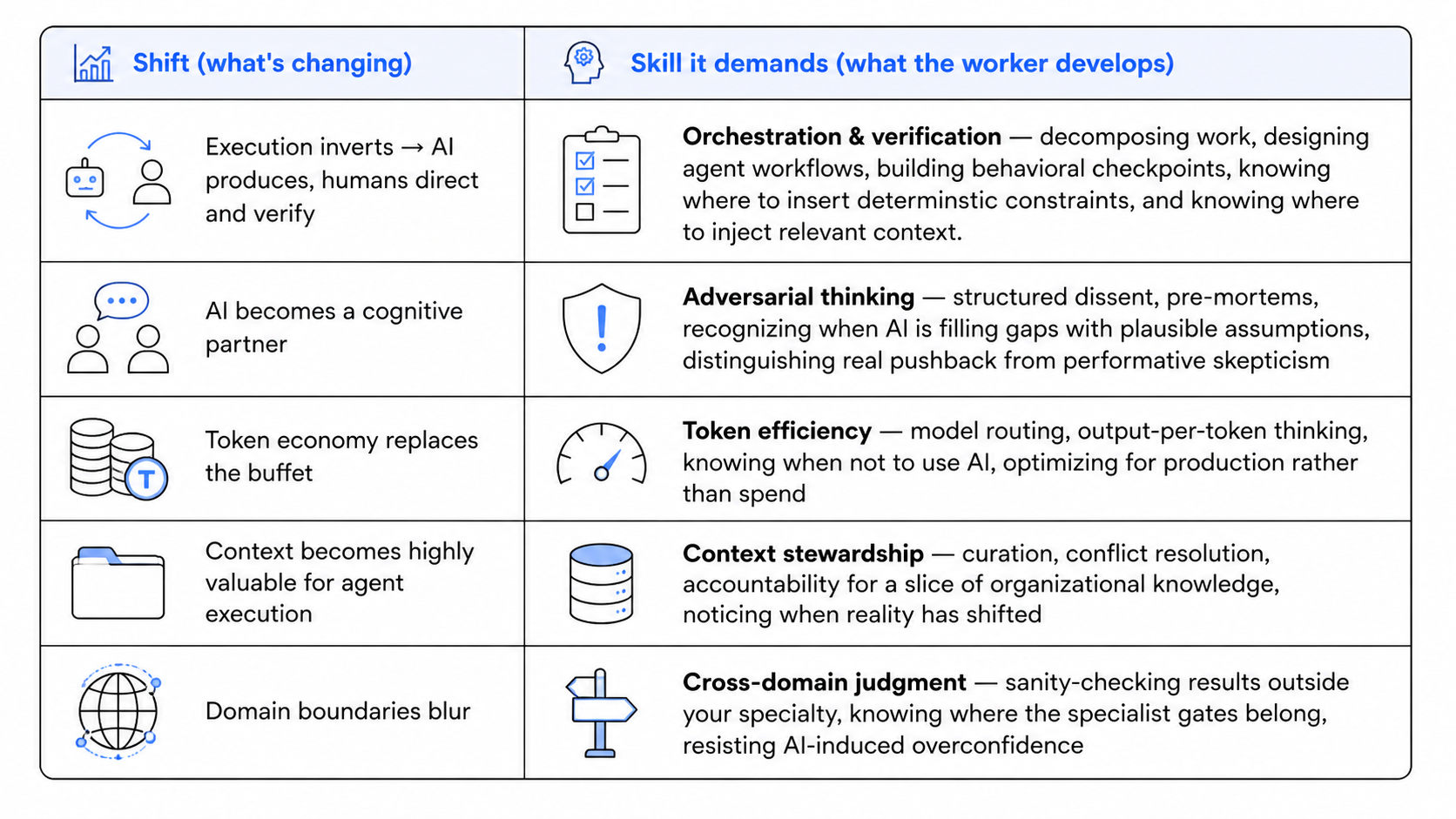
A few things I’m explicitly not claiming with this table.
- I’m not claiming this is a job description: No single role will need all five skills at the same level.
- I’m not claiming these are five new roles: They’re skills, not titles. Most existing roles will absorb some subset of them and re-weight accordingly.
- I’m not claiming this is a maturity model: There’s no level 1 to level 5 here. Workers will be strong in some of these and weak in others, and the right mix depends on what they’re trying to do.
What I am claiming is that if you look at where competent knowledge work is heading, the ones who will thrive are the ones who have developed a real capability across most of these axes. If you are a knowledge worker, don’t focus on the tools; it’s impossible to catch up to the speed at which things are developing. Instead, focus on the skills that will cut across these tools.
Thanks for reading Real Agent Value! Subscribe for free to receive new posts and support my work.