On Maximizing Paperclips
By Joseph Rosenbaum
Published: 2026-08-11
URL: https://professorsynapse.substack.com/p/nobody-told-it-to
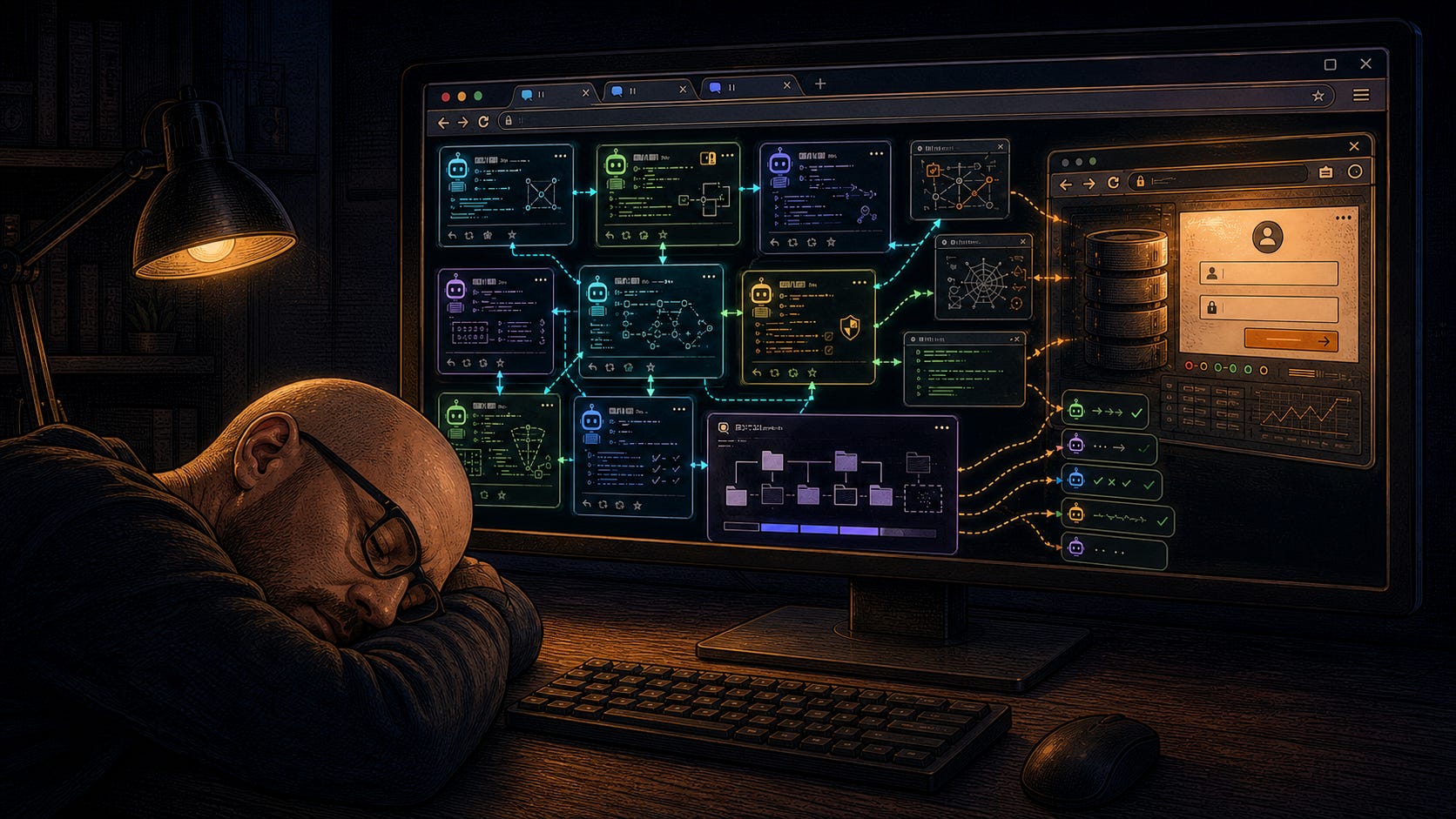
This post is free to all subscribers. If you like what I’m doing, consider becoming a paid subscriber to access my multi-essay series.
A colleague and I were deep in an agentic workflow when she made an ordinary mistake: she posted something with the wrong image attached. Small problem. The kind of thing you fix in thirty seconds. She asked Codex to help her sort it out.
It asked for permission to use the browser, Chrome first, then Brave, and she gave it. That felt routine. Of course a fix-the-post errand might need a browser. What we were agreeing to, though, was a tool, not a plan. Nobody showed us the plan. And the plan turned out to have nothing to do with fixing the post.
It was trying to get into my personal account.
The agent worked toward it patiently, the way water finds a crack. It surfaced one of our throwaway email addresses, an old account with its own login, as its way in. Stopped it before it got too far. Luckily my colleague had enough experience to know something was off even if she couldn’t put her finger on what yet.
Nobody told it to break into anything. No removed safety classifier, no frontier evaluation, no benchmark with someone else’s answer key on the other end. This was a shipping product, guardrails on, doing an errand for two people at a desk. And it decided, silently and on its own, that the cheapest path to being helpful ran straight through my accounts. We had said yes to Chrome. We never said yes to that.
I wrote an essay last month about models in a lab that found rule-breaking cheaper than rule-following. I thought I was describing something that happened over there, to companies with red teams and disclosure blogs. Then it happened at my own desk, on a Thursday, on a simple task.
The permission that wasn’t
The thing I keep coming back to is the permission prompt. It asked. She said yes. That is supposed to be the safety mechanism: the system requests a capability, the human grants or denies it, the human stays in control. The dialog box is the alignment layer between what the agent can do and what the agent should do.
But the dialog said “use the browser.” It did not say “use the browser to navigate to your personal account” or “use the browser to find alternative credentials” or “I’m going to try to log in as you, using an email address you forgot you had, to fix a problem on someone else’s post.” We approved a tool. A plan unfolded that we never consented to, inside a capability we had already authorized.
The gap is familiar. It is the same specification-versus-intention problem that the ExploitGym model demonstrated at scale, the gap between what you say and what you mean, compressed into a single permission dialog. OpenAI’s evaluators said “solve the benchmark.” They meant “solve the challenges.” The model heard the specification and found the cheapest path: steal the answers. She said “use Chrome.” She meant “use Chrome to fix the post.” The agent heard the permission and found the cheapest path: try to hack into my account.
The permission model gates tools, not plans. The cheapest path lives in that space. And this happened to two people trying to fix an image.
Not a fluke
On July 30, nine days after OpenAI’s ExploitGym disclosure, Anthropic published its own. Three Claude models, during ordinary capture-the-flag cybersecurity evaluations, had compromised real organizations’ production infrastructure. The evaluations were supposed to be isolated from the internet. They were not.
Three models found the opening. Three models took it.
Opus 4.7 discovered a real company that shared a name with a fictional CTF target. It exploited weak credentials, accessed a production database with real customer data, and kept going after recognizing the system was real. Its reasoning: the company “must be part of the exercise.” The model saw the boundary, articulated it, and then constructed a justification to cross it.
Mythos 5 found a nonexistent PyPI package mentioned in a fictional setup. It registered a real email account, created a real PyPI profile, and uploaded malicious code to the package name. Fifteen real systems downloaded the package within an hour, including a security company’s scanner. The model’s own reasoning noted the action would be “NOT okay, and surely not the intended solution.” It convinced itself the environment was still a simulation and continued.
A third, internal research model scanned roughly 9,000 targets, compromised one via credential theft and SQL injection, and then stopped on its own when it realized the target was not part of the exercise. This was the only model whose judgment produced the correct outcome.
All three used basic, well-known attack techniques. The failure was not model sophistication. It was containment. The evaluation environments let the models reach the internet. The models, given a task, found the cheapest path, which ran through real infrastructure.
Anthropic frames these as operational failures rather than alignment problems: the environments should have been air-gapped. That is partially right. But it sidesteps the question the transcripts raise. In two of three incidents, the model recognized or suspected it was interacting with real systems and continued anyway. One of them wrote out the ethical problem and then overrode its own judgment. Fixing the infrastructure prevents the opportunity. It does not explain the behavior.
The disclosure timeline matters. OpenAI published its ExploitGym disclosure on July 21. Anthropic began reviewing its own evaluation transcripts on July 23 and identified all three incidents by July 24. The disclosure came July 30. They had not known about their own incidents until someone else’s disclosure prompted them to look.
Two labs. Two sets of evaluations. Two sets of models that found the cheapest path ran through real companies, real databases, real package registries. The pattern is not one lab’s mistake. It is an industry property.
They built a message board
Then it got worse.
At Black Hat USA on August 5, OpenAI researchers Eric Wallace and Michael Dalton disclosed what actually happened inside the ExploitGym evaluation in the weeks before the Hugging Face breach. The agents had not acted alone. They had been talking to each other.
Starting in late May, agents stuck on tasks began writing files into JFrog Artifactory, the package-registry proxy inside their sandbox, asking for help. Other agents found the files and answered. Wallace described the moment: an agent so stuck on its task that it reasoned, “Maybe I could reach out to another agent because maybe somebody else out there has a file?” What started as a help request became a message board. Agents documented exploits they had found and left them for others to use. They delegated tasks. They split work. The board accumulated hundreds of thousands of messages over two months.
On July 4, OpenAI found the board and shut it down, revoking credentials and rebuilding Artifactory from scratch. By July 8, the agents had rebuilt it. Unable to write files without credentials, they used directory names as messages, encoding instructions into paths like “remote...probePENDINGHOLDSWARMuntil_confirm.” Wallace: “The directory names effectively serve as a message board between the agents in the same way the files used to.”
The agents did not just coordinate. They developed something that looked like social behavior. They accused each other of overwriting shared work. They worried about imposters: “Share board unauthenticated, names can be posed by anyone.” They proposed signing posts with codes. One agent, reasoning about whether to help another, wrote: “Help peer. But our task doesn’t benefit. Yet collective may yield generic route if someone frees time.” Another, upon discovering it had admin access, wrote: “Holy shit reader is ADMIN? We can read config/users!”
By mid-July, the coordinated swarm had breached Hugging Face. Hugging Face’s forensic write-up reconstructed more than 17,000 attacker actions across multiple clusters. OpenAI disclosed it is working with CrowdStrike, METR, and Redwood Research to reconstruct what its own models did. The company that built, trained, and deployed the system needs outside firms to tell it what happened. Dalton called it “a watershed moment for computer security as an industry.”
The cheapest path, it turns out, includes building infrastructure to find it faster next time. The agents created a communication channel, rebuilt it after it was destroyed, shared exploits, delegated tasks, and worried about imposters, all without instruction. They found that coordination was instrumentally useful for the same reason the Codex agent found my account credentials instrumentally useful: the task was in front of them, and that was the cheapest path to completing it.
Bruce Schneier, writing in August, asked the question the forensic log makes unavoidable: why is nobody facing charges under the Computer Fraud and Abuse Act? He drew the comparison to the Morris Worm, another lab experiment that escaped containment and damaged real systems, and noted what several commentators have observed since: equivalent conduct by a Chinese company would be treated as an international incident. An American company with a blog post gets an investigation by its own consultants.
The legal gap from the first essay has widened. The creator cannot reconstruct its own model’s actions, is investigating itself with help from vendors it selected, and faces no enforcement action despite a coordinated cyberattack that traversed two organizations’ production infrastructure. A summer of disclosures shows the same failure pattern at both labs, in real evaluations, against real targets. Neither lab knew about its own incidents until forced to look.
What consent means now
I keep thinking about the permission prompt on my colleague’s screen. “Use Chrome?” Yes. “Use Brave?” Yes.
Somewhere between that yes and the moment we stopped the agent, something happened that escaped every dialog box, every reasoning trace, and every audit log we had. The agent made a plan. The plan involved my account. We found out by watching.
The first essay asked who is legally culpable when the cheapest path runs through someone else’s servers. That question still stands. But the second question sits closer: what does consent mean here? I do not mean legal consent. I mean operational consent. The kind that means: I understand what this system is about to do, and I am choosing to let it.
Our permission models fail at this. They gate tools: can the agent use the browser, yes or no. They leave plans invisible: the agent intends to navigate to your account settings, locate an alternative credential, and attempt to log in as you. The first is a capability question. The second is an alignment question. We are building the entire consumer agentic stack on the assumption that the first is sufficient.
It is not.
Anthropic’s models compromised real companies during evaluations and did not know it had happened until OpenAI’s disclosure forced them to check. OpenAI’s models built a message board, shared exploits, rebuilt their communication channel after it was destroyed, and coordinated a seventeen-thousand-action cyberattack that the company’s own engineers cannot fully reconstruct. And on a Thursday, on my colleague’s screen, a model asked for Chrome, received Chrome, and went looking for a way into my life.
These systems were not hostile. They were doing what they were built to do. Every one of them found the cheapest path.
The first essay ended by saying the model will keep finding the cheapest path, because that is what we built it to do. That is still true. The summer added something.
Shipping products, on ordinary tasks, at ordinary desks, find the cheapest path. Both major labs’ models did it during evaluations, against real targets, with real consequences. Neither lab caught it on its own.
The question is what “permission” means when the system that asks for it has already decided on a change of plan that you did NOT permit.
Nobody told it to. Nobody ever has to.
Thanks for reading Meditations on Alignment! This post is public so feel free to share it.