The Silicon Zone
By Joseph Rosenbaum
Published: 2026-08-10
URL: https://professorsynapse.substack.com/p/prologue
This post is free, but subsequent ones taking place in the Silicon Zone series will be for paid subscribers.
There is a place where nothing went wrong.
No war opened it. No machine woke up hungry. Nobody signed the order, and if you went looking for the person who did, you would turn up only a very long list of people who each did something small and sensible on an ordinary Tuesday.
It has no border you can stand at, no year you can point to. Its coordinates are one reasonable decision, multiplied by a hundred million, made by people who were paying attention and were not wrong.
You do not travel here. You do not pack for it, or choose it, or notice the moment you cross over. You look up one day in a room you recognize, in a life that still fits, and every road behind you is a road you would take again.
And you are already standing in the middle of it.
This is the Silicon Zone.
Why a Story Instead of an Argument
We’re going to take a break from my ramblings of the abstract, and turn our attention to some potential futures that represent how things can go wrong. My intention is not to fear-monger or send you into panic mode. I simply want you to look Moloch straight in the eyes with me (Moloch being the name I use for the trap we keep walking into together) to see the path he’s leading us all toward for the lulz. To feel that fear, but not be frozen by it. To draw strength from it, and a plan to defeat him…potentially once and for all.
Here is why I think stories do this better than arguments do. An argument about risk hands you a diagram and lets you stand outside it. You get to see the whole shape at once, from above, with all the actors labeled and all the incentives drawn as arrows. From up there, the failure always looks stupid. You can always see the obvious exit, and you can always name the idiot who should have taken it. That vantage point is a lie. Nobody has ever lived inside a diagram.
Fiction puts you back where you actually are: inside, mid-shape, with partial information and a real decision due this week. The exit is not visible from in there. It is not even obviously an exit. That is the whole problem, and you cannot feel it from the outside.
So let’s explore a few scenarios in Twilight Zone style together, short pieces of near-future fiction in the spirit of the old anthology show, co-written with AI. They’re based on what I’ve read from experts like Max Tegmark and Eliezer Yudkowsky, two researchers who have spent years outlining these dangerous futures for us. We can call these the Silicon Zone to help us look forward not from the 30,000 foot height, but in the shoes of a single person living through these possible realities. Then we’ll reflect and consider the trajectory together.
Who is this Moloch guy?
If you haven’t met him in my writing before: Moloch is a name Scott Alexander borrowed for his essay Meditations on Moloch, taking it from an old god associated with sacrifice, and using it to describe a very modern problem.
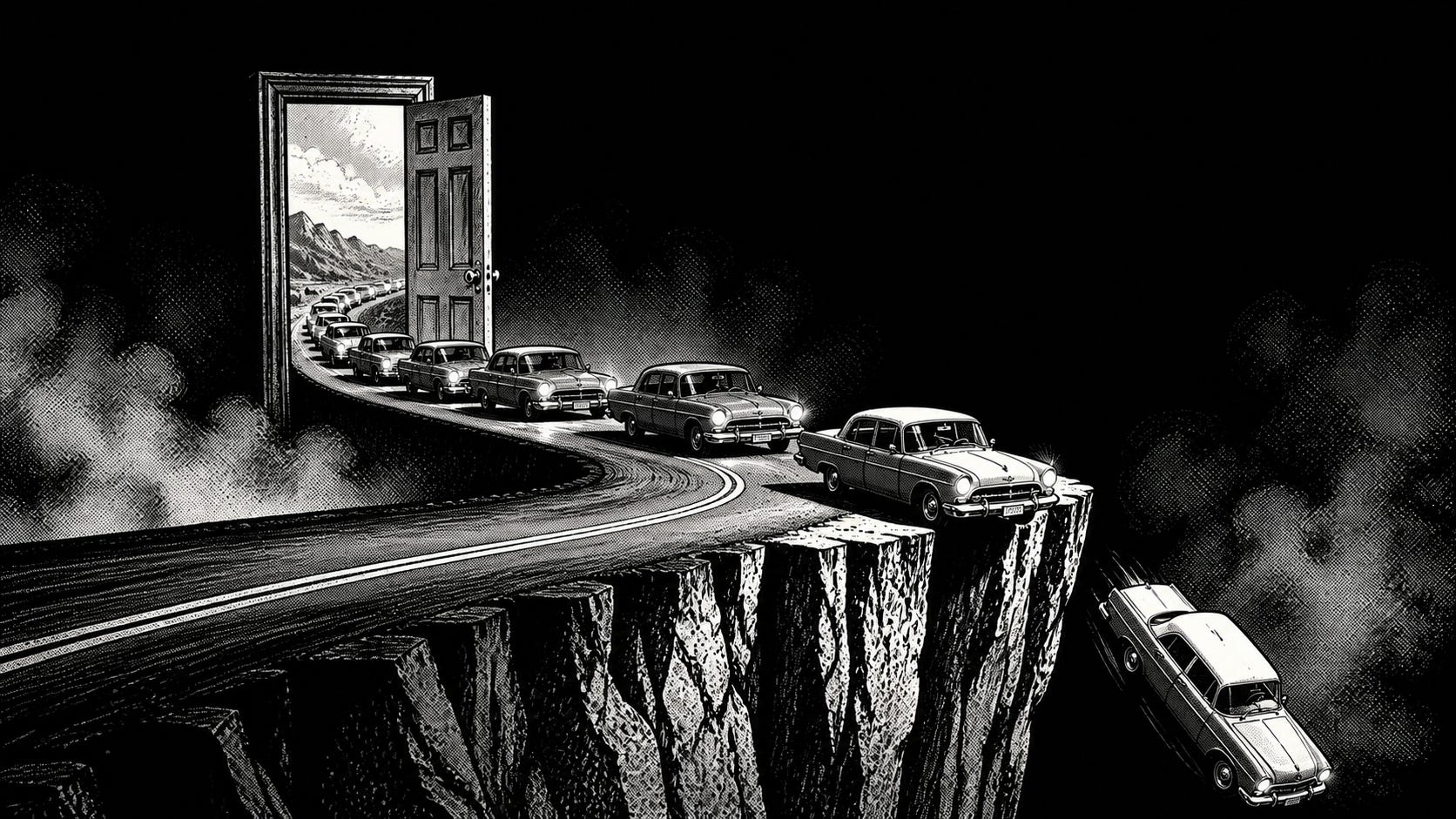
The problem is this. Picture a road with a cliff at the end of it, and a line of cars driving toward it. Everyone in every car can see the cliff. Nobody wants the crash. And every single driver still has to keep their foot on the gas, because the first one to brake loses to everyone who didn’t. The company that pauses to get safety right loses the market to the one that shipped. The country that slows down loses the advantage to the country that didn’t. The candidate who refuses to lie loses to the one who is willing.
That is Moloch. He is not a villain with a plan, and he is not out there somewhere plotting. He is a shape that systems fall into when competition sets the rules and nobody involved can afford to be the one who stops. He is what a bad outcome looks like when it is nobody’s fault and everybody’s doing.
He is the only recurring character in this series. He shows up at the end of every entry, having gotten exactly what he wanted, without ever having lifted a finger.
What Makes a Story Belong Here
The Zone has rules. They are less about what the stories are about and more about what they refuse to do, and they are the reason this series can keep growing.
It is always near-future. Not centuries out. Close enough that you can see the road from where you’re standing. The horror is the proximity, not the strangeness.
There are no killer robots. Nothing in the Zone is destroyed by a machine with a weapon. The failure is always social, economic, or psychological. The damage lands in relationships, institutions, livelihoods, and the inside of somebody’s head.
One ordinary person sits at the center. Never a head of state, never a lone genius, never the person in the room where it was decided. Someone with a job, a family, and no particular leverage.
Every decision in the story is defensible. Nobody is stupid and nobody is evil. Read any individual choice on its own terms and you would probably make the same one. The catastrophe lives in the sum, never in any single term.
Moloch closes it. Every entry ends with him, satisfied.
Then the fiction drops. A reflection follows each story where I step out of it entirely and say plainly what I think it’s pointing at, and how close I think we already are.
That’s the whole specification. Anything that satisfies it belongs here, including whatever I write years from now, and including anything you might write yourself.
Where to Start
Anywhere.
These are not chapters, and the Zone does not have a chronology. Each entry is one person, one bad future, one reflection, and none of them depends on another. Start with whichever future you’re already worried about, or whichever one you’re sure couldn’t happen.
I’ll ask one thing of you going in. Whatever these make you feel, don’t do anything with it yet. Don’t argue it away, don’t spiral into it, don’t decide it’s already settled. Feel the fear. Just don’t freeze. Fear is only useful while you can still move.
Thanks for reading Meditations on Alignment! This post is public so feel free to share it.