By Joseph Rosenbaum
Published: 2026-06-08
URL: https://professorsynapse.substack.com/p/2-fast-slow-and-blind
This is a paid post. If you find value in what I share, a paid subscription is the best way to support this work. That said, I never want cost to be the reason someone can’t read this, so if you need access, send me your email and I’ll add you.
The Gorilla in the Room
I need you to do something for me. If you’ve never seen the below video, stop reading right now, and watch it. It’s a short. You’ll be asked to count how many times a group of people in white shirts pass a basketball. Do it. Count carefully. I’ll wait.
Done?
Did you see the gorilla?
In 1999, cognitive psychologists Daniel Simons and Christopher Chabris ran this experiment at Harvard. A person in a full gorilla suit walks into the middle of the scene, faces the camera, thumps their chest, and walks off. They’re visible for a few seconds. Not in the periphery. Dead center. And roughly half the people watching miss it entirely.
Not “kind of” miss it. Not “oh I saw something but wasn’t sure.” They do not see it. When told about the gorilla afterward, many insist the video must have been swapped. There was no gorilla. They would have noticed a gorilla.
They would not have. And neither, probably, would you. (If you did notice it, congratulations. But Simons later made a follow-up video where the gorilla is obvious, but other changes happen that most gorilla-spotters miss. The blind spot moves. It doesn’t disappear.)
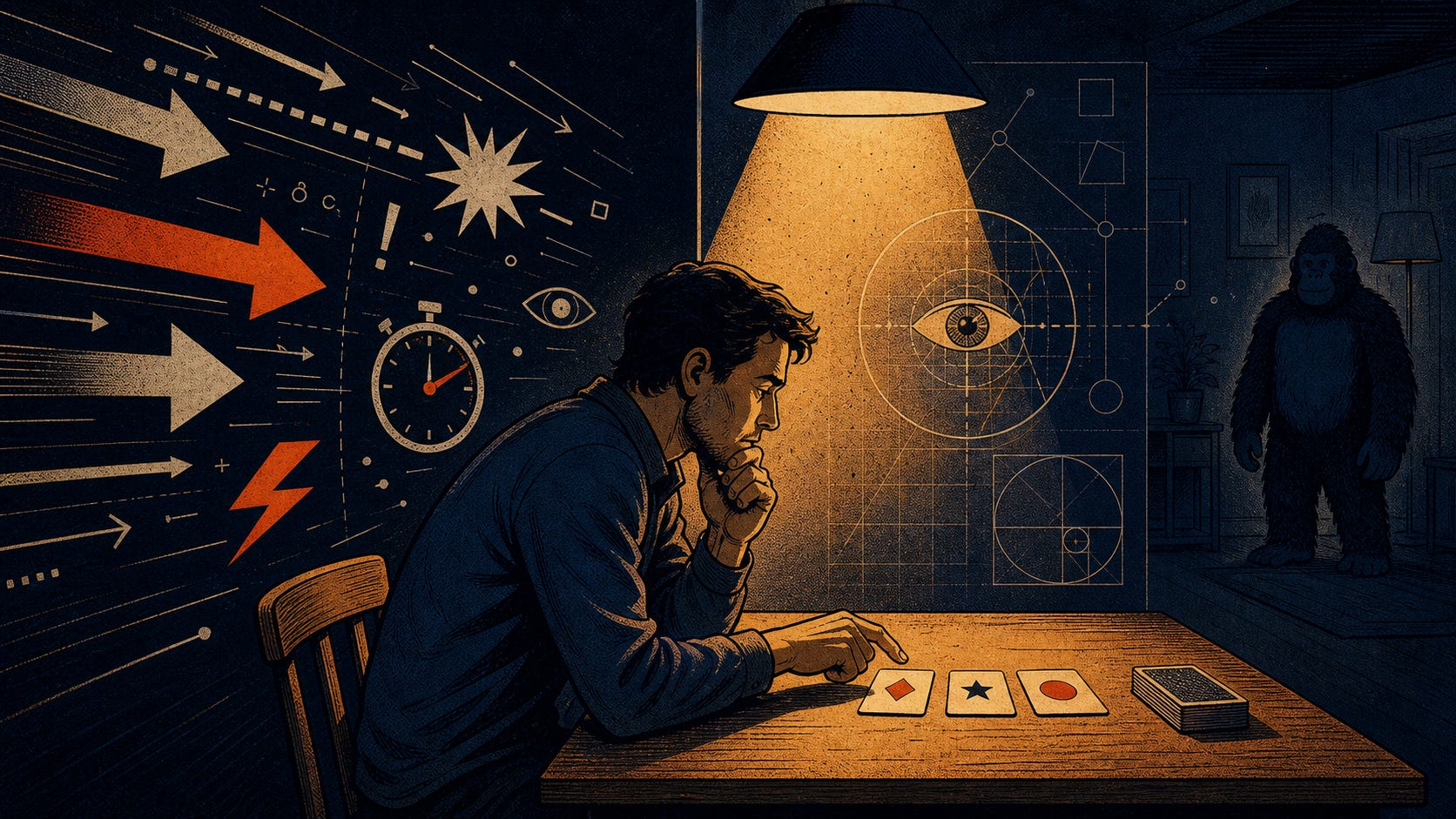
The term for this is inattentional blindness, and it’s not a glitch. It’s a feature. Your attention system doesn’t just prioritize certain things; it actively excludes everything else. What falls outside the beam doesn’t get dimmed. It gets deleted. For all practical purposes, it never happened.
And it gets stranger. In 1998, Simons ran another experiment on a college campus. A researcher posing as a lost tourist stopped a pedestrian and asked for directions. While they were talking, two people carrying a large wooden door walked between them, blocking the view for a moment. During that interruption, the researcher swapped places with one of the door carriers. A completely different person was now standing there asking for directions.
Fewer than half of the pedestrians noticed they were suddenly talking to someone else.
This is called change blindness. Things changing right in front of you that you don’t catch because your attention was occupied with something else, in this case, the content of the conversation rather than the face of the person having it.
Here’s a version that might unsettle you more. In 2013, researchers inserted a gorilla image into lung CT scans, a gorilla forty-eight times larger than the nodules radiologists were trained to spot. These were expert diagnosticians, people whose entire career depends on noticing things in medical images. The majority of them missed it. Eye-tracking data showed that most of them looked directly at the gorilla’s location. Their eyes passed over it. Their brains threw it away.
Remember the magician from the first essay? This is the entire toolkit. If attention is a spotlight, everything outside the beam is dark. The magician doesn’t need to make things invisible. They just need to control where you point the light.
But the implications go well beyond card tricks. Because if you’re blind to a gorilla thumping its chest in the middle of a video you’re watching, what else are you missing? Right now? Today?
The honest answer is: more than you want to know.
Meditations on Alignment is a reader-supported publication. To receive new posts and support my work, consider becoming a free or paid subscriber.