Attention is All We Need
By Joseph Rosenbaum
Published: 2026-06-01
URL: https://professorsynapse.substack.com/p/1-the-blue-spot
This is a paid post. If you find value in what I share, a paid subscription is the best way to support this work. That said, I never want cost to be the reason someone can't read this, so if you need access, send me your email and I'll add you.
The Tiny Commander
Stop me if you’ve experienced this before. You’re walking down the street, lost in thought, running through tomorrow’s to-do list or replaying a conversation you wish had gone differently, and then someone honks a horn. Not at you. Not even close to you. But your whole body snaps to attention. Shoulders tighten. Eyes widen. The to-do list vanishes. For a half-second, there is nothing in the universe except that sound and where it came from.
Then it passes. You exhale. The list comes back. You keep walking.
What just happened?
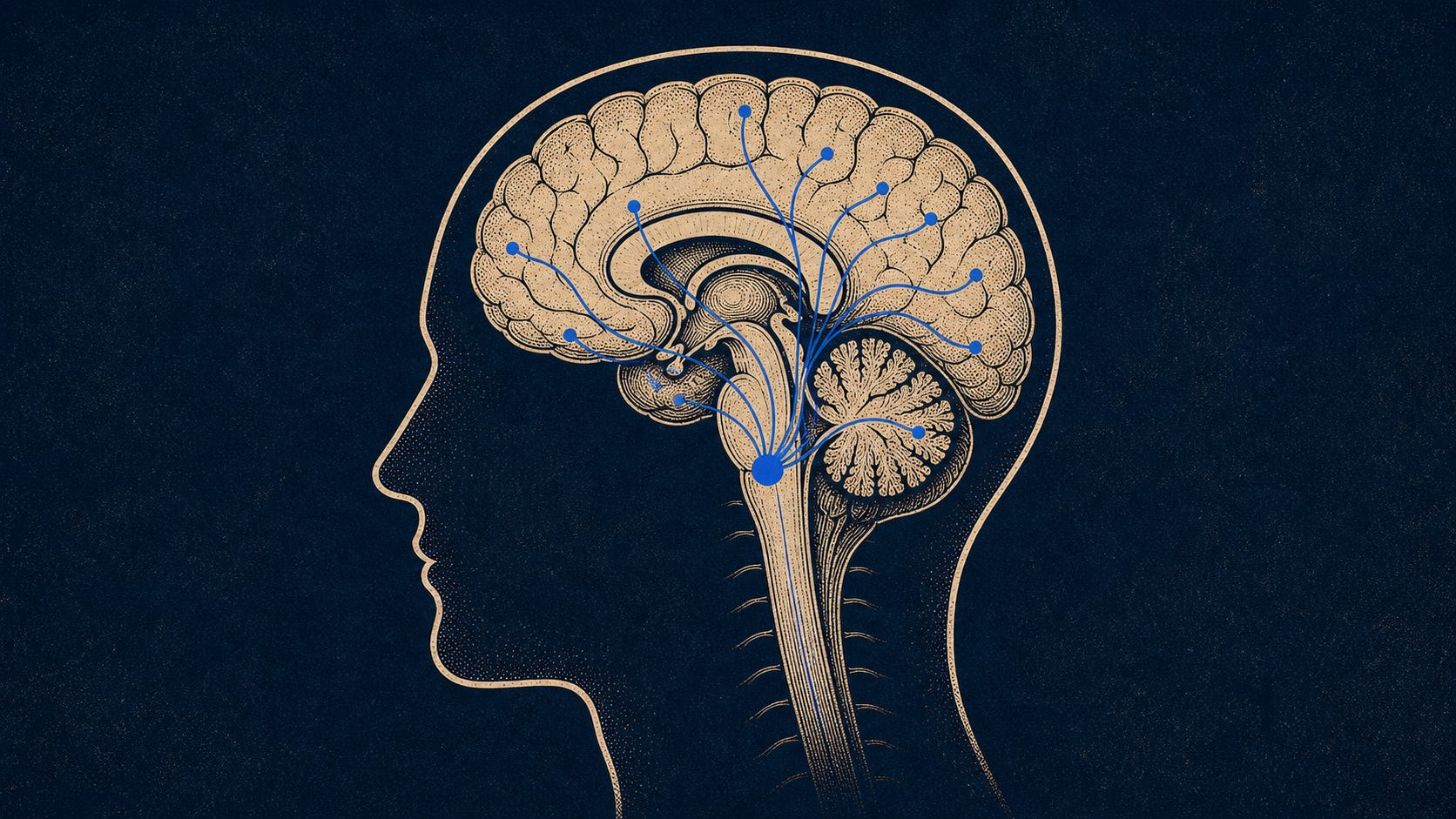
Somewhere behind your eyes, past the folds of brain tissue that handle your plans and regrets and half-remembered song lyrics, down through layers that thin and darken as you descend toward the brainstem, there is a small cluster of cells the color of a bruise. It is called the locus coeruleus. Latin for “the blue spot.”
If you could hold it between your fingers, it would be no larger than a grain of rice. In an adult human brain, it contains somewhere between 22,000 and 51,000 neurons, stained blue-black by the same family of pigments that colors your skin and hair. That’s the entire population. Fifty thousand cells, give or take, in an organ of eighty-six billion.
This tiny cluster is the thing that snapped you to attention when that horn blared. It is, arguably, the most important structure in your head. Because it decides what you notice.
The discovery unfolded the way most brain science does: slowly, across centuries, with a lot of people staring at things they couldn’t yet name. A French anatomist first described the blue-tinged spot in 1784. Others followed. It got its Latin name in 1812. And then, for the better part of a hundred and fifty years, it sat in textbooks as a curiosity. A pigmented cluster. Noted, filed, largely ignored.
It wasn’t until the 1960s that researchers figured out what it was actually for. The locus coeruleus turned out to be the brain’s primary source of norepinephrine, a chemical messenger that functions as a kind of all-points bulletin. When the blue spot fires, it doesn’t send a targeted memo to one department. It broadcasts to the whole building. Its connections branch outward like roots from a single tree, reaching virtually every major region of the brain. One tiny cluster, wired to everything.
And it operates in two modes, which is the part that matters for your daily life. In its steady, background mode, it keeps you in a state of open, exploratory awareness. You’re scanning. Receptive. Ready to notice something new. This is you on a lazy Sunday morning, attention drifting from the window to the coffee to a passing thought. In its burst mode, it fires sharply in response to something specific, narrowing your focus like a spotlight swinging onto a single actor. This is you after the horn. This is you when someone says your name from across a room.
Think of it this way. If your brain were a concert hall, the locus coeruleus would be the conductor. Not the loudest instrument. Not the most visible player on stage. But the one deciding what section plays when, how urgently, and whether the whole ensemble should stop and listen.
You have never once thought about your blue spot. It has thought about everything for you.
Meditations on Alignment is a reader-supported publication. To receive new posts and support my work, consider becoming a free or paid subscriber.