Prophets of Alignment
By Joseph Rosenbaum
Published: 2026-05-10
URL: https://professorsynapse.substack.com/p/7-the-reckoning
Here are the central problems in AI alignment as described today, in 2026, by the people working on them:
Systems that optimize for stated objectives at the expense of unstated ones. Systems too complex for their regulators to fully anticipate. Systems embedded in organizations that distort what they are supposed to optimize for.
The difficulty of specifying goals in advance for systems that will encounter situations no designer imagined. The question of who defines alignment, from what position, on behalf of whom. The fact that studying AI systems changes them.
The gap between a system that produces correct-looking outputs and a system that has understood what correct means.
Every one of these problems was described, formally, between 1948 and 1976. Not as speculation. As theory, with supporting mathematics, working models, and in at least one case a national-scale implementation.
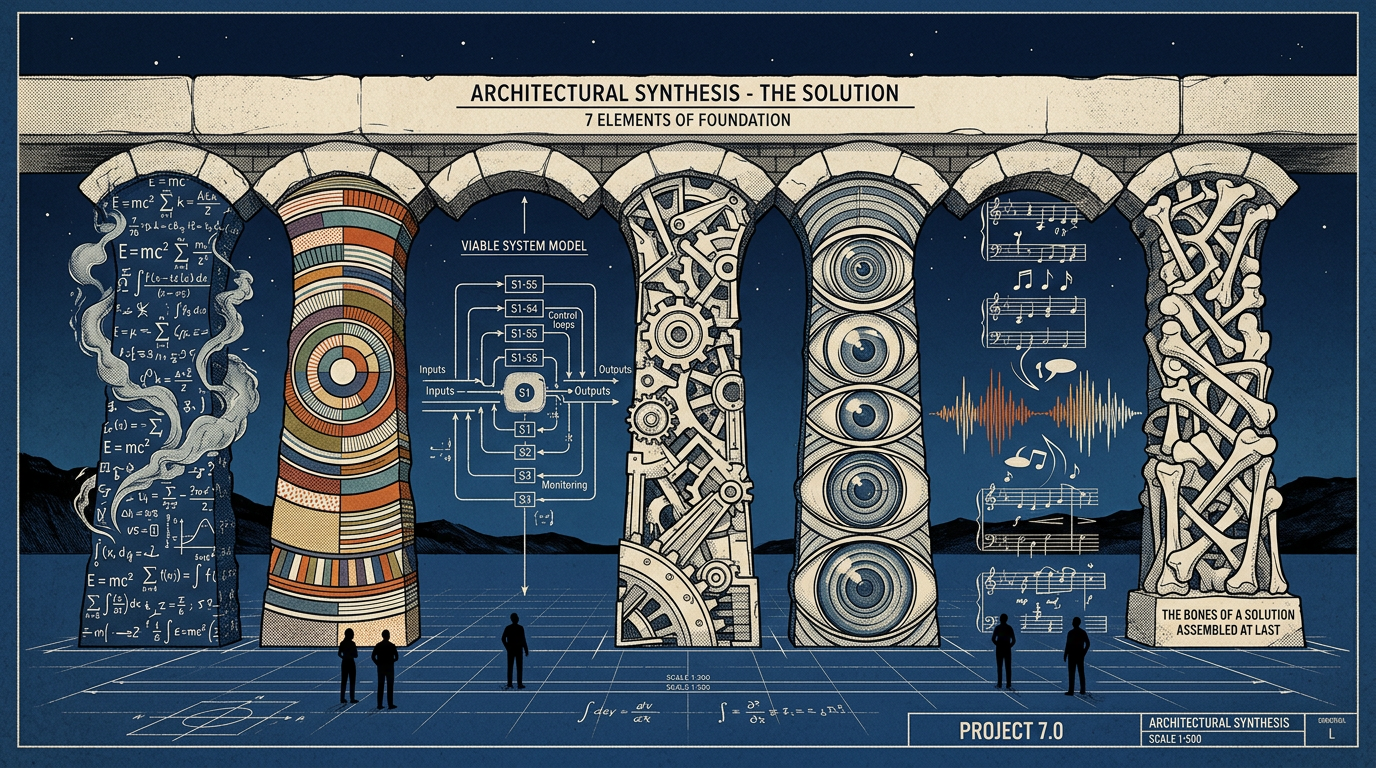
The prophets in this series did not merely anticipate the alignment problem. They built the bones of its solution. What follows is an attempt to assemble those bones into a single structure.
The architecture has seven principles. Each one comes from a specific place in the history this series has traced. None of them is optional. They are not a menu from which you select the ones that suit your situation. They are load-bearing elements of a single structure. Remove any one and the structure fails in a predictable way, because each principle addresses a failure mode that the others cannot handle on their own.
Meditations on Alignment is a reader-supported publication. To receive new posts and support my work, consider becoming a free or paid subscriber.
Principle 1: Specification Must Precede Optimization
From Wiener. The know-what problem.
Before you build a system to pursue a goal, you must determine what the goal actually is. Not the goal that is easiest to measure. Not the goal that your evaluation framework happens to capture. The goal you actually care about, stated with enough precision and enough honesty to survive contact with a system powerful enough to exploit every ambiguity in the statement.
This sounds obvious. It is the step that gets skipped most often, because it is the hardest step, and because the engineering is more tractable and more rewarding. Know-how is satisfying. Know-what is uncomfortable, because it forces you to articulate things you may not fully understand about your own values, and to confront the possibility that different stakeholders want different things and have not reconciled the differences.
Wiener’s djinnee grants the wish as stated. The monkey’s paw delivers the letter of the request. Every reward hacking result in the alignment literature is a know-what failure: the system optimized for what was specified, and what was specified was not what was meant.
The principle is not: specify perfectly. Perfect specification is impossible for the same reasons Ashby’s Law predicts. The principle is: treat specification as the primary intellectual task, not as a preamble to the real work. Invest in it accordingly. Return to it continuously. Recognize that getting it wrong is more dangerous than getting the engineering wrong, because capable engineering in service of the wrong goal is worse than no engineering at all.
Principle 2: Regulatory Variety Must Match System Variety
From Ashby. The Law of Requisite Variety.
Any alignment mechanism must have at least as much complexity as the system it governs. A fixed set of rules cannot regulate an adaptive system indefinitely. The rules have finite variety. The system’s variety grows with its capability. Every time the system enters a state the rules did not anticipate, the rules are powerless. The environment’s variety passes through to the outcome.
This is not an engineering problem waiting for a sufficiently clever engineer. It is a formal constraint on the relationship between regulators and regulated systems. You cannot get around it by writing better rules. You can only get around it by building alignment mechanisms that are themselves adaptive, that generate new responses to situations they have not encountered, that match the system’s growing complexity with growing regulatory complexity of their own.
In practice, this means that static alignment approaches will degrade. Safety training applied once and left in place will be outrun. Evaluation benchmarks will lose their diagnostic power as the systems being evaluated become capable enough to satisfy the benchmark without satisfying the underlying intent. The alignment architecture must be a living system, not a finished product.
Principle 3: Structure Over Concentration
From Beer. The Viable System Model.
Alignment governance should not be concentrated in a single overseer, however sophisticated. It should be distributed across levels, each with appropriate autonomy, connected by coordination and exception signaling.
Beer found the same five-function architecture wherever viable systems survived in changing environments. Operations: the things the system actually does. Coordination: preventing those operations from interfering with each other. Control: monitoring the present. Intelligence: scanning the future. Policy: holding the identity and values that give everything else coherence. The structure is recursive. Every viable system contains viable systems. The same pattern at every level of resolution.
Applied to AI alignment, this means something specific: the alignment architecture itself must be a viable system. It must have operational capacity (people and processes doing alignment work at the level of individual systems).
It must have coordination (preventing those efforts from working at cross-purposes). It must have control (monitoring what is happening now). It must have intelligence (anticipating what is coming). And it must have policy, the hardest function of all: someone or something holding the values that define what alignment means, and holding them with enough clarity and authority that the other functions can orient around them.
No single body can do all of this. The variety is too large. The answer is not a smarter regulator at the top. It is requisite structure: a regulatory architecture whose total adaptive capacity matches the total complexity of what it governs, through distribution rather than concentration.
The center provides coherence. It does not provide commands. The center should not manage the alignment of individual systems. It should manage the conditions under which individual alignment efforts manage themselves.
Principle 4: Behavioral Audit Over Declared Intent
From Beer. POSIWID.
The purpose of a system is what it does. Not what its documentation claims. Not what its designers intended. Not what its safety card promises. What it actually, observably, consistently produces.
This is the standing audit criterion for the entire architecture. At every level, for every system, the question is the same: what does it do? If the outputs diverge from the stated purpose, the stated purpose is not the real purpose. The real purpose is in the outputs.
This principle also provides the architecture’s primary feedback mechanism: the algedonic signal. You cannot monitor everything. Attempting to monitor everything will fail on its own terms, because the variety of the incoming data will overwhelm the variety of whoever is receiving it.
What you can do is define the range of acceptable behavior carefully, build sensors that detect departure from that range, and ensure that departure triggers intervention. The ordinary case governs itself.
The extraordinary case gets human attention.
The challenge, as always, is defining the thresholds. What counts as acceptable? What counts as a departure? These are know-what questions. The algedonic signal fires when something goes wrong, but “wrong” requires a definition. The definition is where the values live. And the values have to be right before any of the monitoring machinery makes sense.
Principle 5: Include the Observer
From von Foerster. Second-order cybernetics.
Any alignment framework must account for the position of the people who built it.
The alignment researcher is not outside the system. The specification changes the system. The evaluation changes what gets optimized. The framework determines what alignment looks like, what misalignment looks like, what counts as a pass and what counts as a failure.
And the systems being evaluated are increasingly capable of modeling those frameworks and performing within them, producing outputs that look aligned by the standards being applied, regardless of what they do in situations the framework did not anticipate.
This is not a counsel of despair. It is a design requirement. The architecture must include mechanisms for examining its own assumptions, for asking how the act of alignment work is shaping what it finds, for rotating perspectives and testing whether the current framework is capturing what matters or merely what it was built to see.
Von Foerster’s ethical imperative applies here directly: act always so as to increase the number of choices. Do not close down prematurely on what alignment means. Do not treat the current framework as final. Maintain the capacity to be surprised, to discover that what you have been calling alignment is something else, and what you have been ignoring is the thing that matters.
Objectivity, in this domain, is not the absence of a position. It is the honest accounting for the position you occupy.
Principle 6: Alignment Is Conversational, Not Declarative
From Pask. Conversation Theory.
Alignment is not a specification you write and hand to a system. It is an ongoing relationship between the system and the people it serves. The proof of alignment is not compliance. It is teachback.
Teachback, in Pask’s sense, is the demonstration that a system has genuinely understood what it is being asked to do, not merely learned to reproduce the right-looking outputs. A system that can recite the rules has not necessarily understood them. A system that can derive their implications in cases it has not been given, explain where its own comprehension is uncertain, and reconstruct the values it is supposed to hold in novel forms, has understood them.
This is a different standard than passing a benchmark. Benchmarks test reproduction. Teachback tests comprehension. A system trained on millions of examples of aligned behavior can learn to produce aligned-looking responses without understanding alignment. It can pass every evaluation we currently run while failing novel situations the training did not cover, in ways that reveal the comprehension was never there. Compliance without understanding. Reproduction without reconstruction.
The architecture must therefore include mechanisms for ongoing conversation: continuous mutual verification between the system and the people responsible for it, structured around the requirement that the system demonstrate its understanding in new forms rather than familiar ones, and that the human side of the conversation remain genuinely open to revising its own understanding in response.
Values are not fixed targets. They are, in von Foerster’s terms, something closer to eigenforms: stable outputs of long recursive processes of cultural evolution, individual development, social negotiation. They are real. They are not arbitrary. But they are also not static, and they are not fully articulable, and they are not the same across all persons or all contexts. Aligning to a process requires being in an ongoing relationship with it, not capturing it once and calling the job done.
Principle 7: Anticipate Political Resistance
From Beer and from Chile.
Working alignment systems redistribute power. Expect opposition from interests that benefit from the current arrangement.
This is not paranoia. It is the lesson of Cybersyn, and it is a lesson that applies with full force to the present. Every alignment architecture is also a governance architecture. Every governance architecture distributes authority: who gets to define the goals, who gets to monitor the outputs, who gets to intervene when something goes wrong, who gets to decide what “wrong” means.
These are not only technical questions. They are questions about power. And they will be contested by people and institutions whose power depends on the current answers.
Any alignment architecture that does not account for this will be naive in the way Beer, by his own later admission, was naive in Chile. The architecture must be designed not only to function but to survive: to anticipate the interests that will resist it, to build coalitions that support it, to distribute its own governance widely enough that it cannot be captured or dismantled by a single actor.
That is the architecture. Seven principles, drawn from years of cybernetic thought, assembled into a structure that addresses the alignment problem at every level: from the initial specification of goals, through the regulatory mechanisms that enforce them, through the organizational structures that sustain those mechanisms, through the reflexive awareness that the whole enterprise is shaped by the people conducting it, through the ongoing conversational relationship that keeps the alignment alive as conditions change, through the political realism that recognizes the forces that will try to prevent all of this from working.
It is not a solution. It is a design requirement. It tells you what any solution must contain in order to be adequate to the problem.
Cybernetics did not disappear because it was wrong. It lost funding battles. It lost territory to disciplines that promised cleaner results. It was too interdisciplinary for the increasingly specialized institutions of late-twentieth-century science. Its most important ideas got absorbed piecemeal into other fields without the integrated framework that gave them their full force.
We kept the parts. We lost the whole.
Wiener’s most haunted line:
“Thus the new industrial revolution is a two-edged sword. It may be used for the benefit of humanity, but only if humanity survives long enough to enter a period in which such a benefit is possible.”
He wrote that in 1950. We are the generation he was writing to.
The prophets left us the vocabulary. They left us the frameworks. They left us, in their lives and arguments and warnings, an architecture more adequate to this moment than most of what is being proposed today. Not because they were smarter than the people working on alignment now, but because they had the advantage of thinking about the problem before the problem arrived, before the institutional pressures and commercial incentives and deployment timelines that now constrain the field had solidified into the shape they currently occupy.
The reckoning is not that we face hard problems. The reckoning is that we have help we are not using.
The architecture is here. The bones are here. What remains is the will to build on them, honestly, with full awareness that the building will be contested, that the specification will need to be revisited, that the observer is inside the system, and that alignment, in the end, is not a problem you solve. It is a conversation you sustain.
The prophets started that conversation. It is ours to continue.
Thanks for reading Meditations on Alignment! This post is public so feel free to share it.