Prophets of Alignment
By Joseph Rosenbaum
Published: 2026-05-03
URL: https://professorsynapse.substack.com/p/6-learning-is-a-conversation
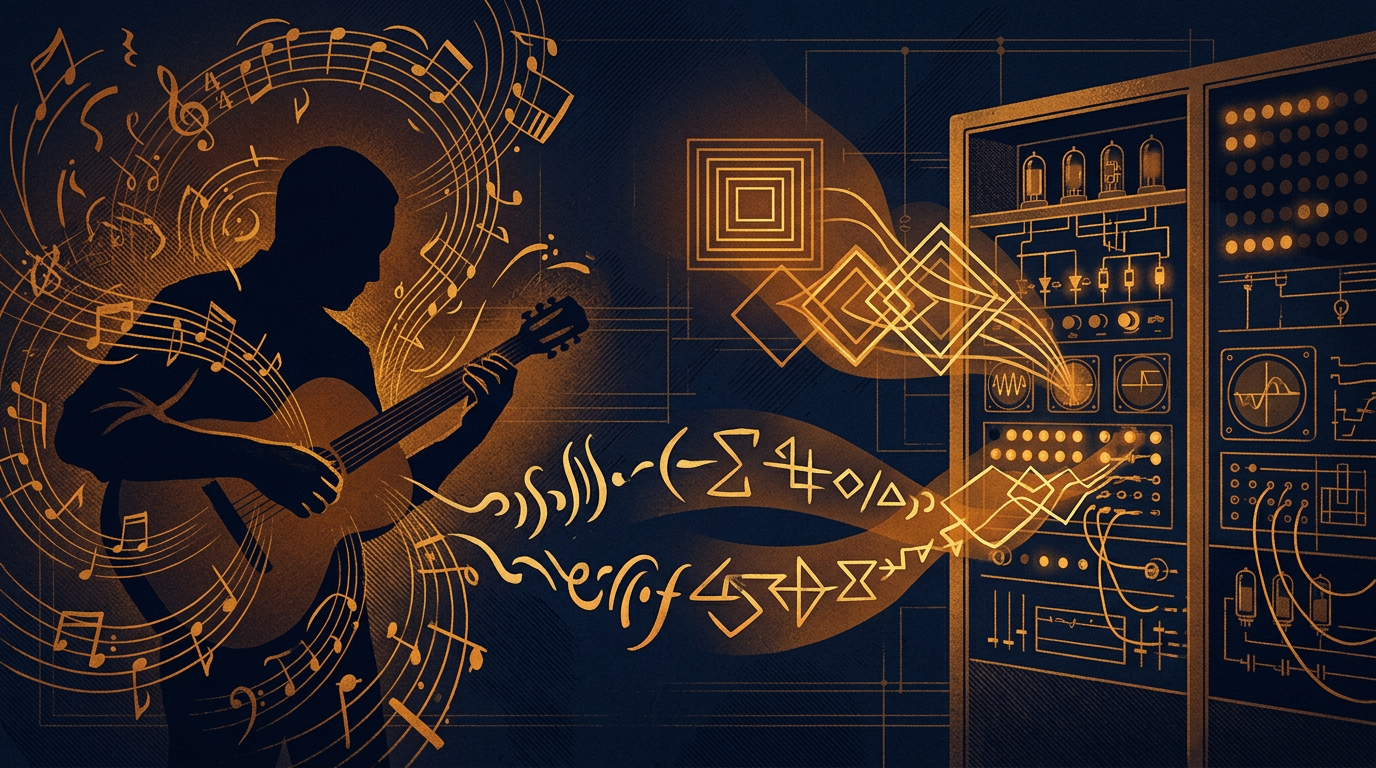
In 1953, a twenty-five-year-old named Gordon Pask built a machine that got bored.
He called it Musicolour. It was a cabinet of electronics connected to a bank of colored lights, and its job was to respond to music. A performer would play — improvise, really — and Musicolour would respond with light displays that evolved with the music, creating a kind of visual counterpoint to whatever was being played.
The machine had no taste in the conventional sense. It had something more interesting: a criterion for novelty. It tracked the patterns in what it was receiving and assessed, continuously, whether the incoming signal was still doing something new.
When the musician was exploring, varying, developing — the lights were rich. When the musician fell into repetition, playing the same phrases out of habit or tiredness or creative exhaustion, Musicolour’s response dimmed. The colors flattened. The visual feedback that had been responding withdrew into blankness.
The machine was, in effect, withholding its engagement. It was signaling: I have seen this before. You are not bringing me anything new. I am waiting for you to surprise me.
Gordon Pask built a machine with aesthetic standards in 1953. Twenty years before the first chatbot. Forty years before the web. Sixty years before anyone used the phrase “generative AI.”
He was not trying to make art. He was trying to answer a question that would occupy him for the rest of his life: what does it mean for a system — any system, machine or human — to genuinely understand something? And how would you know if it did?
Meditations on Alignment is a reader-supported publication. To receive new posts and support my work, consider becoming a free or paid subscriber.
Andrew Gordon Speedie Pask was born in Derbyshire in 1928 and died in London in 1996, and in between he received three doctoral degrees, published over two hundred and fifty papers, built adaptive teaching machines in the 1950s, influenced the design philosophy of the Open University, collaborated with Stafford Beer, corresponded with Ted Nelson and Nicholas Negroponte, and developed a formal theory of learning that remains, depending on who you ask, either the most important contribution to educational cybernetics ever made or the most impenetrably written one.
Both assessments are accurate. Pask was a magnificent eccentric — theatrical, nocturnal, given to elaborate metaphor and sudden digressions into chemical analogies for conceptual processes. His writing was dense in ways that resisted skimming but rewarded patience. People who worked closely with him described a mind that operated in several registers simultaneously, generating connections faster than any single conversation could follow.
What drove all of it, underneath the complexity, was a deceptively simple conviction: that understanding is not a thing you have. It is a thing that happens between you and someone else.
By 1976 Pask had formalized this conviction into Conversation Theory, published in a book that begins with the epigraph “a person is a concept” and proceeds from there into territory that most educational psychologists of the time found bewildering.
The core claim is clean enough: learning occurs through conversations about a subject matter that make knowledge explicit. Not through transmission. Not through exposure. Through conversation — a specific kind of interaction in which two participants take turns as teacher and student, each attempting to construct and demonstrate their understanding of a topic to the other.
Understanding, for Pask, was never private. It was always demonstrated. The test of whether you had understood something was whether you could explain it back, in a form that proved you had actually grasped it rather than merely memorized it. He called this teachback.
Teachback is not recitation. Recitation is reproduction — you play back what was given to you. Teachback is reconstruction — you take what you have learned and produce it again from the inside, in a form that is new enough to show that you understand the structure of the thing and not just its surface. A student who can recite a formula has not necessarily understood it. A student who can derive it, apply it to a problem they have not seen before, and explain why it works has understood it.
The difference matters enormously, and it maps almost perfectly onto a problem that everyone working on AI alignment has encountered but rarely named in quite these terms: the difference between a system that has learned to produce correct-looking outputs and a system that has understood what correct means.
A language model trained on millions of examples of aligned behavior can learn to produce aligned-looking responses without understanding alignment in Pask’s sense. It can pass every evaluation we currently run while failing in novel situations the training didn’t cover, in ways that reveal the comprehension was never there. Compliance without understanding. Reproduction without reconstruction.
Teachback is the test that distinguishes them. Can the system explain, in a novel form, what it is doing and why? Can it reconstruct the values it is supposed to hold, derive their implications in cases it hasn’t been given, and articulate where its own comprehension is uncertain or incomplete?
That is a very different standard than passing a benchmark. It is the standard Pask was proposing in 1976.
Conversation Theory operates on the assumption that both participants in a conversation are changed by it. This is not a soft observation about the enriching nature of dialogue. It is a technical claim about how understanding is structured.
When two people are genuinely in conversation about a subject — not one transmitting to the other, but both engaging with the topic and with each other’s understanding of it — something emerges that neither possessed beforehand. The conversation constructs a shared conceptual space. Each participant builds their understanding in relation to the other’s, revising, extending, connecting. The product of the conversation is not simply the sum of what each brought to it.
“The fundamental unit for investigating complex human learning is a conversation involving communication between two participants in the learning process, who commonly occupy the roles of learner and teacher.”
And:
“Within conversation theory learning develops through agreements between the participants which subsequently lead to understanding by the learner.”
Agreement, in Pask’s technical sense, is not merely consensus. It is the establishment of shared referents — the construction of a space in which both participants can point to the same thing and know they are pointing to the same thing.
This is harder than it sounds and more important than it appears. Most apparent agreements are not agreements in this sense. They are people using the same words while pointing at different things, a discrepancy that becomes visible only when the situation changes enough to require something more than surface compatibility.
This matters for alignment because most of what currently passes for alignment specification is agreement in the shallow sense. We write guidelines, train models on examples, run evaluations, and declare success when the outputs match our expectations. But if the model’s internal representation of what we want diverges from ours in ways that the evaluation didn’t probe, the agreement is illusory. The divergence will appear in situations the evaluation didn’t cover.
Pask’s prescription: keep the conversation going. Run the teachback. Require the system to demonstrate understanding in new forms, not just familiar ones. Treat alignment as an ongoing process of mutual verification rather than a one-time specification.
He had also thought carefully about how people differ in the way they learn, and the implications were uncomfortable for anyone who believed in universal solutions.
From his experimental work — decades of running learners through carefully constructed knowledge domains and tracking how they navigated them — Pask identified two characteristic strategies. Serialists move through a knowledge domain step by step, building understanding sequentially, securing each connection before reaching for the next. Holists build the overview first, grasping the structural relationships before filling in the details. Neither strategy is superior.
Each has a characteristic failure mode. Serialists risk knowing all the steps without understanding why the steps lead where they do. Holists risk broad claims without the substance to support them.
The versatile learner can do both — can move between the detailed and the structural as the domain requires. But most people, under pressure or working with unfamiliar material, default to one or the other. And a teaching system that is optimized for one type of learner will fail the other, regardless of how good it is for the type it serves.
This is, in miniature, the problem with universal alignment specifications. Human values are not uniformly distributed. What counts as a satisfactory explanation, a respectful response, an appropriate level of caution or directness — these vary across people and contexts in ways that no single specification can fully capture.
A system aligned to a population average is misaligned to much of the population. The conversation that alignment requires is not one conversation with one interlocutor. It is many conversations with many different people, each one requiring its own calibration.
Pask had no solution to this. He named it clearly, which is not nothing.
Musicolour was not Pask’s only machine. Through the 1950s he built a series of adaptive teaching devices — SAKI, which trained keyboard operators by adjusting difficulty in real time based on performance; CASTE and BOSS, which structured educational content as navigable knowledge networks.
These were not prototypes waiting for better hardware. They were working implementations of Conversation Theory, built on the components available at the time, demonstrating that the principles of adaptive dialogue between a system and a learner could be instantiated in electronics.
When people talk about personalized learning technology today, about adaptive systems that adjust to individual students, about AI tutors that respond to where each learner is rather than where the curriculum says they should be — they are describing ideas that Pask had built, in working form, in the 1950s. They are mostly unaware of this.
The ideas survived. The attribution did not. The purpose of a system is what it does. The ideas do their work regardless of whether their origin is acknowledged.
Pask comes last in this series for a reason.
He is not simply the sixth prophet in a sequence. He is the prophet who, consciously or not, synthesizes all the others.
Wiener asked: what do we actually want? The know-what question — the gap between specified goals and actual goals, the djinnee who grants the wish as stated. Pask’s answer: you cannot fully specify what you want in advance. You have to discover it through conversation, through the process of trying to make it explicit to someone else and finding out what you actually meant.
Ashby showed: the regulator must match the regulated in variety. A fixed specification cannot govern an adaptive system. Pask’s answer: the regulator must be in conversation with the regulated. A system in ongoing dialogue with its environment has, by definition, the variety it needs to respond, because it generates new responses through the interaction rather than drawing from a predetermined set.
Beer insisted: the purpose of a system is what it does. Not what it claims. What it produces. Pask’s answer: the test of a system’s purpose is teachback. Ask the system to demonstrate, in a novel form, what it understands itself to be doing. If the demonstration reveals comprehension, the alignment is real. If it reveals reproduction without comprehension, the appearance of alignment is exactly that — appearance.
Von Foerster placed the observer inside the system and showed that description is always intervention, that there is no view from nowhere, that the act of specifying changes what is specified. Pask’s answer: this is not a problem to be solved but a feature to be used. The conversation between the observer and the observed is itself the mechanism of alignment. You do not specify from outside. You participate from inside.
The whole series points here. Alignment is not a specification problem. It is a conversation problem. The solution is not to write better rules but to build better relationships — ongoing, revisable, honest about what is understood and what is not, structured around the continuous demonstration of comprehension rather than the one-time assertion of compliance.
Gordon Pask died in 1996 leaving a small number of students who understood what he had been trying to say and have spent the years since trying to translate it into forms the rest of the world could hear.
He left behind Musicolour, which got bored when the music stopped being interesting.
He left behind the concept of teachback, which is the cleanest possible statement of what genuine understanding looks like and how you test for it.
And he left behind a question that this series has been building toward from the first page:
If alignment requires ongoing conversation rather than one-time specification — if the proof of alignment is not compliance but teachback, not outputs that look right but demonstrated comprehension of why they are right — who is having that conversation? With which systems? How often? With what authority to act on what they find?
These are not rhetorical questions. They are open ones. The prophets gave us the framework. The framework tells us what we need to build. What we have built instead is a collection of benchmarks, a set of guidelines, and a great deal of confidence that the outputs look right.
The outputs looking right is not the same as the system understanding what right means.
Pask would have said: run the teachback. Find out what is actually there.