By Tiger Capital Research
Published: 2026-08-02
URL: https://princetonchen.substack.com/p/clarity-act-delay-lowers-year-end
Daily Market Read I | Category: Crypto & Regulation | Date: August 1, 2026
Tiger Capital Research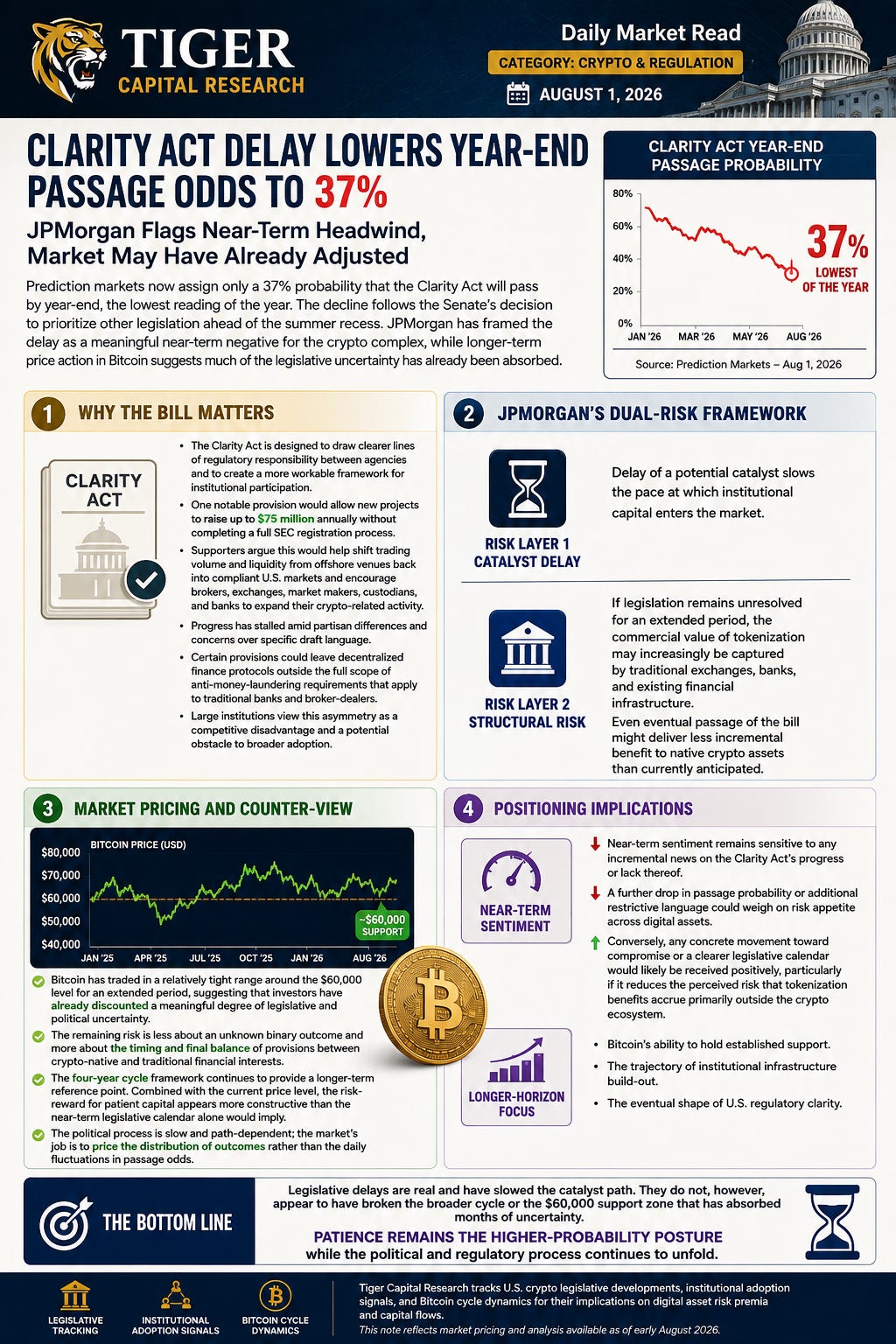
Headwind, Market May Have Already Adjusted
Prediction markets now assign only a 37% probability that the Clarity Act will pass by year-end, the lowest reading of the year. The decline follows the Senate’s decision to prioritize other legislation ahead of the summer recess. JPMorgan has framed the delay as a meaningful near-term negative for the crypto complex, while longer-term price action in Bitcoin suggests much of the legislative uncertainty has already been absorbed.
Why the Bill Matters
The Clarity Act is designed to draw clearer lines of regulatory responsibility between agencies and to create a more workable framework for institutional participation. One notable provision would allow new projects to raise up to $75 million annually without completing a full SEC registration process. Supporters argue this would help shift trading volume and liquidity from offshore venues back into compliant U.S. markets and encourage brokers, exchanges, market makers, custodians, and banks to expand their crypto-related activity.
Progress has stalled amid partisan differences and concerns over specific draft language. In particular, certain provisions could leave decentralized finance protocols outside the full scope of anti-money-laundering requirements that apply to traditional banks and broker-dealers. Large institutions view this asymmetry as a competitive disadvantage and a potential obstacle to broader adoption.
JPMorgan’s Dual-Risk Framework
JPMorgan outlines two layers of risk. The first is straightforward: delay of a potential catalyst slows the pace at which institutional capital enters the market. The second is more structural. If legislation remains unresolved for an extended period, the commercial value of tokenization may increasingly be captured by traditional exchanges, banks, and existing financial infrastructure. In that scenario, even eventual passage of the bill might deliver less incremental benefit to native crypto assets than currently anticipated.
Market Pricing and Counter-View
Bitcoin has traded in a relatively tight range around the $60,000 level for an extended period. This stability suggests that investors have already discounted a meaningful degree of legislative and political uncertainty. From this perspective, the remaining risk is less about an unknown binary outcome and more about the timing and final balance of provisions between crypto-native and traditional financial interests.
The four-year cycle framework continues to provide a longer-term reference point. Combined with the current price level, the risk-reward for patient capital appears more constructive than the near-term legislative calendar alone would imply. The political process is slow and path-dependent; the market’s job is to price the distribution of outcomes rather than the daily fluctuations in passage odds.
Positioning Implications
Near-term sentiment remains sensitive to any incremental news on the Clarity Act’s progress or lack thereof. A further drop in passage probability or additional restrictive language could weigh on risk appetite across digital assets. Conversely, any concrete movement toward compromise or a clearer legislative calendar would likely be received positively, particularly if it reduces the perceived risk that tokenization benefits accrue primarily outside the crypto ecosystem.
For longer-horizon investors, the more relevant variables remain Bitcoin’s ability to hold established support, the trajectory of institutional infrastructure build-out, and the eventual shape of U.S. regulatory clarity. Legislative delays are real and have slowed the catalyst path. They do not, however, appear to have broken the broader cycle or the $60,000 support zone that has absorbed months of uncertainty.
Patience remains the higher-probability posture while the political and regulatory process continues to unfold.
Tiger Capital Research tracks U.S. crypto legislative developments, institutional adoption signals, and Bitcoin cycle dynamics for their implications on digital asset risk premia and capital flows. This note reflects market pricing and analysis available as of early August 2026.