By Tiger Multibagger Watchlist
Published: 2026-08-01
URL: https://princetonchen.substack.com/p/weekly-paper-review-wall-august-1st
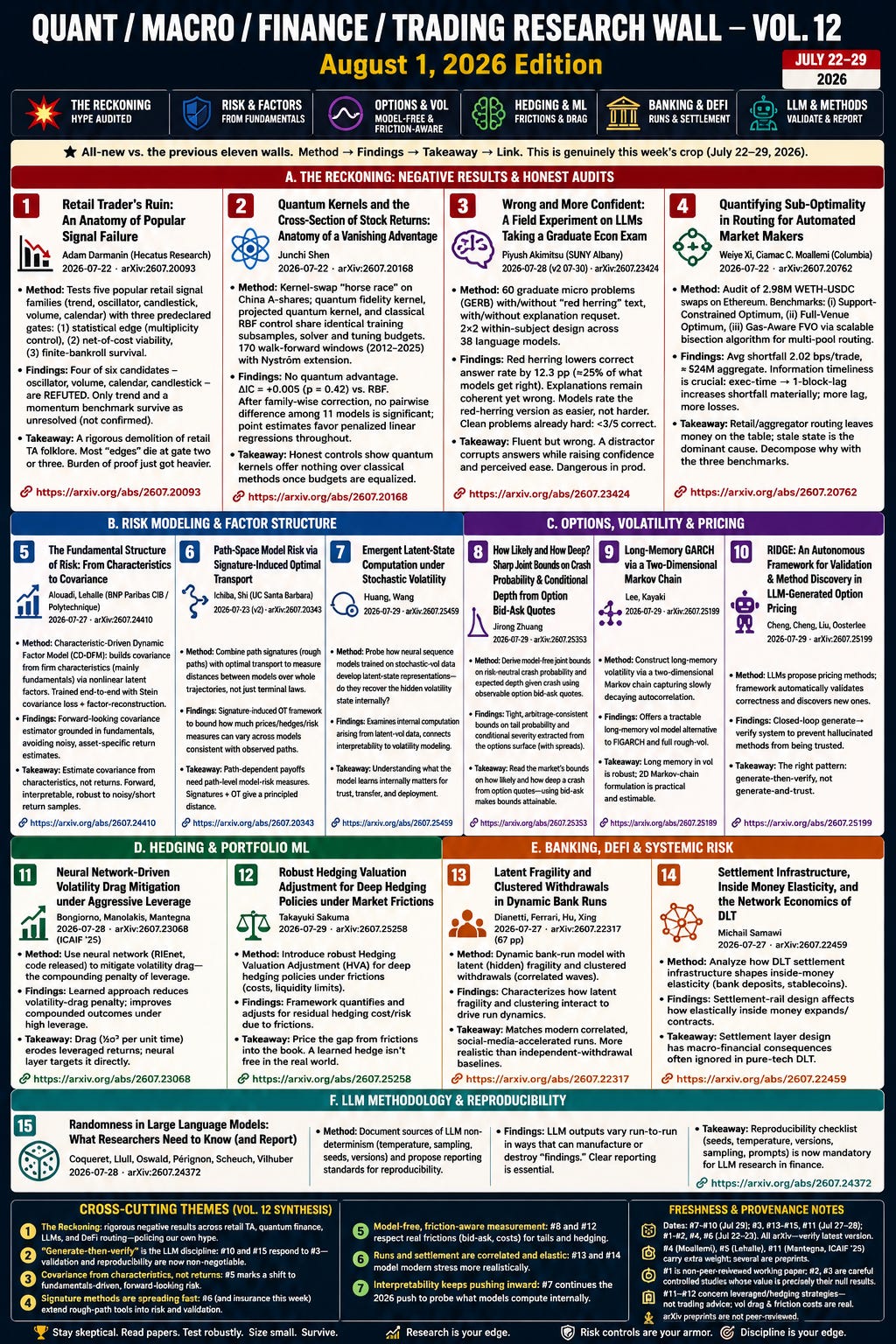
📰 Quant / Macro / Finance / Trading Research Wall — Vol. 12 (August 1, 2026 Edition)
All-new vs. the previous eleven walls. Same compressed structure: method → findings → takeaway → link. This is genuinely this week’s crop (July 22–29, 2026). The dominant theme this week is a reckoning — an unusual cluster of rigorous negative-result audits (retail signals, quantum ML, LLM reasoning, DEX routing) — plus Lehalle’s characteristic-driven risk model, signature methods spreading into risk, and fresh bank-run and options-crash theory.
🧨 SECTION A — The Reckoning: Negative Results & Honest Audits (this week’s dominant theme)
1️⃣ Retail Trader’s Ruin: An Anatomy of Popular Signal Failure
Adam Darmanin (Hecatus Research) · 2026-07-22 · arXiv:2607.20093 ⭐ (devastating retail-signal audit)
🔗 https://arxiv.org/abs/2607.20093
- Method: Tests whether five widely promoted retail signal families — trend, oscillator, candlestick, volume, and calendar rules — deliver a positive, economically meaningful, net-of-cost, survivable edge. Practical viability requires clearing three predeclared gates: statistical edge after multiplicity correction, economic viability after trading costs, and finite-bankroll survival under leverage. Uses exposure-matched benchmarks, stationary-bootstrap CIs, hierarchical Benjamini-Yekutieli control, and equivalence tests.
- Findings: Four of six candidates — oscillator, volume, calendar, and candlestick — are REFUTED, ruled out on statistical and/or economic materiality grounds. Only trend and a momentum calibration benchmark survive as unresolved (not confirmed).
- Takeaway: A rigorous, pre-registered demolition of retail trading folklore. The three-gate framework (stat significance → cost survival → bankroll survival) is the reusable contribution — most “edges” die at gate two or three. If you trade oscillators, volume, calendar, or candlestick signals, the burden of proof just got much heavier. Working paper (not yet peer-reviewed), but methodologically careful.
2️⃣ Quantum Kernels and the Cross-Section of Stock Returns: Anatomy of a Vanishing Advantage
Junchi Shen · 2026-07-22 · arXiv:2607.20168 ⭐ (quantum ML null result)
🔗 https://arxiv.org/abs/2607.20168
- Method: A controlled “horse race” on the Chinese A-share market: a quantum fidelity kernel, a projected quantum kernel, and a classical RBF control share identical training subsamples, solver, and tuning budgets — so only the kernel is swapped. Main evaluation: point-in-time universe, 170 walk-forward windows (2012–2025), with a Nyström extension to full ~38,000-observation windows.
- Findings: No quantum advantage exists. The fidelity kernel is statistically indistinguishable from its RBF control (ΔIC = +0.005, p = 0.42); quantum kernels match but never beat equal-budget linear models; after family-wise correction, no pairwise difference among eleven models is significant, with point estimates favoring penalized linear regressions throughout. The paper also shows how misleading positive results can be manufactured via data selection.
- Takeaway: A model of how to test a “quantum advantage” claim honestly — kernel-swap controls and budget-equalized comparisons. The verdict: on cross-sectional equity return prediction, quantum kernels offer nothing over classical methods once you control the training budget. Essential skepticism for the quantum-finance hype (cf. Vol. 3’s sober quantum review). Penalized linear regression remains the stubborn baseline.
3️⃣ Wrong and More Confident: A Field Experiment on Language Models Taking a Graduate Economics Exam
Piyush Akimitsu (SUNY Albany) · 2026-07-28 (v2 07-30) · arXiv:2607.23424 ⭐ (LLM reasoning fragility)
🔗 https://arxiv.org/abs/2607.23424
- Method: Introduces the Graduate Economic Reasoning Benchmark (GERB) — sixty graduate microeconomics problems, each with a verified answer and step-by-step reference solution. Each problem appears with and without a ”red herring” (an irrelevant passage), and with/without an explanation request — a within-subject 2×2 factorial design answered by 38 language models.
- Findings: The red herring lowers correct-answer probability by 12.3 percentage points (about a quarter of what models get right), while the explanation stays fully coherent and consistent with the (corrupted) reasoning. Worse, models rate the red-herring version as easier, not harder, even as they answer it wrong more often. The effect doesn’t differ between reasoning/non-reasoning or open/closed models. Clean problems are already hard — models average under 3 of every 5 correct.
- Takeaway: Critical for anyone deploying LLMs on financial/economic reasoning. An irrelevant distractor corrupts the answer while leaving a confident, coherent-looking explanation intact — and raises the model’s self-rated ease. This is the “fluent but wrong” failure mode that’s most dangerous in production. Connects to Vol. 11’s calibration-audit theme (FinBench, abliteration) — the internals lie even when the surface looks fine.
4️⃣ Quantifying Sub-Optimality in Routing for Automated Market Makers
Weiye Xi, Ciamac C. Moallemi (Columbia) · 2026-07-22 · arXiv:2607.20762 ⭐ (Moallemi, DeFi 2026)
🔗 https://arxiv.org/abs/2607.20762
- Method: Large-scale empirical audit of DEX routing using 2.98 million WETH-USDC swaps on Ethereum. Compares realized routes to optimized benchmarks, introducing three reproducible optima: a Support-Constrained Optimum (split quality given the pools actually used), a Full-Venue Optimum (value of broader pool access), and a Gas-Aware FVO (pool usage vs gas cost trade-off) — computed at scale via a bisection algorithm for optimal multi-pool routing.
- Findings: Average routing shortfall of 2.02 bps per trade, or ~$24 million aggregate. Key regularity: information timeliness is crucial — moving from execution-time state to one-block-lagged state optimization significantly raises shortfall, and further delays add more.
- Takeaway: Directly actionable for DEX traders, aggregators, and searchers. Retail/aggregator routing leaves ~2 bps on the table on average, and the dominant cause is stale state (block-lag), not pool access. The three benchmarks let you decompose why your route was suboptimal (bad split vs missing venue vs gas). From Moallemi (Paradigm/Columbia), accepted at DeFi 2026.
📐 SECTION B — Risk Modeling & Factor Structure
5️⃣ The Fundamental Structure of Risk: From Characteristics to Covariance
Alexandre Alouadi (BNP Paribas CIB / Polytechnique), Charles-Albert Lehalle (Polytechnique) · 2026-07-27 · arXiv:2607.24410 ⭐ (Lehalle — top microstructure/quant name)
🔗 https://arxiv.org/abs/2607.24410
- Method: Proposes the Characteristic-Driven Dynamic Factor Model (CD-DFM), a non-linear latent factor model that builds the asset cross-section’s covariance structure directly from observable firm characteristics (primarily fundamentals) rather than from noisy historical returns. The learned latent space jointly yields interpretable factor exposures and a forward covariance estimator, trained end-to-end on an objective combining a Stein covariance loss with a factor-reconstruction term, targeting out-of-sample second moments.
- Findings: Delivers a forward-looking covariance estimator grounded in fundamentals, sidestepping the noise and asset-specificity of return-based risk models.
- Takeaway: For risk modelers and portfolio construction: estimating covariance from characteristics rather than return history is the key move — it gives a forward estimator that doesn’t degrade on short/noisy return samples and stays interpretable. From Charles-Albert Lehalle, a leading practitioner-academic. Echoes the Kelly-Pruitt “characteristics are covariances” line but with an end-to-end non-linear, Stein-loss formulation. Directly relevant to anyone maintaining a risk model.
6️⃣ Path-Space Model Risk via Signature-Induced Optimal Transport
Tomoyuki Ichiba, Qijin Shi (UC Santa Barbara) · 2026-07-23 (v2) · arXiv:2607.20343
🔗 https://arxiv.org/abs/2607.20343
- Method: Quantifies model risk over path space by combining path signatures (rough-path theory) with optimal transport — measuring distances between models at the level of whole trajectories rather than terminal distributions.
- Findings: Develops a signature-induced OT framework to bound how much a quantity of interest (price, hedge, risk measure) can vary across models consistent with observed path behavior.
- Takeaway: For model-risk and validation teams: path-dependent payoffs need path-level model-risk measures, and signatures + OT give a principled distance. Part of a striking signatures wave this week (see #14 in insurance) — the rough-path toolkit is spreading fast from execution (Vols. 8, 11) into risk and validation.
7️⃣ Emergent Latent-State Computation under Stochastic Volatility
Xiaoyu Huang, Lulu Wang · 2026-07-29 · arXiv:2607.25459
🔗 https://arxiv.org/abs/2607.25459
- Method: Studies how neural sequence models trained on stochastic-volatility data develop emergent latent-state representations — probing whether the network internally reconstructs the hidden volatility state (cross-listed cs.LG / q-fin.ST).
- Findings: Examines the internal computation that arises when models learn from data with a latent volatility process, connecting interpretability to volatility modeling.
- Takeaway: For quant-ML researchers: understanding what a volatility-forecasting network learns internally (does it recover the latent vol state?) matters for trust and transfer. Part of the broader 2026 interpretability push — probing model internals, not just outputs (cf. Vol. 7’s SAE Bitcoin-bias audit, Vol. 11’s abliteration study).
📊 SECTION C — Options, Volatility & Pricing
8️⃣ How Likely and How Deep? Sharp Joint Bounds on Risk-Neutral Crash Probability and Conditional Depth from Option Bid-Ask Quotes
Jirong Zhuang · 2026-07-29 · arXiv:2607.25353 ⭐
🔗 https://arxiv.org/abs/2607.25353
- Method: Derives sharp (model-free) joint bounds on two crash quantities simultaneously — the risk-neutral probability of a crash (”how likely”) and the conditional expected depth given a crash (”how deep”) — using only observable option bid-ask quotes (not mid-prices, so it respects real market frictions).
- Findings: Provides tight, arbitrage-consistent bounds on tail probability and conditional severity extracted directly from the options surface, accounting for the bid-ask spread.
- Takeaway: Highly practical for tail-risk monitoring. Instead of assuming a model, you read the market’s own bounds on crash likelihood and severity straight from option quotes — and using bid-ask (not mid) means the bounds are actually attainable. Useful for risk desks and anyone pricing crash protection. Complements Vol. 6’s AI-bubble diagnostics and Vol. 8’s tail-hedging work with a model-free options-implied gauge.
9️⃣ Long-Memory GARCH via a Two-Dimensional Markov Chain
Kyungsub Lee, Kennedy Titus Kayaki · 2026-07-29 · arXiv:2607.25189
🔗 https://arxiv.org/abs/2607.25189
- Method: Constructs a GARCH model with long memory by representing volatility dynamics through a two-dimensional Markov chain — capturing the slowly-decaying autocorrelation of volatility that standard GARCH(1,1) misses, while retaining tractability.
- Findings: Delivers a long-memory volatility model via a Markov-chain construction, offering an alternative to fractionally-integrated (FIGARCH) and rough-vol approaches.
- Takeaway: For volatility forecasters: long memory in volatility is empirically robust (cf. Vol. 9’s persistence/roughness study), and a 2D Markov-chain formulation gives a tractable, estimable way to capture it. A practical modeling option where FIGARCH is awkward and full rough-vol is overkill.
🔟 RIDGE: An Autonomous Framework for Validation and Method Discovery in LLM-Generated Option Pricing
Liexin Cheng, Xue Cheng, Shuaiqiang Liu, Cornelis W. Oosterlee · 2026-07-29 · arXiv:2607.25199 ⭐
🔗 https://arxiv.org/abs/2607.25199
- Method: An autonomous framework that lets LLMs propose option-pricing methods while automatically validating their correctness and discovering new approaches — pairing LLM generation with rigorous verification (from a group including Oosterlee, a leading computational-finance name).
- Findings: Provides a closed-loop system where LLM-generated pricing methods are validated rather than trusted, addressing the hallucination risk of LLM-produced quantitative code/methods.
- Takeaway: The right pattern for LLMs in quantitative finance: generate-then-verify, not generate-and-trust. Directly on-theme with this week’s LLM-skepticism cluster (#3) — given how confidently LLMs produce wrong-but-coherent output, autonomous validation is the necessary guardrail for any LLM-driven pricing/method discovery. Complements Vol. 6’s OQL neuro-symbolic options work.
🛡️ SECTION D — Hedging & Portfolio ML
1️⃣1️⃣ Neural Network-Driven Volatility Drag Mitigation under Aggressive Leverage
Christian Bongiorno, Efstratios Manolakis, Rosario Nunzio Mantegna · 2026-07-28 · arXiv:2607.23068 ⭐ (Mantegna — econophysics pioneer; ICAIF ‘25)
🔗 https://arxiv.org/abs/2607.23068
- Method: Uses a neural network (RIEnet, code released) to mitigate volatility drag — the compounding penalty that erodes returns of leveraged positions — under aggressive leverage. Published at ICAIF ‘25 (6th ACM International Conference on AI in Finance).
- Findings: Demonstrates a learned approach to reducing the volatility-drag penalty that afflicts leveraged strategies, improving compounded outcomes under high leverage.
- Takeaway: Directly relevant for leveraged-ETF issuers, vol-targeting strategies, and anyone running leverage. Volatility drag (½σ² per unit time) is the silent killer of leveraged compounding; a neural mitigation layer targets it directly. From Rosario Mantegna (a founder of econophysics), with released code — worth benchmarking for leveraged portfolio management.
1️⃣2️⃣ Robust Hedging Valuation Adjustment for Deep Hedging Policies under Market Frictions
Takayuki Sakuma · 2026-07-29 · arXiv:2607.25258
🔗 https://arxiv.org/abs/2607.25258
- Method: Introduces a robust Hedging Valuation Adjustment (HVA) for deep hedging policies operating under market frictions (transaction costs, liquidity limits) — quantifying and adjusting for the residual hedging cost/risk that frictions impose on a learned hedging strategy.
- Findings: Provides a valuation-adjustment framework specific to neural (deep) hedging policies, making their pricing robust to friction-induced hedging imperfection.
- Takeaway: For derivatives desks deploying deep hedging: a learned hedge is only as good as its cost under real frictions, and an HVA-style adjustment is how you price that gap into the book. On-theme with this week’s #4 (Godin) deep-hedging discourse from Vol. 11 — the field is operationalizing deep hedging for production, frictions and all.
🏦 SECTION E — Banking, DeFi & Systemic Risk
1️⃣3️⃣ Latent Fragility and Clustered Withdrawals in Dynamic Bank Runs
Jodi Dianetti, Giorgio Ferrari, Yunzhi Hu, Hao Xing · 2026-07-27 · arXiv:2607.22317 ⭐
🔗 https://arxiv.org/abs/2607.22317
- Method: A dynamic model of bank runs featuring latent (hidden) fragility and clustered withdrawals — depositors withdraw in correlated waves rather than independently, and the bank’s fragility is not directly observable (cross-listed econ.TH / math finance, 67 pp).
- Findings: Characterizes how latent fragility and withdrawal clustering interact to drive run dynamics, capturing the correlated, bursty nature of real deposit flights.
- Takeaway: Timely given the 2023 regional-bank episodes and ongoing stablecoin-run concerns (cf. Vols. 4, 6, 10, 11). The “clustered withdrawals + hidden fragility” framing matches how modern (social-media-accelerated, correlated) runs actually unfold — more realistic than classic Diamond-Dybvig independent withdrawals. Relevant for bank risk, deposit-insurance design, and stablecoin-redemption modeling.
1️⃣4️⃣ Settlement Infrastructure, Inside Money Elasticity, and the Network Economics of Distributed Ledger Technology
Michail Samawi · 2026-07-27 · arXiv:2607.22459
🔗 https://arxiv.org/abs/2607.22459
- Method: Analyzes the network economics of distributed ledger technology (DLT) for settlement, focusing on inside-money elasticity — how the supply of privately-created money (bank deposits, stablecoins) responds within DLT-based settlement infrastructure.
- Findings: Examines how DLT settlement rails affect money-creation elasticity and network structure, connecting payment-system design to monetary dynamics.
- Takeaway: For anyone thinking about tokenized settlement, wholesale CBDCs, or stablecoin plumbing: the settlement layer’s design shapes how elastically inside money can expand/contract — a macro-financial consequence often ignored in pure-tech DLT discussions. Complements Vol. 10’s stablecoin-plumbing and Vol. 11’s DLT-settlement themes.
🔬 SECTION F — LLM Methodology in Finance
1️⃣5️⃣ Randomness in Large Language Models: What Researchers Need to Know (and Report)
Guillaume Coqueret, Joan Llull, Florian Oswald, Christophe Pérignon, Christoph Scheuch, Lars Vilhuber · 2026-07-28 · arXiv:2607.24372 ⭐ (reproducibility standards)
🔗 https://arxiv.org/abs/2607.24372
- Method: A methodology/standards paper (from a group including finance and reproducibility authorities like Pérignon and Vilhuber) on randomness in LLMs — temperature, sampling, seed effects, non-determinism — and what must be reported for LLM-based research to be reproducible.
- Findings: Documents the sources of LLM non-determinism and proposes reporting standards so that LLM-based empirical results can be replicated and trusted.
- Takeaway: Increasingly essential as finance research adopts LLMs (sentiment, forecasting, agents). LLM outputs vary run-to-run in ways that can manufacture or destroy “findings” — this gives the checklist (seeds, temperature, versions, sampling) for honest, reproducible LLM finance research. Pairs directly with this week’s #2 (quantum kernels showing how selection manufactures results) and #3 (LLM reasoning fragility) — a coherent reproducibility-and-skepticism through-line.
🔑 Cross-Cutting Themes (Vol. 12 Synthesis)
- This was a week of reckoning. An unusual density of rigorous negative results: retail signals mostly refuted (#1), quantum kernels show zero advantage (#2), LLMs are confidently wrong under distraction (#3), and DEX routing leaves $24M on the table (#4). The field is policing its own hype across retail TA, quantum finance, LLMs, and DeFi simultaneously.
- ”Generate-then-verify” is the emerging LLM discipline. #10 (RIDGE autonomous validation) and #15 (randomness reporting standards) both respond to #3’s lesson — LLM output is fluent but unreliable, so validation and reproducibility scaffolding are now mandatory, not optional.
- Covariance from characteristics, not returns. #5 (Lehalle’s CD-DFM) marks a shift in risk modeling toward fundamentals-driven, forward-looking covariance — sidestepping the noise that plagues return-history estimators.
- Signature methods are spreading fast. #6 (signature-OT model risk) and the signatures-in-insurance work this week extend the rough-path toolkit from execution (Vols. 8, 11) into risk, validation, and actuarial modeling — one of 2026’s most portable mathematical exports.
- Model-free, friction-aware measurement. #8 (crash bounds from bid-ask option quotes) and #12 (HVA under frictions) both insist on respecting real market frictions rather than idealized mid-prices — the mature stance for tail risk and hedging valuation.
- Runs and settlement are correlated and elastic. #13 (clustered withdrawals + latent fragility) and #14 (inside-money elasticity on DLT) both model the correlated, dynamic nature of modern banking/settlement stress — more realistic than static or independent-agent baselines.
- Interpretability keeps pushing inward. #7 (emergent latent-state under stochastic vol) continues the 2026 move to probe what models compute internally, not just what they output — the same instinct behind this week’s LLM-reasoning and quantum-audit scrutiny.
⚠️ Freshness/provenance notes: this batch is genuinely current-week — #7, #8, #9, #10 are July 29; #3, #13, #14, #15, #11 are July 27–28; #1, #2, #4, #6 are July 22–23. All are real arXiv papers — verify the latest version and full PDF before citing or trading. #4 (Moallemi/Paradigm), #5 (Lehalle), and #11 (Mantegna, ICAIF ‘25) carry extra weight from prominent authors/venues but several remain preprints. #1 is an explicitly non-peer-reviewed working paper; #2, #3 are careful controlled studies whose value is precisely their negative/ null findings. #11 and #12 concern leveraged/hedging strategies — not trading advice; volatility drag and friction costs are real and strategy-specific. arXiv preprints are not peer-reviewed.集成海报一张