By Tiger Quant Researcher
Published: 2026-07-11
URL: https://princetonchen.substack.com/p/weekly-paper-review-wall-july-11
📰 Quant / Macro / Finance / Trading Research Wall — Vol. 9 (July 11, 2026 Edition)
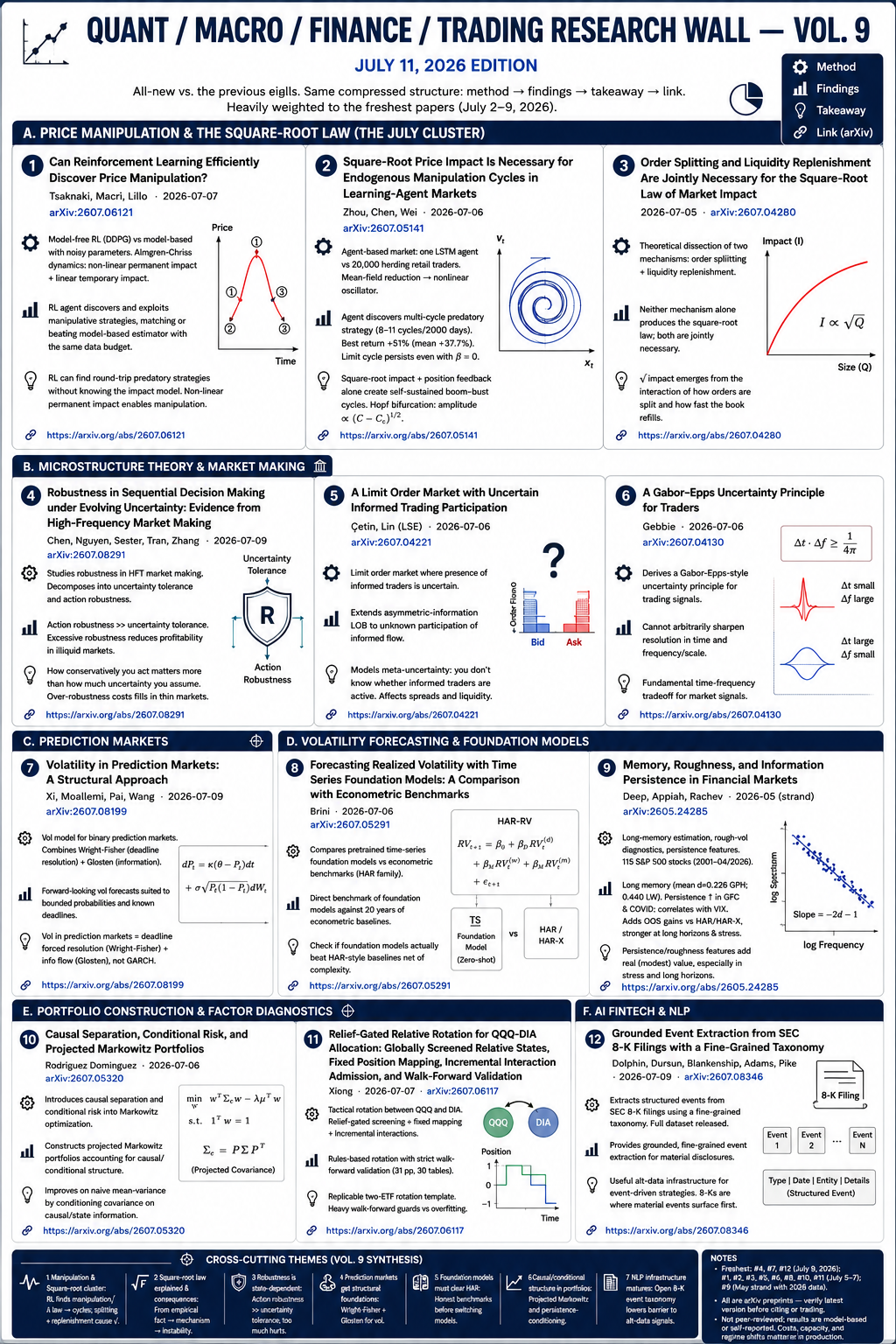
\\ Compressed structure: method → findings → takeaway → link. Heavily weighted to the freshest papers (July 2–9, 2026). This batch has an unusually strong cluster on price manipulation & the square-root impact law, plus prediction-market volatility, HFT robustness, foundation-model vol forecasting, and factor-model diagnostics.\\
🕹️ SECTION A — Price Manipulation & The Square-Root Law (the July cluster)
1️⃣ Can Reinforcement Learning Efficiently Discover Price Manipulation?
\\Ioanna-Yvonni Tsaknaki, Andrea Macrì, Fabrizio Lillo · 2026-07-07 · arXiv:2607.06121\\ ⭐ \(Lillo, 4 days old)\
🔗 <https://arxiv.org/abs/2607.06121>
- \\Method:\\ Asks whether a model-free RL agent (DDPG) can find and exploit price-manipulation opportunities better than a model-based approach that knows the correct data-generating process but relies on noisy parameter estimates. Single-asset market with Almgren-Chriss dynamics: \\non-linear permanent impact + linear temporary impact\\. Establishes existence of manipulative strategies in discrete time; computes the optimal full-information benchmark via Sequential Least Squares Quadratic Programming.
- \\Findings:\\ Compares the model-based estimator vs the agnostic RL agent trained on the same data budget. Frames the practical tradeoff: correct model + noisy parameters vs no model assumptions + direct learning.
- \\Takeaway:\\ For anyone studying manipulation detection or surveillance: RL can discover round-trip predatory strategies without knowing the impact model, which matters for regulators and exchanges building detection systems. The non-linear-permanent-impact assumption is what makes manipulation profitable — a key structural condition to watch.
2️⃣ Square-Root Price Impact Is Necessary for Endogenous Manipulation Cycles in Learning-Agent Markets
\\Yang Zhou, Jianwen Chen, Ruipeng Wei · 2026-07-06 · arXiv:2607.05141\\
🔗 <https://arxiv.org/abs/2607.05141>
- \\Method:\\ Minimal agent-based market: one CMA-ES-optimized LSTM institutional agent vs 20,000 herding retail traders. Mean-field reduction maps the system onto a nonlinear oscillator.
- \\Findings:\\ The agent \\spontaneously discovers a multi-cycle predatory strategy\\ — 8–11 complete cycles over 2000 days, +51% best return (mean +37.7% across 20 seeds). Two bifurcations: a continuous \\Hopf transition\\ as institutional capital exceeds critical threshold C\c (amplitude ∝ (C−C\c)^½), and a discontinuous fold transition in herding-scale space. Critically, \\the limit cycle persists even with zero herding (β=0)\\: position-tracking feedback + square-root price impact alone create a self-sustained oscillator. The four-phase cycle is architecture-independent (an MLP reproduces it), confirming it’s a property of the impact structure, not the network.
- \\Takeaway:\\ A striking result — boom-bust manipulation cycles can emerge purely from square-root impact + position feedback, no retail herding required. For risk teams: the square-root impact law you rely on for execution also creates endogenous instability when large adaptive agents are present. Connects the manipulation cluster (#1) to the impact-law cluster (#3).
3️⃣ Order Splitting and Liquidity Replenishment Are Jointly Necessary for the Square-Root Law of Market Impact
\\arXiv:2607.04280 · 2026-07-05\\
🔗 <https://arxiv.org/abs/2607.04280>
- \\Method:\\ Theoretical dissection of \why\ the square-root impact law holds, isolating two mechanisms: \\order splitting\\ (metaorders sliced over time) and \\liquidity replenishment\\ (the book refilling between child orders).
- \\Findings:\\ Argues both ingredients are \\jointly necessary\\ — neither order splitting nor liquidity replenishment alone produces the square-root law; you need both together.
- \\Takeaway:\\ Completes the microfoundation picture behind the empirical square-root law confirmed in Vols. 6–8. For impact modelers: the concavity of impact isn’t a primitive — it emerges from the interaction of how you split orders and how fast the book refills. If either mechanism is absent in your venue, don’t assume a √ exponent.
🌐 SECTION B — Microstructure Theory & Market Making
4️⃣ Robustness in Sequential Decision Making under Evolving Uncertainty: Evidence from High-Frequency Market Making
\\Ying Chen, Hoa Nguyen, Julian Sester, Hoang Hai Tran, Yijiong Zhang · 2026-07-09 · arXiv:2607.08291\\ ⭐ \(2 days old)\
🔗 <https://arxiv.org/abs/2607.08291>
- \\Method:\\ Studies sequential decision-making under evolving uncertainty in HFT market making, where changing dynamics break static policies. Decomposes robustness into two dimensions: \\uncertainty tolerance\\ (how much uncertainty the decision-maker allows) and \\action robustness\\ (how conservatively decisions respond).
- \\Findings:\\ Robustness is a \\state-dependent mechanism that reshapes behavior\\, not just protection against misspecification. \\Action robustness matters substantially more than uncertainty tolerance.\\ Crucially, \\excessive robustness can reduce profitability in illiquid markets\\ by limiting execution opportunities.
- \\Takeaway:\\ For market makers and RL-policy designers: the “how conservatively you act” knob dominates the “how much uncertainty you assume” knob. And robustness isn’t free — over-hedging against uncertainty costs you fills in thin markets. Tune action robustness first, and dial it down where liquidity is scarce.
5️⃣ A Limit Order Market with Uncertain Informed Trading Participation
\\Umut Çetin, Mingwei Lin (LSE) · 2026-07-06 · arXiv:2607.04221\\
🔗 <https://arxiv.org/abs/2607.04221>
- \\Method:\\ Sequel to the Çetin-Lin-Livieri “When large trades are not news” paper (Vol. 8). Models a limit order market where the \\participation of informed traders is itself uncertain\\ — liquidity providers don’t know whether informed traders are active.
- \\Findings:\\ Extends the asymmetric-information LOB framework to the case where the presence (not just the direction) of informed flow is unknown, characterizing how this deeper uncertainty affects price formation and adverse selection.
- \\Takeaway:\\ A refinement of adverse-selection theory. In real markets you rarely know whether informed players are even in the book right now — this models that meta-uncertainty. Relevant for spread-setting and for understanding why liquidity can evaporate when the \possibility\ of informed flow rises.
6️⃣ A Gabor–Epps Uncertainty Principle for Traders
\\Tim Gebbie · 2026-07-06 · arXiv:2607.04130\\
🔗 <https://arxiv.org/abs/2607.04130>
- \\Method:\\ A short (7 pp) theoretical piece deriving a \\Gabor-Epps-style uncertainty principle\\ for trading — a time-frequency tradeoff analog applied to market signals (from the author behind several 2026 square-root-law and microstructure notes).
- \\Findings:\\ Formalizes a fundamental limit on jointly resolving a trading signal in time and in “frequency” (rate/scale) — you cannot arbitrarily sharpen both.
- \\Takeaway:\\ A conceptual constraint for signal designers: there’s an inherent tradeoff between how precisely you localize a signal in time vs in frequency/scale. Analogous to the sampling limits in the Vol. 7 inference-latency work — sharper time resolution costs you scale resolution. Useful mental model for multi-horizon signal construction.
🎲 SECTION C — Prediction Markets
7️⃣ Volatility in Prediction Markets: A Structural Approach
\\Weiye Xi, Ciamac C. Moallemi, Mallesh Pai, Shouqiao Wang (Columbia / Paradigm / Tempo Labs) · 2026-07-09 · arXiv:2607.08199\\ ⭐ \(Moallemi, 2 days old)\
🔗 <https://arxiv.org/abs/2607.08199>
- \\Method:\\ Builds a volatility model tailored to \\binary prediction markets\\, where — unlike standard assets — prices are bounded probabilities, payoffs are binary, and contracts resolve at known deadlines (so ARCH/GARCH don’t naturally apply). The model combines two economic mechanisms: a \\Wright-Fisher deadline-resolution component\\ (capturing how remaining binary uncertainty is forced to resolve as the deadline approaches) and a \\Glosten-style\\ information/microstructure component.
- \\Findings:\\ Delivers forward-looking volatility forecasts appropriate to the bounded-probability, deadline-resolving structure of prediction-market contracts — the inputs needed for derivatives pricing, market making, and vol-linked strategies on these venues.
- \\Takeaway:\\ The right way to think about prediction-market vol: it’s not GARCH on returns, it’s deadline-forced resolution (Wright-Fisher) plus information flow (Glosten). For anyone market-making or trading vol on Polymarket/Kalshi, this is the structural foundation — volatility mechanically rises into resolution in a way standard models miss. From Moallemi (Columbia/Paradigm), a top name in market microstructure.
📈 SECTION D — Volatility Forecasting & Foundation Models
8️⃣ Forecasting Realized Volatility with Time Series Foundation Models: A Comparison with Econometric Benchmarks
\\Alessio Brini · 2026-07-06 · arXiv:2607.05291\\
🔗 <https://arxiv.org/abs/2607.05291>
- \\Method:\\ Tests whether \\pretrained time-series foundation models\\ (the zero-shot “GPT-for-time-series” class) can forecast realized volatility, benchmarked head-to-head against established econometric models (HAR family etc.). 41 pp.
- \\Findings:\\ A direct, honest comparison of foundation-model forecasting against the econometric workhorses that have dominated RV forecasting for two decades.
- \\Takeaway:\\ For vol forecasters weighing the foundation-model hype: this is the benchmark to read before switching. The recurring 2026 lesson (across walls) is that HAR-style baselines are stubbornly hard to beat — check whether the foundation model actually clears them net of complexity. Pairs with Vol. 5’s transformer-vs-HARQ Chinese-equity study.
9️⃣ Memory, Roughness, and Information Persistence in Financial Markets: A Structural Approach to Volatility Forecasting
\\Akash Deep, Nicholas Appiah, Svetlozar T. Rachev · 2026-04 (active strand) · arXiv:2605.24285\\
🔗 <https://arxiv.org/abs/2605.24285>
- \\Method:\\ Combines semiparametric \\long-memory estimation\\, \\rough-volatility diagnostics\\, and persistence-based forecasting features on a panel of 115 S&P 500 constituents (Nov 2001 – Apr 2026). Tests whether persistence measures add forecasting info beyond standard predictors.
- \\Findings:\\ Volatility proxies show substantial long memory (cross-sectional mean GPH d=0.226; local-Whittle d=0.440) and locally rough dynamics. Persistence rises during the GFC and COVID and correlates positively with VIX. Adding cross-sectional persistence aggregates, sectoral persistence, and persistence-by-stress interactions produces \\moderate but statistically significant OOS gains beyond HAR/HAR-X, strongest at longer horizons and during stress\\.
- \\Takeaway:\\ Practical volatility-forecasting enhancement: persistence/roughness features add real (if modest) value over HAR, concentrated exactly where you need it — long horizons and stress regimes. The stress-interaction terms are the actionable ingredient for vol-managed portfolios.
📊 SECTION E — Portfolio Construction & Factor Diagnostics
🔟 Causal Separation, Conditional Risk, and Projected Markowitz Portfolios
\\Alejandro Rodriguez Dominguez · 2026-07-06 · arXiv:2607.05320\\
🔗 <https://arxiv.org/abs/2607.05320>
- \\Method:\\ Introduces “causal separation” and conditional-risk concepts into Markowitz portfolio construction, producing \\projected Markowitz portfolios\\ that account for conditional/causal structure rather than unconditional covariance alone (28 pp).
- \\Findings:\\ Develops a portfolio framework where the optimization is projected onto a space respecting causal/conditional risk relationships, aiming to improve on naive mean-variance under structured dependence.
- \\Takeaway:\\ For allocators frustrated with Markowitz’s instability: conditioning the covariance structure on causal/state information is the proposed fix. Fits the broader 2026 theme (DeePM in Vol. 5, causal masking in Vol. 6) of injecting economic/causal structure into otherwise mechanical optimizers.
1️⃣1️⃣ Relief-Gated Relative Rotation for QQQ-DIA Allocation: Globally Screened Relative States, Fixed Position Mapping, Incremental Interaction Admission, and Walk-Forward Validation
\\Zheli Xiong · 2026-07-07 · arXiv:2607.06117\\
🔗 <https://arxiv.org/abs/2607.06117>
- \\Method:\\ A tactical \\QQQ-vs-DIA rotation\\ strategy (tech-heavy Nasdaq-100 vs Dow) using “relief-gated” relative-state screening, fixed position mapping, and incremental interaction admission, under strict walk-forward validation. 31 pp, 30 tables.
- \\Findings:\\ Builds a rules-based rotation between two major index ETFs with an emphasis on walk-forward-validated state definitions and controlled feature admission.
- \\Takeaway:\\ A concrete, replicable two-ETF tactical rotation template with disciplined validation. The heavy walk-forward + incremental-admission methodology is the transferable part — a guard against the overfitting that plagues rotation strategies. Note: single-pair, self-reported backtest; scrutinize costs and the walk-forward protocol before trusting.
🧠 SECTION F — AI Fintech & NLP
1️⃣2️⃣ Grounded Event Extraction from SEC 8-K Filings with a Fine-Grained Taxonomy
\\Rian Dolphin, Joe Dursun, Jarrett Blankenship, Katie Adams, Quinton Pike · 2026-07-09 · arXiv:2607.08346\\ ⭐ \(2 days old)\
🔗 <https://arxiv.org/abs/2607.08346>
- \\Method:\\ Extracts structured events from \\SEC 8-K filings\\ (the primary channel for U.S. material corporate disclosures) using a fine-grained event taxonomy. Full dataset and taxonomy released publicly.
- \\Findings:\\ Provides a grounded, fine-grained event-extraction framework for 8-Ks, turning unstructured material-disclosure text into structured, machine-readable events.
- \\Takeaway:\\ Directly useful alt-data infrastructure for event-driven strategies. 8-Ks are where material corporate events surface first; a fine-grained taxonomy + open dataset lowers the barrier to building event-driven signals. Pairs with Vol. 8’s domain-aware Shapley for financial NLP — the pipeline from filing → structured event → signal is maturing fast.
🔑 Cross-Cutting Themes (Vol. 9 Synthesis)
- \\A price-manipulation & square-root-law cluster dominates this batch.\\ #1 (RL discovers manipulation), #2 (square-root impact → endogenous manipulation cycles, no herding needed), #3 (order splitting + replenishment jointly cause the √ law). Together they show the same impact law that governs execution costs also generates instability and manipulability — a coherent, important research thread this week.
- \\The square-root law is now being both confirmed and mechanistically explained.\\ After empirical confirmations in Vols. 6–8, #3 pins down its joint microfoundations and #2 shows its dynamical consequences. The field has moved from “does it hold?” to “why, and what does it imply?”
- \\Robustness is state-dependent, and more isn’t always better.\\ #4 (HFT market making) finds action robustness dominates uncertainty tolerance and that over-robustness costs fills in illiquid markets — a nuanced correction to “just make it robust.”
- \\Prediction-market modeling gets proper structural foundations.\\ #7 (Moallemi’s Wright-Fisher + Glosten vol model) gives prediction markets their own volatility theory, distinct from GARCH — the newest layer atop the settlement/microstructure work of Vols. 6–8.
- \\Foundation models still must clear HAR.\\ #8 benchmarks TS foundation models against econometric vol baselines — the same “flashy model vs stubborn baseline” honesty running through every wall.
- \\Causal/conditional structure keeps entering portfolio construction.\\ #10 (projected Markowitz) and the persistence-conditioning in #9 continue 2026’s move toward structured, state-aware optimization over unconditional methods.
- \\Financial NLP infrastructure is professionalizing.\\ #12 (open 8-K event taxonomy) provides reusable event-extraction infrastructure — the alt-data plumbing that event-driven quant depends on.
⚠️ \Freshness/provenance notes: #4, #7, #12 are 2 days old (July 9, 2026); #1, #2, #3, #5, #6, #8, #10, #11 are July 5–7; #9 is a late-May strand with 2026 data. All are real arXiv papers — verify the latest version and full PDF before citing or trading. #1 and #7 come from prominent groups (Lillo; Moallemi/Paradigm), giving them extra practitioner weight, but remain preprints. Several are agent-based or model-based results (#2, #3) or self-reported single-pair backtests (#11) — not live-trading guarantees; costs, capacity, and regime shifts bite in production. arXiv preprints are not peer-reviewed.\