By Tiger Capital Research
Published: 2026-07-08
URL: https://princetonchen.substack.com/p/samsung-posts-record-profit-and-surpasses
Daily Market Read III | Category: Semiconductors & AI Supply Chain | Date: July 7, 2026
Tiger Capital Research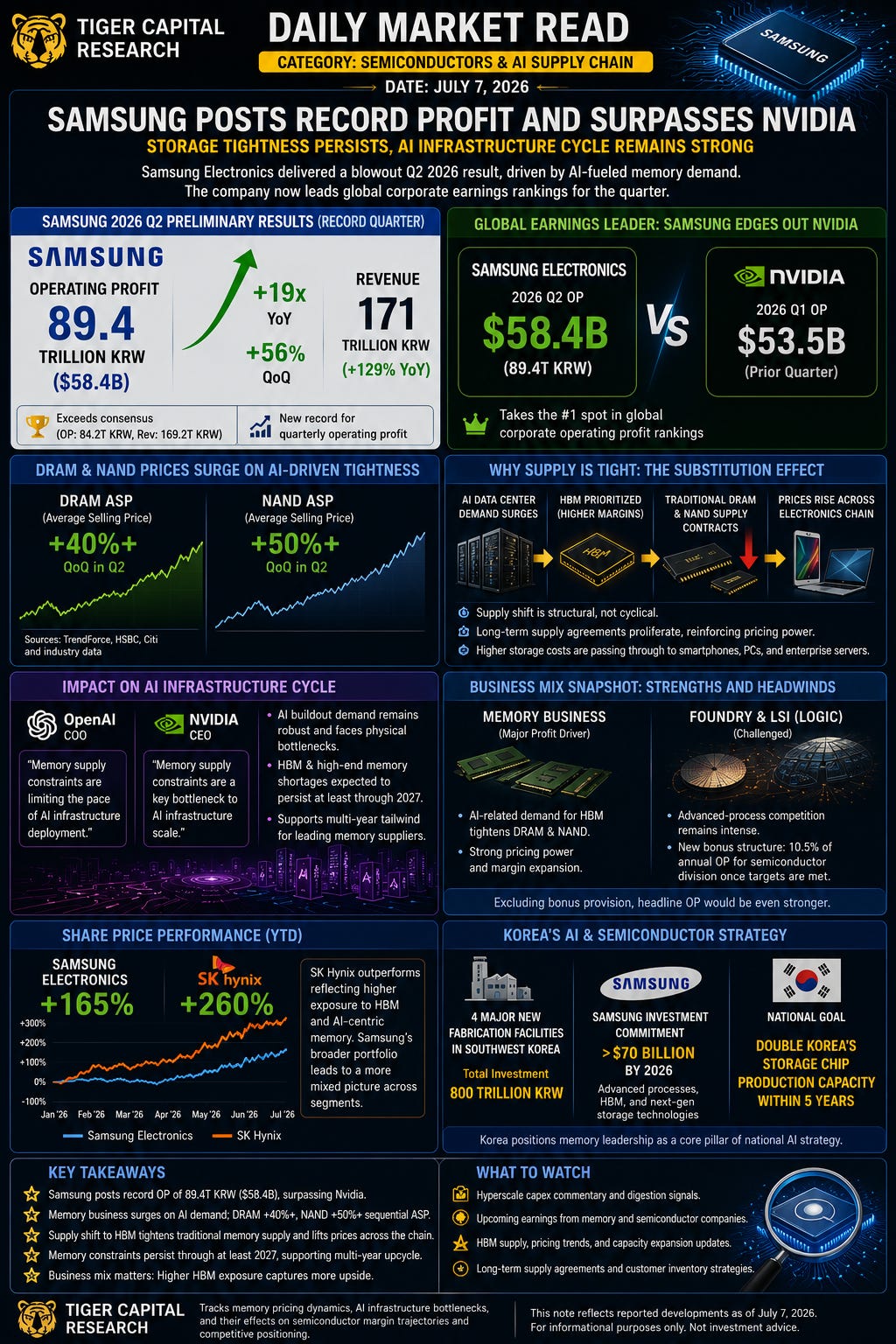
Samsung Electronics delivered a blowout second-quarter 2026 preliminary result that vaulted it to the top of the global corporate profit rankings. Operating profit is expected to reach 89.4 trillion Korean won (approximately $58.4 billion), representing a roughly 19-fold increase year-over-year and a 56 percent sequential gain. The figure comfortably exceeded consensus expectations of 84.2 trillion won and set a new company record for quarterly operating profit. Revenue came in at 171 trillion won, above the 169.2 trillion won estimate and up 129 percent year-over-year.
The result edges out Nvidia’s prior-quarter operating profit of $53.5 billion, placing Samsung at the top of the global list for the period. The surge was driven overwhelmingly by the memory business, where AI-related demand for high-bandwidth memory (HBM) has tightened supply across the broader DRAM and NAND markets. Industry data show DRAM average selling prices rising more than 40 percent sequentially in the second quarter, with NAND prices up over 50 percent. Multiple research houses, including HSBC and Citi, report broadly similar magnitude increases.
The supply shift is structural. As memory makers prioritize higher-margin HBM production to meet AI data-center orders, traditional DRAM and NAND availability has contracted. This “substitution effect” is now feeding through the electronics supply chain, raising storage costs for smartphones, PCs, and enterprise servers. Long-term supply agreements are proliferating as customers seek to lock in future availability, further reinforcing pricing power for the leading memory producers.
Samsung’s result carries broader implications for the AI infrastructure cycle. While market attention has focused on potential digestion in hyperscale capex, the memory tightness and price momentum suggest that AI buildout demand remains robust and is still encountering physical bottlenecks. Both Nvidia’s CEO and OpenAI’s COO have publicly noted that memory supply constraints are limiting the pace of AI infrastructure deployment. Industry forecasts continue to point to HBM and high-end memory shortages persisting at least through 2027.
Not all segments contributed equally. Samsung’s foundry and logic (LSI) businesses are still expected to post losses, weighed by advanced-process competition and a new employee compensation structure that ties semiconductor-division bonuses directly to operating profit (10.5 percent of annual profit earmarked for special bonuses once targets are met). Some analysts estimate that excluding the bonus provision, the headline operating profit would have been even stronger.
From a capital-markets perspective, Samsung’s year-to-date share-price performance (+165 percent) has been solid but trails SK Hynix (+260 percent). The gap largely reflects business mix: SK Hynix is more concentrated in HBM and AI-centric memory, while Samsung maintains a broader portfolio that includes foundry, logic, and consumer electronics. Over the longer term, both companies are viewed by Korean authorities as central pillars of national AI strategy. The government and the two groups are advancing plans for four major new fabrication facilities in southwestern Korea with a combined investment of 800 trillion won, alongside Samsung’s own commitment to spend more than $70 billion by 2026 on advanced processes, HBM, and next-generation storage technologies. The national goal is to double Korea’s storage-chip production capacity within five years.
For investors, Samsung’s print reinforces two important dynamics. First, the AI infrastructure cycle continues to generate strong pricing power and margin expansion in the memory segment even as other parts of the semiconductor complex experience volatility. Second, the physical constraints around advanced memory are unlikely to resolve quickly, supporting a multi-year tailwind for the leading suppliers. At the same time, the result highlights the importance of business mix: companies with greater exposure to the highest-growth AI memory products have captured more of the upside, while more diversified players face a more mixed picture across segments.
Near-term price action in memory and related names will likely remain sensitive to any incremental signals on hyperscale capex plans and to the tone of upcoming earnings from the memory cohort itself. A durable stabilization or further re-rating in the sector would probably require continued evidence that AI-related demand is absorbing incremental supply without meaningful digestion. Until then, the memory complex remains one of the clearest fundamental beneficiaries of the ongoing AI buildout, with Samsung’s record quarter serving as the latest confirmation that the cycle is still in expansion mode rather than peak.
Tiger Capital Research tracks memory pricing dynamics, AI infrastructure bottlenecks, and their effects on semiconductor margin trajectories and competitive positioning. This note reflects reported developments as of July 7, 2026.