By Tiger Capital Research
Published: 2026-07-07
URL: https://princetonchen.substack.com/p/storage-and-memory-stocks-lead-sharp
Daily Market Read II | Category: US Equities & Semiconductors | Date: July 7, 2026
Tiger Capital Research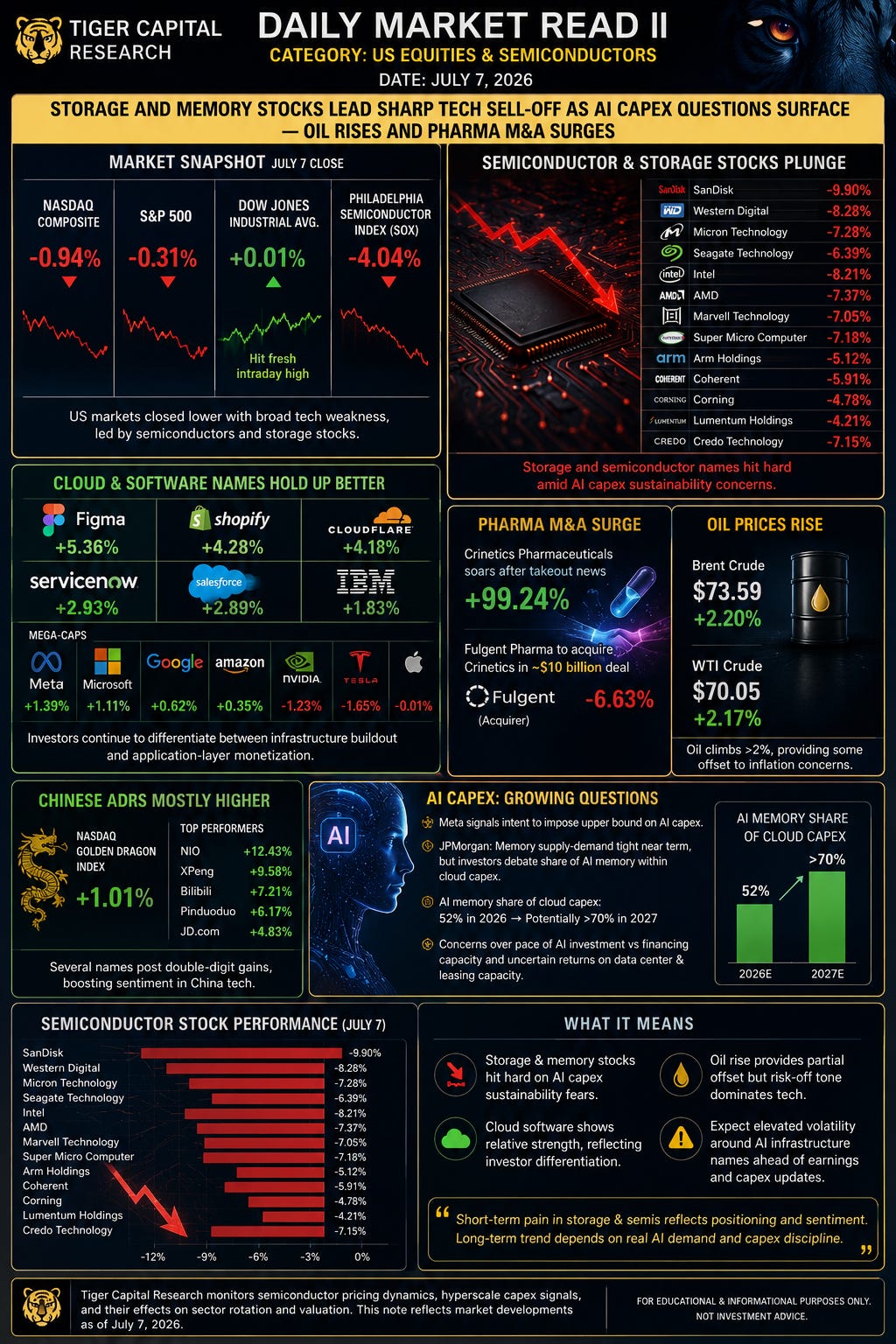
US equity indices closed lower on July 7, with the Nasdaq Composite falling 0.94 percent and the S&P 500 declining 0.31 percent while the Dow Jones Industrial Average finished essentially flat after touching a fresh intraday high. The session was defined by a broad and violent decline in semiconductor and storage names, selective strength in cloud software, and continued investor scrutiny of AI capital expenditure sustainability.
Semiconductor stocks bore the brunt of the selling. The Philadelphia Semiconductor Index dropped more than 4 percent. Storage-related names were hit particularly hard: SanDisk fell nearly 10 percent, Western Digital declined more than 8 percent, Micron Technology dropped over 7 percent, and Seagate Technology lost more than 6 percent. Intel fell more than 8 percent, while AMD, Marvell, and Super Micro Computer each declined over 7 percent and Arm dropped more than 5 percent. Optical communications names also weakened, with Coherent down nearly 6 percent, Corning off nearly 5 percent, Lumentum lower by roughly 4 percent, and Credo down more than 7 percent.
In contrast, several cloud computing and software names moved higher. Figma rose more than 5 percent, Shopify and Cloudflare gained over 4 percent, ServiceNow and Salesforce advanced nearly 3 percent, and IBM rose nearly 2 percent. Among the technology mega-caps, Meta and Microsoft each gained more than 1 percent while Google and Amazon posted modest advances. Nvidia and Tesla each fell more than 1 percent and Apple was essentially unchanged.
Individual stock moves were dramatic in places. Crinetics Pharmaceuticals surged more than 99 percent after reports that Fulgent Pharma would acquire it in a transaction valued at approximately $10 billion. The acquirer itself finished lower on the day. Chinese ADRs were mostly higher, with the Nasdaq Golden Dragon Index up more than 1 percent; several names posted double-digit gains while others advanced modestly.
Oil prices rose more than 2 percent, with Brent crude reaching $73.59 per barrel and WTI trading near $70.05 per barrel. The move provided some offset to concerns about input cost inflation but did not prevent the broader risk-off tone in technology.
The semiconductor weakness occurred against a backdrop of growing market discussion about the trajectory of AI-related capital spending. Meta has recently signaled intentions to impose an upper bound on AI capex, prompting questions about whether hyperscale spending is beginning to moderate. JPMorgan analysts noted that while memory supply-demand fundamentals remain tight in the near term, investors are increasingly debating the share of AI memory within overall cloud capex (estimated at 52 percent this year and potentially exceeding 70 percent next year) and whether that rapid ascent is sustainable. Some market participants are also expressing concern about the pace of AI investment relative to financing capacity and the uncertain returns on incremental data-center and leasing capacity.
The session illustrates the tension between short-term positioning dynamics and longer-term fundamental questions. Storage and memory names, which had benefited from both AI demand and earlier supply constraints, were especially sensitive to any hint of spending digestion. At the same time, select cloud software names held up better, suggesting that investors continue to differentiate between infrastructure buildout and application-layer monetization. The violent moves in individual names, both the storage complex and the pharma acquisition target, underscore how quickly capital can rotate when sentiment shifts or when discrete catalysts appear.
Near-term price action will likely remain sensitive to any additional commentary from hyperscalers on capex plans and to the tone of upcoming earnings from memory and semiconductor companies. A durable stabilization in the sector would probably require clearer evidence that AI-related demand remains on track and that recent price action reflects position unwinds rather than a fundamental reassessment of spending trajectories. Until then, volatility around AI infrastructure names is likely to persist even as broader market breadth and commodity moves provide partial offsets.
Tiger Capital Research monitors semiconductor pricing dynamics, hyperscale capex signals, and their effects on sector rotation and valuation. This note reflects market developments as of July 7, 2026.