By Tiger Capital Research
Published: 2026-07-07
URL: https://princetonchen.substack.com/p/spacex-enters-nasdaq-100-after-just
Daily Market Read I | Category: Index Inclusion & Passive Flows | Date: July 7, 2026
Tiger Capital Research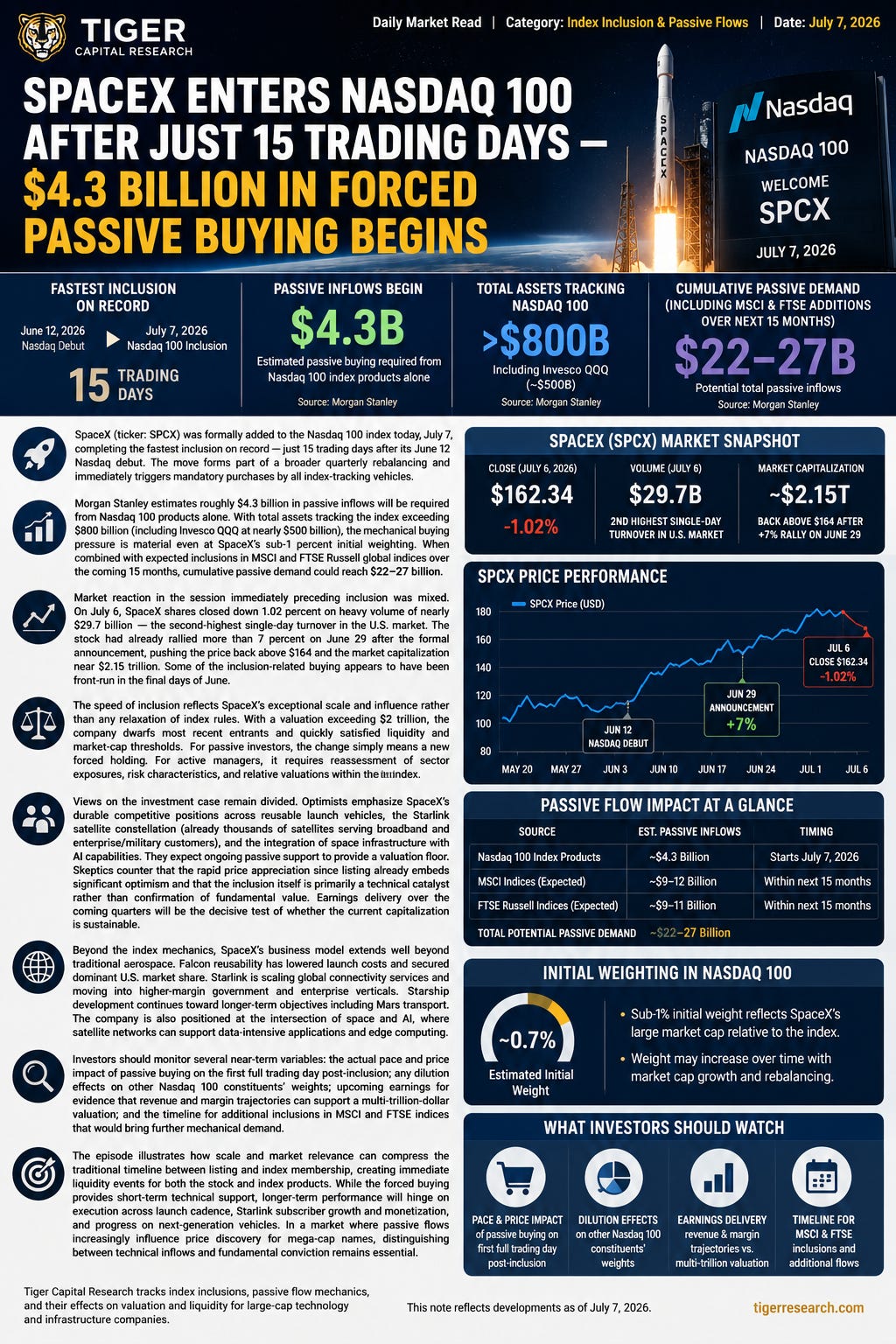
SpaceX (ticker: SPCX) was formally added to the Nasdaq 100 index today, July 7, completing the fastest inclusion on record — just 15 trading days after its June 12 Nasdaq debut. The move forms part of a broader quarterly rebalancing and immediately triggers mandatory purchases by all index-tracking vehicles.
Morgan Stanley estimates roughly $4.3 billion in passive inflows will be required from Nasdaq 100 products alone. With total assets tracking the index exceeding $800 billion (including Invesco QQQ at nearly $500 billion), the mechanical buying pressure is material even at SpaceX’s sub-1 percent initial weighting. When combined with expected inclusions in MSCI and FTSE Russell global indices over the coming 15 months, cumulative passive demand could reach $22–27 billion.
Market reaction in the session immediately preceding inclusion was mixed. On July 6, SpaceX shares closed down 1.02 percent on heavy volume of nearly $29.7 billion — the second-highest single-day turnover in the U.S. market. The stock had already rallied more than 7 percent on June 29 after the formal announcement, pushing the price back above $164 and the market capitalization near $2.15 trillion. Some of the inclusion-related buying appears to have been front-run in the final days of June.
The speed of inclusion reflects SpaceX’s exceptional scale and influence rather than any relaxation of index rules. With a valuation exceeding $2 trillion, the company dwarfs most recent entrants and quickly satisfied liquidity and market-cap thresholds. For passive investors, the change simply means a new forced holding. For active managers, it requires reassessment of sector exposures, risk characteristics, and relative valuations within the index.
Views on the investment case remain divided. Optimists emphasize SpaceX’s durable competitive positions across reusable launch vehicles, the Starlink satellite constellation (already thousands of satellites serving broadband and enterprise/military customers), and the integration of space infrastructure with AI capabilities. They expect ongoing passive support to provide a valuation floor. Skeptics counter that the rapid price appreciation since listing already embeds significant optimism and that the inclusion itself is primarily a technical catalyst rather than confirmation of fundamental value. Earnings delivery over the coming quarters will be the decisive test of whether the current capitalization is sustainable.
Beyond the index mechanics, SpaceX’s business model extends well beyond traditional aerospace. Falcon reusability has lowered launch costs and secured dominant U.S. market share. Starlink is scaling global connectivity services and moving into higher-margin government and enterprise verticals. Starship development continues toward longer-term objectives including Mars transport. The company is also positioned at the intersection of space and AI, where satellite networks can support data-intensive applications and edge computing.
Investors should monitor several near-term variables: the actual pace and price impact of passive buying on the first full trading day post-inclusion; any dilution effects on other Nasdaq 100 constituents’ weights; upcoming earnings for evidence that revenue and margin trajectories can support a multi-trillion-dollar valuation; and the timeline for additional inclusions in MSCI and FTSE indices that would bring further mechanical demand.
The episode illustrates how scale and market relevance can compress the traditional timeline between listing and index membership, creating immediate liquidity events for both the stock and index products. While the forced buying provides short-term technical support, longer-term performance will hinge on execution across launch cadence, Starlink subscriber growth and monetization, and progress on next-generation vehicles. In a market where passive flows increasingly influence price discovery for mega-cap names, distinguishing between technical inflows and fundamental conviction remains essential.
Tiger Capital Research tracks index inclusions, passive flow mechanics, and their effects on valuation and liquidity for large-cap technology and infrastructure companies. This note reflects developments as of July 7, 2026..3