By Tiger Capital Research
Published: 2026-07-05
URL: https://princetonchen.substack.com/p/chip-stocks-extend-losses-as-labor
Daily Market Read I | Category: US Equities & Semiconductors | Date: July 5, 2026
Tiger Capital Research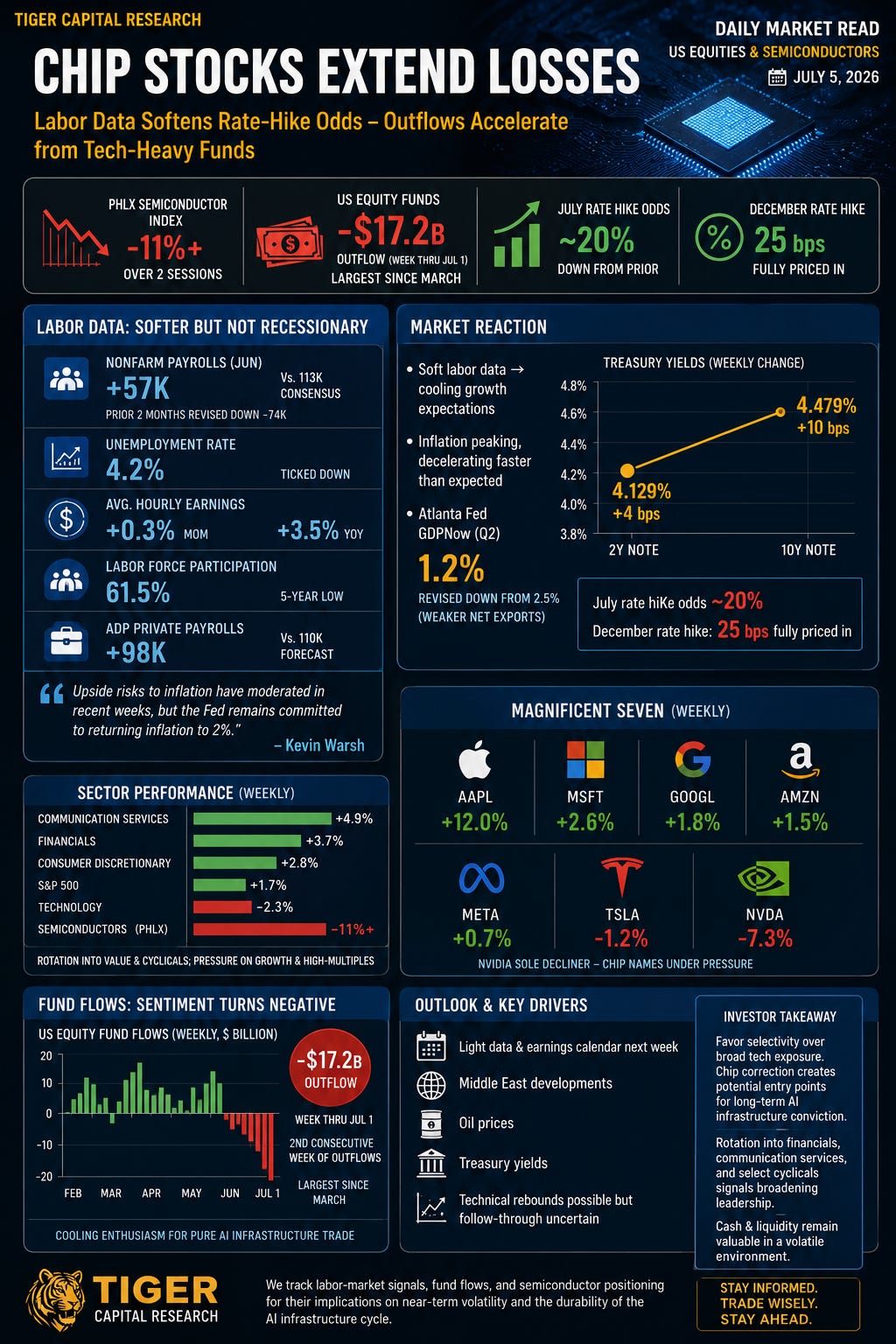
US chip stocks suffered another sharp leg lower this week even as broader equity indices posted gains and rate-hike probabilities eased. The Philadelphia Semiconductor Index fell more than 11 percent over two sessions, extending a violent mean-reversion move after months of concentrated strength. Equity fund flows turned decisively negative, with US stock funds recording a $17.2 billion outflow in the week through July 1 — the second consecutive week of net redemptions and the largest since March.
The immediate catalyst was a soft June employment report. Nonfarm payrolls rose just 57,000, well below the 113,000 consensus and with prior months revised lower by a combined 74,000. The unemployment rate ticked down to 4.2 percent while average hourly earnings rose 0.3 percent month-over-month and 3.5 percent year-over-year — both in line with expectations. The labor-force participation rate slipped to a five-year low of 61.5 percent. ADP private payrolls also missed, adding only 98,000 jobs against forecasts of 110,000.
Markets interpreted the data as consistent with a cooling but non-recessionary labor market. Initial jobless claims remain low and job openings stay elevated, offering no clear recession signal. The Atlanta Fed’s GDPNow tracker for the second quarter was revised sharply lower to 1.2 percent from 2.5 percent, largely on weaker net exports. Economists noted that while the labor market is softening at the margin, wage pressures are not reaccelerating and inflation appears to be peaking and decelerating faster than previously anticipated.
Kevin Warsh’s recent comments reinforced the hawkish-to-neutral tone. He acknowledged that upside risks to inflation have moderated in recent weeks but reiterated the Fed’s commitment to returning inflation to the 2 percent target. Treasury yields rose across the curve, with the 2-year note up roughly 4 basis points to 4.129 percent and the 10-year up about 10 basis points to 4.479 percent. Market pricing for a July rate hike fell to around 20 percent, while December still carries a full 25-basis-point hike in expectations.
Against this backdrop, sector performance diverged sharply. Communication services led the week with a 4.9 percent gain, followed by financials at 3.7 percent and consumer discretionary at 2.8 percent. The “Magnificent Seven” were mixed: Apple posted a 12 percent weekly advance while Nvidia was the sole decliner. Chip names bore the brunt of the rotation as investors questioned whether the pace of AI-related capital expenditure can be sustained without faster enterprise monetization. Schwab noted that the sell-off reflects both genuine rotation into other sectors and a necessary correction of overcrowded positioning in semiconductors after an extended run.
Fund flows confirm the shift in sentiment. The two-week streak of outflows from US equity funds marks the first sustained withdrawal since March and coincides with cooling enthusiasm for the pure AI infrastructure trade. Broader market breadth, however, remains constructive outside the most expensive parts of the technology complex. Economic data and growth expectations continue to support a baseline of moderate expansion rather than contraction.
Near-term volatility is likely to remain elevated. Next week’s calendar is relatively light on major data and earnings, leaving technical price action, any Middle East developments, oil prices, and Treasury yields as the dominant drivers. Early technical rebounds in chip names are possible, but the damaged price structure suggests limited follow-through. A more durable stabilization would probably require either clearer evidence that AI capex plans remain on track or a further softening in rate-hike odds that reduces pressure on growth-sensitive multiples.
For investors, the current setup favors selectivity over broad exposure within technology. The semiconductor correction creates potential entry points for those with multi-quarter conviction in the AI buildout, provided positioning is sized for continued volatility. At the same time, the rotation into financials, communication services, and select cyclicals offers a reminder that market leadership can broaden when growth expectations stabilize and valuation dispersion compresses. Cash and liquidity remain useful tools while the market digests the latest labor data and recalibrates the path of policy.
Tiger Capital Research tracks labor-market signals, fund flows, and semiconductor positioning for their implications on both near-term volatility and the durability of the AI infrastructure cycle. This note reflects data and commentary available as of July 5, 2026.