By Tiger Quant Researcher
Published: 2026-06-21
URL: https://princetonchen.substack.com/p/weekly-paper-review-wall-june-21
📰 Quant / Macro / Finance / Trading Research Wall — Vol. 6 (June 21, 2026 Edition)
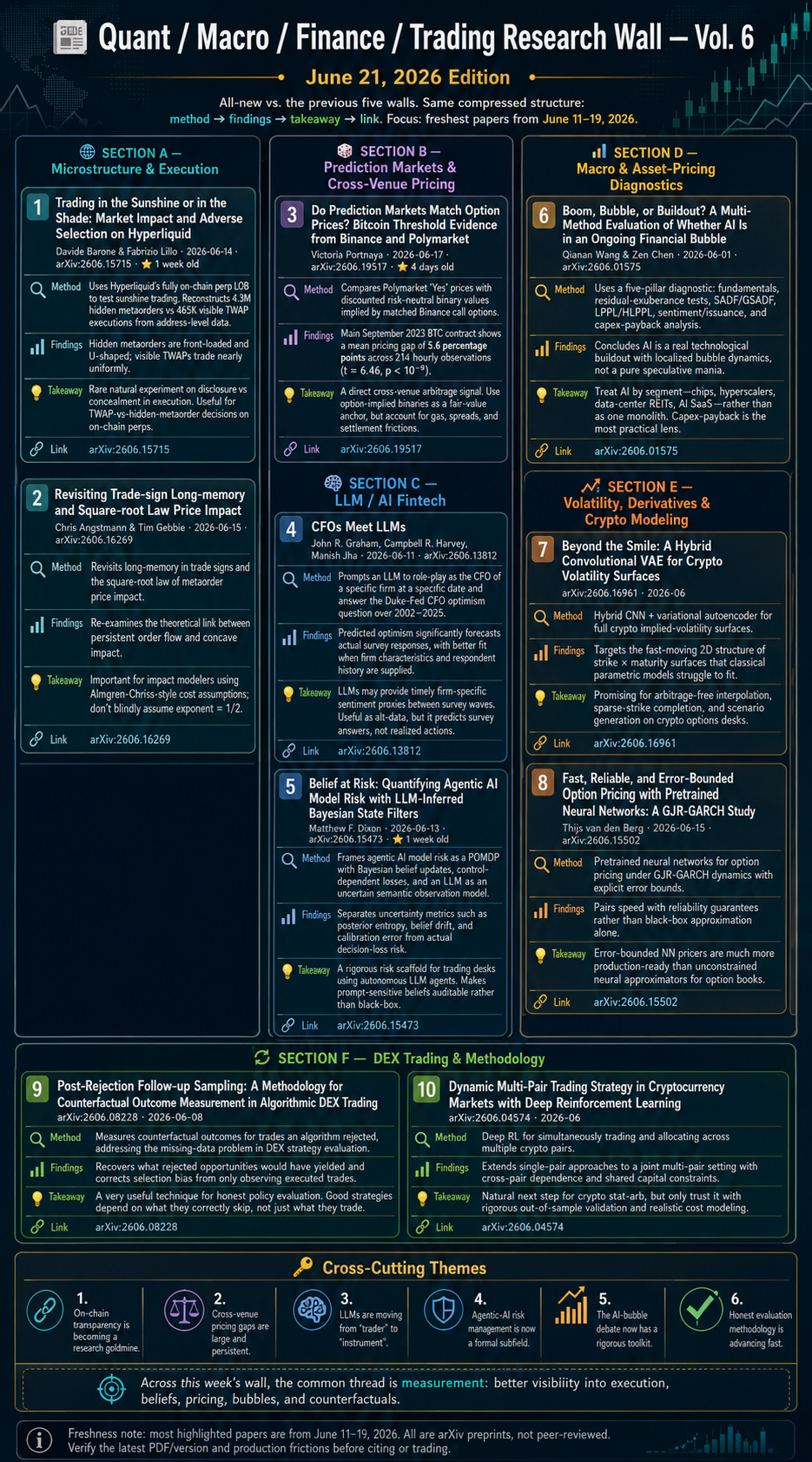
All-new vs. the previous five walls. Same compressed structure: method → findings → takeaway → link. Heavily weighted to the freshest papers (June 11–19, 2026). Spans on-chain sunshine trading, prediction-market vs option arbitrage, CFO-sentiment LLMs, agentic-AI model risk, AI-bubble diagnostics, crypto vol surfaces, and DEX counterfactuals.
🌐 SECTION A — Microstructure & Execution (freshest)
1️⃣ Trading in the Sunshine or in the Shade: Market Impact and Adverse Selection on Hyperliquid
Davide Barone & Fabrizio Lillo (Scuola Normale Superiore, Pisa) · 2026-06-14 · arXiv:2606.15715 ⭐ (1 week old) 🔗 <https://arxiv.org/abs/2606.15715>
- Method: Tests “sunshine trading” theory — the prediction that publicly disclosing trading intentions reduces adverse selection and attracts liquidity. Rare to test in TradFi (preannouncement is uncommon), so they use Hyperliquid, a fully on-chain perp-futures LOB where protocol-native TWAP orders disclose their terms from inception and stay visible. Address-level data reconstructs 4.3M hidden metaorders vs 465K visible TWAP executions.
- Findings: The two styles differ sharply: hidden metaorders follow front-loaded, U-shaped schedules consistent with transient-impact optimal execution, while visible TWAPs trade nearly uniformly.
- Takeaway: A rare natural experiment on disclosure vs concealment in execution. For anyone trading on-chain perps, it directly informs the TWAP-vs-hidden-metaorder decision. The on-chain transparency that crypto traders often fear is exactly what makes this study possible — and the impact asymmetry is measurable.
2️⃣ Revisiting Trade-sign Long-memory and Square-root Law Price Impact
Chris Angstmann & Tim Gebbie · 2026-06-15 · arXiv:2606.16269 🔗 <https://arxiv.org/abs/2606.16269>
- Method: Working paper (13 pp) revisiting two of the most robust empirical regularities in microstructure: the long-memory of trade-sign sequences and the square-root law of metaorder price impact.
- Findings: Re-examines the theoretical link between persistent order flow and the concave (square-root) impact function that anchors most modern execution-cost models.
- Takeaway: For impact modelers, a fresh critical look at the foundations underneath Almgren-Chriss-style cost models. Worth reading alongside the square-root-law literature before you assume the exponent is exactly ½ in your venue/asset.
🎲 SECTION B — Prediction Markets & Cross-Venue Pricing
3️⃣ Do Prediction Markets Match Option Prices? Bitcoin Threshold Evidence from Binance and Polymarket
Victoria Portnaya (Kyiv School of Economics) · 2026-06-17 · arXiv:2606.19517 ⭐ (4 days old) 🔗 <https://arxiv.org/abs/2606.19517>
- Method: First option-implied benchmark test of prediction-market pricing for crypto threshold contracts. For each hour in a matched sample, compares the Polymarket “Yes” price against the discounted risk-neutral binary value implied by a listed Binance call option on the same underlying, strike, and maturity; studies the gap.
- Findings: In the main September 2023 Bitcoin contract, the mean pricing gap is 5.6 percentage points across 214 hourly observations (t = 6.46, p < 10⁻⁹) — a large, statistically overwhelming, persistent discrepancy between two venues pricing the identical binary payoff.
- Takeaway: Direct cross-venue arbitrage signal for prediction-market traders. The two “digital ecosystems” don’t agree on identical state-contingent payoffs. Use Binance option-implied binaries as a fair-value anchor when trading Polymarket BTC threshold markets — but model execution frictions (gas, oracle settlement, spreads) before assuming the gap is free money.
🧠 SECTION C — LLM / AI Fintech (fresh, high-pedigree)
4️⃣ CFOs Meet LLMs
John R. Graham, Campbell R. Harvey, Manish Jha (Duke / Fuqua) · 2026-06-11 · arXiv:2606.13812 ⭐ (prestigious authors) 🔗 <https://arxiv.org/abs/2606.13812>
- Method: Prompts an LLM to role-play as the CFO of a specific company at a specific date, answering the economic-optimism question from the Duke-Federal Reserve CFO Survey over 2002–2025. Tests whether the LLM reproduces actual individual human responses.
- Findings: The predicted optimism score significantly forecasts the CFO’s actual answer, surviving firm and year-quarter fixed effects and controlling for the most recent prior response. Predictive accuracy increases with information supplied — both respondent history and firm characteristics improve fit.
- Takeaway: Business sentiment surveys are slow, periodic, and reach only hundreds of firms. This suggests LLMs can synthesize timely, firm-specific sentiment proxies between survey waves — a potential alt-data source for nowcasting corporate behavior. From Campbell Harvey (one of the most cited names in empirical finance), so worth serious attention. Note: reproduces survey responses, not realized corporate actions.
5️⃣ Belief at Risk: Quantifying Agentic AI Model Risk with LLM-Inferred Bayesian State Filters
Matthew F. Dixon (Quiota LLC) · 2026-06-13 · arXiv:2606.15473 ⭐ (1 week old) 🔗 <https://arxiv.org/abs/2606.15473>
- Method: Mathematical framework for agentic-AI model risk. Represents the system as a partially-observed Markov decision process (POMDP) with latent states, Bayesian belief updates, control-dependent losses, and tail-risk functionals. Key idea: treat the LLM as an uncertain semantic observation model mapping high-dimensional evidence into a probability vector over latent regimes, while a Bayesian filter imposes temporal coherence and produces auditable posteriors.
- Findings: Cleanly separates uncertainty quantification (posterior entropy, belief drift, calibration error) from risk measurement (distribution of losses from decisions under those beliefs).
- Takeaway: As trading desks deploy autonomous LLM agents, this gives a rigorous, auditable risk-management scaffold — the LLM’s prompt-sensitive, possibly-miscalibrated belief becomes a measurable state rather than a black box. Code at github.com/mfrdixon/belief-at-risk. Essential reading if you’re putting LLM agents anywhere near capital.
📊 SECTION D — Macro & Asset-Pricing Diagnostics
6️⃣ Boom, Bubble, or Buildout? A Multi-Method Evaluation of Whether AI Is in an Ongoing Financial Bubble
Qianan Wang & Zen Chen · 2026-06-01 · arXiv:2606.01575 🔗 <https://arxiv.org/abs/2606.01575>
- Method: Hybrid review + diagnostic framework (as of May 2026) grounded in asset-pricing foundations (state prices, SDFs, martingale valuation, pricing kernels), connecting to rational bubbles, behavioral bubbles, and modern econometric bubble-detection. Proposes a five-pillar diagnostic: fundamental valuation, residual-exuberance tests, SADF/GSADF explosive-root procedures, LPPL/HLPPL price-pattern diagnostics, sentiment/issuance measures, and capex-payback analysis.
- Findings: Central conclusion — AI is best understood as a real technological revolution with localized bubble dynamics, not a pure speculative mania nor a pure rational buildout. Segmentation is the framework’s main value: infrastructure firms with realized revenue and durable bottlenecks differ sharply from narrative-driven names capitalizing future productivity before cash flows appear. Flags data-center assets as bubble-prone when long-duration capital is financed against short-duration tech assumptions.
- Takeaway: A usable surveillance toolkit, not a verdict. The SADF/GSADF + LPPL combination is the standard explosive-bubble econometric kit — apply it per-segment (chips vs hyperscalers vs data-center REITs vs AI SaaS) rather than to “AI” as a monolith. The capex-payback lens is the most practical pillar for equity selection.
📈 SECTION E — Volatility, Derivatives & Crypto Modeling
7️⃣ Beyond the Smile: A Hybrid Convolutional VAE for Crypto Volatility Surfaces
arXiv:2606.16961 · 2026-06 🔗 <https://arxiv.org/abs/2606.16961>
- Method: Hybrid convolutional variational autoencoder (VAE) for modeling cryptocurrency implied-volatility surfaces — combines CNN spatial feature extraction with a VAE latent generative structure to capture the full surface beyond simple smile parametrizations.
- Findings: Targets the distinctive, fast-moving shape of crypto vol surfaces, which classical parametric models (SVI, SABR) struggle to fit consistently across the highly dynamic crypto regime.
- Takeaway: For crypto options desks: a generative model of the vol surface enables scenario generation, arbitrage-free interpolation, and surface completion where listed strikes are sparse. CNN-VAE is a sensible architecture when the surface has rich 2D structure (strike × maturity) that parametric forms miss.
8️⃣ Fast, Reliable, and Error-Bounded Option Pricing with Pretrained Neural Networks: A GJR-GARCH Study
Thijs van den Berg · 2026-06-15 · arXiv:2606.15502 🔗 <https://arxiv.org/abs/2606.15502>
- Method: Pretrained neural networks for option pricing under GJR-GARCH dynamics, with an emphasis on error bounds — not just speed, but reliability guarantees on the approximation.
- Findings: Delivers fast pricing with explicit error control, addressing the common criticism that neural pricers are black boxes with no accuracy guarantees.
- Takeaway: The error-bounded angle is what matters here. A fast NN pricer you can’t bound is dangerous in production; one with provable error tolerances can replace expensive Monte Carlo for GJR-GARCH option books. Relevant for any desk running GARCH-family pricing at scale.
🔁 SECTION F — DEX Trading & Methodology
9️⃣ Post-Rejection Follow-up Sampling: A Methodology for Counterfactual Outcome Measurement in Algorithmic DEX Trading
arXiv:2606.08228 · 2026-06-08 🔗 <https://arxiv.org/abs/2606.08228>
- Method: A methodology for measuring counterfactual outcomes in algorithmic DEX trading — when your algo rejects a trade, you never observe what would have happened. Post-rejection follow-up sampling addresses this missing-data / selection problem to recover what rejected opportunities would have yielded.
- Findings: Provides a principled way to evaluate the rejection arm of a trading policy, correcting the selection bias that arises from only observing executed trades.
- Takeaway: A genuinely useful evaluation technique. Most backtests only score what you traded — but a strategy’s quality depends just as much on what it correctly declined. This is the DEX analog of counterfactual policy evaluation, important for honestly assessing any gated/filtered trading system.
🔟 Dynamic Multi-Pair Trading Strategy in Cryptocurrency Markets with Deep Reinforcement Learning
arXiv:2606.04574 · 2026-06 🔗 <https://arxiv.org/abs/2606.04574>
- Method: Deep RL for dynamic multi-pair trading in crypto — simultaneously managing a portfolio of trading pairs rather than a single pair, letting the agent allocate across and rotate among pairs.
- Findings: Extends single-pair stat-arb/RL approaches to the joint multi-pair setting where cross-pair dependencies and capital allocation interact.
- Takeaway: For crypto stat-arb: single-pair RL leaves money on the table by ignoring cross-pair structure and shared capital constraints. A multi-pair formulation is the natural next step, though (as the broader 2026 RL literature keeps showing) demand rigorous OOS validation and realistic cost modeling before trusting the Sharpe.
🔑 Cross-Cutting Themes (Vol. 6 Synthesis)
- On-chain transparency is becoming a research goldmine. #1 (Hyperliquid sunshine trading) and #3 (Binance-vs-Polymarket) both exploit the fact that crypto venues expose data TradFi never would — natural experiments on disclosure and cross-venue pricing that were previously untestable.
- Cross-venue pricing gaps are large and persistent. #3 finds a 5.6pp Polymarket-vs-option gap with t=6.46. Digitization created multiple platforms pricing identical payoffs, and they don’t agree — a recurring 2026 theme (echoing earlier walls’ prediction-market work).
- LLMs are moving from “trader” to “instrument.” #4 uses an LLM as a sentiment-measurement device (role-play CFOs); #5 treats the LLM as a semantic observation model inside a Bayesian filter. The frontier is using LLMs as calibrated measurement tools, not just decision-makers.
- Agentic-AI risk management is now a formal subfield. #5 (Belief at Risk) gives auditable POMDP-based risk math precisely because autonomous LLM agents are reaching live capital.
- The AI-bubble question gets a rigorous toolkit, not a hot take. #6 insists on per-segment SADF/GSADF + LPPL + capex-payback analysis rather than a monolithic “bubble or not” verdict.
- Honest evaluation methodology keeps advancing. #9 (counterfactual DEX outcomes) tackles the selection bias of only scoring executed trades — part of the broader 2026 push (across all six walls) toward backtest integrity over flattering Sharpe ratios.
⚠️ Freshness/provenance notes: #1, #2, #3, #5, #8 are days-to-two-weeks old (June 13–17, 2026); #4 and #6 are early-to-mid June; #7, #9, #10 are June 2026 cross-lists. All are real arXiv papers — verify the latest version and check the full PDF for exact figures before citing or trading. Several report backtest or in-sample results (#7, #10) — not live-trading guarantees; costs, capacity, and oracle/settlement frictions (especially #3’s cross-venue arb) bite in production. arXiv preprints are not peer-reviewed.