By Tiger Capital Research
Published: 2026-06-21
URL: https://princetonchen.substack.com/p/us-iran-framework-eases-near-term
Daily Market Read I | Category: Regime Read | Date: June 21, 2026
Tiger Capital Research
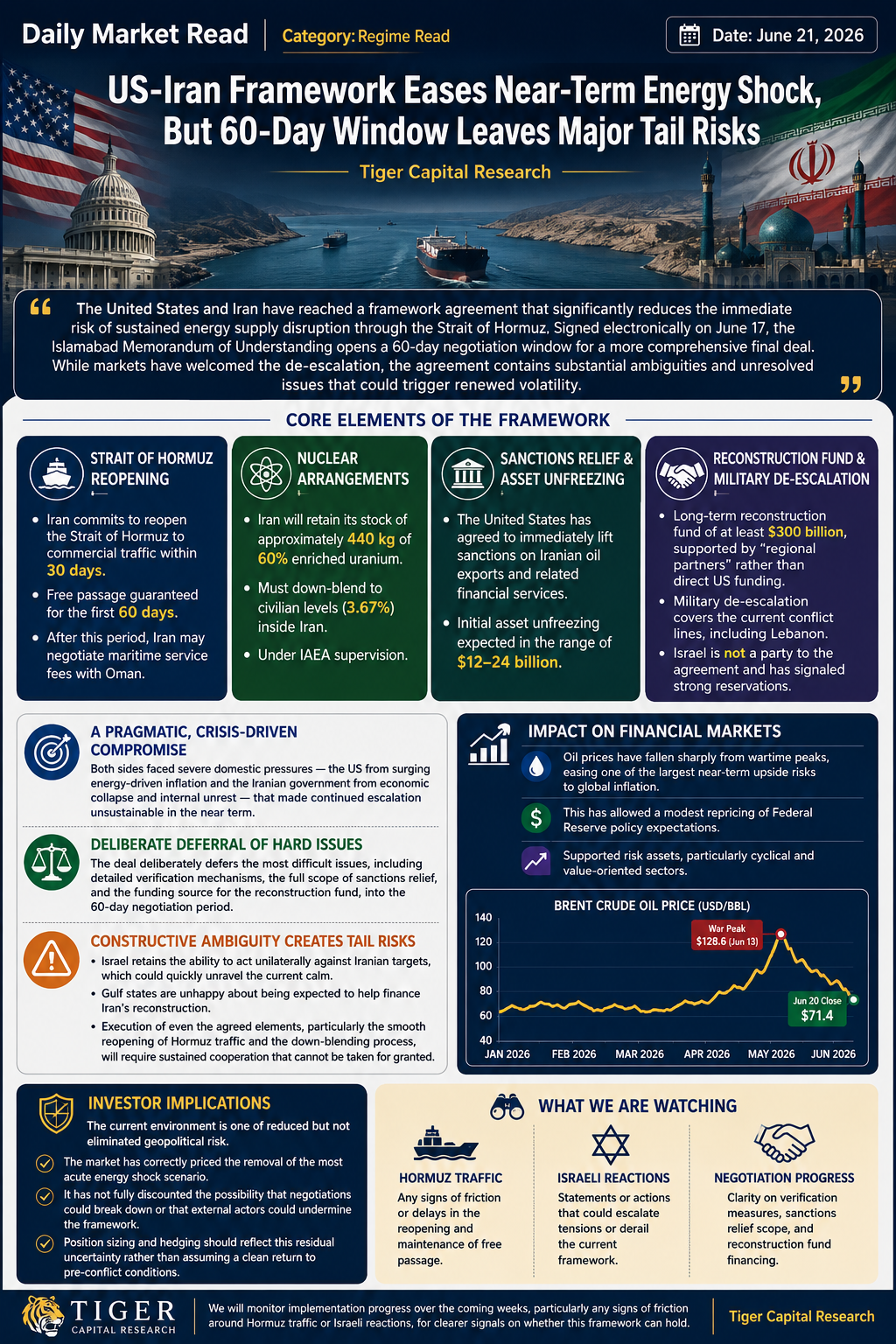
The United States and Iran have reached a framework agreement that significantly reduces the immediate risk of sustained energy supply disruption through the Strait of Hormuz. Signed electronically on June 17, the Islamabad Memorandum of Understanding opens a 60-day negotiation window for a more comprehensive final deal. While markets have welcomed the de-escalation, the agreement contains substantial ambiguities and unresolved issues that could trigger renewed volatility.
The core elements of the framework include Iran’s commitment to reopen the Strait of Hormuz to commercial traffic within 30 days, with free passage guaranteed for the first 60 days. After this period, Iran may negotiate maritime service fees with Oman.
On the nuclear front, Iran will retain its stock of approximately 440 kilograms of 60% enriched uranium but must down-blend it to civilian levels (3.67%) inside Iran under IAEA supervision. The United States has agreed to immediately lift sanctions on Iranian oil exports and related financial services, with initial asset unfreezing expected in the range of $12–24 billion.
A notable but vague provision envisions a long-term reconstruction fund of at least $300 billion, to be supported by “regional partners” rather than direct US funding. Military de-escalation covers the current conflict lines, including Lebanon, though Israel is not a party to the agreement and has already signaled strong reservations.
The agreement is best understood as a pragmatic, crisis-driven compromise rather than a comprehensive strategic reset. Both sides faced severe domestic pressures — the US from surging energy-driven inflation and the Iranian government from economic collapse and internal unrest — that made continued escalation unsustainable in the near term.
The deal deliberately defers the most difficult issues, including detailed verification mechanisms, the full scope of sanctions relief, and the funding source for the reconstruction fund, into the 60-day negotiation period.
This “constructive ambiguity” creates meaningful tail risks. Israel retains the ability to act unilaterally against Iranian targets, which could quickly unravel the current calm. Gulf states have expressed unhappiness about being expected to help finance Iran’s reconstruction. Execution of even the agreed elements, particularly the smooth reopening of Hormuz traffic and the down-blending process, will require sustained cooperation that cannot be taken for granted.
For financial markets, the immediate impact has been clear: oil prices have fallen sharply from wartime peaks, easing one of the largest near-term upside risks to global inflation. This has allowed a modest repricing of Federal Reserve policy expectations and supported risk assets, particularly cyclical and value-oriented sectors.
However, the relief is partial. The agreement does not eliminate the possibility of renewed disruption during the 60-day window, nor does it resolve longer-term questions around Iran’s nuclear program and regional influence.
Investors should treat the current environment as one of reduced but not eliminated geopolitical risk. The market has correctly priced the removal of the most acute energy shock scenario, but it has not fully discounted the possibility that negotiations could break down or that external actors could undermine the framework. Position sizing and hedging should reflect this residual uncertainty rather than assuming a clean return to pre-conflict conditions.
We will monitor implementation progress over the coming weeks, particularly any signs of friction around Hormuz traffic or Israeli reactions, for clearer signals on whether this framework can hold.
Tiger Capital Research