GenAI may be useful because it can do more human-like work. That may also be why it feels so threatening.
By Prof. Pilyoung Kim
Published: 2026-06-29
URL: https://pilyoung.substack.com/p/what-happens-when-ai-makes-your-expertise
In the last post, I wrote about a study showing that AI adoption may lower psychological safety and, through that pathway, may be linked to higher depression. The key idea was that AI may affect well-being not only through job loss, but also through uncertainty: people may feel less safe to speak up, ask questions, or admit that they are struggling with change.
Why does AI feel so personally threatening, even when it is useful?
A paper by Hermann, Puntoni, and Morewedge (2025), GenAI and the psychology of work, helps explain this. It is more of a theoretical and review paper than a single empirical study. The authors bring together research on generative AI, work, and psychological needs. Their main argument is that work is not only an economic activity. Work is also a source of identity, meaning, and social reward. GenAI is changing work because it can enhance or replace worker capabilities, including capabilities that used to be considered more uniquely human, such as cognitive, creative, and interpersonal skills.
GenAI can be helpful because it can perform many human-like tasks. But for the same reason, it can feel threatening.
Why GenAI feels different from earlier technologies
Many technologies have changed work. Machines have replaced physical labor. Computers changed information work. The internet changed how people communicate, learn, and organize.
But GenAI feels different because it enters areas that many people connect closely with their own intelligence and identity. It can write, summarize, code, create images, analyze information, generate ideas, simulate conversation, and sometimes appear socially responsive.
The authors argue that GenAI challenges traditional human-machine boundaries because it can show cognitive, creative, and interpersonal capabilities that were often considered inherently human. It can also appear more human-like through conversational interaction and social cues.
This may be one reason AI can feel so uncomfortable.
If a machine performs a physical task, people may feel displaced in a practical sense. But when a machine performs cognitive, creative, or social tasks, people may feel displaced in a deeper psychological sense.
They may wonder:
What is still special about my expertise?
What did all my years of learning mean?
If AI can do this too, what is my role?
Am I being helped, or am I being replaced?
The promise: AI can support competence, autonomy, and relatedness
The paper uses self-determination theory to explain both the benefits and threats of GenAI. According to this framework, people have basic psychological needs for competence, autonomy, and relatedness.
Competence means feeling effective and capable.
Autonomy means feeling some control over one’s actions.
Relatedness means feeling connected to others.
The authors explain that GenAI can support all three. It can increase competence by helping people perform tasks more effectively, make decisions, solve problems, and create higher-quality work. It can increase autonomy by taking over repetitive or routine tasks, allowing people to spend more time on meaningful or creative work. It can also support relatedness by helping people communicate, collaborate, or focus more on social aspects of work.
The paper also reviews evidence that GenAI can increase productivity across many kinds of tasks in writing, consulting, coding, customer support, product innovation, and other domains.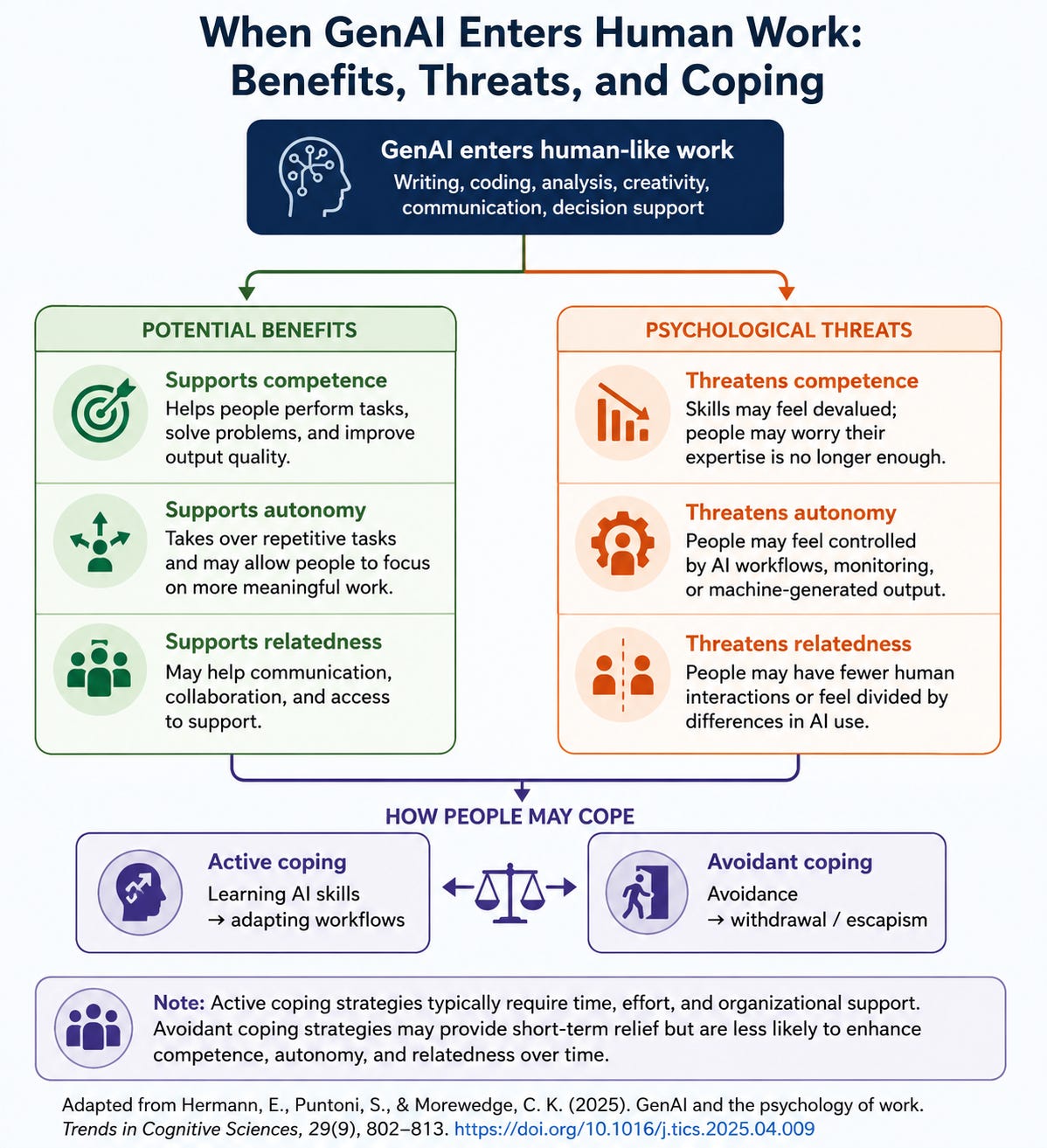
The threat: AI can make people feel less competent and reduce autonomy
But, GenAI can threaten competence when it replaces or devalues skills people already have, or when it creates new expectations that people do not yet feel prepared to meet.
A person may have spent years developing writing skills, coding skills, analytic judgment, design ability, teaching methods, or professional communication skills. Then GenAI enters the workplace and appears to perform some of these tasks quickly and fluently.
Even when AI output is imperfect, the psychological effect can still be strong. People may feel that their skills are becoming less valuable. They may feel pressure to develop new AI-related skills. They may worry that their expertise is no longer enough.
The paper also discusses autonomy. GenAI can support autonomy when it removes repetitive tasks or helps people work more flexibly. But it can reduce autonomy when people feel that AI systems are controlling the workflow, making decisions, monitoring them, or turning them into editors of machine-generated output.
People may feel less ownership over their work if they think the main contribution came from AI. The authors also note that AI used for monitoring or surveillance may create especially serious autonomy-related threats.
The threat: AI can change human connection
The paper also discusses relatedness. GenAI may reduce some human-to-human interactions if people turn to AI instead of colleagues for information, support, or feedback. It may also create divisions among workers based on who uses AI, who resists it, who benefits from it, and who feels left behind.
The authors describe how GenAI can reduce opportunities for collaboration, create social isolation, and even affect how people perceive one another. If people begin to see coworkers through the lens of the AI systems they use, there may be risks of dehumanization or reduced social connection.
How people may cope with AI-related threat
One of the most unique parts of the paper is the discussion of coping strategies.
The authors describe five ways workers may respond when GenAI threatens their sense of competence, autonomy, or relatedness: direct resolution, symbolic self-completion, dissociation, escapism, and fluid compensation.
Some of these strategies are more active. For example, people may try to directly resolve the threat by learning how to use GenAI effectively, adapting workflows, or collaborating with others to build new skills.
Others are more avoidant. People may avoid GenAI-related tasks, withdraw from situations where they feel out of control, disengage from teamwork where AI is prominent, or mentally escape from the stress.
The authors note that direct resolution and fluid compensation may require more time and personal resources. These strategies may also require organizational support, such as training or resources. In contrast, dissociation and escapism may provide immediate distance from the threat, but they can reduce engagement, growth, and connection to work.
We often talk as if people should simply adapt. Learn AI. Use AI. Keep up. Do not resist.
But this framework really helps to understand what happens if the demand for adaptation is beyond what we can cope with. Adaptation requires effort. It requires time, support, emotional energy, and a sense that learning is possible. If people are already overwhelmed, under-supported, or afraid of being judged, they may be more likely to choose passive coping strategies such as avoidance or escapism.
Can we blame ourselves?
When people are in an overwhelming situation with little support, they choose the coping strategies available to them. Avoidance is a common response to threat, exhaustion, or lack of control.
The shrinking space of uniquely human skills
One of my own concerns is that the area where people need to use AI is expanding quickly, while the area that feels uniquely human may feel like it is shrinking.
For years, people were told to focus on uniquely human skills: creativity, critical thinking, communication, empathy, judgment, and complex problem-solving. But GenAI is now entering many of these domains too.
This creates a difficult psychological situation. People may hear two messages at the same time:
“You need to become AI proficient.”
“Focus on the human skills AI cannot replace.”
Both may be true. But both require effort. And the boundary between AI skills and human skills is moving quickly.
This may create stress not only because people need to learn new tools, but because they need to keep redefining what their work means.
Why support matters
The paper’s conclusion is that organizations need psychologically informed design, development, and deployment of GenAI. Training and skill development can increase competence. Allowing people to shape how AI tools are integrated into their tasks can support autonomy. Supportive relationships, feedback, empathy, and collaborative cultures can support relatedness.
If we want people to use AI well, we cannot only give them access to tools. People also need time to learn, opportunities to practice, and environments where they can ask questions without shame. They need support for both technical skills and human skills.
This may also need to start earlier in education. Children and youth are growing up in a world where AI will shape learning, work, creativity, and relationships. Preparing them should not only mean teaching them how to prompt a chatbot. It should also mean helping them develop adaptability, judgment, curiosity, emotional resilience, ethical reasoning, and a stable sense of self when the world around them changes quickly.
And adults need this too.
Reference
Hermann, E., Puntoni, S., & Morewedge, C. K. (2025). GenAI and the psychology of work. Trends in Cognitive Sciences, 29(9), 802–813. https://doi.org/10.1016/j.tics.2025.04.009.