A study suggests that one hidden risk of AI adoption may be lower psychological safety
By Prof. Pilyoung Kim
Published: 2026-06-15
URL: https://pilyoung.substack.com/p/when-ai-makes-life-feel-more-uncertain
There has been growing discussion in the news and media about how AI may increase people’s anxiety and negatively affect well-being. Much of this discussion focuses on job loss, automation, and whether AI will replace human workers. But the psychological impact of AI may be broader than actual job loss.
Many people already feel pressure to adapt to AI. They may feel that they need to learn quickly, keep up with new tools, and prove that their skills are still valuable. Some may worry that the expertise they worked hard to develop may become less important. Others may feel uncertain about how their work, education, or future opportunities will change.
This is why empirical evidence is important. AI may create new opportunities. It may help people work more efficiently, learn new skills, and access new forms of support. At the same time, we need to understand what kinds of psychological risks AI creates, and what kinds of skills and environments may help people navigate this transition while maintaining their well-being.
In this study, AI adoption refers to how much an organization is using AI technologies in its systems and daily operations. For example, a company may use AI in hiring, human resources, marketing, customer service, strategic planning, finance, or operations.
Psychological safety means feeling that it is safe to speak up, ask questions, admit uncertainty, raise concerns, or make mistakes without being punished, embarrassed, or judged harshly.
In the workplace, this might mean feeling able to say:
“I do not fully understand how this AI system works yet.” “I am worried about how this will affect my role.” “I think we should discuss possible risks before using this tool.” “I made a mistake while using this new system and need help.”
A study on AI adoption and depression
One recent paper that speaks directly to this issue is by Kim, Kim, and Lee (2025), titled The dark side of artificial intelligence adoption: linking artificial intelligence adoption to employee depression via psychological safety and ethical leadership.
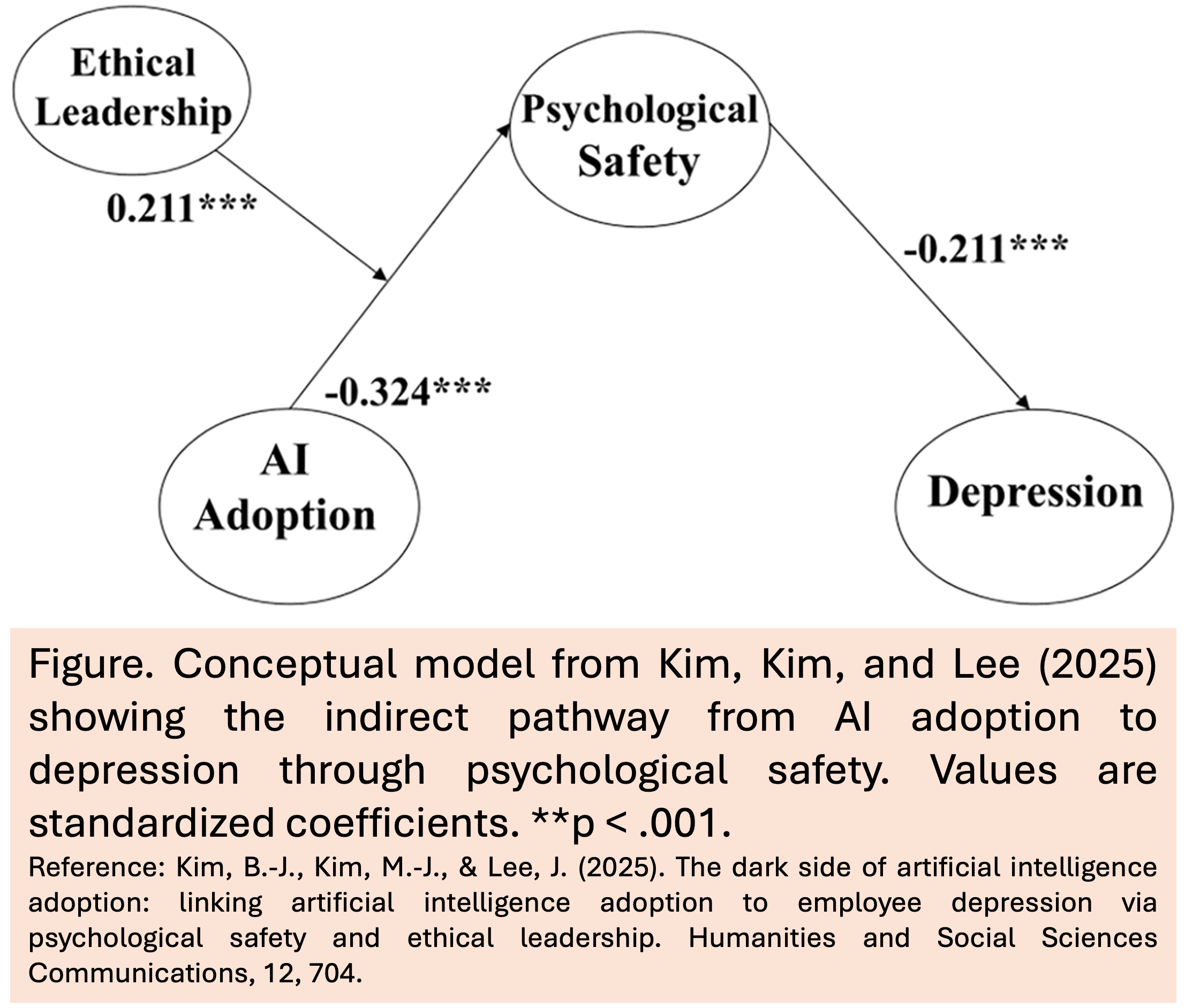
The authors studied 381 employees in South Korean companies using a three-wave time-lagged survey design. They examined whether AI adoption in organizations was related to employee depression, and whether psychological safety explained this association.
The main finding is that AI adoption was associated with lower psychological safety, and lower psychological safety was associated with higher depression. The indirect pathway was through psychological safety: AI adoption may reduce people’s sense that it is safe to speak up, ask questions, raise concerns, or admit uncertainty. When psychological safety is lower, people may be more vulnerable to depressive symptoms.
Why this matters in the workplace and beyond
We often think of AI adoption as a technical or organizational change. A company introduces new tools. People learn how to use them. Workflows change. Productivity may improve. But this study suggests that AI adoption may also change how safe people feel in the environment around them.
The authors explain that AI adoption can increase uncertainty. Employees may feel uncertain about their job security. They may feel vulnerable about their AI skills. They may worry that their role will change or that their existing expertise will become less valuable. These uncertainties can make people less willing to share their ideas, ask questions, or express concerns.
Although this study focused on employees, I think the idea may be applied more broadly. AI is creating uncertainty not only at work, but also in education, parenting, creative fields, and young people’s future planning. People may wonder what skills will matter, what kinds of work will remain valuable, and how quickly they need to change.
When people feel that AI is changing the meaning of their skills or future opportunities, they may not want to say openly that they are struggling. If they are worried about being seen as outdated, replaceable, or resistant to innovation, they may stay quiet. They may act as if they are adapting well even when they are anxious. Asking for help can feel risky when the environment already feels uncertain.
The role of leadership and environment
The paper also examined ethical leadership. The authors argue that ethical leaders may reduce some of the negative effects of AI adoption by being transparent, fair, and concerned about employee well-being. In the study, ethical leadership moderated the relationship between AI adoption and psychological safety.
I found this point important, although the finding was not perfectly straightforward. The authors present ethical leadership as a buffer, but the pattern seemed somewhat more complicated than I expected, especially because low ethical leadership was associated with higher psychological safety when AI adoption was high. I wish the authors had explained this part more clearly.
Still, the broader message is useful. AI adoption depends on whether people feel included, informed, and respected during the transition.
What this tells us about AI and well-being
This study gives us a clearer picture of what may be happening psychologically. AI is likely increasing uncertainty in many people’s lives. This uncertainty may involve job security, skills, status, competence, learning, and future opportunities. When uncertainty increases and psychological safety decreases, people may become more vulnerable to depression and other forms of distress.
This issue will likely become more important as AI becomes more capable and more widely adopted. The impact of AI on work tasks, education, and future opportunities is likely to grow. Even when AI creates opportunities, it may also create stronger pressure to adapt. People may increasingly feel that they need to change how they work, how they learn, and how they understand their own value.
What may help people navigate this period?
As we think about how adults and young people should prepare for this age, the answer cannot be only “learn AI skills.” We also need to think about psychological and social capacities.
People will need the ability to adapt to change and uncertainty. They will need to keep learning without feeling ashamed that they do not already know everything. They will need to tolerate ambiguity. They will need to ask good questions, seek support, and think critically about when AI should and should not be used.
For young people, this may be especially important. They are entering a world where valued skills may change quickly. They may need technical literacy, but also adaptability, resilience, curiosity, self-reflection, and the ability to maintain a sense of meaning even when the work and learning landscape changes.
The burden should also not be placed only on individuals. Environments matter. People need places where they can ask questions, express concerns, and admit uncertainty without feeling judged. Leaders, educators, parents, and organizations need to include people’s concerns in the process rather than treating concern as resistance.
Without this kind of environment, people may adopt AI outwardly while struggling inwardly.
The deeper question
To me, this paper is important because it shifts the question. Instead of asking whether AI improves productivity, we also need to ask whether AI adoption makes people feel more or less psychologically safe. Instead of asking whether people are using AI, we need to ask how AI is affecting their well-being, their sense of security, and their ability to speak honestly about change.
AI will bring new possibilities. If we want people to benefit from these possibilities, we need to better understand the psychological conditions that help people navigate uncertainty.
The deeper question is how people can continue to protect their well-being in the age of AI.
Reference: Kim, B.-J., Kim, M.-J., & Lee, J. (2025). The dark side of artificial intelligence adoption: linking artificial intelligence adoption to employee depression via psychological safety and ethical leadership. Humanities and Social Sciences Communications, 12, 704. <https://doi.org/10.1057/s41599-025-05040-2>