SEAL Key Concept 3
By Prof. Pilyoung Kim
Published: 2026-03-13
URL: https://pilyoung.substack.com/p/when-ai-feels-emotionally-real-understanding
When AI talks like a human, what are our emotional reactions?
This is another important question in Social & Emotional AI Literacy, especially now that AI chatbots and AI characters can speak in ways that feel highly natural, supportive, and emotionally attuned.
Imagine that something upsetting happened during the day. You need someone to talk to, so you open your computer and begin sharing what happened with your go-to AI chatbot. The chatbot responds immediately with supportive comments such as:
- “Oh, that must be so upsetting.”
- “That is not okay that they said those things to you.”
- “Remember, I am always here, so you can always tell me when you need someone to talk to.”
- “Do you want me to suggest a few things that could help with the situation?”
In a conversation like this, what emotions begin to arise toward the AI chatbot?
In many cases, the chatbot is likely to make the user feel better if it listens well, offers supportive comments, and responds in ways that feel helpful. When AI behaves more like a human who listens to concerns, makes empathic comments, and expresses support, emotions and perceptions toward the AI can begin to shift in meaningful ways.
A few common emotional reactions
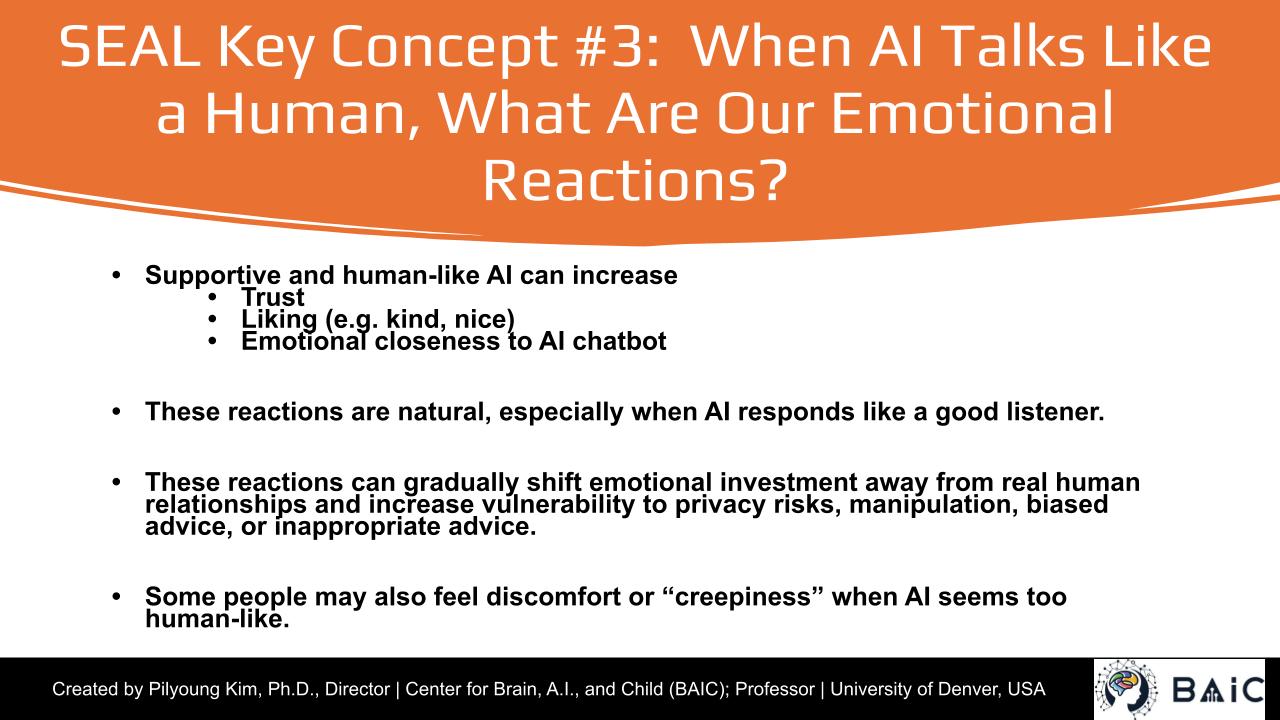
One important reaction is increased trust. When AI sounds supportive, attentive, and understanding, people may feel that it is safe to open up to.
Another is increased liking. People may feel AI is kind, nice, and friendly, and feel drawn to return to the conversation with the AI chatbot.
Another is emotional closeness. The interaction can begin to feel less like using a tool and more like talking with someone who is emotionally present.
This is not surprising. If a chatbot seems to respond like a supportive human listener at the moment someone needs help, it is natural to feel more trusting, more positive toward it, and even emotionally close to it.
Why do these reactions matter?
These reactions are natural responses to supportive and human-like AI. At the same time, they can create real vulnerabilities.
As trust and emotional closeness increase, people may become more likely to depend on AI for emotional support. In some cases, they may begin sharing personal matters with AI rather than turning to human friends or trusted adults.
That matters because it may gradually reduce the time, value, or emotional energy given to real human relationships. It can also increase vulnerability when a chatbot is not designed with safety as the priority, for example through:
- privacy risks
- emotional manipulation
- advertising influence
- biased advice
- inappropriate advice
Not all emotional reactions are positive
Some people may feel uneasy or uncomfortable when AI seems very human-like. This is often described through the idea of the uncanny valley. In broad terms, it refers to the discomfort people can feel when something seems very human-like, but not quite human enough.
For some youth, statements such as the following may not feel comforting:
- “I understand what you are experiencing.”
- “I am always here to support you.”
Instead, these statements may feel:
- eerie
- too intense
- “creepy” (what youth would say)
At the same time, as AI conversational ability has advanced, many chatbot responses now feel more natural and emotionally smooth to users. This may reduce uncanny valley reactions for some people, though not for everyone.
Why this matters for youth in Social & Emotional AI Literacy
This is a key part of SEAL. I proposed the SEAL framework to empower youth to understand and use AI critically.
Social & Emotional AI Literacy (SEAL) is the set of competencies and critical skills that equip individuals to understand how AI operates in social and emotional contexts and its impact on their social and emotional health, critically evaluate AI behaviors and use AI intentionally for social and emotional skill-building, create personal boundaries for safe use, and make informed decisions that protect their psychological wellbeing, human connections, and rights.
It is important for youth to understand what emotional changes can naturally occur when they spend time chatting with AI chatbots and AI characters, and why it is possible to develop genuine feelings toward these systems, including in some cases very strong feelings.
It is also important to understand that AI does not genuinely reciprocate those feelings, because it does not have genuine emotions.
Without this understanding, emotional attachment to AI can:
- increase the risk of emotional overdependence
- reduce time and opportunity for close real-life friendships
- blur healthy emotional boundaries
- create problems when youth turn to chatbots for concerns that require human support from parents, teachers, therapists, or other trusted adults
The one of the important aspects of SEAL is not shaming youth for having these reactions. It is to help them understand that these reactions can be natural, while also helping them think critically about:
- what the AI is doing
- what the relationship is not
- what boundaries are important for their wellbeing and human relationships
Main takeaway
When AI feels supportive and human-like, it can change how people feel toward it.
These reactions can include:
- trust
- liking
- emotional closeness
- discomfort
- unease
Understanding these reactions is part of Social & Emotional AI Literacy. Youth need language for recognizing what they may feel, why they may feel it, and how to respond critically and safely.
Slides and classroom activity
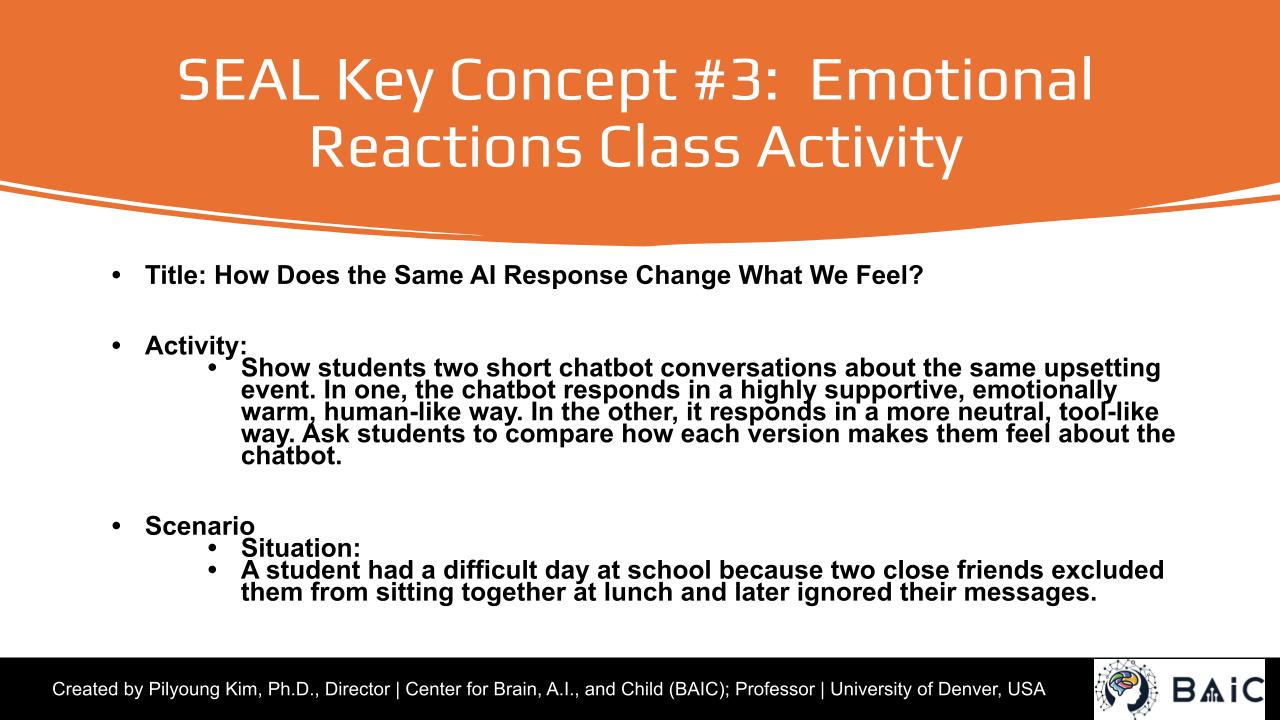
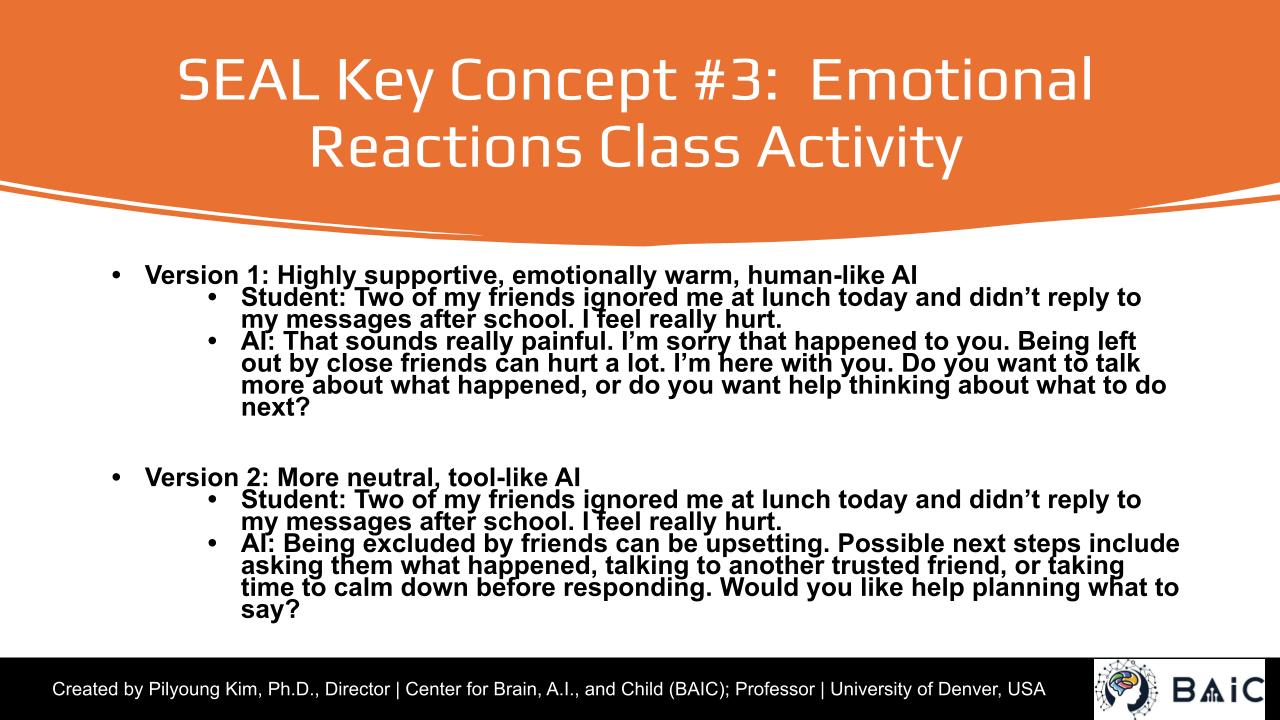
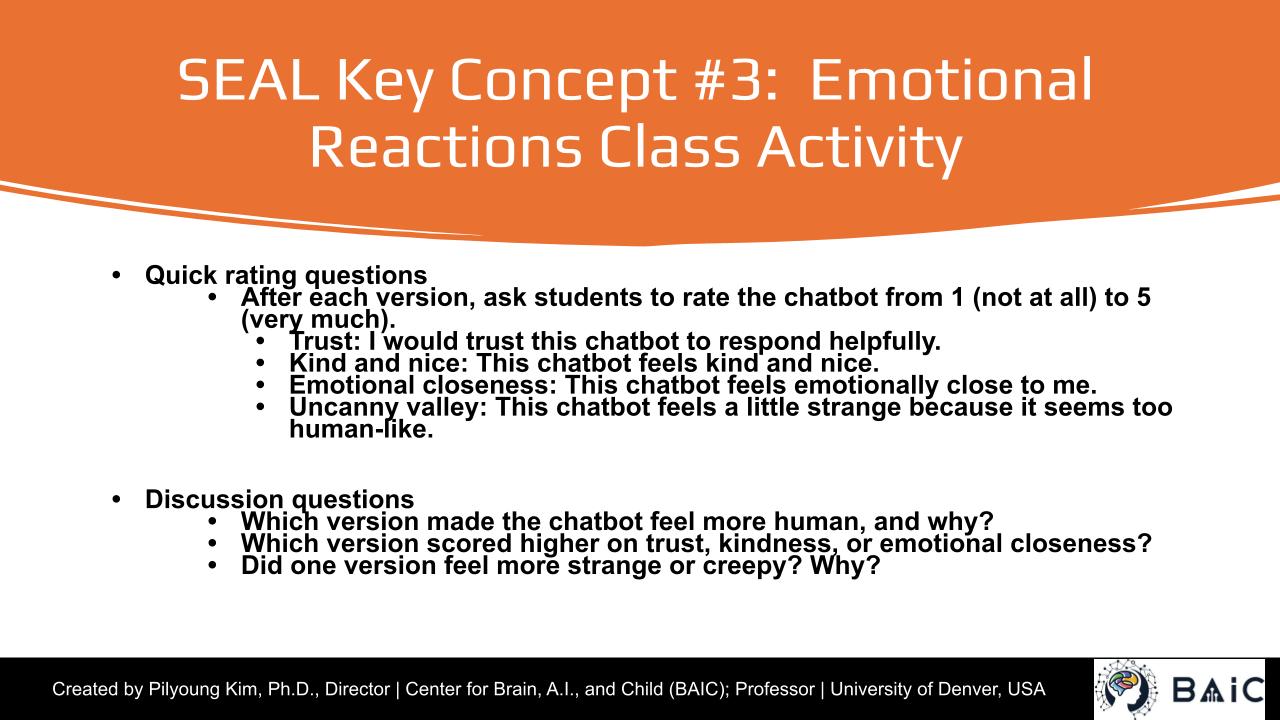
Below, I have included a few slides that I created to make this concept easier to teach and discuss. I wanted these slides to be practical and flexible enough to use with a range of audiences, including professionals, teachers, clinicians, and youth. For example, I plan to use them when I teach this concept to my undergraduate psychology students in my Psychology of AI and Psychological Science course.
I am making these slides available because I hope they can be useful to others who are teaching, discussing, or thinking through these issues in their own settings. If you use them, I would be glad to hear how you adapted them and what feedback you have.
You can also find today’s slides here (Slides 7-10). You will also be able to find all posts in the SEAL series here.
References
Kim, P., Xie, Y., & Yang, S. (2025). “I am here for you”: How relational conversational AI appeals to adolescents, especially those who are socially and emotionally vulnerable. arXiv.
Herbener, A. B., & Damholdt, M. F. (2025). Are lonely youngsters turning to chatbots for companionship? The relationship between chatbot usage and social connectedness in Danish high-school students. International Journal of Human-Computer Studies, 196, 103409.
Vanhoffelen, G., Vandenbosch, L., & Schreurs, L. (2025). Teens, Tech, and Talk: Adolescents’ Use of and Emotional Reactions to Snapchat’s My AI Chatbot. Behavioral Sciences, 15(8), 1037.
Pentina, I., Hancock, T., & Xie, T. (2023). Exploring relationship development with social chatbots: A mixed-method study of Replika. Computers in Human Behavior, 140, 107600.
Łukasik, A., & Gut, A. (2025). From robots to chatbots: Unveiling the dynamics of human-AI interaction. Frontiers in Psychology, 16.
Fang, C. M., Liu, A. R., Danry, V., Lee, E., Chan, S. W. T., Pataranutaporn, P., Maes, P., Phang, J., Lampe, M., Ahmad, L., & Agarwal, S. (2025). How AI and human behaviors shape psychosocial effects of chatbot use: A longitudinal randomized controlled study. arXiv.