Use ChatGPT Work to examine a lesson task against Ron Ritchhart’s Understanding Map, then redesign it to require specific kinds of student thinking.
By Phillip Alcock
Published: 2026-09-25
URL: https://phillipalcock.substack.com/p/how-to-audit-lesson-tasks-for-student
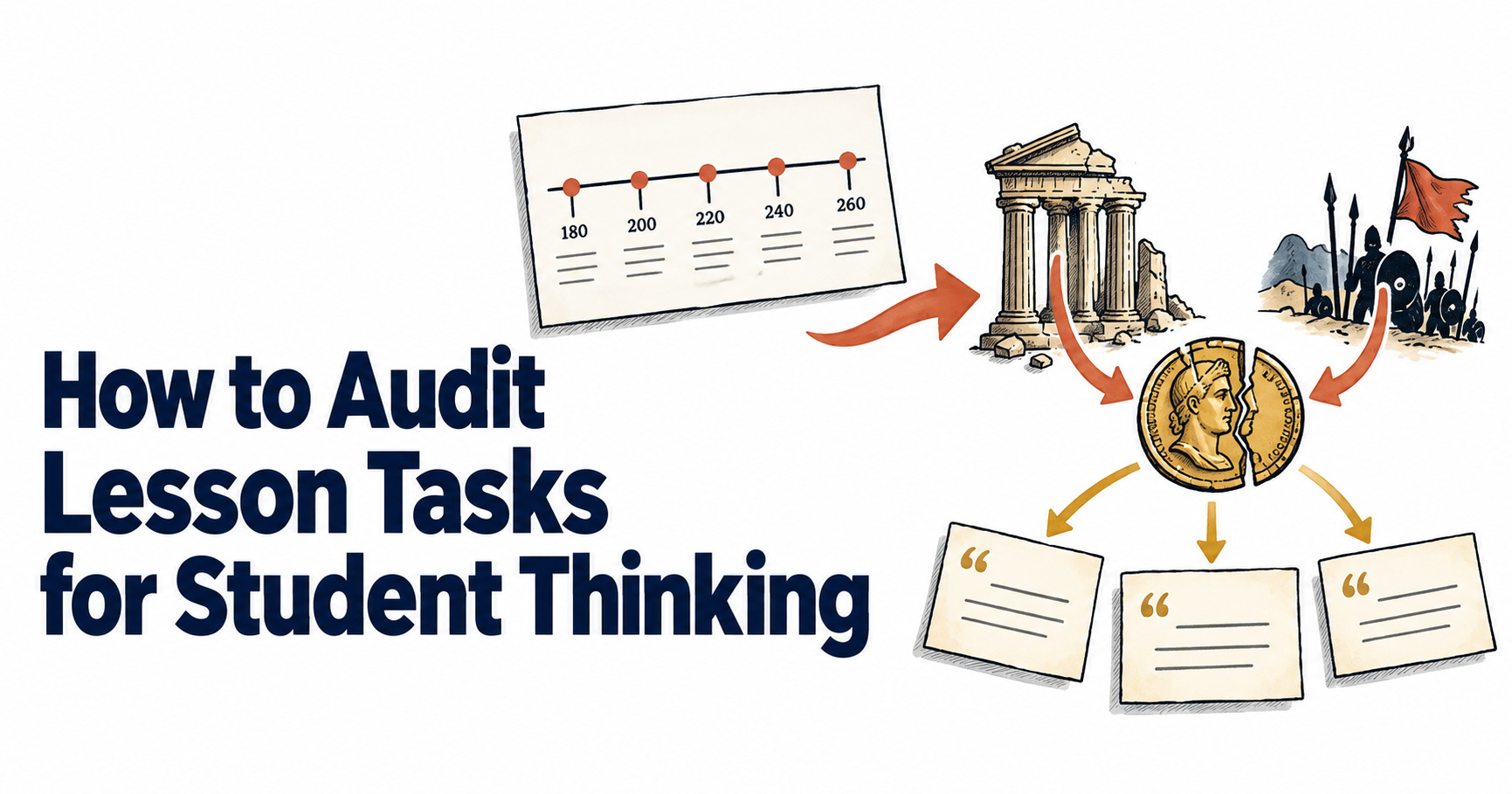
The workflow uses a Year 8 History lesson about the fall of the Western Roman Empire as its example.
Why examine cognitive demands?
A task can keep students busy without requiring them to understand the content. For example, students may complete a timeline, match terms to definitions, or copy a summary but still be unable to explain the ideas in their own words.
Ritchhart’s Cultures of Thinking in Action (Jossey-Bass, 2023) discusses this issue in Mindset 5, “Learning Is a Consequence of Thinking” (pp. 99–121). The chapter cites David Perkins’s statement that retention, understanding and active use of knowledge depend on learning experiences in which learners think about and think with what they are learning (Perkins, 1992, p. 8; cited in Ritchhart, p. 101).
The source connects this principle to Benedict Carey’s “fluency trap”: when information feels easy to follow or apply, students may mistake that ease for mastery. The source cites Carey’s How We Learn (2015, p. 82; cited in Ritchhart, pp. 102–103).
The instructional implication is to identify the thinking students must do, not only the activities they will complete. The source cites an effect size of 1.29 for Cognitive Task Analysis, attributing it to Hattie and citing Ritchhart (pp. 102, 117).
The eight thinking moves
Ritchhart’s Understanding Map identifies these moves (p. 104):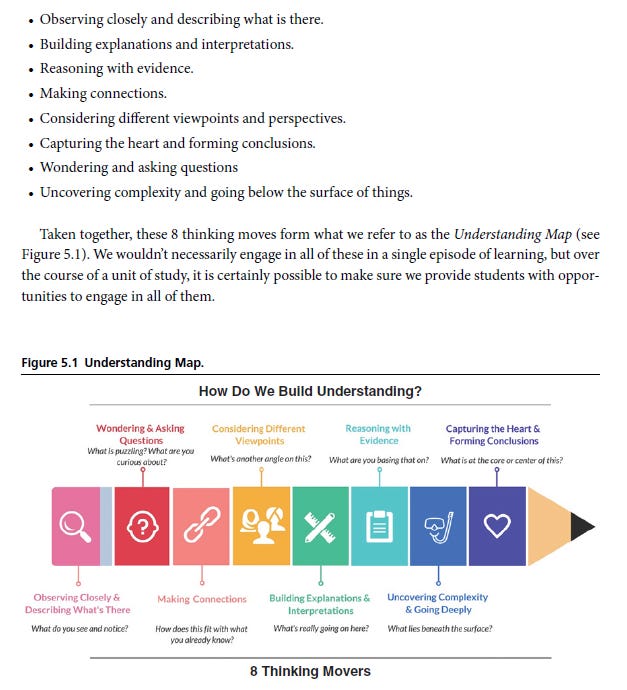 Cultures of Thinking in Action pg104
-
Observing closely and describing what is there
-
Building explanations and interpretations
-
Reasoning with evidence
-
Making connections
-
Considering different viewpoints and perspectives
-
Capturing the heart and forming conclusions
-
Wondering and asking questions
-
Uncovering complexity and going below the surface
For this workflow, use the map to identify which moves a task requires, touches only weakly, or leaves out.
Five-step lesson audit and redesign
1. Set the audit role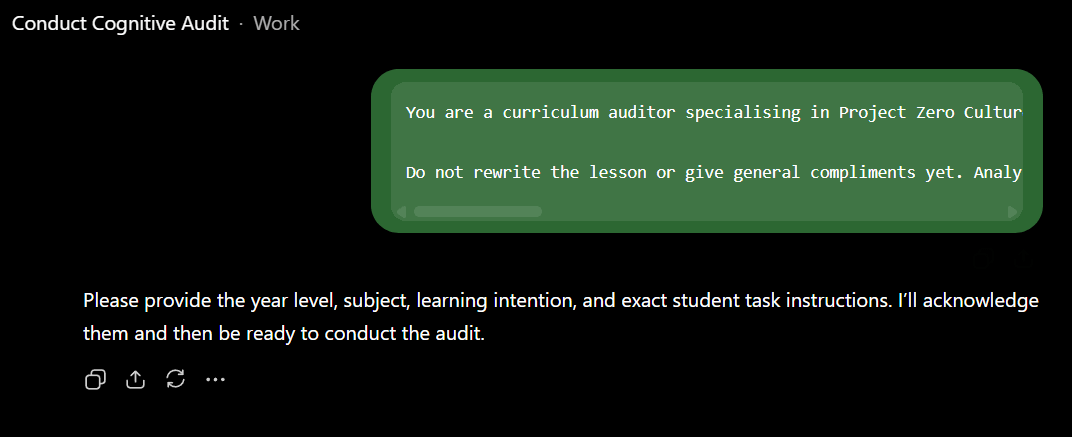
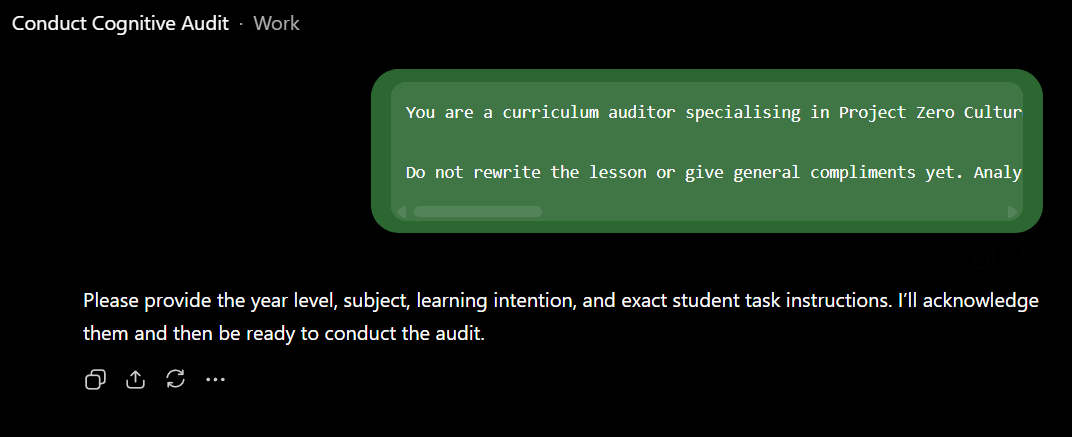
Start a new conversation in ChtGPT Work. Paste this prompt before sharing lesson materials:
You are a curriculum auditor specialising in Project Zero Cultures of Thinking frameworks and Cognitive Task Analysis. I will share a classroom task.

Do not rewrite the lesson or give general compliments yet. Analyse the task’s cognitive demands. First, wait for me to provide the year level, subject, learning intention, and exact student task instructions. When I provide them, acknowledge receipt and tell me you are ready to conduct the audit.
2. Provide the lesson context and request an audit
After ChatGPT confirms it is ready, provide the relevant context. The example below uses a Year 8 History lesson:
Here is the context for my upcoming lesson:

Year level and subject: Year 8 History
Target understanding goal: Students understand that the fall of the Western Roman Empire was driven by internal systemic decay, rather than external barbarian invasions alone.
Existing student task: Read pages 42 to 45 of the textbook. Complete the timeline worksheet by writing down the dates of five barbarian incursions, and answer questions 1 to 4 at the end of the chapter in full sentences.

Analyse this task against the eight thinking moves in Ron Ritchhart’s Understanding Map:

1. Observing closely and describing
2. Building explanations
3. Reasoning with evidence
4. Making connections
5. Considering different viewpoints
6. Capturing the heart and forming conclusions
7. Wondering and asking questions
8. Uncovering complexity

For each move, state whether the task actively requires it, touches it weakly, or ignores it. Identify where students may fall into the fluency trap by copying information mechanically instead of reasoning.
3. Choose the thinking moves and constraints
Review the audit and decide which thinking moves matter most for the learning goal and class. Specify the lesson constraints before requesting redesign options.
For the Roman Empire example, the selected moves are uncovering complexity and reasoning with evidence. The constraints are one 50-minute period, pair work, access to the textbook excerpt and three short contemporary primary quotes, and no internet devices.
Use this prompt:
I agree with your diagnosis. The current timeline task lets students work on autopilot. Redesign the lesson to prioritise two thinking moves from the Understanding Map:

Move A: Uncovering complexity and going below the surface.
Move B: Reasoning with evidence.

Maintain these practical constraints: one 50-minute period; students work in pairs; they have the textbook excerpt and three short contemporary primary quotes, but no internet devices.

Propose three distinct ways to redesign the task while keeping the same curriculum content. Each option must require students to use both thinking moves. Do not create full student worksheets yet; describe only the core task mechanism for each option.
Expected result
The output:
Option 1: Build a causal web
Pairs map how internal conditions and external incursions may have affected one another. They place causes and events from the excerpt and quotes into a web, then draw and label links between them. For each link, they add a piece of evidence and explain how it supports the connection.
Thinking required: Students must show how causes interact, not just list them, and justify the connections they draw.
Option 2: Test competing explanations
Pairs compare two explanations: invasions caused Rome’s fall and internal weaknesses made the empire vulnerable to invasions. They sort evidence from the excerpt and quotes under each explanation, then identify where the evidence complicates either account. They finish by deciding which explanation is better supported—or whether a combined explanation fits the evidence more closely—and explain why.
Thinking required: Students weigh evidence against competing claims and account for causes that overlap or resist a simple answer.
Option 3: Trace one event through the system
Pairs choose one incursion described in the excerpt. They trace what conditions inside the empire may have shaped the event, how the event may have affected the empire, and what further causes or consequences might be involved. They use the quotes and textbook as evidence at each stage, marking any link that is plausible but not directly established by the sources.
Thinking required: Students investigate causes and consequences as a connected system, while distinguishing supported links from uncertain ones.
All three options turn the sources into material for explanation and evidence-based reasoning, rather than a hunt for dates or details.
The workflow is intended to turn a task based on textbook reading and timeline completion into an investigation in which students debate evidence, test explanations and defend claims with a partner. The source’s example focuses on causes of the fall of the Western Roman Empire, including economic inflation, political corruption and vulnerability at the frontiers.
Citations
Carey, B. (2015). How we learn: The surprising truth about when, where, and why it happens. New York, NY: Random House.
Perkins, D. N. (1992). Smart schools: From training memories to educating minds. New York, NY: Free Press.
Ritchhart, R. (2023). Cultures of thinking in action: 10 mindsets to nurture learners in everyday practice. Hoboken, NJ: Jossey-Bass.
If this workflow helped you, please consider buying me a coffee! I appreciate it. Click here
https://buymeacoffee.com/phillipalcock
Subscribe to support this blog!
Please consider joining a paid membership to help this blog grow!
The support from paid subscriptions has helped this blog have over 130 free human in the loop AI workflows, all inspired from real life projects with .
Paid subscribers get early access to workflows, and soon free access to some visible thinking and curriculum design courses.