A guest post by Laura Kriegel, Founder of Camp Stomping Ground
By Peter Gray
Published: 2026-05-09
URL: https://petergray.substack.com/p/113-conflict-is-the-curriculum
Dear friends,
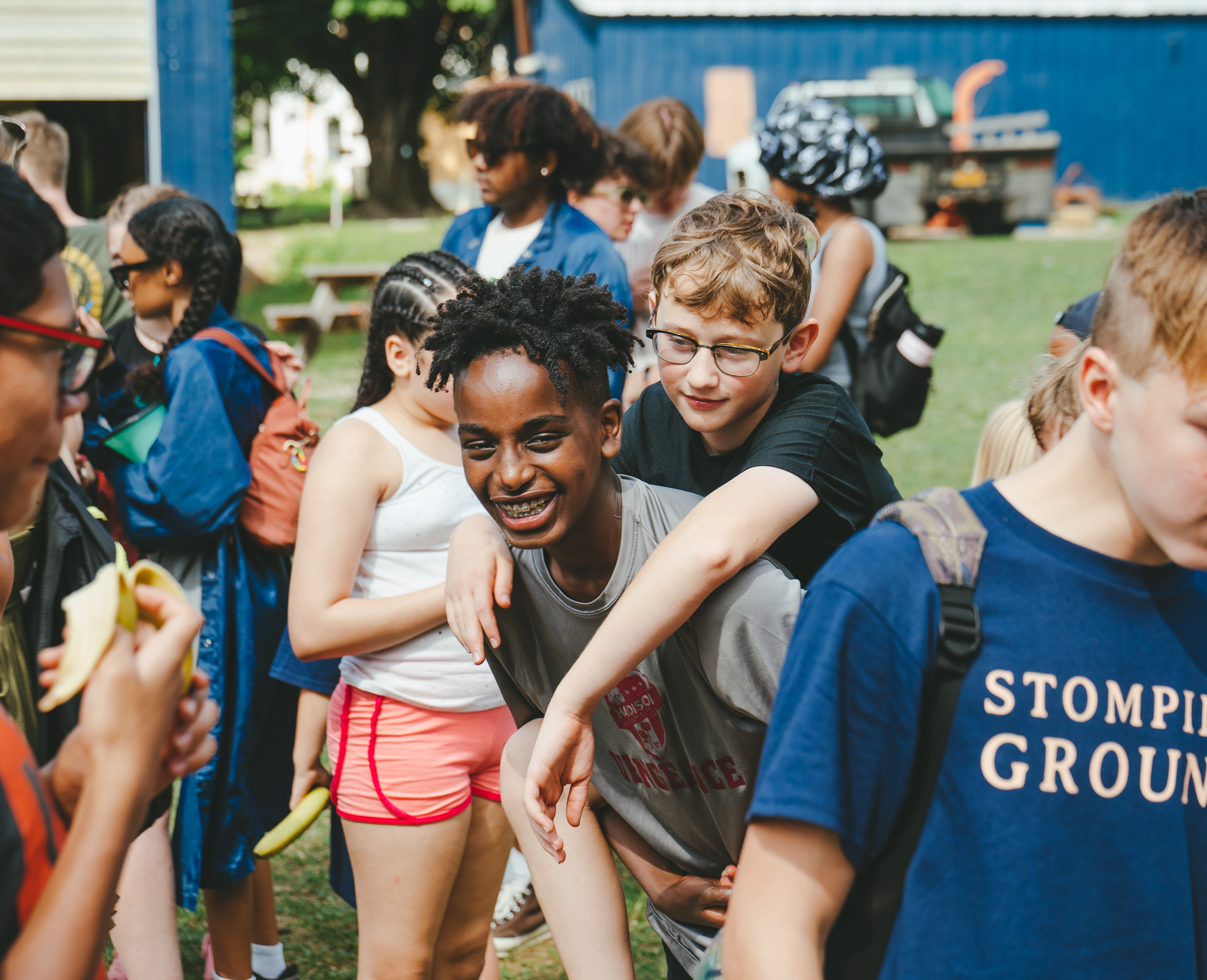
This is the second of two guest posts (see here for the first) by Laura Kriegel, founder and executive director of a remarkable camp, Camp Stomping Ground in Middle Grove, NY, which deliberately brings kids together who differ widely in age, personality, economic background, and cultural background. Conflict is inevitable, and Laura’s theory—proven correct repeatedly—is that the role of adults is not to solve the conflict but to create the space and freedom for the kids to solve it.
Laura’s Post
When a fight breaks out between two kids, the adult instinct is to stop it. Separate them. Assign blame. Issue consequences. Move on.
We’ve built entire systems around this instinct: zero tolerance policies, behavior charts, referrals, suspensions. We’ve professionalized conflict management to the point where children are rarely allowed to sit inside a hard moment long enough to learn anything from it. The mess gets cleaned up before the lesson can happen.
Peter Gray’s work on free play has been making the case for years that what children need most is what we keep taking away from them - time, autonomy, and the chance to work things out themselves. And that sounds like conflict. Real conflict, with real stakes, in a community that trusts kids enough to let it get uncomfortable before it gets resolved.
At Stomping Ground, conflict isn’t a problem we manage. It’s the curriculum.
Jaylen, Darius, and Joseph
A few summers ago, two campers named Jaylen and Darius arrived at camp with a long history between them. Sometimes friends, sometimes rivals, they were placed in the same cabin, both jockeying to be cool, one edging into bullying the other. Darius was neurodivergent and wasn’t always reading the social dynamics clearly. Jaylen was frustrated. It was exactly the kind of slow-burn conflict that in most settings would get someone kicked out - the tension managed rather than acknowledged.
We didn’t do that. We sat in circles with them. Almost every day.
My camp director Klee and I kept showing up, kept asking questions, kept trying to help them see each other. We were coming up short. The circles felt repetitive. I wasn’t sure they were working.
Then a young staff member named Joseph said something that cracked it open.
Joseph was new that summer. He’d grown up in inner-city Rochester, and camp - the woods, the bugs, the whole unfamiliar vibe of it - was a stretch. He was figuring it out in real time, giving everything he had, not yet sure what he believed about any of this circle stuff.
In one of those daily circles, Joseph looked at the boys and said something like: you have to think about what people are going through at home. And then he named it. Darius’s dad was dying. Darius thought everyone was against him. He was moving through the world braced for impact, and none of his behavior made sense until you knew that.
Something shifted in Jaylen. A recognition. An oh. He realized he could let Darius’s behavior go. That it wasn’t about him. That Darius was carrying something enormous and didn’t have the words for it.
What made it land wasn’t the insight itself. It was Joseph. These boys thought Joseph was cool. He was from where they were from, he talked how they talked, and here he was, in the middle of the woods at this weird camp, naming big feelings out loud without flinching. That was the permission slip. If Joseph could do it, maybe they could too.
I called Joseph recently to ask if he remembered that circle. He did. He said it was a moment of clarity, for the boys and for himself. He saw, maybe for the first time, why this process works. Why it matters. Why you have to keep showing up even when the circles feel like they’re going nowhere.
Free time and a Container
No curriculum would have designed that moment. No adult could have scripted it. It required free time to build the tension, daily circles to build the container, and Joseph, barely older than those boys, still finding his own footing, to say the true thing at the right moment.
Here’s what we’ve learned from watching this happen summer after summer: kids don’t need adults to resolve their conflicts. They need adults to hold the container while they do it themselves.
We’re explicit about this from the first night of every session. We tell campers: conflict is going to happen here, and when it does, we’re going to talk about it. Not punish it. Not manage it from above. Talk about it. The norms are visible. The expectations are shared. There’s no hidden curriculum.
Sociologist Iannaccone, whose work Anna Lembke draws on in Dopamine Nation, describes this kind of transparent community norm as a “club good,” the shared rules that make belonging real. The clarity of what a community asks of you is part of what makes it yours. Kids figure this out fast. Within a week, campers who’ve never heard of restorative justice are calling their own circles, facilitating conversations between their friends, running the process themselves.
Zoe, Maya, and Conflict Resolution as Play
Two campers named Zoe and Maya (both now on staff) used to come to their counselor Klee every single day at age seven and eight asking for a circle about everything. She took my thing. She was mean to me. She’s not my friend anymore. Klee sat with them every time, patiently. What she eventually realized was that the circle had become a form of play. They were practicing it the way kids practice everything important: by doing it over and over, with low stakes, until it was theirs.
That’s the free play argument right there. You don’t teach resilience, self-regulation, communication, empathy, accountability. You build conditions where kids have to practice all of those things because the stakes are real, the community is watching, and there’s no adult swooping in to make the discomfort stop. The conflict is the curriculum. The mess is the lesson plan.
Agency and Empathy Grow Together
A 2024 study published in Conflict Resolution Quarterly tracked empathy and perspective-taking in adolescents during a two-week session at Stomping Ground. Researchers found that emotional empathy and perspective-taking increased significantly over the course of the session - not from instruction, but from the conditions. Autonomy. Creativity. Restorative circles.
On days when campers felt more in control of their choices, they reported higher empathy. Agency and empathy, it turns out, grow together.
But the study can’t fully capture what I watched happen in that circle with Joseph and Jaylen and Darius. You can measure the outcome. You can’t schedule the moment. You can only create the conditions where the moment becomes possible and then trust the kids enough to let it unfold.
Learning Across Cultures
A few years before Joseph’s summer, I ran a circle that I was pretty sure had failed.
A group of Black kids from inner-city Rochester had come to camp. It was their first time in the woods, so they were apprehensive at first, finding their footing as the week went on. The way they asserted their belonging involved language that felt second nature to them and was devastating to a camper named Marcus, whose two moms are lesbians.
I called a circle. I brought in my Black male staff. I got on the phone with Marcus’s moms. I sat in the impossible middle of it. I wanted the Rochester kids to belong, knowing how much Marcus was hurting, trying to hold space for everyone, and I felt, by the end, like I had failed every single person in that room. The staff who had to over-explain their culture. Marcus, who deserved more. My own ideals about what a circle is supposed to do.
Marcus is on staff now. A few years ago, he wrote his college application essay about that circle. He got into Columbia.
He wrote: “I felt vengeful and wanted the other kids to be punished. But rather than retribution, the founder of the camp organized a circle where all of us discussed our perspectives on what happened. The other kids came from communities that normalized that kind of language, and they didn’t understand the serious history behind the words they used. Learning to empathize and communicate across differences is one of the most valuable skills I’ve ever learned, and I learned it from camp.”
He didn’t realize it at the time, he wrote. The learning snuck up on him.
After reading his essay I knew, for the first time after all these years, that the conflict circle had worked.
And Now, Your Thoughts and Questions
Thank you, Laura!
And now, readers, I’m interested in your thoughts and questions about anything relevant to this letter. Laura has kindly agreed to respond to any questions that are directed toward her. This Substack is, in part, a forum for discussion, and your questions, thoughts, stories, and agreements or disagreements add to its value for me and other readers.
If you are not already a paid subscriber, please consider becoming one. I use all funds that come to me from paid subscriptions to help support nonprofit organizations aimed at bringing more play and freedom to children. Paid subscribers are also invited to join me for monthly online discussions.
With respect and best wishes,
Peter
Play Makes Us Human is a reader-supported publication. To receive new posts and support my work, consider becoming a free or paid subscriber.
Thanks for reading Play Makes Us Human! This post is public so feel free to share it.