A guest post by Laura Kriegel, co- Founder of Camp Stomping Ground
By Peter Gray
Published: 2026-05-03
URL: https://petergray.substack.com/p/112-mixed-age-play-in-action
Dear friends,
As some of you know, I have long been an advocate of opportunities for children to mix freely across wide spans of ages. See, for example, my Substack Letters #10, #11, and #12 and my review of research on mixed-age interactions in The American Journal of Play.
So, naturally, I was delighted when Laura Kriegel offered to share, with you and me, some of her observations about mixed age play at the camp she co-founded.
Laura and I became acquainted more than 10 years ago, when we were both on the organizing team managing the Alliance for Self-Directed Education (ASDE) in its early startup days. Laura is, among other things, the artist who created the illustrations that still adorn some of the pages of the ASDE website (e.g. here). Laura went on to co-found and serve as executive director of a remarkable, sliding-scale tuition, summer camp, Camp Stomping Ground, in Middle Grove, NY, based on principles advocated by ASDE.
It is a place where children of a wide range of ages play freely, where children’s rights are respected, and where the major lessons—learned largely in play—are lessons of personal responsibility, empathy, and conflict resolution.
Laura’s Post
I want to tell you about two kids who couldn’t speak the same language and became best friends anyway.
Alannah and the seven-year-old boy
Last summer at Stomping Ground, a twelve-year-old named Alannah started spending time with a seven-year-old boy who had just arrived at camp speaking only Spanish. No shared words. Wide age gap. Different backgrounds. And for two weeks, they were inseparable: exploring, playing, figuring each other out through gesture and laughter and whatever universal language kids speak when no adult is managing the interaction.
On pickup day, both kids pulled their parents over to meet each other. Both sets of parents were surprised: different genders, five-year age gap, no common language. And yet there it was. A real friendship. Born entirely from free time and proximity and the simple fact that we didn’t assign it.
This is what Peter Gray’s research predicted. And it’s what I watch happen at camp every summer.
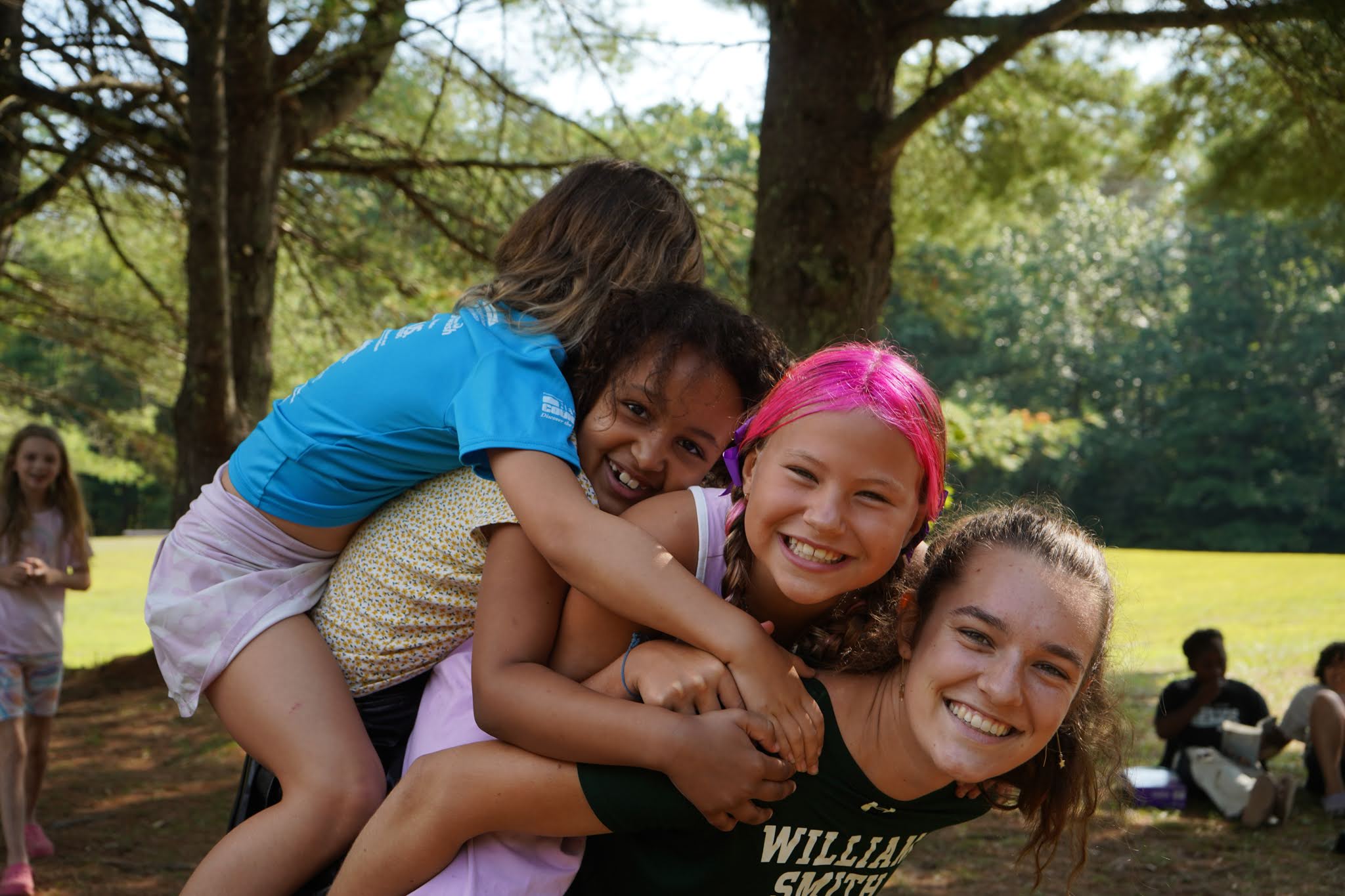
At Stomping Ground, kids ages 6 to 16 share the same space and make their own choices about how to spend their time. We don’t sort them by age for activities. We don’t engineer friendships. We trust the kids, and then we try to get out of the way.
What we’ve learned, summer after summer, is that when you remove the age-sorting that defines almost all other environments kids live in--school, sports, most organized activities--something opens up. Kids gravitate toward exactly who they need. And it’s almost never who you’d expect.
Max and the kid who was driving everyone a little crazy
There’s a camper named Max. He’s fifteen now, a big presence at camp, one of those kids who fills a room. A few summers ago, Max noticed a younger kid who was driving everyone a little crazy. He was pushing limits, using bully language, cursing, looking for reaction anywhere he could find it. The kind of kid who, in most environments, gets isolated or managed or sent somewhere else.
Max didn’t manage him. He just... became his person.
They’d hang out. When the younger kid was dysregulating, staff would quietly ask if Max wanted to take a bike ride with him. And Max always said yes. He was proud of that kid. He talked about him. He watched him settle.
At the end of the session, Max’s mom wrote to tell me it had been his favorite part of camp.
I think about that a lot. What Max got from that relationship wasn’t just the satisfaction of helping someone younger. He got to see himself differently. Somewhere in being that kid’s anchor, he found something about himself that structured mentorship programs, with their assigned pairs and adult supervision, tend to squeeze out.
The natural advantages of age mixing
Peter Gray writes about the way mixed-age play used to be the default of childhood: the neighborhood, the backyard, the street. Older kids naturally scaffolded younger ones. Younger kids stretched themselves to keep up. The age range itself was the curriculum.
What we’ve built at camp isn’t really a program. It’s more like a restoration of conditions. We give kids unstructured time and a diverse community, and we watch what they build together.
We see older kids unconsciously soften their language around younger ones. They do this because they feel the responsibility, not necessarily because we asked. We see six-year-olds run with teenagers in night games, holding their own in ways that genuinely astonish us.
We see it most vividly in the places where skills get passed around. In our Makerspace and Adventure Playground, kids teach each other how to use hot glue guns, how to hold a hammer, how to drive a nail without bending it. Nobody assigned this. It just happens: an older kid noticing a younger one struggling, a younger kid watching and then trying, a small moment of mastery that wouldn’t have occurred in a sorted, same-age group.
Sometimes a camper will offer an Option (our word for a facilitated activity) and it turns the whole age hierarchy on its head. Last summer a ten-year-old who crochets tiny animals ran a workshop. Kids signed up who were thirteen, fourteen, fifteen. They sat with her and learned. She was the expert. She knew it. They knew it.
And something important happened in that room that had nothing to do with crochet: a kid found out where she fits. What she brings. Why the community is better because she’s in it.
The importance of mattering and belonging
That sense of belonging, not just being included, but being needed, is, I’d argue, one of the deepest things free play in a mixed-age community can offer. Researchers who study happiness keep arriving at the same conclusion: humans thrive when they feel part of something bigger than themselves. Kids are no different.
The ten-year-old teaching crochet isn’t just learning a social skill. She’s experiencing herself as someone who matters to a group. That’s not a small thing. That might be the whole thing.
In our all-gender cabins, we tend to have wider age ranges because fewer families opt in (though that’s steadily changing). That means in these cabins, there’s a diversity of wants, needs, and preferences all under the same roof, and they have to work together to decide what’s best for everyone.
And they do. We consistently see something different from the same-age, same-gender groups. Less conflict. More of what I can only describe as family. Something shifts when the group stops being a peer cohort and starts being something more heterogeneous, more like the world.
Young counselors as extensions of the age range
There’s also what happens between our counselors and our oldest campers.
Our staff tends to be only a few years older than the teenagers at camp. That age gap, close enough to be relatable, wide enough to matter, is its own kind of magic. Counselors remember being fifteen at camp, remember finding their voice in a circle or their confidence on a stage, and they watch younger kids working through the same things. The learning runs in both directions. The counselors grow too.
Campers remember specific things staff said to them for years. They come back as counselors and reference moments from when they were twelve. There’s a thread that runs through this age-mixed community that I think is genuinely rare in modern childhood.
Autonomy and empathy
A 2024 study published in Conflict Resolution Quarterly tracked empathy and perspective-taking in adolescents during a two-week session at Stomping Ground. Researchers found that both emotional empathy and perspective-taking increased significantly over the course of the session. They also found that on days when campers felt more in control of their choices (more autonomous) they reported higher empathy
I don’t think that’s a coincidence. When kids choose who they spend time with, they’re practicing something real. They’re navigating differences, negotiating needs, figuring out how to be in relationship with people who aren’t their mirror.
Alannah and her Spanish-speaking best friend didn’t need a translation app or a structured activity. They needed time, space, and enough trust from the adults around them to let something unexpected happen.
That’s the whole thing, really. Get out of the way. Let them find each other.
Concluding Thought
Thank you, Laura!
I know from speaking with Laura that she would welcome qualified researchers who would like to conduct observational studies of children’s natural interactions in an age-mixed setting, also demographically mixed in other ways, that optimizes freedom and respect for one another.
And now, I’m interested in your thoughts and questions about anything relevant to this letter. Laura has kindly agreed to respond to any questions posed here that are directed toward her.
With respect and best wishes,
Peter
Play Makes Us Human is a reader-supported publication. To receive new posts and support my work, consider becoming a free or paid subscriber.
Thanks for reading Play Makes Us Human! This post is public so feel free to share it.