Gardening is one of my favorite ways to play; and it produces food.
By Peter Gray
Published: 2026-03-25
URL: https://petergray.substack.com/p/vegetable-gardening-as-a-key-to-health
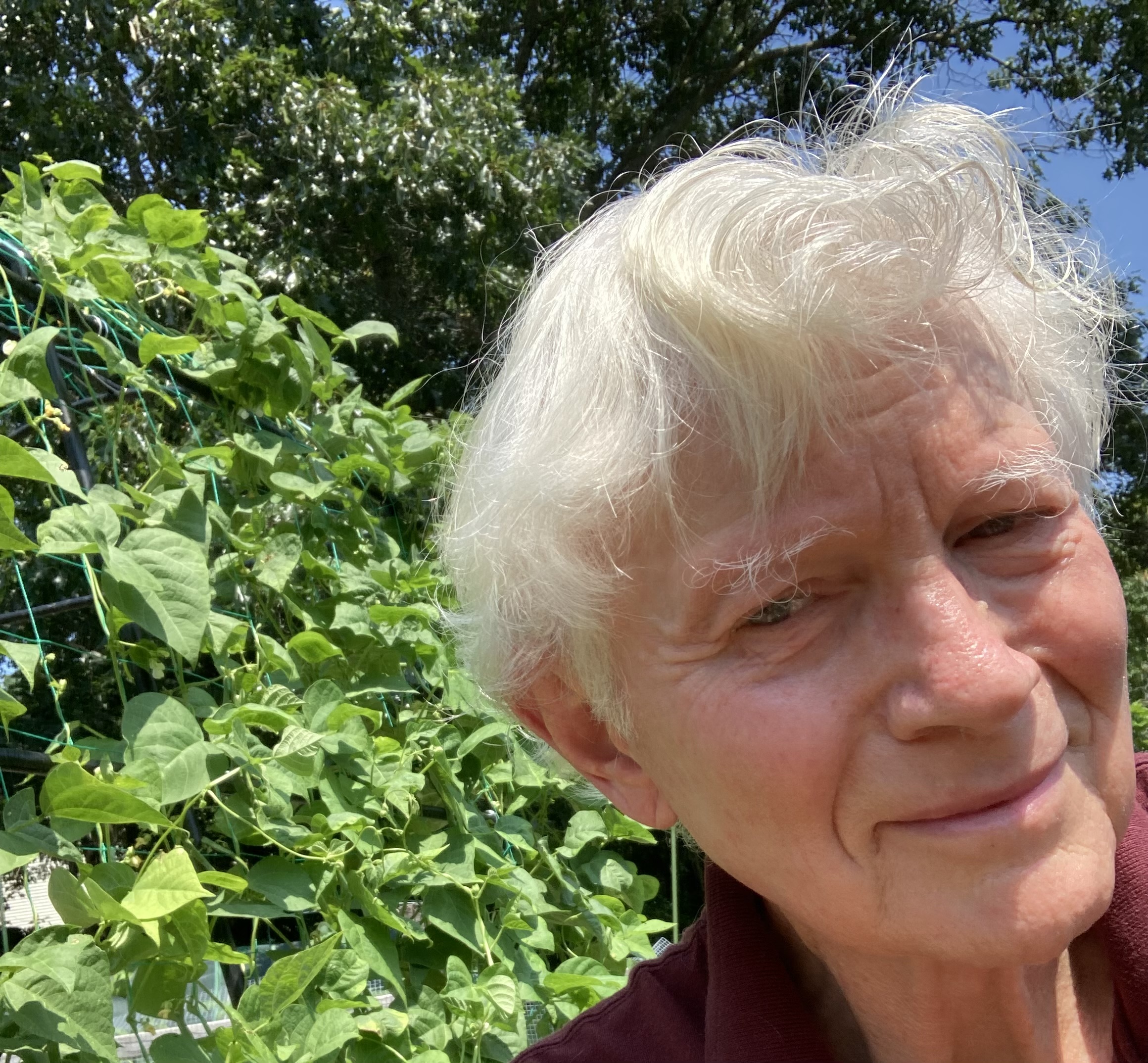 \The author and his beans\
Dear friends,
It’s spring. The last traces of the late-winter snow are vanishing here in Eastern Massachusetts. The squirrels are amorously chasing one another around in my back yard, and the male wild turkeys are strutting, trying to impress the females with their not-quite-peacock tail feathers fanned. And an old man’s fancy turns to …. gardening.
I’ve been vegetable and fruit gardening pretty much my whole adult life. I started in 1972, right after I joined the faculty at Boston College, and have continued with it every year since, except for a few years when I lived in a forest with insufficient sun. I’ve lived in five different houses in areas not far from Boston over the years, and at every one—except for that one in the forest—I immediately planted fruit trees and dug up an area for vegetables.
My wife and I have lived for seven years at our current residence, and the little mail-order dwarf and semi-dwarf fruit trees I set out when we first moved here began producing big crops last summer, especially, amazingly, the peaches.
The berries I planted have been productive now for several years. Last year, I harvested great crops of strawberries, raspberries, blackberries, and blueberries, which have the good sense to produce their crops at different times, giving me fresh berries continuously from late spring to early fall, and plenty to freeze. My yield of vegetables this past year included, in alphabetical order, asparagus (the earliest harvest), beans, beets, bok choy, broccoli, carrots, chard, corn, cucumbers, kale, lettuce, peas (of the sugar snap variety), peppers (both sweet and hot), rhubarb (if you count it as a vegetable), rutabaga, tomatoes (of course!), spinach, squash (butternut, which stored well through the winter in our garage—I just ate the last one this week), turnips (I’m still harvesting last-year’s crop, which kept well in the soil under heavy mulch), and zucchini.
What I Get from Gardening
Here is what gardening does for me personally:
• It gets me out of the house into the fresh air nearly every day, from at least early April (when I mend the fence, turn the soil, and plant the earliest crops) through December and sometimes later, as I mulch root crops, with leaves I’ve raked, for continued harvest through the winter.
• It’s an endless source of meaningful exercise. Spading, hoeing, raking, carrying mulch, and the like are equivalent in exercise to what some people pay for at a gym. And the exercise is meaningful because it produces something. It doesn’t just spin a wheel or cause weights to go up and down in the air. What a joy to watch a sprout come from a seed, then a full plant from the sprout, and then, from the plant, the tomatoes, beans, cucumbers, or …. It’s magic.
• It teaches mindfulness; I must pay attention to my immediate world when I garden.
• It teaches patience; I hoe, plant, weed, and wait and wait and wait to see what happens.
• It teaches the futility of perfectionism. There’s no such thing as a perfect garden. Some plants make it beautifully, some barely make it, and some fail completely; and there’s no predictable pattern from year to year in how this works out. This is life.
• It provides an endless source of puzzles to solve, as I strive (through only organic means) to outsmart the various animals and diseases that try to rob me of my crops. In the process I’ve learned a lot about the local fauna and nature’s deterrents.
• It greatly improves my diet. I had no idea, before I grew them, that I would so enjoy kale, broccoli, chard, turnips, and rutabaga. Gardening has made it easy to become a vegetarian. The vegetables and fruits are so good I no longer have a taste for meat. Because some crops store through the winter, either in the soil or in the garage, we (my wife and I) eat from the garden essentially every day of the year. I’ve also learned to grow salad greens indoors in a sunny window during the coldest months.
• Last but by no means least, it appeals to my natural frugality. Free food! To be honest, that’s why I started gardening, in 1972.
What Research Tells Us About the Value of Gardening
Quite a lot of research has been published documenting the benefits of vegetable gardening. Here’s a summary of some of it.
• Jennifer Bail and colleagues recruited chronic disease survivors (including cancer survivors) into a study in which some were provided with supplies and instruction in gardening, with the result that, over the summer, they spent more time outdoors, ate more fruit and vegetables, lost weight, and became more physically fit. Other research on effects of community gardening has shown similar effects (e.g. here).
• Another study, of people over age 62 living in an urban area, compared those who had been assigned an allotment garden with their otherwise similar neighbors who had not received such an allotment. Those with a garden reported fewer physical complaints and greater psychological wellbeing than did those without.
• In an experiment in the Netherlands, participants who regularly gardened were given a frustrating, stressful task and then were asked to spend the next 30 minutes gardening or reading. Those in the gardening condition overcame the stress very quickly, as measured both by self-report and a physiological index, while those in the reading condition did not.
•In a study in the twin cities of Minneapolis and Saint Paul, participants rated their level of emotional well-being during 15 different presumably enjoyable leisure-time activities, and gardening regularly came out among the top three by this measure.
The researchers also found that vegetable gardening promoted well-being more than did ornamental gardening and that vegetable gardening was the only activity that promoted well-being even more among low-income participants than among those with higher incomes. Free food.
• Many other studies—reviewed here and here—have shown that gardening significantly reduces both physical and psychological indices of stress. Findings include lower blood pressure, better heart-rate regulation, lower cortisol level, and reduced anxiety and depression.
• Researchers interested in the stress-reducing effects of gardening have discovered that dirt (of the earth variety) contains a bacterium that is good for us--Mycobacterium vaccae. When you dig in the soil and breathe it in, M. vaccae joins your microbiome and acts to reduce inflammation and reduce neural and behavioral effects of stress ( here and here).
This may help explain the findings noted above, but I suspect the bigger role comes from the exercise, better eating, and enjoyment that comes from the activity itself. Otherwise you could just sniff dirt.
Final Thought
It doesn’t take much room to grow vegetables. In one place I lived I grew quite large quantities in just a few square yards. I’m a believer in crowding crops closer together than recommended, partly to reduce weed growth, but then feeding them with lots of home-made compost. You can also eliminate weeding almost entirely with lots of mulch.
And if you have no sunny areas, you can still grow great spinach and other greens. Maybe in a future post I’ll tell you some ways I’ve learned to protect crops from the wildlife in my neighborhood.
And now, as always, I’m interested in any stories, comments, or questions you might have relevant to this essay.
With respect and best wishes,
Peter
Play Makes Us Human is a reader-supported publication. To receive new posts and support my work, consider becoming a free or paid subscriber.