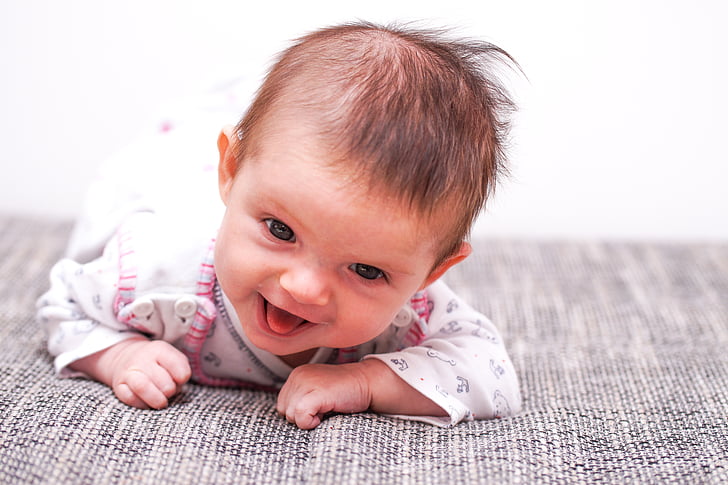
Mother Nature, to protect our species, endowed babies with the capacity to charm us.
By Peter Gray
Published: 2026-03-17
URL: https://petergray.substack.com/p/106-babies-earliest-play-smiling
 \PickPik, CC..\
Dear Friends,
Last summer, I became a grandfather—times 3. My stepson married a woman who came with an already hatched beautiful 4-year-old girl, Brooklyn, and then they quickly had a daughter, Sofia, born in July. And a month before that, my stepdaughter, with her husband, brought baby Finn into the world.
Wow, now I understand why grandparents can’t stop talking about their grandchildren. Every grandchild is the most beautiful, smart, amazing human being on earth. I used to think people were exaggerating, but now I understand. I’ve learned that, while it is unseemly to brag about your children, you can brag about your grandchildren all you want and get away with it.
Until Finn was born, I had gone decades with almost no direct contact with babies. My stepchildren were well past babyhood by the time I fell in love with their divorced mother and got to know them, and more than half a century has passed since my biological son was an infant. My research, as you may know, has focused on kids in the age range that we unfortunately call “school age,” not babies or toddlers.
But now I’m suddenly interested in babies; all babies, not just my grandchildren. Everywhere I go when I see babies I can’t help but smile at them and look to see if they smile back.
Babies are charming. That’s a good part of how they survive. They need adults, and Mother Nature endowed them with means of being adorable to us, so we’ll care for them. Of course, she also endowed them with means to annoy us no end, with loud crying and screams, if we fail to meet their needs. They manipulate us through reward and punishment.
From an evolutionary perspective, we might even say (sorry!) that Mother Nature endowed babies with the means to both seduce and blackmail us. The smiling and laughing are part of the seduction; the screams are the blackmail.
Anthropologists who have studied hunter-gatherer bands note that adults there are motivated to be so attuned to babies’ needs and provide care so quickly that cries almost never occur. Cries can attract predators. It’s as if the baby is saying, “You better feed me, and quick, or I’m going to continue calling lions and tigers into camp.” Maybe I’ll say more about the blackmail in a future letter; here I want to talk about the seduction.
Research on Babies’ Humor
Perhaps because of my new interest in babies, a recent NYT opinion article, entitled “The evolutionary brilliance of the baby giggle,” by researcher Gina Mireault caught my attention. Mireault has spent two decades studying the development of babies’ smiles, laughter, and sense of humor.
That article led me to look up and read some of her research articles. Here is some of what she and her colleagues have found.
Babies typically begin to smile in response to someone smiling at them at around 4 to 6 weeks (1 to 1.5 months) of age. By 2 to 4 months, their smile becomes more reliable, and they also may respond to playful provocation with laughter, real “belly laughs,” to use Mireault’s term.
These are babies’ earliest ways of interacting socially, positively, with caregivers and others. Well before they begin to talk or even babble, babies communicate with us through back-and-forth smiling and laughing. Play Makes Us Human.
Around 5 to 6 months of age, a new development occurs in babies’ play with us. They begin to understand humor. In research (don’t you wish you were in this field?) Mireault found that at around this age babies will smile and laugh when they see an adult doing something silly—like putting a cup on top of their head and repeatedly saying “whoosh,” even if the adult is not looking at the baby and has a neutral face. Mireault presents such findings as evidence that by this age babies begin to understand cognitively the difference between being serious and being playful.
Their laugh is their way of saying to us, “Hey, I know you are deliberately being funny, not weird.” Before this age, babies will stare at an adult acting in such a way, signaling an understanding that this is unusual, interesting, strange, but not signaling an understanding that the adult is deliberately clowning around. I love the fact that babies understand humor before they can talk.
During the second half of their first year, babies begin to engage in some clowning themselves, apparently to amuse the person interacting with them. They might hide their own face and then pull the blanket away, laughing, or start to give something to the caregiver and then pull it away while laughing, perhaps the earliest form of teasing.
Yes, Play Makes Us Human. And babies, in their early play, prove to us just how human they are!
Further Thoughts
I Googled “YouTubes of babies laughing” and, no surprise, found lots of charming videos. Watch this one and this one and laugh out loud.
And now, I invite you to share any thoughts and stories you might have about the playfulness of babies or the joy of being a grandparent. Please share this letter with anyone who might be interested, and, if you aren’t already a paid subscriber, please consider joining that esteemed rank.
With respect and best wishes,
Peter
Play Makes Us Human is a reader-supported publication. To receive new posts and support my work, consider becoming a free or paid subscriber.
Three of Gina Mireau’s Articles
Mireault et al (2018). Social, cognitive, and physiologicl aspects of humour perception from 4 to 8 months: Two longitudinal studies. British Journal of Developmental Psychology, 36, 98-109.
Mireault et al (2015). Laughing matters: Infant humor in the context of parental affect. J. of Exp. Child Psych. 137, 30-41.
Mireault (2026), <https://infantstudies.org/a-funny-thing-happened-in-the-infant-lab-what-humor-can-teach-us-about-how-infants-think/>