You don’t have to use AI to pay for its expansion. Here’s how to protect your hardware budget, your workflows, and your career.
By Nate
Published: 2026-11-25
URL: https://natesnewsletter.substack.com/p/ai-boom-memory-shortage
You can ignore every model launch, decline every chatbot subscription, and still help pay for the AI boom the next time you replace your phone.
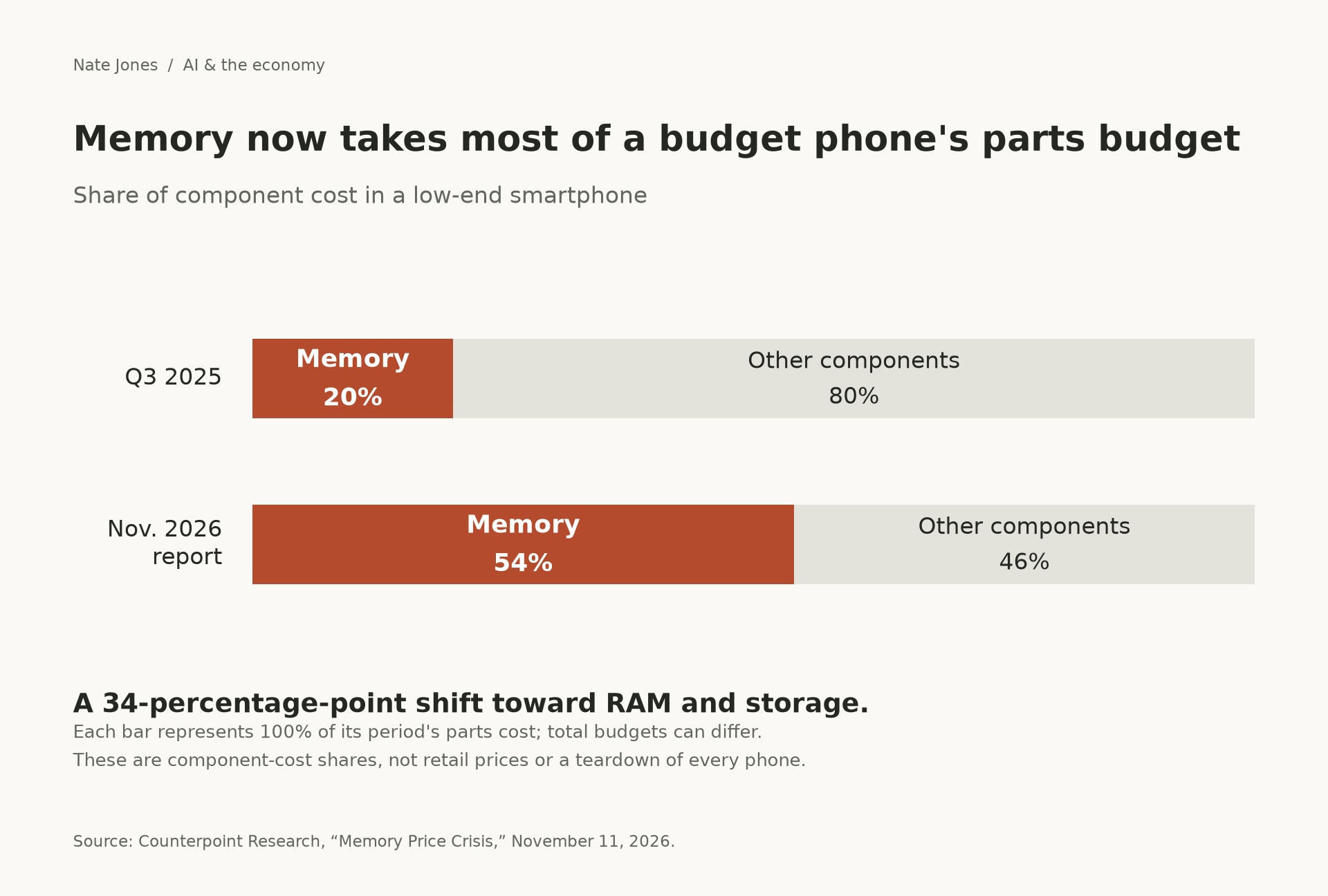
A year ago, memory accounted for about 20% of the parts cost of a low-end smartphone. Now it accounts for 54%, according to Counterpoint Research. More than half the component budget goes to RAM and storage before the manufacturer pays for the screen, cameras, processor, or battery. Worldwide average smartphone retail prices have risen 20% this year, according to the same report. Your particular phone may have moved less, or more.
That’s how the AI buildout reaches people who never opened ChatGPT. Phone makers and laptop makers are competing with data centers for constrained supplies of memory. The companies building those data centers face a second pressure: the market price of the intelligence they sell keeps falling.
Put those forces together and you get a financial vise. Physical inputs become more expensive while competition pushes down what customers will pay for a given level of AI capability. Understanding who can survive that squeeze matters when you’re buying a computer, choosing an AI tool, or deciding where to work.
Here’s what’s inside:
- Why your next laptop could cost more. Agents run on the same kinds of ordinary memory your phone and laptop use, and cloud companies are securing more of the production capacity.
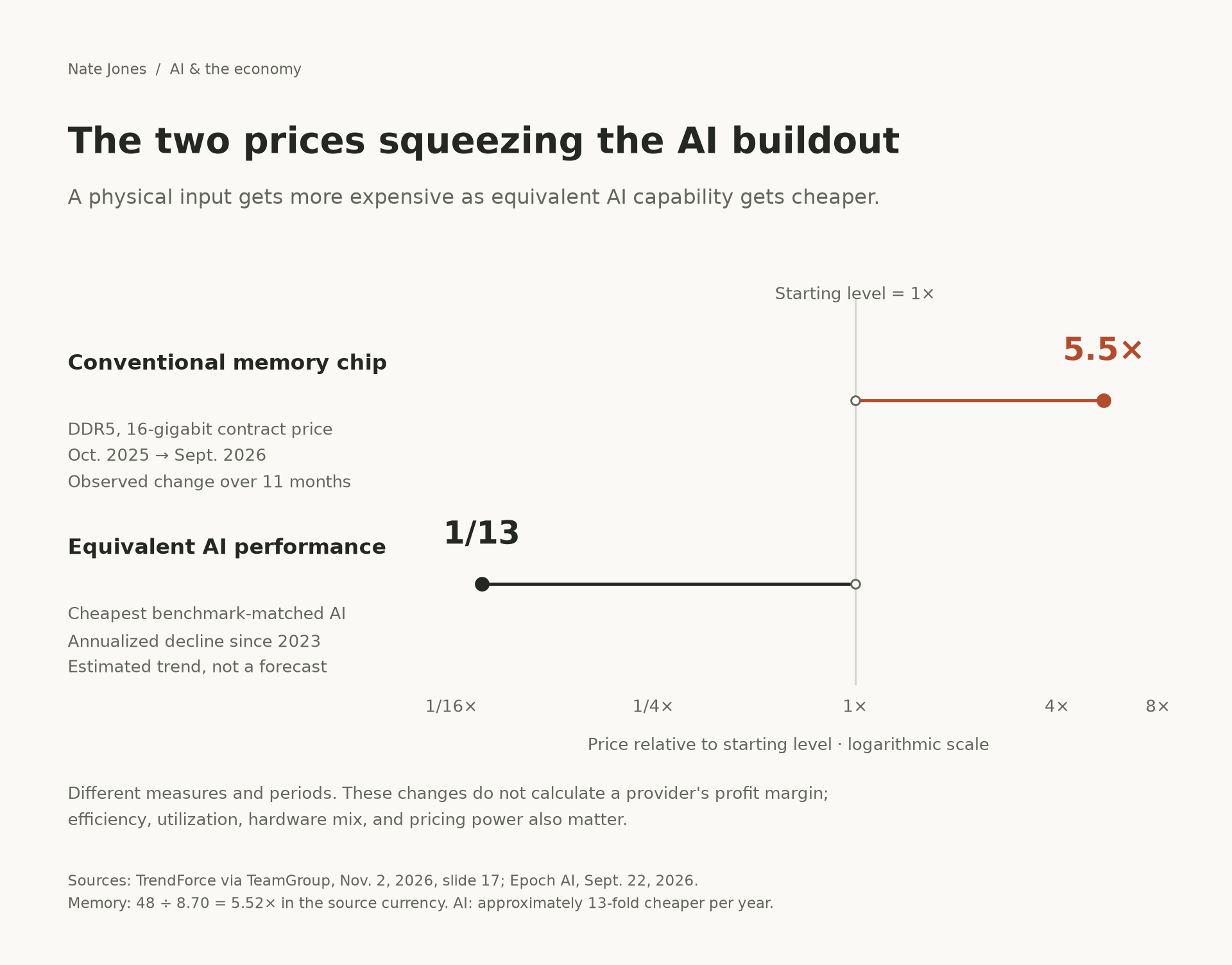
- The squeeze on AI providers. A standard memory chip’s contract price rose about 5.5-fold in under a year, while AI performance gets roughly thirteen times cheaper every year.
- How to buy hardware right now. Compare refurbished, previous-generation, and new machines on the memory you actually need, not the sticker price.
- Three questions for any vendor or employer. A quick stress test for whether a business survives if its compute bill rises 30%.
- AI cost literacy. A one-workflow test that shows what a completed task really costs, so you can defend your AI budget when someone asks.
Let’s start with what an agent fixing a bug has to do with your laptop.
Nate’s Substack is a reader-supported publication. Paid subscribers get access to the full archive and my Slack community!
Why agents pulled your laptop into the boom
Think about what happens when you ask an agent to fix a bug.
The model reasons about the problem. Then the agent opens files, runs code, reads the result, launches a test, and tries again. It might open a browser to inspect the page it changed. Each step needs somewhere to execute, somewhere to hold the working state, and memory for the programs doing the work.
Multiply that by agents running across thousands of companies, sometimes for hours, and the hardware story gets much bigger than the GPU answering your prompt.
AI has always needed ordinary servers alongside specialized chips. Agents make those servers more central to the workload. Counterpoint’s latest memory analysis identifies agentic AI as a major source of demand for conventional memory, including DDR and LPDDR, the broad families also used in personal computers and phones.
The server and the laptop don’t need identical memory modules to compete. Their manufacturers draw on overlapping production capacity. When cloud companies secure more of that capacity, consumer-device makers have less room to negotiate.
The moment AI starts using computers to do work, it needs more of the ordinary computing infrastructure the rest of us depend on.
Expanding memory supply takes years. Power has its own delays: Berkeley Lab found that, in regions with available data, new generation projects reaching operation in 2025 had spent a median of more than five years getting from a grid-connection request to operation.
You can’t software-patch a memory fab into existence.
The price squeeze inside the buildout
Now look at what the companies buying all that equipment can charge for its output.
Epoch AI estimates that the cost of achieving a given level of AI performance has fallen roughly thirteenfold per year since 2023 across the benchmarks it studied. That measures the cheapest way to reach a particular capability level. It doesn’t mean your subscription bill falls thirteenfold.
For comparison, a standard 16-gigabit DDR5 chip’s contract price rose about 5.5-fold from October 2025 to September 2026, according to TrendForce figures reproduced by TeamGroup.
A provider selling yesterday’s impressive AI capability faces cheaper competition. Better models keep arriving. Work that once required a frontier model becomes possible on something smaller and faster.
For customers, that’s wonderful. For a company buying equipment today and counting on years of future revenue to repay it, it creates a demanding calculation.
Efficiency can make the calculation work. Better chips and software can reduce the cost of a task even when memory prices climb. Growing usage can also compensate for lower prices. The danger comes when those improvements fail to keep pace with falling selling prices, new investment, and existing financial commitments.
There’s plenty of evidence that people want the product. OpenRouter, which routes requests to AI models, reported weekly token usage growing from 0.5 trillion in January 2025 to 128.4 trillion in September 2026—roughly 250-fold in 20 months.
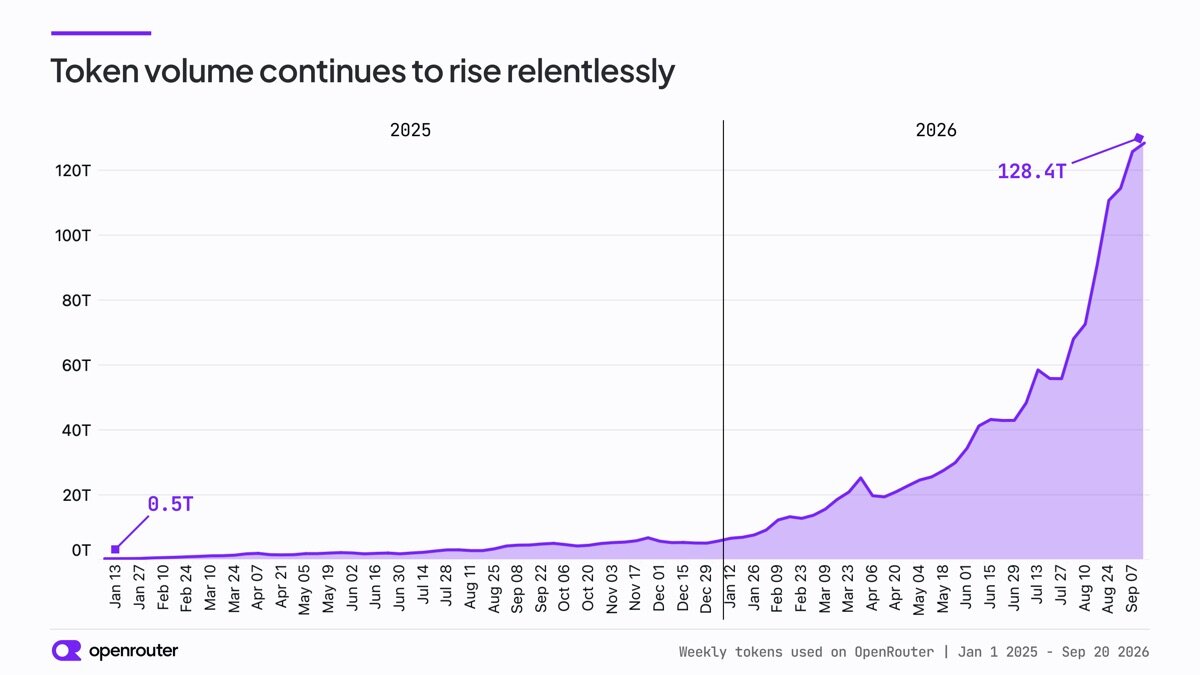
Source: OpenRouter, “The Token State of Play,” September 22, 2026. Weekly tokens on OpenRouter. Reseller activity excluded.
Revenue adds another check. Anthropic reports that its third-quarter revenue grew more than twelvefold from a year earlier. Paying customers are a much stronger demand signal than excitement about a demo.
I’ve written about why the AI doom narrative misses real adoption and the economics and capacity questions worth watching. Both matter here. Strong demand gives companies a reason to build. It doesn’t settle whether the financing works.
A Federal Reserve governor describes a buildout increasingly funded by debt, alongside growing long-term leases and other commitments. Companies are making promises to pay that extend well beyond the next model release.
Meanwhile, the equipment ages. A Brookings conference paper discusses GPUs becoming economically obsolete within three to six years, even though the buildings and power infrastructure remain useful much longer. The chips can still function while newer equipment makes them less competitive.
Imagine underwriting a long-term loan whose repayment depends on equipment earning attractive returns for years. You have to judge how quickly that equipment loses earning power, what replacing it will cost, and whether customers will pay enough throughout. A surge in today’s demand answers only part of that question.
If lenders become more selective, exposed builders may struggle to finance their next expansion or refinance old debt. Providers could respond with tighter usage limits, different subscription tiers, or a harder push for profitable customers. Those are possible responses to financial pressure, not a forecast that every AI price will rise.
The pressure can reach your workplace through a tool your team depends on, a vendor that changes its terms, or an employer that suddenly wants every AI expense justified.
How to make better decisions inside the squeeze
Start with hardware. If your current machine does the job, a discretionary upgrade can wait. If you need a replacement for work, buy for the workload and the years you expect to keep it. Saving on RAM that you can’t later upgrade can become an expensive compromise.
Budget devices reveal memory-cost pressure first because there’s so little room to absorb it. Manufacturers can raise prices, cut features, or stop selling a model. Buying a more expensive device doesn’t remove the tradeoff. Watch what happens to the RAM and storage you get at a given price, and what it costs to move up a tier. A familiar sticker price can hide a worse deal.
Compare refurbished and previous-generation machines with the memory you actually need against new base models. Check battery condition, warranty, and remaining software support. The useful comparison is the cost of a machine that will serve you well for several years. Older inventory isn’t automatically a bargain, and nobody can promise the next sale will solve a supply shortage.
For AI tools, use today’s inexpensive access while keeping your options open. Test routine work on cheaper, faster models. Reserve the frontier model for tasks where its additional reasoning produces a result you can actually distinguish. The right split comes from your work, not a universal percentage.
Keep the instructions, source files, and evaluation examples you need to move an important workflow. Try a second provider before an outage or price change makes the decision for you. Cheap cloud access can be useful even while local hardware is expensive, but neither today’s price nor today’s usage allowance is a permanent promise.
When choosing a vendor or considering an employer, I’d ask three questions:
- Can this business work at today’s compute costs? Or does its plan require another dramatic cost decline, continued discounts, or fresh financing before it can cover its bills?
- What happens if its compute bill rises 30%? Use that as a stress test, not a prediction. Can it improve efficiency, absorb the cost, or charge customers more without losing them?
- What would customers still pay for if model access became interchangeable? Look for valuable work the company completes, integrations customers depend on, and results that justify the price.
Those questions also point toward a career skill: AI cost literacy. Learn what a completed task costs once you include model calls, failed attempts, software, and the human time spent checking the output.
Take one recurring workflow at work. Run a representative set of tasks through your current setup and a cheaper alternative. Compare acceptable results, total expense, and review time. Record where the cheaper approach fails and where paying for a stronger model saves enough rework to justify it.
When someone asks whether the AI budget is worth keeping, you’ll be able to show which work gets done, what it costs, and how to keep doing it if a provider changes the deal. That puts you in a much stronger position than someone with an impressive demo and no idea what it costs to run.
Nate’s Library MCP
Your subscription now works inside your AI.
Nate’s Library MCP is a read-only MCP server that gives your AI direct access to my entire published content library. Connect once, and then the archive just shows up in your normal AI conversations. You ask your AI a question during your actual working session and it pulls from everything I’ve published to answer it.
Setup takes just a few clicks.
Join the Slack →
It’s where I’ll be sharing things between articles, where you can get help on builds in real time, and where the fastest conversations in this community are already happening. I’ll see you in there!
If you have any issues connecting to my MCP or Slack, please email [email protected].
Coming up
On Friday: why you need a personal stake in the future, with practical ways to discover unfamiliar possibilities, compare alternatives, and test a new direction.
Related reading
- Pied Piper was a documentary: the third force nobody’s tracking in the AI memory crisis: why a compression algorithm, not a faster chip, may decide who wins the AI memory crunch.
- Executive briefing: NVIDIA is building the financing system for AI compute: how Wall Street is trying to turn GPUs and their future revenue into an asset class.
- Your AI bet can be right and still run out of money: how timing and lenders sink a correct forecast, plus the two-clock prompt to test your own bet.
- Executive briefing: your cloud provider is your competitor for AI compute: what to do when the inference capacity you budgeted for isn’t available at any vendor.
I make this Substack thanks to readers like you! Learn about all my Substack tiers here