Your favorite model has taught you what intelligence feels like. That could make the next important advance surprisingly easy to miss.
By Nate
Published: 2026-11-23
URL: https://natesnewsletter.substack.com/p/judge-ai-models
On November 17, OpenAI released GPT-6.2 Astra. The following day, Google released Gemini 4 Neon. I’ve been using both, and the contrast exposes a problem with how we’ve learned to judge AI.
Astra has been frustrating for writing and general coding in my experience. It can get absorbed in details that don’t deserve the attention, and its explanations can make understanding the work feel like another assignment. Astra’s negative reviews are describing real problems.
Meanwhile, Neon has felt like a breath of fresh air: fast, clear, positive, and easy to work with. Google has found something here, and I enjoy thinking and writing with it.
And yet there are problems where I love using 6.2 Astra. Difficult, messy, detail-heavy problems where its determination to inspect everything becomes the reason I want it involved.
Those reactions can all be accurate. That’s the uncomfortable part.
We’ve spent years getting used to the idea that a smarter model will feel better to talk to. It will understand what we mean sooner, require less explanation, and produce something more impressive. That has been a good way to notice progress. It’s becoming a dangerous way to judge the whole of it.
A model can get worse at the work you do every day while becoming more useful for work that changes your business. You can review it honestly, dislike it for excellent reasons, and still miss the advance that matters to somebody else. Eventually, what that person does with it can affect you.
This asks more of us than picking a winner from the latest leaderboard. We have to understand the work we’re handing over, the judgment we’re keeping, and the capabilities our usual tests never give us a chance to see.
Here’s what’s inside:
- Two prompts that match AI to your work. The first identifies what your tasks actually require, and the second helps you choose models and design useful handoffs between them.
- Why a model you dislike can still earn a place. How the same release can frustrate your writing and still be the one you want on a messy product problem.
- Where I currently start with Astra, Neon, Claude Opus, and Claude Fable. A table matching each model to the kind of help the work needs.
- How to hand work from one model to another. What to send so the second model keeps the contradictions, constraints, and open questions the first one found.
- A test for the capability your normal work never shows you. How to evaluate a model with an adjacent team, and what to record so the result means something.
I’ll also show you how to tell when adding another model just creates more work.
Paid subscribers get access to the full post, Nate’s Library MCP, and my Slack community!
Grab the prompt kit
These two prompts go into the AI tool you already use. Describe a task or two and you come out with a model choice and instructions for your top task, built around what that work demands.
The kit covers:
- Audit your tasks. Prompt 1 turns a short description of one to five tasks into a copyable audit of what must be accurate, where your judgment decides quality, and who can judge the result.
- Choose a setup. Prompt 2 recommends keeping your setup, changing how you use it, trying another model, or combining two, and maps each task to the capability it needs.
- Handoff instructions, if Prompt 2 recommends one. You get instructions for both models, with the evidence and its source references carried across.
- Check the recommendation before you trust it. A comparison plan counts your preparation and review time, and four checks test the advice for fit, simplicity, fidelity, and economics.
Nate’s Library MCP
Your subscription now works inside your AI.
Nate’s Library MCP is a read-only MCP server that gives your AI direct access to my entire published content library. Connect once, and then the archive just shows up in your normal AI conversations. You ask your AI a question during your actual working session and it pulls from everything I’ve published to answer it.
Setup takes just a few clicks.
Join the Slack →
It’s where I’ll be sharing things between articles, where you can get help on builds in real time, and where the fastest conversations in this community are already happening. I’ll see you in there!
If you have any issues connecting to my MCP or Slack, please email [email protected].
Why I can dislike Astra and still want it involved
Good writing requires judgment about the whole piece. Where does the argument go? What does the reader need to understand first? Which detail is interesting but belongs somewhere else? When have you explained enough?
You can make every sentence individually defensible and still write an exhausting article. The work requires knowing what to leave out.
Software engineering has a related problem. A good engineer cares about correctness and architecture, and still knows which rough edges matter now. Some bugs block the product. Some deserve a note and a later fix. Some technically possible failure modes are a terrible use of the next hour.
I think of that as forest-and-trees judgment. It means seeing the individual problem and its place in the larger job.
In my use, 6.2 Astra leans hard toward the trees. It wants to inspect every one. Give it a problem where progress depends on deciding which details can wait, and that behavior can be maddening. I’ve gotten the earlier GPT-6 Astra to write well. The newer model has a different feel, and I don’t find that difference helpful for everything.
The team at Every made a useful distinction in its assessment of Astra and GPT-6.2 Sol: the models can handle bounded tasks efficiently, while the work the team most wants help with still needs better judgment and follow-through.
The week Astra came out, I was also working through a product problem involving customer feedback, executive perspectives, technical constraints, and architecture. The challenge was understanding how those things fit together. There were a lot of dimensions to hold in view at once.
Asking for a polished summary of customer needs is a very different assignment.
A summary can give you the major themes while smoothing out the disagreements. It can make the material easier to read before you’ve understood why the pieces don’t agree. In product work, that disagreement can be the thing to investigate. A customer request, a leadership priority, and a technical constraint don’t become compatible because someone writes a good paragraph connecting them.
What I valued about Astra was its willingness to stay with that complexity. It kept chewing on the relationships and details instead of quickly turning the material into a tidy account. That was useful to me. I wanted help thinking through the problem before deciding how to explain it.
This is why I resist turning my frustration with the model into a verdict on everything it can do. I can find its writing poor and its analytical persistence valuable in the same week, even in different parts of the same project.
Persistence still needs a purpose. An exhaustive answer can be wrong. An analysis that flags every imaginable concern can leave you with more work than you started with. The useful question is whether the scrutiny helps you understand something consequential: an unresolved contradiction, a condition the recommendation depends on, a constraint that changes the decision.
If it doesn’t, checking more things is just another way to consume your time.
Neon and Claude make the comparison more interesting
Neon has been a good reminder that communication is a real capability. Clear writing and quick responses make it easier to stay in a thought, react to an answer, and keep going. A model that makes collaboration pleasant can help you do better work because you can actually maintain the exchange.
Google positions Neon between Carbon, for the hardest long-running projects, and Hydrogen, for fast everyday execution, and its model card describes a model adapted from Carbon to balance depth and efficiency. Google’s launch announcement also explicitly emphasizes clear writing and a natural, direct tone. Those are product choices that matter when you’re going to spend hours working with the thing.
My experience of that tone is unusually positive. The model feels chipper without making every response a struggle to parse. For writing, framing, and working through ideas, I find that valuable.
Then there’s Claude. Opus 5.5 is where I often turn for solid engineering and work that needs taste, coherence, and execution. Fable 5.2 is especially interesting when the problem is hard and ambiguous. It can feel intuitive: you give it something that isn’t fully formed, and it brings back a direction worth considering. The useful part is the surprise: a connection or approach that helps you move an open-ended problem forward.
Anthropic’s own guidance for Fable 5.2 is revealing. It recommends starting with Opus 5.5 for most coding and knowledge work, then moving to another model as the task requires. Fable 5.2 and Anthropic’s Mythos 5.2 are positioned for the most ambitious, open-ended technical work. Even the company selling the models isn’t offering a simple instruction to choose the most capable one for everything.
These are differences in the kind of collaboration you get. A precise brief, an ambiguous engineering assignment, and an idea you want to bounce around place different demands on a system. Sometimes one model handles all three well enough. Sometimes you feel the change in fit immediately.
The difficulty is that we keep trying to compress those differences into a single answer to “Which model is smarter?”
The part of intelligence your test can’t see
For much of the ChatGPT era, progress was easy to recognize from the chair you were sitting in. A model followed your instructions more reliably. It wrote something that sounded less mechanical. It made a presentation you could actually use. You didn’t need a new profession to appreciate the improvement.
That experience trained our expectations. We learned to look for intelligence in the qualities that showed up quickly in conversation.
But the skills involved in intelligence don’t all move together. Exact checking, engineering coherence, visual taste, useful surprise, clear communication, and the ability to sustain a long task are distinguishable capabilities.
Picture a sea urchin with spikes extending in every direction. Shine a light on it and look at the shadow on the ocean floor. Your particular set of tasks is like that light: it reveals some parts of the shape much better than others. A spike can grow in a direction that barely changes the shadow you’re watching. You can look carefully and still miss it.
That’s the problem with making your own experience the whole measure of progress. Your experience is real. It’s also selective.
Benchmarks can help us see beyond our own tasks, provided we read what they actually measure. As of November 20, Artificial Analysis’s comparison of Astra and Fable gives GPT-6.2 Astra a 62 on its Intelligence Index and Fable 5.2 a 65 at their maximum effort settings. But the same comparison reports Astra ahead on Terminal-Bench-Science, while Fable leads on HLE-Diamond and a physics subset. Even “good at science” is too broad to describe every result.
My product work gives me one perspective on Astra. A person using it for a mathematical argument has another. Someone trying to ship a coherent application has another again.
There’s also a harder possibility: the qualities you care about can regress while other qualities improve.
Some models really do come out worse. You don’t owe every bad response a search for the hidden genius behind it. A claimed strength needs evidence from the work it’s supposed to improve.
What you do need is a little more precision about the verdict. “This makes my work harder” can be completely justified, but the further claim that nothing important has improved requires a much wider view.
The labs have reasons to build different things
The companies behind these models also have different businesses to serve. I think those incentives help explain the variety we’re seeing.
Google has a large existing business and multiple ways to distribute and monetize AI. In its third-quarter earnings call, Alphabet described AI contributing across Search, Cloud, and subscriptions. A range of models with different balances of speed, cost, and capability makes commercial sense in that setting. The best fit for frequent interactions across a huge user base may differ from the best fit for a project running for hours.
Anthropic’s model guidance reflects a related division inside its own family: a broadly useful daily model, with more expensive or specialized capability available when the work calls for it. In my use, the Claude models’ attention to taste, engineering judgment, and finished work has made them powerful workday tools.
OpenAI is serving several kinds of demand too. Its 6.2 announcement describes models for both difficult projects and everyday work, and it explicitly emphasizes scientific performance alongside professional outputs and coding. I read that as a company trying to serve work with very different requirements. Success in a specialized technical setting can matter commercially even when the interaction doesn’t become my favorite way to write.
All three companies compete across overlapping territory. What changes is the combination of capabilities a particular release offers, the cost of using them, and the work the surrounding product makes possible.
That’s why I expect more variety. There are too many useful combinations for a single familiar chatbot experience to be the only destination. The next model can be a meaningful advance without being the replacement you wanted for your current favorite.
Your favorite model has been training you, too
There’s another reason the reviews split, and it lives on our side of the conversation.
When you get results with a model, you learn how to work with it. If detailed instructions help, you learn to write them. A model that reliably fills in a loose brief teaches you what you can leave unsaid. Fast retries train you to iterate, and a slow, expensive run makes you deliberate about starting it.
Those are reasonable adaptations. Over time, they become your idea of how working with AI is supposed to feel.
I see this in my own preference for fast iteration in Codex. Sometimes I’m still figuring out what I think. I want a response, then I want to react to it and give more direction. That rhythm lets me keep supplying judgment as the work develops. It’s a different relationship from handing over a clear assignment and expecting an agent to carry it through independently.
Close iteration and a full handoff are two patterns for organizing the work between a person and a model.
But after you’ve used one pattern hundreds of times, a model that needs something else can feel immediately wrong. It asks for specificity where you expected initiative. It takes initiative where you wanted control. It slows down to check things when you’re trying to discover the shape of an idea. Or it gets breezy when you need every condition examined.
That can be a model failure, an underspecified assignment, or a model and workflow that don’t fit each other very well. It’s worth working out which before you decide what the release means.
Model comparisons also need to name the environment. Codex is a tool you work in. Astra is a model you can use within it. The instructions, tools, context, and effort settings all affect what happens. A fast, closely supervised session and a long independent run are different tests, even when the model name is identical.
If you’re new to that way of working, my Codex guide covers the basics. Here, the important question is how much of the judgment you’re supplying, and how much you expect the system to supply.
We need to become more conscious of distinctions that used to be automatic parts of our craft. That starts with describing the task before picking the model.
Audit the shape of your work
“I’m in product” doesn’t tell a model enough about what you need. Neither does “I write” or “I manage a team.” Those jobs contain many different kinds of thinking.
Working through ambiguous feedback, choosing a recommendation, checking it against constraints, and explaining it clearly can all happen inside one assignment. They may call for different behavior. If you treat the whole assignment as one undifferentiated task, you may never notice which part is causing the trouble.
In the companion kit, Match AI to the Work You Actually Do, the first prompt helps you make those distinctions. Start with one task if that’s enough to identify where you need help, or describe several to compare their demands. You can work from brief descriptions without providing confidential documents or client details.
The point is to make your own judgment visible. Where do you already know what a good result looks like? Where are you discovering it through the work? Which mistakes would invalidate the output? Which decisions require your taste? Where does speed let you stay involved in a way that improves the result?
Treat the audit as a description to correct. If the model misreads what matters in your job, tell it. That correction is part of defining the task.
The useful output is a clearer account of your work. You should be able to recognize where an analytical model belongs, where you need a collaborator with taste, and where the important capability is responding quickly enough for you to keep directing the process.
It may also show that your existing setup is fine. You don’t need to reorganize your work every time a new model appears.
Choose a model and define the handoff
With the audit in hand, a model recommendation becomes more useful. You’re choosing a capability for a reason, and you have a way to tell whether the choice helped.
These are my current starting points, based on the work I’ve described here:
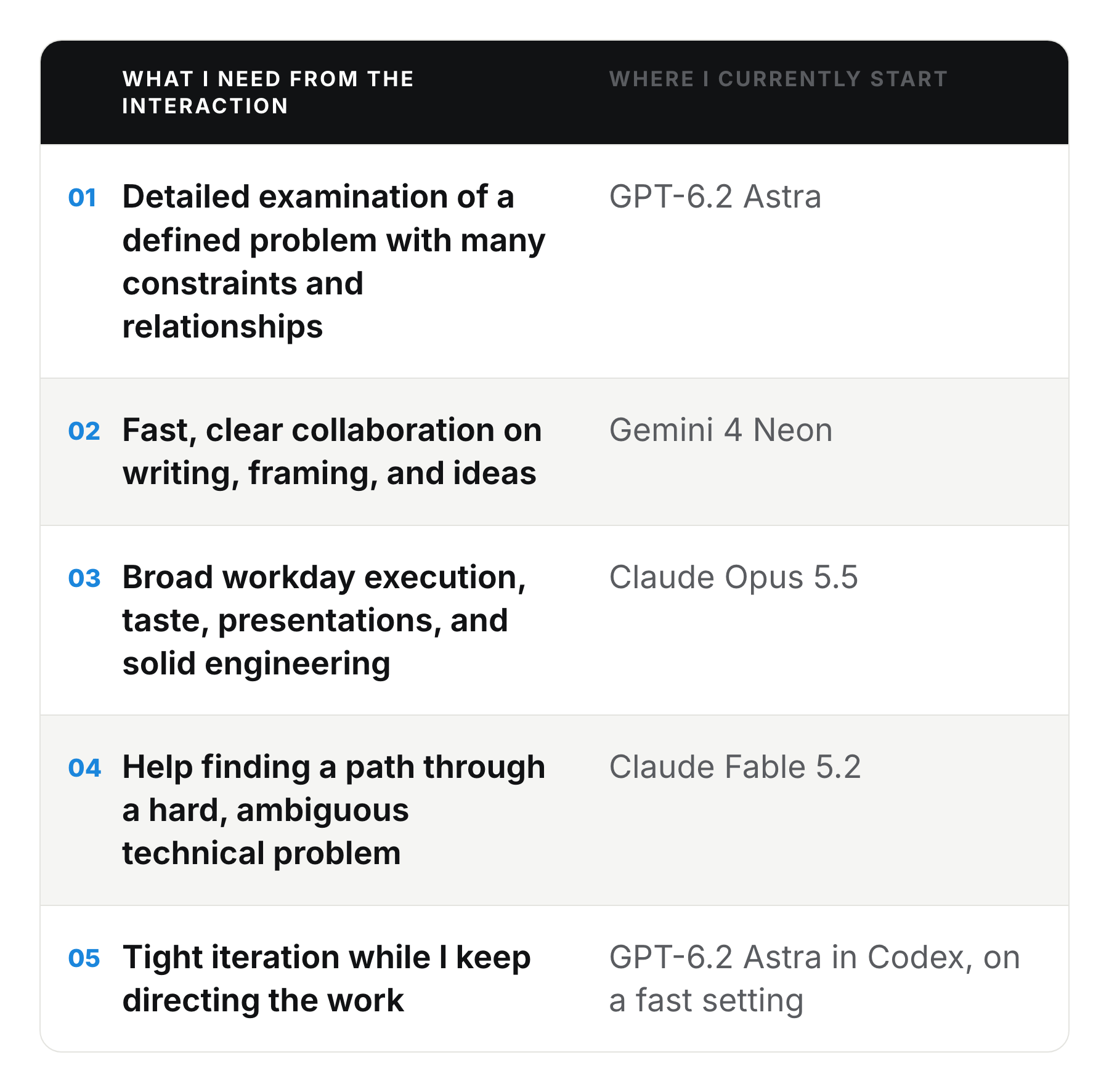
Those are starting points for testing. Your task, your instructions, and your own way of thinking can change the result.
A two-model handoff becomes useful when the next stage needs a different strength. In the product work I described, detailed analysis and explanation are distinguishable jobs. You can ask Astra to work through the relationships, then ask Neon to make the resulting analysis readable.
But you have to preserve what made the first stage worth doing. If the second model removes the contradictions, hard constraints, or unresolved questions, the polished result can be worth less than the difficult original.
The handoff therefore needs more than a request to “make this readable.” Send the conclusion with its supporting evidence, assumptions, and unresolved questions. Keep source references attached to the claims they support, and tell the second model which distinctions must survive the rewrite. Otherwise, you’re asking it to decide what matters without necessarily giving it the basis for that decision.
Clearer communication and independent verification are separate jobs. A second model confidently repeating the first model’s conclusion doesn’t confirm it. To check the conclusion, someone or something needs access to the underlying evidence and a way to assess it.
And measure the extra work. A handoff has a cost in time, attention, and sometimes money. It earns its place when the combined result is better enough to justify preparing the transfer and reviewing what comes back. If one model already handles the assignment well, keep the simpler arrangement.
The second prompt in the kit uses your audit to make those decisions. Include the tools you already have, your constraints, and any observations from using them. You can include the models in my table above as candidates, but ask the model to distinguish those recommendations from evidence about your particular work. The prompt produces a recommendation and copyable instructions for the task you want to start with. Expect it to recommend improving your existing setup, including how you brief or work with one model, more often than adding another.
A model helping you choose a model can produce a very persuasive recommendation before it has done any of your work. Treat the recommendation as something to compare against your current setup, with the audit as the standard for judging it.
Test something your normal work doesn’t reveal
A task audit and better model choices improve your own use of AI. The bigger risk these launches expose is that an important capability can develop outside your normal view.
That risk grows if you lead a team. Your personal test may capture the work you enjoy or understand best. It may say very little about the work that limits the team’s output. If everyone evaluating a model comes from the same function, you can repeat that blind spot at organizational scale.
Set up what I think of as blind spot radar. Choose one function adjacent to your own that does substantially different work. Talk to the person who actually owns it. Find out what they need to produce, what makes the work difficult, and what counts as a consequential error. Then select a real task they can evaluate in an appropriate environment.
The owner of that work should help define the test and judge the result. If you don’t understand the field, you can’t reliably substitute your impression of the answer for their assessment.
Keep the test manageable. The minimum is a defined task, a current way of doing it, a model to try, and a record of what happened. Record the setup as well as the result: the model version, application, important instructions, tools, and how much a person intervened. Otherwise, you won’t know what you’re comparing when something changes.
Beyond the eval basics I’ve written about before, the extra requirement here is choosing work that exposes a capability your usual tasks leave hidden.
Ask the task owner to assess whether the result is correct, complete, and usable, and count the time needed to prepare the assignment and to correct and review the result. If the apparent improvement matters, repeat the comparison on more than one task before changing the process. One impressive answer is a reason to investigate further.
Then look at the effect on the team. Did the work become easier for the next person to use? Did the model reduce a delay, or transfer the difficult checking to somebody else? Could the improvement change how quickly a decision is made or how much work the team can take on?
Those answers connect a specialized capability to a business consequence. The benefit has to survive beyond the person who first liked the output.
There’s an equally useful negative result. The model may be impressive in one respect and still fail the task. Keep that finding. You don’t have to turn an evaluation into an adoption decision, and you don’t have to keep using a model because a benchmark said you should like it.
What matters is that you’ve looked somewhere your normal habits wouldn’t have taken you.
A bad review can be right and still leave something out
I get the fatigue around another model launch. If you’ve finally found a setup that helps you work, the suggestion that you reassess everything again is exhausting. Most of us have actual work to do.
The useful response is to get more selective about what we investigate. Keep a default that works. Understand why it works. When a new release behaves differently, look for the particular task where that difference might matter. If you lead a team, make sure that task isn’t always drawn from your own corner of the business.
That approach lets you take negative reviews seriously without assuming they describe the whole frontier. It also lets you enjoy a model like Neon without making pleasant conversation stand in for every other capability.
I’m going to keep using Astra for the kinds of scrutiny I find valuable, Claude for the work where its judgment helps me, and fast iteration when I want to keep directing the thinking. Those choices can change. The more durable habit is being able to explain what I’m asking the system to do and how I’ll know whether it helped.
The next breakthrough may arrive in a form you find awkward. Somebody who understands a different kind of work may recognize its value first. If they can turn that capability into a better process, a better product, or a faster discovery, the consequences can reach you before the model becomes something you enjoy using.
AI can change your world before it changes your mind.
Which part of your work needs a kind of intelligence your usual model struggles to provide? And which adjacent function would you test before writing off the next release? I’d love to hear what you’re finding.
Related reading
- Fable 5 is the smarter model. I still open GPT-5.6 Sol every day: tell an AI how you actually work and get back a mix of models that fits.
- What I’d actually give Fable 5.2 to do: how I’d use it on a project, judge what it adds, and keep the bill under control.
- Astra and the choices we never get around to making: what longer-running agents and better computer use make worth exploring, and how to give Astra the work.
- Claude Code and Codex bet on different harnesses: how the same model scored 78% in one harness and 42% in another, and why your team’s investment in one harness compounds every week.