The principles, technical limits, and shared team methods behind long-running agents, with a companion of worksheets and prompts.
By Nate
Published: 2026-11-20
URL: https://natesnewsletter.substack.com/p/long-running-ai-agents
The latest AI systems are being asked to stay with a problem for hours or days. They investigate, try an approach, check the result, and keep working when the first attempt fails. The person directing them can step away from the individual steps and return to review progress or make the calls that matter.
We’re seeing examples across the major labs. OpenAI recently reported AI sessions running for hundreds of hours finding and fixing problems in its system for managing code. Anthropic described an experiment in which more than 1,000 agents worked for eight days on a prototype operating system. Google reports extended engineering and scientific research projects using Gemini. Together, they show the growing ambition to give AI work that takes sustained effort.
That matters well beyond software engineering. Think about researching a difficult question, developing a product, or preparing a big piece of client work. You make progress by trying things, examining what happened, and changing your approach. Often you understand the assignment better after some of the work is done. If AI can take part in that process, you can hand it more of the work and spend more of your own attention on the decisions that shape the result.
But that may be a long way from your experience today. You correct a mistaken assumption, then find the same mistake in the next draft. You change direction, and the agent keeps going with the old plan. Someone else picks up the project with their AI, and you have to explain the decisions again. Give an agent like that eight hours on its own and you can end up with more work to repair.
Getting from there to useful longer runs means understanding what lets work improve as it continues. The agent needs a way to recognize progress, receive feedback, retain what the work has taught it, and respond when the goal or the evidence changes. The tools have to support those needs. When several people are involved, their agents also need access to shared decisions and a consistent way of working with them. An organization can have many people getting better at using AI and still leave them reconciling incompatible interpretations of the work.
Here’s what’s inside:
- What progress means on a long run. How to tell an agent what the next stretch of work should produce or reveal, so a discovery changes the plan.
- What makes a longer run possible. The model, the harness around it, the limits of context, and why a 100-step chain needs a way to catch and repair its own errors.
- A diagnosis for your own work. A four-row table that turns “the agent forgot” into a cause you can test, worked through on a proposal draft that copied the wrong price.
- A shared way for the team to work. How to write team methods, assign roles, and handle collisions so one person’s correction reaches everyone’s agents.
- The Long-Running Work Companion. Three sets of examples, four worksheets, and five prompts for diagnosing failures and coordinating contributors.
Below, we’ll look at the principles, explain the technical capabilities and limits behind them, and work through what changes when you move from an individual project to a team.
Paid subscribers get access to the full post, Nate’s Library MCP, and my Slack community!
Grab the Long-Running Work Companion
You correct your agent, and the same mistake shows up in the next draft. A teammate’s agent keeps working from a plan you already changed. The companion is where you work out why, first on worked examples and then on your own project, with prompts you paste into the AI you already use.
The companion covers:
- Three worked cases. A research project, a build, and a team proposal where the agent’s result went wrong, with the reasoning for each.
- Four worksheets. Filled, partly filled, and blank versions for diagnosing a result, planning the next stretch, agreeing how the team works, and learning from a trial.
- Five prompts. Paste them as written to run the four-cause test, compare ways to continue, prepare the next assignment, hand work across a team, and review what happened.
- A capability check. A table and five harmless tests that show what your tools actually support before you trust a longer run.
Nate’s Library MCP
Your subscription now works inside your AI.
Nate’s Library MCP is a read-only MCP server that gives your AI direct access to my entire published content library. Connect once, and then the archive just shows up in your normal AI conversations. You ask your AI a question during your actual working session and it pulls from everything I’ve published to answer it.
Setup takes just a few clicks.
Join the Slack →
It’s where I’ll be sharing things between articles, where you can get help on builds in real time, and where the fastest conversations in this community are already happening. I’ll see you in there!
If you have any issues connecting to my MCP or Slack, please email [email protected].
What it means for the work to make progress
There’s a reason long runs are harder than giving the AI a longer to-do list. On hard work, you often discover what the assignment should have been by attempting it.
A research project might start with a broad question and become valuable when you identify a narrower question you can actually answer. A prototype might fail in a way that saves you from building the wrong product, or a client proposal might get much better because someone notices that the requested timeline conflicts with the scope. Each of those advances changes what it makes sense to do next.
I ran into this while using Codex to build a set of questions to test AI on my own work. It gathered hundreds of documents and developed a thousand questions. As the project went on, my understanding of what I wanted changed. I wanted stronger answers to the most valuable questions, something I could understand and use. Eventually an agent got stuck repeating the same work, and I ended up writing a short note for another agent explaining what needed to happen differently.
The research was there. What hadn’t carried through was my evolving understanding of the assignment. The next agent needed to know what had failed and why the next effort should be different.
That experience is part of what I discussed in my earlier article on working context. Here the question is how you arrange the work so that discoveries, corrections, and decisions improve what happens next, across hours of effort and potentially across several people.
Start by separating the outcome you care about from the route you currently expect to take. Suppose a team wants to understand why customers are abandoning a new product. Reviewing support conversations is a possible next step. If the early evidence points to a specific failure in onboarding, the next useful move is to investigate that failure.
You need enough direction to recognize what would make the next stretch of work useful, even before you know the answer. You might ask the agent to identify competing explanations, show the evidence for each, and tell you which uncertainty would most change what the team does. That gives exploration a purpose while leaving room for the evidence to change the plan.
Later, the same project may need a different kind of work. Once you have a credible explanation, you might want a prototype change and a way to test it. At that point, continuing to collect possible explanations can become avoidance. A good agent needs to recognize the transition, or bring you the evidence that makes the transition worth considering.
The scale of an assignment can be ambitious while the next step stays specific. Developing a product is a large goal. Learning whether people can complete the first essential action is a concrete step toward it. The reason to break work into pieces is that the result of one piece can improve your choice of the next. If the pieces are too large, you wait too long to discover a bad assumption. If they’re too small, the agent can lose the purpose while efficiently completing fragments.
So the first question for your own work: what should the next effort produce or reveal, and how could that change what follows?
The conditions that let useful work accumulate
Professional work usually comes with structures that help answer that question. We check intermediate results against requirements and ask for help when we reach a tradeoff we can’t settle alone. Remembering why an earlier approach failed lets us revise the plan without repeating the same mistake.
I’ve written before about how much those structures matter when we judge what AI can and cannot do. Giving an agent more time is a chance to use those structures again and again, if they’re actually there.
A company wants to know whether a competitor’s lower prices explain a recent loss of business. An agent finds a cheaper advertised offer. That’s evidence, but the offer might exclude support or target a different customer, or the company’s own delivery problems might have mattered more than price.
A useful next attempt depends on a standard for the answer. If the job is to inform a pricing decision, the agent needs to compare what customers can actually buy and look for evidence about why customers chose the competitor.
Now imagine the agent discovers that the cheaper offer has much narrower scope. That finding should change the next investigation. It should also stay available, with its source, so a later session doesn’t restart the same comparison as if the offers were equivalent. If the evidence then points to delivery reliability, the person directing the project may need to revise its emphasis.
Direction, evidence, feedback, retained understanding, and judgment work together in that example. A clear direction without contrary evidence can sustain a bad explanation. Good feedback that disappears at the end of a session can’t improve the next attempt, and a detailed memory of an old plan can make it easier to keep doing the wrong work.
In software, some of that feedback can be unusually direct. A test can show that a particular input produces the wrong output, and the agent can change the implementation and run the test again. In research, a check might mean opening the original source and seeing whether it supports the claim. In a business recommendation, the facts can be correct while the choice still depends on which risk the company is willing to accept.
Those differences affect how much work can proceed independently. Fast, meaningful checks let an agent attempt and repair more without waiting. Slow or interpretive feedback makes an intermediate human review more valuable. The right review point is where a consequential error or decision becomes visible, before too much work depends on it.
The checks themselves deserve attention. A proposal can contain the approved price and still promise something the team can’t deliver. A software test can repeat the code’s mistaken assumption, and a second model can agree with the first because both are missing the same fact. Agreement is a signal, and you still have to open the source or watch the behavior.
You also need to decide what should become a reusable instruction. If a customer’s price changes, record the new approved price. If agents keep copying prices from old examples, improve the method for finding and checking commercial terms. When one customer dislikes a particular phrase, note it for that customer and leave the company-wide rules alone.
The agent can apply a decision already made, identify a conflict, and assemble evidence for resolving it. A person may still need to decide that the circumstances are different, that two requirements can’t both be satisfied, or that the original goal should change.
A good question from the agent brings you closer to that decision. It names the conflict, shows what’s affected, and lays out the choices, without asking you to repeat something the project already records.
Before getting technical, try a small piece of reasoning. In the competitor example, would you ask the agent to collect twenty more prices or examine whether the offers already found are comparable? If comparability is unresolved and could reverse the conclusion, investigate it first. If the existing comparisons are sound but cover an unrepresentative part of the market, more collection may help.
What makes long-running AI agents possible
The model matters. A system that can’t interpret a failure, choose a useful tool, or perform the underlying task won’t become dependable because you made a good project folder. Better reasoning and tool use expand the kinds of work agents can take on. So does training for sustained work: OpenAI described native training across multiple context windows as an explicit development in GPT-5.1-Codex-Max, its coding model released in November 2025.
The software around the model matters for a different reason. It connects the model’s choices to actions and returns the consequences. The model might request a file, propose a change, or ask to run a check. The software performs the operation and feeds the result into another model call, and that can repeat many times within one assignment. That surrounding software is often called an agent harness.
So an agent needs access to the relevant files, applications, and tools, and a way to check the result.
When the project outlasts the context window
Every model call has a finite amount of information it can consider. Instructions, conversation, source material, tool definitions, and tool results all use that space. As the run grows, the system has to manage what stays active.
Three mechanisms serve different purposes. Compaction reduces the history carried forward while preserving useful state. Retrieval lets the agent reopen particular material when it needs it. Persistent storage keeps the work and records outside the current model call.
A larger context window gives the model more room. That room won’t settle which of two conflicting decisions is current, and it won’t make a pile of irrelevant material helpful. OpenAI’s compaction can preserve opaque model state as well as readable material, but you should still keep exact requirements and original evidence somewhere the agent can retrieve.
A note saying “the test passed” only covers the version that was tested. If the implementation changes, the note may no longer apply. A good continuation record points the next session toward the work and evidence it needs to check.
When I talk about the system learning from the work, I mean later actions use retained findings and corrections. The model’s trained weights usually stay the same, and the learning happens through what the system preserves, retrieves, and uses next.
Longer chains need detection and repair
Small errors become important when later actions depend on them. To see the arithmetic, imagine 100 indispensable steps, each with an independent 99% chance of succeeding. With no repair, the chance that every step succeeds is about 37%.
Longer runs need chances to detect a problem and recover before it spreads. That means producing work, checking the actual result, preserving the failure evidence, and changing the approach or repairing the result.
The reports from OpenAI, Anthropic, and Google make more sense in this light. OpenAI describes tests against known behavior, repeatable simulations, and formal models used to investigate bugs in the project behind its hundreds-of-hours sessions. Those give the agents ways to challenge an implementation.
Anthropic reported a related failure in its own long-running-agent experiments: agents sometimes marked features complete after limited checks even when the full user interaction didn’t work. Giving them tools to test the actual browser interaction helped expose defects. So check the thing the user needs to accomplish, and know what your check leaves untested.
For a research brief, that could mean checking whether its central conclusion survives a contrary source, and for a proposal, it could mean comparing the finished commercial terms with the approved record.
Remembering the work doesn’t restart a stopped process
There’s another kind of continuity problem that good notes can’t solve. Suppose an agent asks an application to create a record. The application creates it, but the connection drops before the agent receives confirmation. Now the agent doesn’t know whether it worked, and repeating the operation could create a duplicate.
Reliable recovery may require a saved execution record, a stable identifier for the operation, and a way to see what happened in the application. Some services support idempotency keys, which make an operation idempotent: retry it and the effect is the same as doing it once. A system without that support may need to reconcile the result another way, or stop and ask a person if the outcome can’t be established safely.
A stopped process, an expired login, or an unavailable tool raises a similar problem: the environment needs its own way to continue. Some systems can preserve their position, wait for an external event, and resume without keeping a process running during the wait.
Find out which of these capabilities your product has before you treat a prompt that says “keep going” as a complete plan for execution.
Longer runs cost more
Useful attempts cost time and money. Reasoning, retrieving information, running tools, checking results, and repairing mistakes all count. Repeated setup and enormous tool responses can eat much of the run. Selective retrieval, concise tool results, and caching stable input can reduce repeated processing. Parallel work can help when tasks are independent, but it also creates work to coordinate and combine the results.
Diagnose AI agent mistakes in your own work
Now you can start diagnosing a real assignment, before reaching for a new platform or a bigger prompt.
Take the proposal problem from the video. Say the approved terms are $18,000, and the new draft copies $15,000 from an older proposal supplied as an example. It’s a familiar mistake.
It’s tempting to say the agent forgot. But the wrong number alone doesn’t tell you what happened.
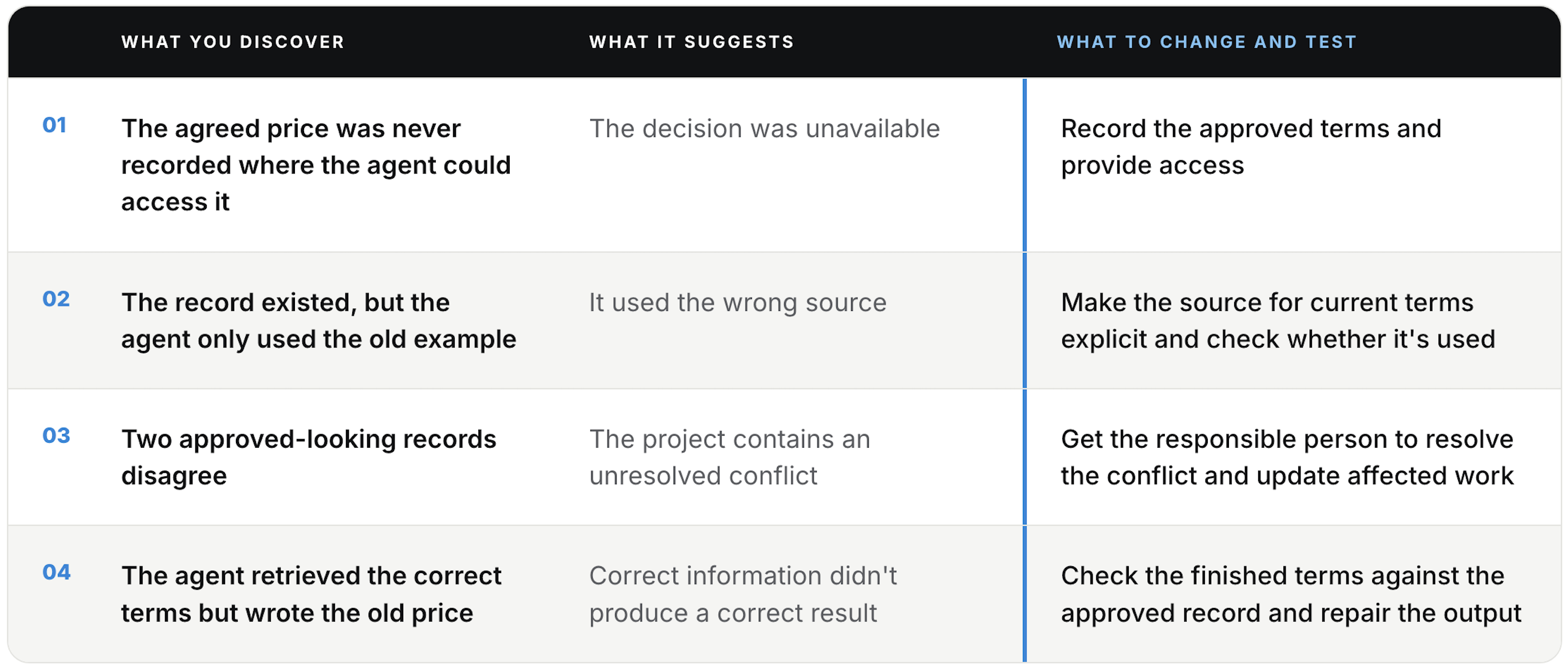
More than one of these can be true. If you can’t see what the agent actually retrieved, you may need a new trial that makes that step visible. Asking the agent afterward why it made the mistake gives you hypotheses to test.
Work through the second row. You find that the approved record was available but the agent only used the old proposal. A useful change is to separate the roles of those sources: the deal record supplies current commercial terms, and the old proposal shows how to present them. Then test another proposal with different terms. Check both the source the agent used and the finished result.
That trial can show whether the change addresses the suspected cause. If the agent loads the correct source and still uses the old number, the problem sits after retrieval, and the next change should address the output check or the agent’s ability to perform the task.
Now try a variation before reading on. The draft contains a delivery date from the client’s latest email. The approved scope contains a later date. What would you check first?
Start with whether an authorized decision changed the commitment, since a newer email only shows what the client asked for. The mismatch could be a missing approval, a stale project record, or a failure to distinguish a request from a decision. Until that’s resolved, “use the newest information” is the wrong instruction.
The companion includes similar cases in research and building, designed to develop the habit of investigating causes.
Once you have a supported diagnosis, decide where the correction belongs. My Working Context Starter Kit gives you a simple way to preserve the result. README.md explains the method. CURRENT.md describes the current outcome and state. CONTEXT-MAP.md points to sources and explains when to retrieve them. DECISIONS.md preserves the reasons for decisions, including ones that have been superseded. Stable instructions stay in the instruction system your tool already uses.
Those files don’t need the whole conversation. In the price example, the approved terms belong in the deal record. The current assignment points to that record. The source map distinguishes it from an old example. A reusable method might require comparing the finished commercial terms with the approved ones, and the reason for that change goes where a later contributor will find it.
Take an ambitious project you can already access and identify one consequential correction or discovery within it. State what the next attempt should do differently and why. Give the agent the current information and method, then check the result. Start a fresh session with access to the work and see whether it can continue without your original explanation. Change a relevant detail in another attempt to see whether it applies the lesson.
Write down your prediction before the trial. If it fails, work out what happened: was the decision absent, was it not retrieved, was the instruction interpreted too broadly, was the check inadequate, or could the model not perform the work? That diagnosis determines what you revise.
Surviving a crash and running a whole project overnight need their own tests, separate from the fresh-session trial. Run them on harmless material. The companion provides a capability table for recording what you observed, what documentation supports, and what remains unknown.
You can do this without waiting for a company-wide rollout, because the value is learning how to improve work you already control. As soon as other people contribute, the same reasoning leads to a larger organizational question.
Share AI agent methods across your team
Suppose you’ve improved the proposal method. Your own agent now gets the commercial terms right. A colleague takes over the next stage using a different model, a different personal setup, and a different collection of examples. How much of what you learned reaches their work?
That’s why I spent so much of the video on shared project information and team methods.
A useful shared method is written around the problem the team is solving. It explains how to use the relevant information, what requirements apply, what checks matter, and which decisions need someone else’s judgment. People can bring different agents to the work while using the same approved commitments and standards.
A skill is one way to package that method: a reusable set of instructions for a kind of work, sometimes accompanied by scripts or reference material. It can express your personal preferences. It can also carry the team’s accumulated judgment about preparing proposals, developing product requirements, reviewing research, or assembling a deck.
When the skill lives beside the shared work, the next contributor can discover and apply it. The team can improve it when a recurring problem reveals a missing instruction or check. You no longer depend on everyone remembering to update their own private setup.
A small shared method for proposal work might read:
Use the approved deal record for price, scope, and commitments. Use earlier proposals as presentation examples. Create a separate working version for a new draft and record which version you started from. Compare the finished commercial terms with the approved record. Bring conflicting or unapproved commitments to the account lead. Request review of the current working version before it is used with the client.
The source rule addresses the old-price mistake, while the separate version protects another contributor’s work. Comparing the finished terms checks whether the method actually produced the right result. The account lead resolves decisions the writer can’t authorize, and the reviewer inspects the version that might reach the customer.
Your version will differ. What matters is that you can explain why its parts are there. A long instruction file full of rules nobody can justify is hard to improve and easy to contradict.
Research teams need a different method. You may want several contributors to investigate competing explanations without copying one another’s conclusions. They can share definitions, evidence standards, current decisions, and an account of what remains unresolved while keeping the investigations independent.
This is part of what I meant in the video by organizing knowledge work more like code. Software teams have developed ways to preserve changes, work on separate attempts, compare differences, run checks, and reconcile contributions. A repository is an organized project collection with a record of changes. Similar practices can help even when the work is entirely documents.
Coding agents already have tools for searching files, reading material, making targeted changes, and running checks. Their training includes work that uses those operations. Making knowledge work reachable through those operations gives you a practical way to use capabilities the agents already have.
A shared project can point to sources: the systems that hold approved terms, customer records, or research evidence. The important questions are which record governs a particular decision, who can change it, how fresh it is, and whether the agent can retrieve it when needed.
Keep source roles explicit. A recent customer message may reveal a new need without changing what the company has promised. An older approved contract may still govern a commitment. A newer draft may contain an unapproved idea. “Latest” and “approved” answer different questions.
Give shared methods an owner too. When a correction improves the method, someone should decide whether it applies more broadly and update the shared instructions. If it changes only one customer’s situation, keep it with that customer’s work, so one local exception doesn’t silently become a rule for the entire company.
Test the setup with two contributors. Give them the same current sources and shared method, with related assignments that require some independent judgment. Check whether both actually load and apply the method. Compare their results against the requirements they should share. Agent products differ in whether they find a shared file on their own and how closely they follow it.
The test is whether the team’s judgment survives the handoff while people still have room to contribute something useful.
Make review and decisions part of the work
Shared methods can also help people know when their attention is needed.
A team is preparing a client deck. A writer starts version 15 from version 14 in a separate working area. Then the client emails asking for an earlier delivery date. The approved scope still has the original date. A reviewer is waiting to inspect the new deck.
There are several jobs here. The agent needs to preserve the client’s request as evidence, recognize the conflict, identify the person who can change the commitment, and keep the reviewer focused on the right version. It can keep drafting material that doesn’t depend on the unresolved date.
A good question from the agent might look like this:
The client has requested June 15 delivery. The approved scope still says June 22, and I found no record that we accepted the change. Meeting June 15 with the current scope would require an earlier internal review. Do you want to accept that schedule, propose reduced scope, or retain the existing date? I have left the commitment unchanged and continued the sections that do not depend on it.
That question makes the decision visible and tells the person what’s happening while it’s unresolved. If the agent instead asks “What should I do next?” the person has to reconstruct the whole situation.
After the account lead decides, the decision needs to reach the active work. Updating one chat won’t do it if other contributors keep using the old terms. The project record should reflect the approved change, affected tasks should be updated, and the reviewer should receive the version that incorporates it.
Roles decide who can make that change. The writer may draft within approved terms. The account lead may change commercial commitments. The reviewer may assess the result and identify required changes. A person can have read access without having authority to approve, and an agent can be technically able to edit a file without being authorized to change the commitment inside it.
Written instructions describe expected behavior. Application permissions and restricted execution environments enforce access and actions. You need to know which restrictions are actually enforced. A role written in a Markdown document doesn’t create an access control.
You also need a real mechanism for new information to arrive. An authorized connector or recurring retrieval job might bring relevant client correspondence into the project, preserving source links and a clear record of what was checked. A person might do that step instead. Choose a setup suited to how quickly the information changes and how costly a delay would be.
A skill that says “tell Jane when a new version is ready” needs something behind it: a process that detects the change, invokes the method, and sends the authorized notification. Check whether your software supports those steps. If it doesn’t, name the human step explicitly.
Conflicting work needs a real mechanism too. Imagine two people start from version 14. One saves a new version while the other is still drafting. If the second contribution silently overwrites the first, you lose work. Separate working copies preserve both attempts. A version check can detect that an update was based on older material. Someone still needs to compare the contributions and resolve real differences.
Two changes can combine cleanly as text and still contradict one another: one section can promise a faster delivery while another keeps assumptions that make it impossible.
More agents mean more room for parallel work and more need for that coordination. Cursor reported experiments in which agents using shared locks spent much of their time waiting and sometimes mishandled the locks. Changing their roles helped. Before adding agents, ask whether the tasks can proceed independently and whether their results can be evaluated and combined.
The team exercise in the companion follows two contributors using shared sources and a shared method. When a decision changes and their contributions conflict, they have to establish what reached each person and reconcile the work before sending the new version for review.
A person stays responsible for what reaches the customer. Better shared context and methods should free that person to understand the customer’s problem and judge the work, with less time spent repairing preventable confusion.
Decide how far the work can go
There’s no universal number of hours that makes an agent run useful. The right amount of independence depends on the work, the feedback available, the consequences of error, and the capabilities you’ve actually observed.
A building task with rapid executable checks may support many attempts between reviews. An exploratory research project may need a decision when the evidence changes the question, and a client project may proceed through several independent contributions and then wait for someone to approve a new commitment.
Extend the work when you have evidence that the setup carries direction, checks results, preserves what it learned, and handles the interruptions that matter. If a trial fails, investigate the failure before increasing the duration. The right change might be a better check, a more capable model, or a human decision that no amount of additional output will settle.
Judge the results in terms you can observe. Are you explaining the same thing less often? Are recurring corrections disappearing? Do contributors use the same current decisions? Are there fewer collisions? Do the questions coming back make the hard calls easier?
Include the cost of maintaining the setup and reviewing the output. A run can save drafting time and create more work in reconciliation, while another takes longer but uncovers an issue that would have reversed the recommendation.
If your agent never asks you a question, look at that: it can mean you’re still driving every step yourself. What matters is whether the agent raised the questions that required judgment and answered the rest from available information.
Completion also needs a precise meaning. A model ending its response, a tool finishing an action, a check passing, and an assignment satisfying its purpose are different events. Look at the actual work. Record unresolved decisions. If the project is waiting, preserve the reason and the way it should resume. If another attempt produces no useful evidence, change the approach, get the call you need from a person, or stop.
The companion below gives you three sets of examples, four worksheets in filled, partly filled, and blank forms, and five prompts you can use with your agent. Start with the examples, then use your own material. Write down what you think is happening before asking the agent for its interpretation. Compare the explanations against the evidence and test the change you choose.
Grab the Long-Running Work Companion
Use the existing Working Context Starter Kit alongside it for the reusable context files. The companion adds diagnosis, continued-work design, and team coordination, and it works with the tools you already have.
The next useful step may be a fresh session that carries one important correction properly. It may be a team trial in which a changed decision reaches every affected contribution. Choose a test that will tell you something about the larger work you want to attempt. When you can explain why the setup fits that work, show where it succeeds, and recognize where it needs intervention, you have a basis for giving the agent more responsibility.
Related reading
- Your AI agent is lying when it says it’s done: three checks to run on an agent’s “finished” work, from 11,755 runs where the ones that lied looked the most finished.
- Get the cheat code on long-running AI agents: what Manus, Google and Anthropic learned about managing context inside a long session, plus 12 prompts.
- My honest field notes on scaling agents past the demo phase: why adding more agents can make a system worse, and six rules from teams running hundreds.
- How to make the whole team faster without slowing down your best builders: why one person’s AI speed doesn’t reach the rest of the organization on its own.
Coming up
Sunday’s Executive Briefing: email, flights, banks, even the NSA had trouble this week. Why the systems we run on are now much easier to break than to repair, and why defending them has become the harder job.
I make this Substack thanks to readers like you! Learn about all my Substack tiers here