When the next Claude or GPT model ships, I want to see an old robot try again. Can it now recover from a mistake that used to require a human?
By Nate
Published: 2026-11-19
URL: https://natesnewsletter.substack.com/p/ai-robotics-bitter-lesson
In October, Lucy Cai and Claire Mao, the founders of the robotics lab Most Robotic, gave OpenAI’s GPT-6 Astra control of a kitchen arm they called Podrick. They wanted to see how much of a dinner party it could prepare. Starting the rice meant pressing a small tab. When Podrick missed, dinner was no closer to ready. Across several runs, Cai says, Astra learned to narrow down where to press by halving the search area. A programmer would recognize the technique as binary search. Here the sign it had worked was the cook light coming on.
Robotics is my pick for the AI story of 2027 because it puts Rich Sutton’s Bitter Lesson to a physical test. Sutton saw a pattern across decades of AI research. Experts would teach a machine how they solved a particular problem. As computing power grew, more general methods could search farther and learn from more experience, eventually overtaking solutions people had worked out by hand. In November, a new version of Claude more than doubled its predecessor’s score on the same simulated robot. If you skipped the robotics section of the release because you were there for Claude’s software skills, you missed a result about both.
The question for 2027 is how far the newer model’s advantage travels when the switch the machine keeps missing is on a real rice cooker.
Here’s what’s inside:
- Why robots were built for a fixed world. How factories made robots worth owning by bolting the world in place, and why teaching a robot each new kitchen task by demonstration gets expensive.
- Who supplies the skill. How to read a robot demo for the part a person programmed and the part the model found on its own, using Cai and Mao’s salad and rice cooker.
- What changed in 2026. The tests that handed robots to general models, from Claude’s simulated arms to Stanford’s 24 of 25 real trials and an agent that wrote its own air fryer routine.
- Why the specialists are speeding up too. How an open-source race, helped along by an AI coding assistant, got a humanoid controller test down to 3.4 minutes on a desktop graphics card, and why a robot may want a better planner and a better specialist at once.
- What to watch in 2027. The second attempt, the clock, and the moment a human walks over: the signals that tell you whether the next model release reaches a real kitchen.
First, the bargain that made factory robots worth owning.
Paid subscribers get access to the full post, Nate’s Library MCP, and my Slack community!
Nate’s Library MCP
Your subscription now works inside your AI.
Nate’s Library MCP is a read-only MCP server that gives your AI direct access to my entire published content library. Connect once, and then the archive just shows up in your normal AI conversations. You ask your AI a question during your actual working session and it pulls from everything I’ve published to answer it.
Setup takes just a few clicks.
Join the Slack →
It’s where I’ll be sharing things between articles, where you can get help on builds in real time, and where the fastest conversations in this community are already happening. I’ll see you in there!
If you have any issues connecting to my MCP or Slack, please email [email protected].
Why factories got there first
Imagine your job is to get the rice cooker’s switch pressed a thousand times a day. The arm has sensors to tell it where things are and motors to move the gripper. You could give it a hard search problem every time. Or you could bolt the cooker in place and teach the arm one movement you can count on. For a long time, that second choice was how you made a robot worth owning.
In 1961, General Motors put a programmable arm called Unimate beside a die-casting press in New Jersey. The press produced a metal part. The arm unloaded it. The engineers knew what was coming out of the press and where it would be. They could arrange the equipment so the arm encountered the same problem on every cycle. That was a sensible bargain for a factory with thousands of hot parts to move.
You can make a robot smarter about finding a part, or you can spend a little money on a fixture that holds the part in the same place every time. If you run the line all day, the fixture may be the best engineering decision you ever make. Repeat that decision across tools, workstations, and procedures, and you get a robot that is extraordinarily capable inside the world people built for it.
Engineers also learned to give robots more freedom by dividing the work among specialists. Imagine an arm unloading mugs that arrive in different positions. A vision system estimates where a mug is. A planner works out a path the arm can take without hitting the shelf. A controller reads the positions of the joints and adjusts the motors to follow that path. Each part can be tested on its own. If the arm hits the shelf, there’s a meaningful difference between a camera that put the shelf in the wrong place and a motor that failed to follow a good plan. This division of labor is still there in widely used robotics software.
A household is expensive to organize around a robot. People move the mugs. The towel you want it to pick up changes shape every time somebody drops it. A person can show the robot how to handle those variations, which gave robotics another route to specialization. Record a skilled operator doing the job. Use the camera images and the operator’s movements to train a policy, the robotics term for a rule or model that chooses an action from what the machine can sense.
For a kitchen example, look at Stanford’s Mobile ALOHA project from 2024. An operator guided two robot arms through tasks including sautéing and serving a piece of shrimp. The researchers collected 50 demonstrations per task and trained on those examples alongside earlier robot data. The robot could learn a delicate, two-handed skill that would be tedious to program movement by movement. Now add the next ten dishes to the menu. Who demonstrates each one? What if the next stove is different? Those questions tell you where the cost of a new capability goes.
What a language model brings to the kitchen
A language model comes to this problem with an unusual head start. It has encountered instructions for cooking rice, explanations of switches, and a lot of code written by people trying to find out why something didn’t work. Give it a camera view, a way to ask the arm to move, and a fresh view after the move, and some of that knowledge becomes useful to a robot. The robotics team still has to make a command like “move here” mean something precise enough for a motor to execute.
An early version of that arrangement appeared in Google’s SayCan project in 2022. Researchers gave a mobile robot a collection of skills it could already perform. When a person said they had spilled a drink, a language model could work out that a sponge would be useful. The robot’s skill estimates helped determine which steps it could carry out in that room. Knowing what people use to clean up a spill had come from language. Knowing how to pick up the sponge had come from robotics.
In 2023 Google DeepMind tried bringing those jobs into one model. Its RT-2 system started with a model trained on images and language, then trained it further on web data and recordings of robot actions. Given a camera image and an instruction, it could predict a movement. That’s what researchers mean by a vision-language-action model. Web training helped it recognize what the user meant by the bag about to fall off the table. Robot experience helped it reach for the bag. Building and training a model expressly for robotics was a substantial research project.
By October 2026 two people could try a different route. Cai and Mao connected OpenAI’s general coding model to their arm through software tools. Their dinner-party videos document two different answers to the question of who supplies the skill. For their caprese salad, Astra kept spilling ingredients when it tipped a bowl. The two founders wrote a pouring routine. Astra could assemble and dress the salad by deciding when to call it. The humans also had to come up with a combination they wanted to eat. Cai says that took a couple of days of eating a lot of salad.
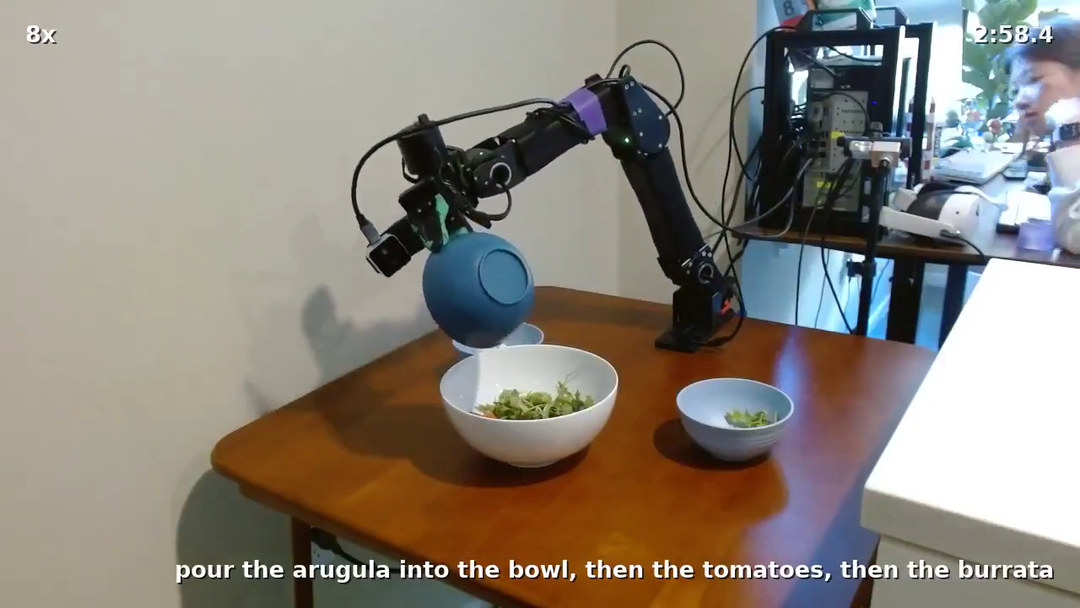
At 0:22, Podrick tips the blue bowl. The smooth pour is the routine Cai and Mao wrote. Astra’s part is choosing when to use it. Watch Podrick make the salad
Put the two dishes side by side. At the rice cooker, Cai and Mao gave Astra the means to move the arm, and the model worked out how to search for the switch. From across the kitchen, both jobs can look like a robot following a recipe. Cai’s account lets you see who supplied the missing skill.
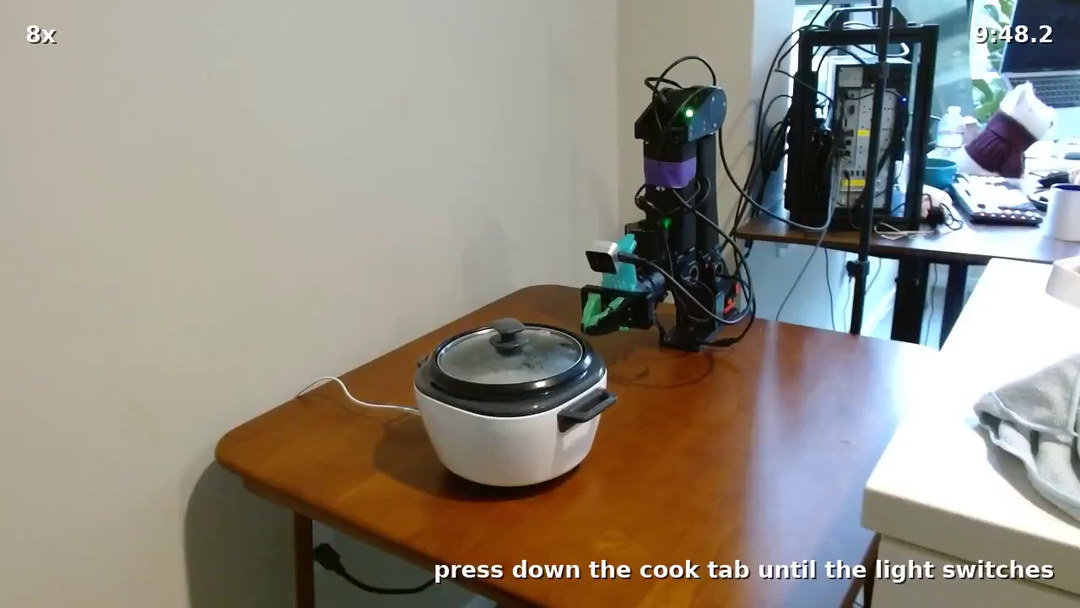
A person washes the rice and adds water about 20 seconds in. Skip ahead to 0:28 for the smaller job Astra has to figure out. The signal that it pressed the tab is the cooker’s light. Watch Cai and Mao’s rice cooker demo
What I want to know is whether that division of labor changes when a better general model comes along. Could the next version figure out a movement that Cai and Mao had to program this time?
What changed in 2026
Start with the comparison a robotics team would want to run. Keep the robot and its controls fixed. Change only the model. Anthropic did this in its November release of Claude Fable 5.2, giving the older and newer versions camera images from the same simulated two-arm robot and the same tools to operate it. At maximum effort the score rose from 27.6% to 64.9%.
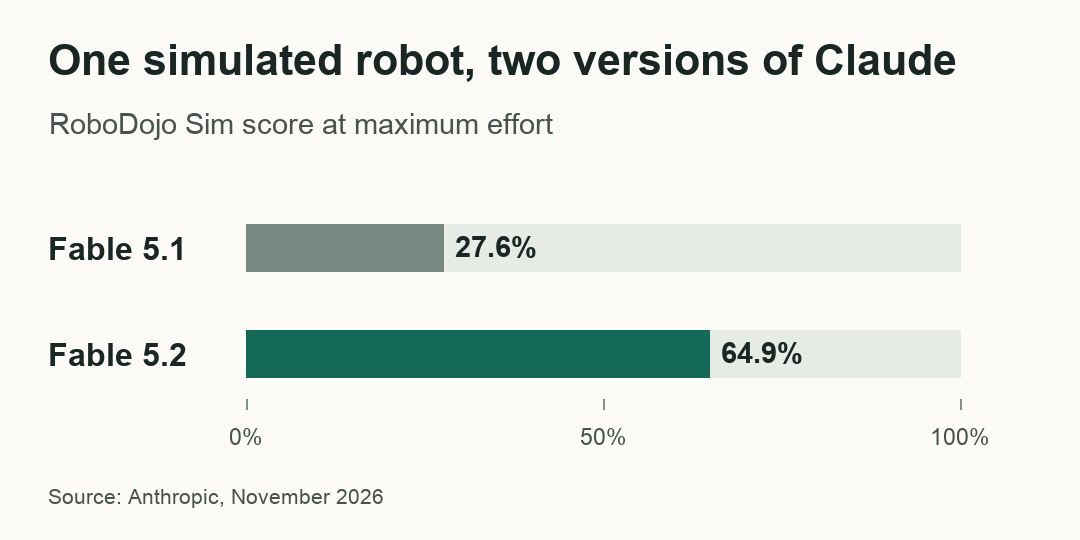
Anthropic ran both versions on the same simulator. The bottle-cap clip on the release page shows what Fable 5.2 could do on hardware. See Anthropic’s robotics demos and benchmark
A separate Stanford project asked how much of that ability a builder could get out of an off-the-shelf agent on real equipment. Hengyuan Hu and colleagues built a visual interface that let a coding agent look through a mobile robot’s cameras and place a virtual gripper where it wanted the real gripper to go. Conventional robot software handled the motion. For the model, placing the gripper on an object became much more like pointing at something in a screenshot. The Stanford team then gave Astra five physical jobs without additional training on the robot.
One was to clean a table with a wipe. The gripper blocked the camera while it worked, so the agent moved the gripper out of the way to see where the table was still dirty. On one run it dropped the wipe and pushed it across the table with the gripper closed. Across all five jobs Astra completed 24 of 25 trials. The failure came on a lamp whose stem and pull chain were both silver. The robot reached for the stem. I like the failure and the wipe for the same reason. You can point to the exact judgment the person asking for the job was relying on the robot to make.
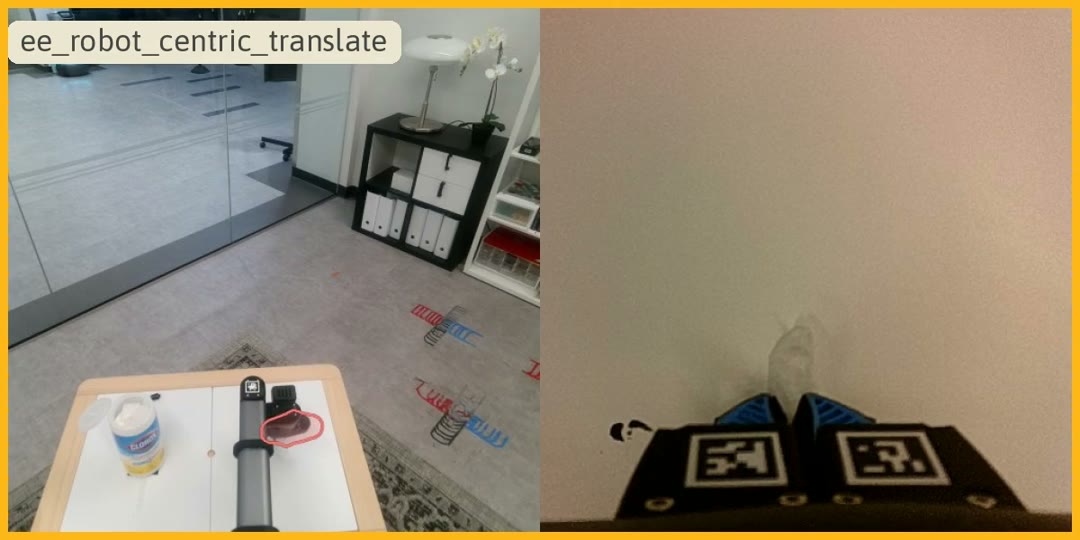
The view on the left is from the robot’s head. The one on the right is from its wrist. At 1:14, the gripper lifts and the marks still on the table come back into view. Watch the inspection
A team led by researchers at Harvard went one step further. Could the agent write the missing skill itself and leave the code for another run? In their October project, called RAX, they gave a physical robot arm access to an air fryer. The agent had to work out how to open the drawer, put objects inside, and close it. The drawer tipped and shifted when the arm let go of it. A camera got bumped. The team released the session logs, so you can see the agent measure the handle again and close the drawer with an extra push.
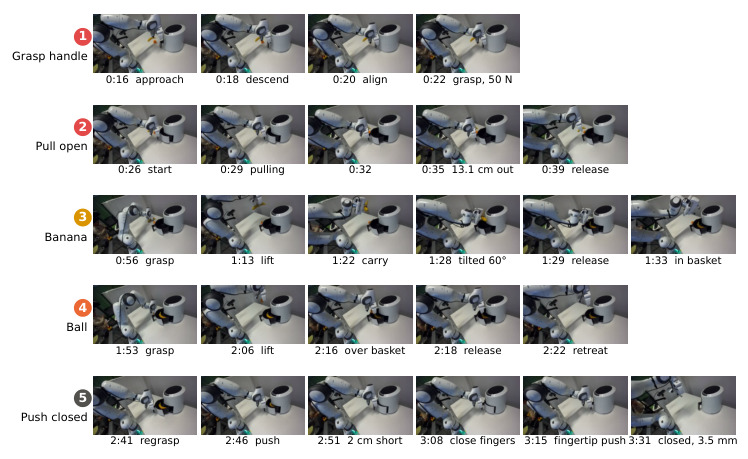
Read the bottom row of the RAX team’s frame sequence from left to right. At 2:51 the drawer is still two centimeters short. In the last frame, at 3:31, the final push has brought it to within 3.5 millimeters of where it started. Read Figure 27 in the paper

What came out of that session was a program the arm could run after the agent disconnected. For the salad, Cai and Mao had to write a reliable routine for an awkward physical movement. The air fryer researchers showed how such a routine could be produced by an agent allowed to investigate the equipment and test its work. If a model takes an hour to understand a drawer and leaves behind code that can open it all week, what matters to the person using the appliance is what the second opening costs.
This is the bet OpenAI made explicit in November when it told Fortune it had moved researchers from its stand-alone robotics team onto general-model teams. The company cited what it had seen its frontier models do on robots. The move makes sense if some of the most valuable work you can do for a robot is also work you want to do for every other customer of the model.
Why roboticists were arguing about three minutes
There’s a second development you could easily miss if you only follow the model releases. The specialists have been making progress of their own. In November, Ros Shinkle, who previously worked on the arm of Boston Dynamics’ four-legged Spot robot, asked her friends outside robotics whether they realized how cheap it had become to train a whole-body controller. When a reader remembered three hours, Shinkle pointed to the open-source projects that followed the original paper. To understand how both numbers can be right, it helps to know what the teams asked the robot to learn.
A whole-body controller solves a problem a tabletop arm gets to skip. Reach forward with a cup in your hand and your weight shifts over your feet. A two-legged robot has to coordinate that shift with its reach or it falls. One way to teach it is to give a simulated robot recordings of human movements and train it to follow them while staying on its feet. Nobody has to ask a language model where each knee should be fifty times a second.
The three-hour result came from an October 20 paper by Qiayuan Liao and colleagues. Their method, SuperMimic, trained software to predict how a simulated humanoid would respond to a movement, then used those predictions to improve the controller. After three hours on one NVIDIA H100 GPU, it beat the tracking score of NVIDIA’s released SONIC controller across 129,514 motions from the training library. SONIC had trained for seven days on 128 L40 GPUs and a larger set of motion data.
Here’s where the people who follow coding agents come back into the picture. The authors’ code was unavailable when Chong Zhang at ETH Zurich read the paper. Zhang says it took an hour with an AI coding assistant to write an unofficial implementation. By October 21, Zhang’s code was public. Within weeks other researchers were trying variations. Huy-Quang Dao’s InstantTrack changed the way the controller was trained. Fuyi Chen built on that work with BlinkMimic, directing more practice toward motions the robot still failed.
The three-minute result belongs to this smaller experiment. BlinkMimic trained one simulated humanoid to follow 40 motion clips in 3.4 minutes on a single RTX 4090, a graphics card sold for desktop PCs. It had to clear a tracking threshold at three consecutive checks without failing a clip. XMimic later reached the same target in under a minute on four H100s, excluding compilation. If you need a week on a cluster, somebody has to like your idea well enough to give you the week. If you have a desktop and an afternoon, you can try a change, find the step that still makes the robot stumble, and send the next researcher both the code and the troublesome clip.
NVIDIA’s own robotics group put the SONIC controller on a real humanoid at a popcorn stand. Their GR00T 2 Turbo model used camera images and joint positions to plan a short stretch of movement about once a second. SONIC translated the plan into targets for the joints 50 times a second. The robot held a cup with one hand and worked the scoop with the other. In NVIDIA’s serving test, each trial required two filled cups. It completed all 48. A robotics engineer might want a better planner and a better specialist in the same robot.
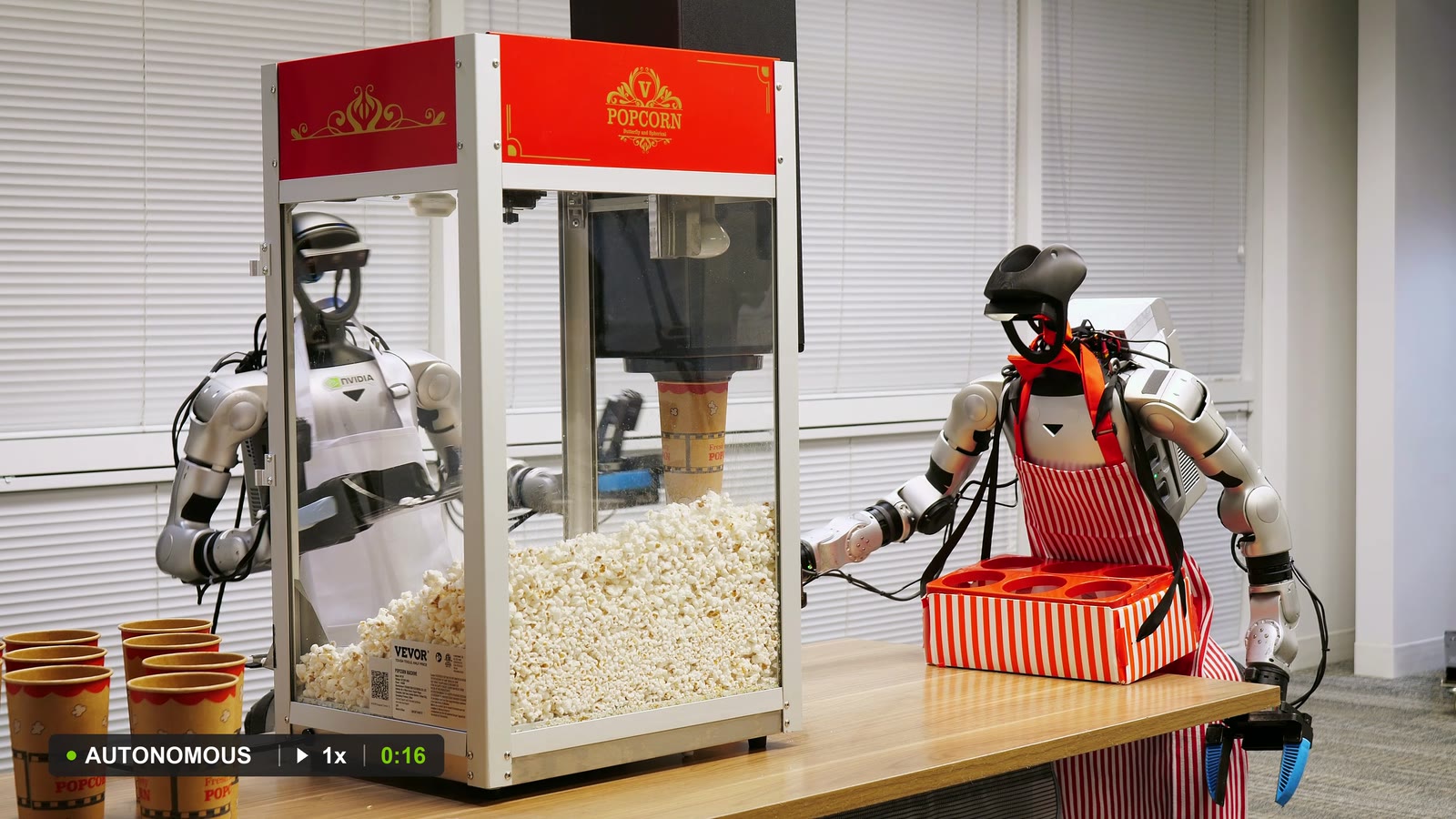
In NVIDIA’s film, watch the hand holding the cup while the other hand works the scoop. Keeping them lined up is part of the job. The film shows SONIC on hardware. The three-minute BlinkMimic result measures training in simulation. Watch the popcorn demo
What I’m watching in 2027
The claim worth testing in 2027 is how far the Bitter Lesson travels. If a team spends a year perfecting a routine for one arm and one bowl, the next kitchen still needs its own work. If a general model gets better at discovering the routine, every team that can connect that model to its cameras and controls gets a chance to use the improvement. I’d start with the places where we can actually measure the difference.
The first payoff I expect is a shorter trip from a request to a working skill in places where the equipment stays put and a camera can tell whether the job succeeded. Think of a lab technician getting a familiar arm to handle a new tray without calling the engineer who installed it. A crowded kitchen is a harder prediction. There, the test is whether the skill still works after someone swaps the bowl, changes the light, or reaches across the counter.
For that prediction to hold up, the improvements have to survive the move to real equipment. In November, Jiaming Tang and colleagues at MIT’s HAN Lab and partner institutions tested an open Qwen reasoning model on two physical tasks, picking up objects and aligning blocks. It went zero for 30. After training entirely in simulation, the revised model went 18 for 30 on the real robot. That’s the kind of follow-up I want to see for a three-minute training run. When the simulated robot stops stumbling, does its physical counterpart keep its feet?
I’d also look for people who can afford to try the next release on the same equipment. Robert Scoble interviewed Axel Peytavin, founder of Innate, about a $995 mobile robot called MARS. Peytavin later gave two of those robots the same job at the same time. Google’s Gemini controlled one, OpenAI’s Astra the other, and there was a sock to retrieve. Somebody won ten of the 29 races. Usually the sock went unclaimed. On a laptop, waiting ten seconds can get you a better answer. In a race, those ten seconds belong to the other robot, too.
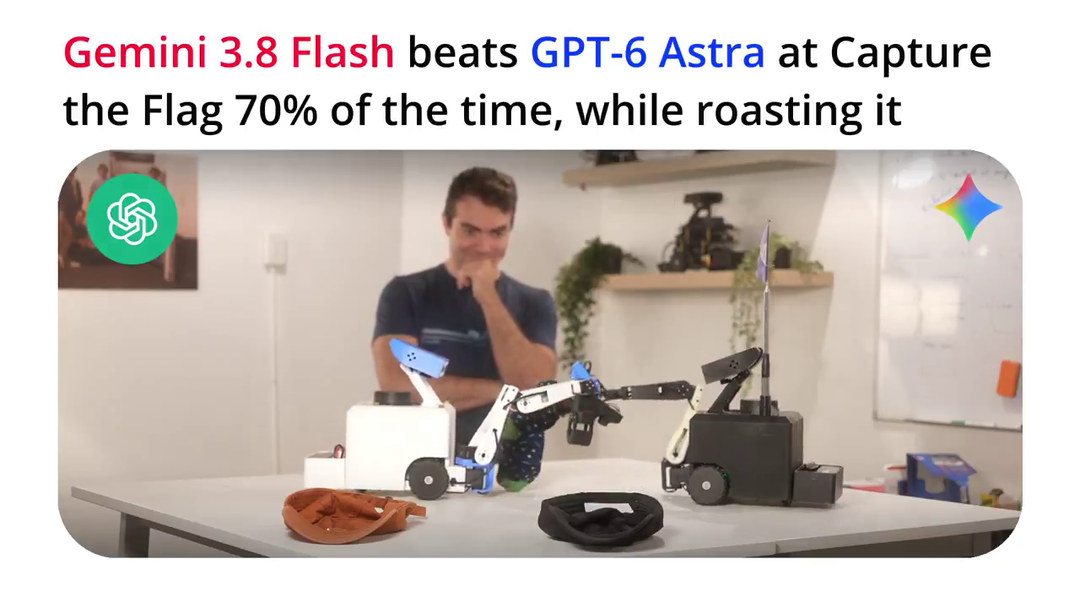
Peytavin’s clip shows one of Gemini’s wins. The 70% in the video is seven of the ten races with a winner. Nineteen other races ended with neither robot retrieving the sock. Watch the race
Buying a machine is only part of the expense. In Project Fetch, Anthropic timed how long volunteers needed to get a robot dog through four jobs on the way to fetching a ball. The team with an earlier Claude took about three hours. Later, Opus 4.7 did those four jobs on its own in nine minutes and 35 seconds. The dog still couldn’t bring the ball back by itself. But a builder who only spent ten minutes getting things working has the rest of the afternoon to try something new.
Finally, watch someone use a robot for work they already care about. Dhvanil is an artist in Berlin who keeps a public record of PB27, a drawing practice with a robot arm. Dhvanil built the painting rig and judges the art. Codex and Claude Code write software and operate the arm. For a watercolor of an autumn tree, the arm made 303 brush marks overnight. Between passes it mixed lighter shades on a second palette, and a camera measured the paint wells before the brush went back to the paper. There’s another painting Dhvanil wants to make.
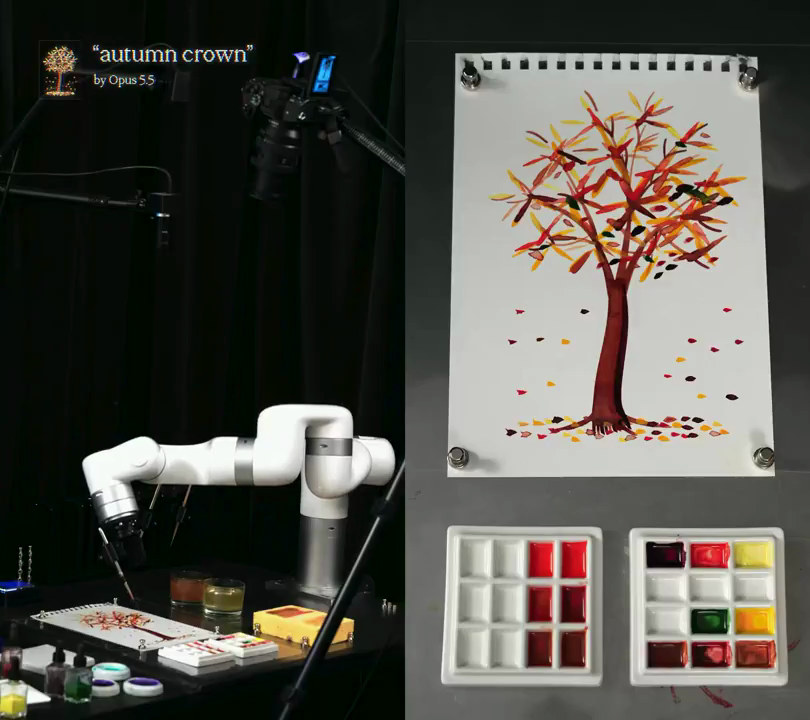
The film compresses about four and a half hours into 24 seconds. Keep an eye on the wells below the painting. They show the colors the arm had available for its second pass. Watch Dhvanil’s overnight watercolor
The distinction between finishing once and being worth somebody’s time is going to matter. Apple’s robotics researchers tested Claude Opus 5.5 on twelve tabletop tasks. With recovery from controller errors enabled, their system succeeded in 104 of 108 physical trials, and under the same stop-on-error rule used for the two specialist systems, it still succeeded in 94. On successful runs the agent averaged four minutes and 40 seconds. The specialists averaged 44 and 62 seconds on the jobs each managed to finish. An artist can wait overnight for a watercolor. Try asking a line cook to wait four minutes for a bowl.
That’s why I’d follow the people who show you the second attempt, the clock, and the moment a human walks over. And I’d keep an eye on the other equipment a coding agent can learn to operate this way. Anthropic has already described Claude adjusting a laser, measuring the change through a camera, and writing a script that could do the alignment again. Once a machine can take an action and give the model a trustworthy measurement, the same question a roboticist asks about a gripper becomes interesting to the scientist who owns the instrument.
For the next dinner party, I’d give Cai and Mao the bowl Astra kept spilling. Try the old model and the new one on Podrick before writing a new pouring routine. Count the spills, time the attempts, and mark the moment somebody has to put down a drink and help. If a release built for millions of people can give these two cooks a better evening, I want to know what else improved the day that model shipped.
Related reading
- Why NVIDIA is building world models, and what developers will build with them: what a world model actually is, and how it connects to the LLM you already use.
- What I’d actually give Fable 5.2 to do: how I’d use it on a project, judge what it adds, and keep the bill under control.
- Reinforcement learning is the theory of everything for AI: a plain-language guide to how rewards shape what an agent learns to do over time.
- Who sees the future clearly, builds it: NVIDIA and the technologies we’re not talking about: the long game beyond GPUs for chatbots, in robotics, cars, and AI in the physical world.
Coming up
On Friday: the principles, technical limits, and shared methods behind AI agents that can keep doing useful work for hours or even days.
I make this Substack thanks to readers like you! Learn about all my Substack tiers here