What OpenAI’s repository problem reveals about testing, review, and decisions—and how to identify the constraints in your own work.
By Nate
Published: 2026-11-06
URL: https://natesnewsletter.substack.com/p/openai-pando-git-backend
OpenAI’s coding agents increased the amount of work moving through its development systems. Engineers could pursue more changes at once, and agents repeatedly retrieved code, ran tests, and submitted their work. The infrastructure that supported those activities struggled to keep up.
OpenAI built Pando to address the repository part of that problem. The company published its engineering explanation on November 2.
I had just sat down with Vijaye Raji, OpenAI’s CTO of Applications, to discuss how agents were changing work inside the company. He joined OpenAI through its acquisition of Statsig, the company he founded.
When one part of the work accelerates, it changes what the rest of the organization must handle. Individual engineers get more productive. The team delivers far less of that gain.
You need to identify the resulting delays, understand their causes, and change the systems or decisions responsible for them. Agents can help with that work, too.
Here’s what’s inside:
- Why OpenAI rebuilt its Git backend. What agent traffic did to OpenAI’s monorepo, the two design changes behind Pando, and the nearly 80% drop in median push latency OpenAI reports.
- Where the speedup stalls. How FurtherAI’s fivefold jump in merged changes per engineer moved the wait into testing, review, and deciding what to build.
- Review rules an agent can run itself. How FurtherAI turned repeated review comments into 21 automated checks whose failures agents fix before a person looks.
- Prototypes you’re willing to throw away. Vijaye’s case for not getting attached to code, and how to bring a working demo to a team without ending the debate.
- A seven-question constraint review. A table you can fill out with your own recent work to find where it waits and run one experiment on it.
The full conversation with Vijaye comes with this piece.
Paid subscribers get access to the full post, Nate’s Library MCP, and my Slack community!
Nate’s Library MCP
Your subscription now works inside your AI.
Nate’s Library MCP is a read-only MCP server that gives your AI direct access to my entire published content library. Connect once, and then the archive just shows up in your normal AI conversations. You ask your AI a question during your actual working session and it pulls from everything I’ve published to answer it.
Setup takes just a few clicks.
Join the Slack →
It’s where I’ll be sharing things between articles, where you can get help on builds in real time, and where the fastest conversations in this community are already happening. I’ll see you in there!
If you have any issues connecting to my MCP or Slack, please email [email protected].
Why OpenAI needed a new Git backend
A repository holds a project’s code and its history. OpenAI uses a monorepo, which keeps code for many parts of the company in one shared repository. A branch lets an engineer or agent develop a change separately before combining it with the shared version.
That setup creates work whenever someone retrieves code or submits a change, and agents multiply both: each agent working for an engineer needs code to inspect and modify, and each change it proposes sets off automated tests that need the same code. More parallel development means more requests to the systems serving that repository.
Vijaye described engineers producing more prototypes and more proposed changes as coding got faster. Reviews, automated testing, and the systems for delivering software struggled to keep up. The volume moving through the repository became one of the problems OpenAI had to solve.
When we reached that subject, I asked about changes colliding on their way into production. If several agents work simultaneously, how does OpenAI keep their changes from interfering with each other?
Vijaye said collisions are solvable if you’re not locking on main, and pointed to a bigger constraint: getting the code out to the agents. Before an agent could change anything, it needed the relevant files. He described the need to retrieve only the necessary code and to use caches, which keep copies available so requests don’t all reach the same place.
How Pando scales Git for AI agents
Pando replaces OpenAI’s repository backend while preserving Git compatibility. Engineers and agents continue using Git. OpenAI describes two changes to how the backend handles their requests:
- It processes updates to unrelated branches independently. Work on one branch doesn’t wait for updates elsewhere. Each branch retains an ordered history, but reading several branches may show them at different moments.
- It reuses compressed code packages across readers. The server can supply the same stored data to many agents instead of preparing a separate package for each request. Caches help deliver that data.
OpenAI reports that median push latency, the time Git takes to accept a pushed change, fell nearly 80%. Pando began serving production traffic in April. A single engineer designed its core, agents implemented it, and a handful of engineers deployed it after ten weeks. OpenAI tested Git compatibility and simulated system behavior, then later used mathematical methods to find bugs and prove properties of the system. The company says it’s exploring ways to share the technology behind Pando with its users.
In our conversation, I put it to Vijaye that leadership had handed the repository team a problem to solve without prescribing the method. He said that’s always the case. They had to investigate the constraints and keep the existing system running while building its replacement.
Why infrastructure caps what coding agents deliver
A faster agent helps a project only when the next stage can use its work. If the agent finishes a change in an afternoon and the test environment takes a day to become available, the project still waits for the environment. Further improvements in coding speed leave that delay in place.
The cause matters. Provisioning might require a person to run a sequence of commands. Several teams might keep breaking the environment they share. Engineers might lack access that someone could have arranged at the start. Each cause requires different work.
A leader who sees only the coding time can miss where the work piles up. Reviewers receive more changes. Test jobs wait for machines. Unresolved product questions interrupt implementation. People switch tasks while waiting, then have to rebuild the context when a result arrives.
Those delays affect customers. A bug fix that waits for review still leaves the customer with the bug. A feature that passes technical checks but addresses the wrong problem consumes engineering time without helping the person who requested it.
In May, I wrote about platform teams absorbing the work that faster application teams create. Pando shows OpenAI assigning engineering work to a specific constraint. You can apply the same approach: find where work waits, investigate the cause, and give someone the time and authority to improve it.
Why AI coding moves the bottleneck
Sashank Gondala describes how the constraint keeps moving in his account of building an AI-native engineering organization at FurtherAI. FurtherAI improved code generation, testing, review, and bug intake, then found that decisions about the work came to determine its pace.
Testing and review must handle more changes
He reports roughly five times as many merged code changes per engineer since January, with a revert rate below half a percent. FurtherAI got there by adding tests alongside agent-written code, expanding automated review, improving test execution, and automating parts of bug intake. Each improvement exposed another place where work accumulated.
The test infrastructure is a good example. FurtherAI parallelized tests and selected the tests affected by a change. Its system could then run twenty times as many tests in the same seventeen minutes.
A test system that worked well for the previous volume becomes a constraint when the work arriving at it changes.
Gondala also tells us what those improvements cost. Through the summer, much of FurtherAI’s engineering effort went into tests and tooling. Customer-facing changes per engineer stayed between seventeen and thirty a month. That rose to forty-five in September.
If you were only looking for an immediate jump in customer-facing output after buying coding tools, you could have missed what FurtherAI was building: systems that would support more work later. They had to make those investments while continuing to serve customers.
Leaders face that tradeoff whenever they decide whether an engineer can spend a week fixing a recurring development problem. A requested feature has an obvious customer and purpose. Improving an internal tool requires the engineer to explain who will benefit and how. That improvement pays off on every later feature and for everyone who works on them.
Make a specific case for that work. Identify who waits, how often the problem occurs, and how much time people spend correcting it. Explain what a successful change would allow them to do. Those details help distinguish a useful investment from a tool somebody wants to build because building tools is fun.
They also create a way to check the result. If you change how tests run, you should know whether engineers receive trustworthy feedback sooner, whether they rerun jobs less often, and whether defects escape into production. The number of merged changes tells you how much code moved. Customers experience whether the software works and whether it solves their problem. You need both views to understand what the investment bought.
Repeated engineering rules can become automated checks
At FurtherAI, when a bug or review comment exposed an engineering rule, an engineer wrote a small Python check. The check ran on commits and proposed changes. When it found a violation, it failed the build and explained the fix. Agents could then correct their own work. Gondala says FurtherAI went from zero to twenty-one of these rules.
Think about the hours hidden inside a recurring review comment. An engineer submits a change. A reviewer notices a familiar problem. The reviewer writes a comment, the engineer reads it, the agent makes the correction, and the reviewer looks again. Everyone did reasonable work. The same sequence happens next week because the rule still lives primarily in the reviewer’s head.
Now give the agent a reliable check while it works. The check catches the error and tells the agent what to change before a reviewer has to get involved. FurtherAI uses tests, automated checks, and AI review to allow qualifying low-risk changes to merge automatically. Gondala reports that up to a third of changes now take that path.
For example, imagine your application has a shared method for making network requests because it handles authentication and timeouts. Agents keep writing direct requests that bypass it. A reviewer can point that out repeatedly. You can also build a check for the prohibited pattern, explain the approved method, and include a small example of the correct usage. Every new agent session can benefit from the correction.
Experienced engineers know which apparently minor mistakes keep producing expensive failures. Their knowledge becomes particularly valuable here: choosing rules the system can enforce reliably, separating those from preferences that need discussion, and explaining why each rule exists. That explanation helps whoever maintains the check when the application changes.
I made a related argument in the Codex plugins guide: repeated work improves when the agent can inherit your instructions, tools, and checks.
Start with your own recent reviews. Find a correction somebody has had to make several times. Determine whether you can detect the mistake reliably. Write the message the agent will see when the check fails. Try the check against past examples, including valid code that looks similar. Then put it where the agent encounters it before asking a person to review.
Some problems need a different approach. A check can tell you that a form contains required fields. A customer trying to complete the form can tell you that the questions make no sense. Automating the first kind of problem frees people to investigate the second.
Planning and review take a larger share of delivery time
FurtherAI eventually reached a problem that better test infrastructure couldn’t solve: deciding what to build.
Gondala uses a simple hypothetical feature to explain it. The feature takes three days to plan, six days to implement, and one day to review. Ten days total. Agents make implementation three and a half times faster.
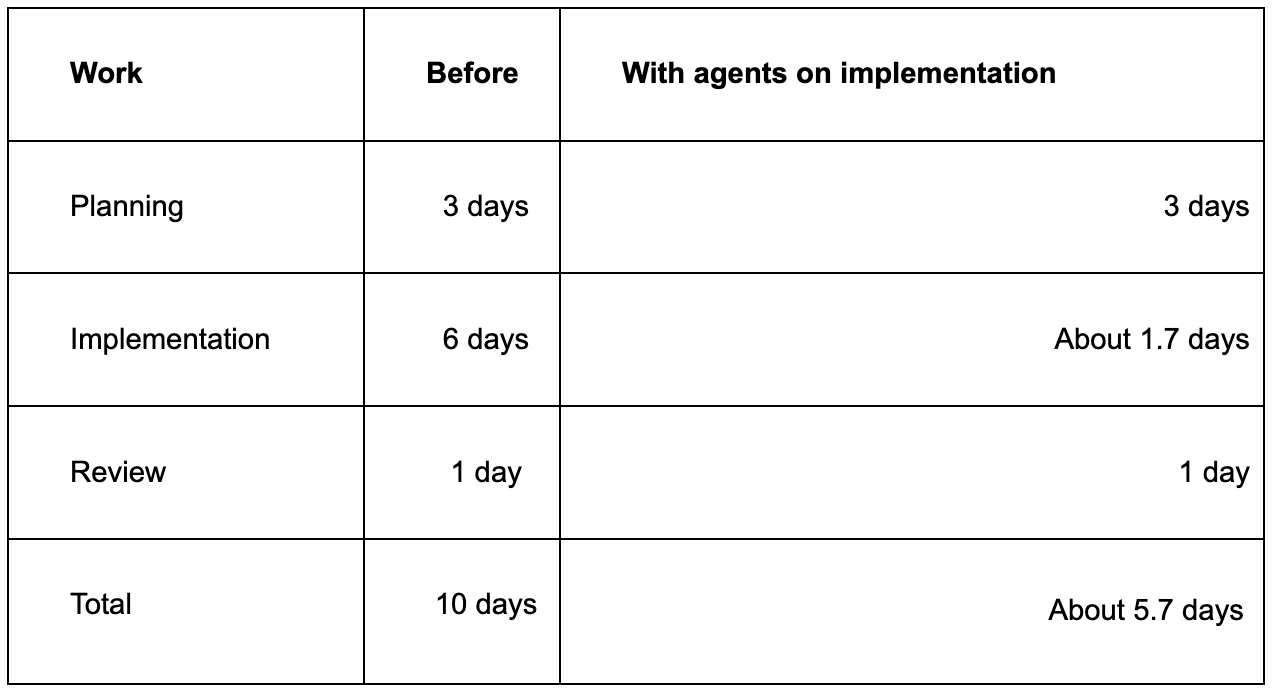
The implementation improved dramatically. The whole feature got about 1.75 times faster. Planning and review now consume 70% of the elapsed time.
You can keep shrinking implementation, but those four days remain until you change how you plan and review. At some point, a manager who once approved a manageable amount of work becomes the person everyone waits for. Faster engineers arrive at that person’s desk more often.
Gondala’s response is to give engineers more responsibility for understanding customer problems, planning work, making tradeoffs, and checking the result. He describes seniority partly through how much of a problem a person can own. The strongest engineers can take an unclear problem, decide what to do, and own the measure that says whether it worked.
That changes what an organization has to teach. An engineer who receives a detailed ticket has practice implementing somebody else’s decisions. An engineer who owns a customer problem needs to understand why the customer cares, which compromises are acceptable, and what would count as success. Giving someone a broader title won’t supply that context.
Suppose customers abandon your onboarding process while importing their data. The ticket says, “Add a progress bar.” An engineer can build that quickly with an agent. But customers might be leaving because the import fails on a common date format. They might be unsure whether uploading the file will overwrite existing records. They might be waiting for information from a colleague.
A progress bar helps with one explanation. You need to find out which one applies.
An engineer who can inspect failed imports, speak with support, and watch a customer attempt the task has a much better chance of choosing a useful change.
Vijaye made a related point when I asked him about roles becoming blurrier. Product managers, application engineers, and infrastructure engineers bring different ways of seeing the same problem. Product considers the steps a person must take. Engineering considers how the application should work with what already exists. Infrastructure considers what happens under load. Agents help each of them do more with that expertise.
The organizational question is where those contributions belong. If every small decision must travel through the same people in the same sequence, the queue in front of them grows. Bring the necessary expertise into the problem early, make the constraints explicit, and give someone enough authority to move the work forward.
Then keep that person involved after release. The person who owns the import problem should see whether customers complete the import. That feedback develops the judgment needed for the next assignment.
Without that connection, you can get very good at finishing tickets while remaining dependent on somebody else to decide whether the tickets were worth doing.
More prototypes require more product judgment
I pushed Vijaye on a problem I see in AI development: people build prototypes rapidly, push them toward production, and lose the taste and coherence that make a product worth using.
His advice was direct: “Don’t get attached to code.”
OpenAI throws away more code now because engineers can explore more ideas. “What differentiates you from someone who can just code,” he said, “is the ability to say, no, this is not the right solution.”
This gets harder when a prototype looks finished. A polished screen can make an untested idea look ready for customers. People start discussing when to ship it, even though they haven’t established that it solves the original problem.
Go back to the import example. An agent builds a beautiful progress screen with a smooth animation and thoughtful messages. The demo runs cleanly on a prepared file. If the real problem is an unsupported date format, you’ve made the wait more attractive while leaving the failure in place.
Bring the actual failing file into the conversation. Run it through the prototype and watch what happens. Now you have evidence to work with.
Cheaper implementation should make throwing work away easier emotionally. You can afford to try an approach and discard it. But you have to value what the attempt taught you. If leaders only reward the number of features that reach production, people will find reasons to ship the prototype. If leaders ask what the team learned and which customer problem it resolved, discarding the wrong approach becomes useful work.
Vijaye also described how he uses prototypes as a leader. After thinking about voice as a way for more people to use ChatGPT, he used Codex to build a simplified voice experience. He tried the idea himself, selected it from among other experiments, and brought it to the team as something they could discuss and develop.
Productionizing it, he said, is “a completely different set of problems.”
I love being able to put something in front of people and let them try it. They can see what I mean, get confused, find a problem, or suggest a better way. A leader can do that work before asking anyone to invest in the idea.
The leader also has to make it possible for people to disagree. When the boss arrives with a working demo, people can interpret that as a decision already made. Say what you were trying to learn, what convinced you, and what still needs investigation. Let the people responsible for building the product test the assumptions that made the demo persuasive.
Gondala makes the complementary demand of managers: use the product in staging, where changes run before they reach customers. Experience the feature as a customer would. A manager who actually attempts an import will notice problems that a completed review checklist won’t reveal.
Then help engineers learn to notice those problems themselves. If the manager must personally approve every interaction, the engineers will queue up behind that manager. Developing their judgment gives the organization more people who can make a good decision and keep going.
Measure what happens after release
Vijaye’s Statsig background came through strongly when we talked about measuring changes. He wants teams to observe what the product does and to use feature flags: switches that let them enable or disable a behavior. You need a way to detect a problem and a way to respond.
That becomes more demanding as the volume of changes increases. An engineer can understand an individual change and still miss its interaction with something another team shipped.
For the import problem, decide what you want to observe before release. Track how many customers start and finish an import, which errors they encounter, and how long successful imports take. Look for repeated attempts and requests for support.
A lower error rate with more abandoned imports deserves investigation. Perhaps the new design prevents errors by making it harder to start. More completed imports with more corrupted records would be a disaster. You need enough of the picture to recognize both outcomes.
Choose the release method around what the change can do. You can enable a new interaction for a small group and expand it once you see people complete the task successfully. Decide who can disable the behavior and how they’ll do it. If a change can alter stored customer records, plan how to protect and restore those records, too. Turning off a screen won’t undo a data change.
Find the constraint in your own work
Start with one piece of work that took longer than expected. Choose something people remember, with enough records to reconstruct what happened. In software, use a recent fix or feature. In another function, use a completed analysis, customer request, or recurring report.
Write down the customer problem, then reconstruct the work. Record when you understood the request and settled on an approach, how long implementation took, and when tests and reviews finished. Add the release date and what you learned from customers afterward. The sequence should show where people worked, waited, or repeated an earlier step.
Separate time spent working from time spent waiting. “Review took three days” could mean a reviewer spent three days examining a difficult change. It could also mean twenty minutes of review after two days and twenty-three hours in a queue. Those situations require different fixes.
You can use the same approach outside software. Suppose an agent produces a weekly financial analysis in an hour, but colleagues spend two days reconciling conflicting definitions of revenue. Identify who owns the definition and which records everyone should use. Once the owner settles it, the agent can apply the agreed definition and flag exceptions for review.
To apply FurtherAI’s test work to your team, examine what happens on either side of the seventeen-minute run.
Imagine engineers on your team routinely wait two hours for a runner, the machine that executes the automated tests. The tests then finish in seventeen minutes. Engineers often switch tasks while waiting, so a result that arrives at noon may not get attention until late afternoon. Shaving a minute off the seventeen-minute run would leave most of that delay intact.
Now you have a specific assignment: investigate the wait for runners and reduce it without weakening the tests. The engineer responsible can inspect job records, find which jobs occupy the machines, and determine whether to add capacity, cancel unnecessary runs, or change scheduling. An agent can help analyze those records and implement the selected change.
Before trying it, record the current wait and choose what improvement would justify keeping the change. Track failures and reruns as well. A fast test result that people don’t trust creates its own delay. Give the experiment a clear owner and a limited scope, then compare the result with the original problem.
Once the runner wait falls, follow the work again. If reviews now account for most of the delay, bring the same attention to what reviewers need and where their time goes.
The short review I’d bring into a team conversation:
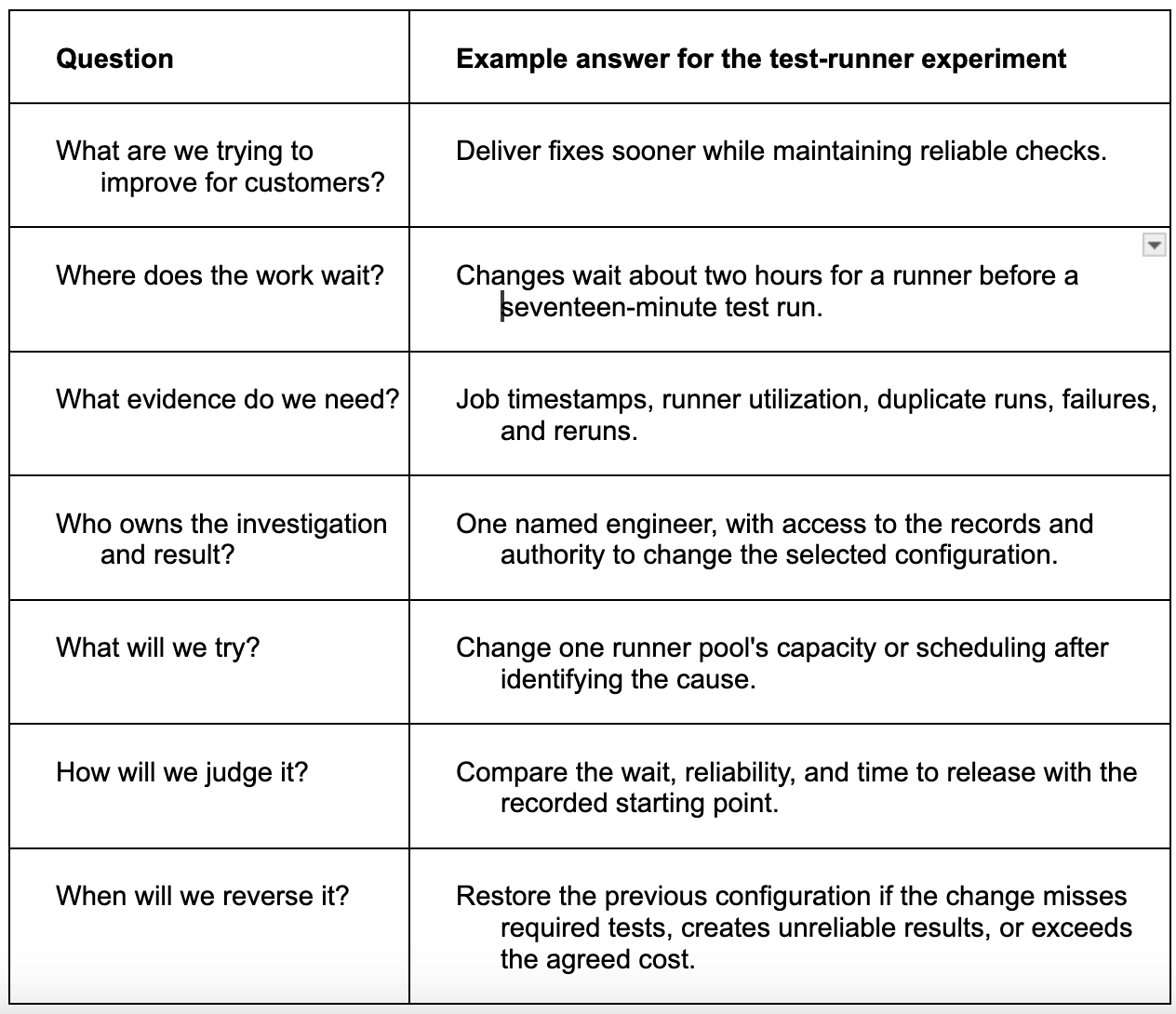
Fill that out with your own recent work. Bring the engineer who made the change, the person who reviewed it, and someone who understands the customer problem. Open the actual records. Find the first place where the work stopped moving and determine why.
Then give someone the time and authority to clear it. Put your agents to work on it. The next person who has a useful change to ship should get it to a customer sooner.
Related reading
- You’re spending six figures on AI models. The bottleneck is a 4-minute CI pipeline — and nobody’s fixing the right thing.: the tool layer, the human layer, and the four roles that survive both.
- Executive briefing: you bought better tools and your finished work still waits: why getting one person’s AI speed through the rest of the organization is a separate problem.
- Your prototype graveyard is leaking secrets. The Prototype Classifier + Demotion Audit decide what stays: PMs used to ration engineering, and now they have to classify abundance.
- Exclusive: a conversation with Tibo from Codex on what your company has to become when the model can actually do the work: the five leadership chairs Tibo thinks a company has to rethink once Codex can do the work.
I make this Substack thanks to readers like you! Learn about all my Substack tiers here