AI agents put work within reach that you once needed a team to attempt. How to decide what deserves doing, what your time is worth, and when to spend more.
By Nate
Published: 2026-11-04
URL: https://natesnewsletter.substack.com/p/ai-agent-cost-worth-it
Elon Musk just said his AI agent costs too much to serve. His own company has been showing how the same agent saves money.
A Grok Bot customer had run through their allowance with four days left before the reset. When they asked for it early, Musk’s explanation was direct: “The cost of serving Grok Bot was unsustainably high relative to revenue.”

In a September procurement write-up, xAI reported that Grok Bot found 43 paid seats for one software product with no activity in 90 days, and that review and downgrades produced $14,220 in savings.
Both things can be true. An agent can create substantial value for its user while costing its provider too much to supply at the current price. The cost of doing the work, the price charged for doing it, and the value of getting it done are three different numbers.
We’re about to have to get much better at thinking about all three.
The question underneath the Grok bill is what happens when an individual can afford to direct work that previously required assembling a team. I think this is one of the biggest changes agents bring to ordinary working life. Which work to fund, how much effort it deserves, and whether the result justified the expense are becoming decisions that more of us make ourselves.
You can investigate more possibilities, build things you’d otherwise leave in a notebook, or ask for help with a problem before it becomes urgent enough to justify everybody else’s time. Or you can spend a surprising amount of money generating work that nobody needs, then spend your evenings reviewing it.
In the video that goes with this piece, I promised to help you work out what your time and your agents’ work are worth. We’ll do that, including an interview you can give your AI to work through your own situation.
Here’s what’s inside:
- Reopen the work you stopped considering. Find the ideas you shelved because the work made them impractical, and see how an agent changes the cost of investigating them.
- Put a working range on your hour. Value your time by its next use, then test ordinary decisions against a range like $20 to $50.
- Run the numbers on the inherited weekly report. See how the setup pays back by the second week, and why a $20 option can beat a $5 one once your attention counts.
- Budget an idea you’ve never tried. Choose the maximum money and human attention you’re willing to spend finding out whether people will use it.
- Have your AI interview you. It asks one question at a time and ends with a decision note and a brief for the agent doing the work.
We need to start with the work you’ve already decided you can’t afford to attempt.
Paid subscribers get access to the full post, Nate’s Library MCP, and my Slack community!
Nate’s Library MCP
Your subscription now works inside your AI.
Nate’s Library MCP is a read-only MCP server that gives your AI direct access to my entire published content library. Connect once, and then the archive just shows up in your normal AI conversations. You ask your AI a question during your actual working session and it pulls from everything I’ve published to answer it.
Setup takes just a few clicks.
Join the Slack →
It’s where I’ll be sharing things between articles, where you can get help on builds in real time, and where the fastest conversations in this community are already happening. I’ll see you in there!
If you have any issues connecting to my MCP or Slack, please email [email protected].
The work you stopped considering
Most people have a list of things they intend to do. Somewhere behind it is another list: things they no longer seriously consider because the work involved makes them impractical.
Maybe you have an idea for a service customers keep asking for. Understanding whether it could work would require reviewing old requests, talking to people, sketching a version, and testing it. With a full-time job, the idea stays an idea.
Or you know that a recurring problem at work could be fixed. It would mean getting information from three teams, understanding the exceptions, building something small, and persuading somebody to try it. Nobody is giving you three people to work on that. So you learn to live with the problem.
Then there’s the career change you’ve been considering. You could learn the vocabulary, examine the work, try a project, and find out where your experience transfers. But every time you start, the size of the assignment sends you back to the job you already understand.
These possibilities disappear before they reach a budget discussion. We adjust what we want to accomplish to fit the labor available to us. After a while, the adjustment becomes so familiar that it feels like a judgment about the idea itself. We say the service probably wouldn’t work, the internal problem isn’t worth fixing, or the career change is unrealistic. Some of those judgments are correct. Others we have never investigated enough to know.
An agent can change the cost of that investigation. It can organize the old customer requests, construct a rough version of the service, compare the information from three teams, or put together a learning project around your existing skills. You still have to decide whether the customer evidence means anything, and you need permission to use company information. A career experiment requires you to learn. But a useful decision can take far less work than you previously imagined.
There are no existing hours to save when the alternative was never attempting the work. A time-saving calculator will miss the opportunity.
Suppose a teacher has wanted to build a set of practice materials around the particular mistakes students in her class keep making. She has useful observations and a clear idea of what good material would look like, but has never had the time to produce and revise all of it. If AI helps her create something she can check and improve, the benefit is better teaching material that now exists. Whether generating the first draft took ten minutes or an hour is a secondary question.
In a field experiment at Procter & Gamble, professionals worked on product-innovation challenges alone or in teams, with or without AI. Individuals using AI matched the performance of teams working without it. AI also helped participants produce proposals that combined technical and commercial considerations more evenly.
We should pay closer attention to the assignments people become willing to take on. A person who can investigate a possibility before asking for a team can bring evidence or a working demonstration into the conversation.
When AI agents create more work for others
The ability to start more work arrives before the ability to judge all of it.
Imagine the project-readiness meeting from the video. Eight people are trying to determine whether something can launch. There are conflicting dates, a spreadsheet with uncertain assumptions, and a concern somebody raised last week that may or may not have been resolved. Now give everyone an agent.
The next meeting could have eight analyses. Each one is organized. Each one has an executive summary. Several confidently rely on different versions of the plan. Someone has to reconcile the disagreements and determine which questions still need a human answer. You have increased the amount of work around the decision without improving the decision.
This is why I keep coming back to using agents as clarifiers. The valuable assignment is to establish which disagreement changes the launch date and make it possible for the people responsible to resolve it. The agent needs enough context to understand the decision. The person directing it needs enough judgment to reject an elegant summary that leaves the real problem untouched.
That judgment includes knowing when to stop. If the important fact is that two teams are planning against different delivery dates, you might need a conversation between those teams. Another hour of automated research could make the analyses more complete while doing nothing to resolve the disagreement.
There’s a cost to that extra work even if your subscription covers it. Someone’s attention is going to be consumed by the result. Every new document becomes one more thing a colleague may assume they should read. An agent can transfer labor from the person generating the material to the people expected to evaluate it.
I find this frustrating because the person using AI can feel productive throughout the process. The screen is moving. There’s a lot to show for the afternoon. Meanwhile, the team has acquired another responsibility.
You need a reason for the work beyond “the agent can do it,” and you need to know whose situation should improve when it’s finished.
Someone who has spent years dealing with a particular kind of customer, project, classroom, or operational failure may recognize a valuable assignment much faster than someone with better prompting technique. They know which distinction matters and can describe a result that would change what happens next.
Their experience helps direct an agent. But only if they use it to choose and evaluate the work. Experience doesn’t automatically protect anyone from being impressed by a well-written answer.
Four kinds of return on AI agents
When you pay for software, you usually have a fairly clear idea of the activity it supports. A spreadsheet helps you work with numbers. An editing tool helps you edit. You decide whether the features are useful enough to justify the price.
With an agent, you’re also deciding how much effort to commission. Should it examine another source? Try a different implementation? Investigate the exception? Run the process again with better context? Keep working on the idea after the first attempt fails?
Those decisions resemble the ones a manager makes about a team’s time, or an investor makes about an uncertain opportunity. In both cases, you’re allocating resources now in the hope that a useful result will emerge later.
Small-business owners and freelancers have always had to think this way. What’s changing is how accessible small amounts of intellectual work are becoming, and how often an ordinary user can make these choices. You don’t need a permanent development team to investigate whether a modest tool could solve a recurring problem.
The possible outcomes vary enough that one measure of return won’t work for all of them.
Reducing an expense. If unused software seats are removed and the invoice goes down, there’s a direct financial result. The cost of finding, checking, and implementing the change still comes out of it, but the benefit is visible.
Creating room in the week. A recurring report gets done correctly without consuming Friday afternoon. Your salary stays exactly the same. The benefit might be that you can finish a customer project, give a colleague the attention they need, or leave on time. Treating all of those as cash savings would be misleading. Treating them as worthless would be ridiculous.
Removing a constraint that affects other people. Resolving the conflicting launch assumptions might let a team make a decision days earlier. The person directing the agent could spend more time on the problem and still create substantial value for everybody else. Their personal minutes saved would be the wrong measure.
Buying information about a possibility. You build a small version of an internal tool because nobody knows whether it will help. If colleagues try it and reveal a fundamental problem, the experiment may have been worthwhile. You learned something before committing to a larger project.
Those distinctions matter because they change the evidence you should demand: a real change in spending, time you recover, a decision that gets better or more timely, or an answer to a question that affects your next commitment.
It’s tempting to collapse all of that into a giant return-on-investment number. An agent helps with a sales presentation, the sale eventually closes, and suddenly the agent is credited with the entire contract. Or an agent identifies a project risk, and the user assigns it the value of avoiding a catastrophe that might never have happened.
Be more precise. Your colleagues, your customer relationships, and your own judgment still did work. A useful contribution doesn’t have to claim the entire result to justify its cost.
For uncertain work, I’d rather see a clear question and a modest initial commitment than a spectacular return calculated from invented probabilities. “I’ll spend an afternoon and $30 finding out whether three colleagues can use this to complete the task” is a decision you can act on. “This could be a million-dollar idea” tells you almost nothing about what to do tomorrow.
Your time doesn’t have one universal price
People get stuck here. They understand the argument, but then they ask, “Fine. What is an hour of my time actually worth?”
Your pay can be a starting point, but it won’t answer the question by itself.
If you freelance and have a backlog of paying work, an hour returned to you might let you complete another billable assignment. The value depends on whether that work is really available, whether the hour is usable, and what you keep after costs.
On salary, the same hour usually doesn’t change your paycheck. You could use it to deliver something important, avoid working late, or spend less of your day on a task you dread. Those are valid reasons to value the hour.
If you’re spending your own money to recover personal time, you get to decide what that time is worth to you within your budget. Paying a certain amount to protect an evening with your family can be worthwhile.
I’d begin with the next use of the time. Suppose an agent reliably returns a two-hour block to your week. You might finish work you already owe, take on an additional project, learn something you have been avoiding, or rest. Which of those would you actually choose?
That answer makes the valuation less abstract. It also exposes weak claims. If the agent “saves” five minutes in twenty scattered places but adds a long review session at the end of the day, you may not have gained the usable time you imagined.
Then choose a working range, such as $20 to $50 for the hour you recover. Even a rough one is enough to test many ordinary decisions. If the agent costs $3 and reliably frees the hour, the exact number doesn’t matter. At $35, you need to understand the benefit and the tradeoff better.
Realistic alternatives narrow the range. What would competent help cost? How much would you pay to recover this specific block of time? Is there paid work you could complete instead? Would you still buy the time back if the money left your account today? The cost of hiring a specialist, the income you might earn, and your willingness to pay for an easier Friday aren’t interchangeable.
Also separate the value of an outcome from your ability to finance it. A project can be worth doing and still exceed the money you can responsibly commit. If your employer receives most of the benefit, that may be a reason to ask the employer to fund the work. I’ve written about making the case for a better AI budget before. Personal enthusiasm doesn’t make you responsible for privately financing a company’s productivity gains.
Assign the agent work with an economic purpose
Let’s return to the inherited weekly report from the video. You know the one: somebody else used to make it, now you make it, and several unwritten rules live in your head.
Before asking an agent to automate it, find out what the report is for. Who reads it? Which decision does it support? Which parts need to be correct? Retiring the report may be the best result if nobody needs it anymore. An excellent automation of abandoned work would be an odd thing to celebrate.
If the report does matter, give the agent the old inputs, an example of a correct output, and the exceptions you normally handle. Ask it to reproduce a previous difficult week. Check the totals. Check how it treats a project that moved between categories. The first useful milestone is evidence that it can produce a result you’d trust enough to use.
Now we can put numbers around an illustrative version of that situation.
The report currently takes three hours each week. With the agent’s help, you still spend 45 minutes preparing inputs, checking the result, correcting exceptions, and maintaining the process. The other two hours and fifteen minutes come back. Suppose you value that usable time at $40 an hour, and the additional AI and tool spending is $15 per report.
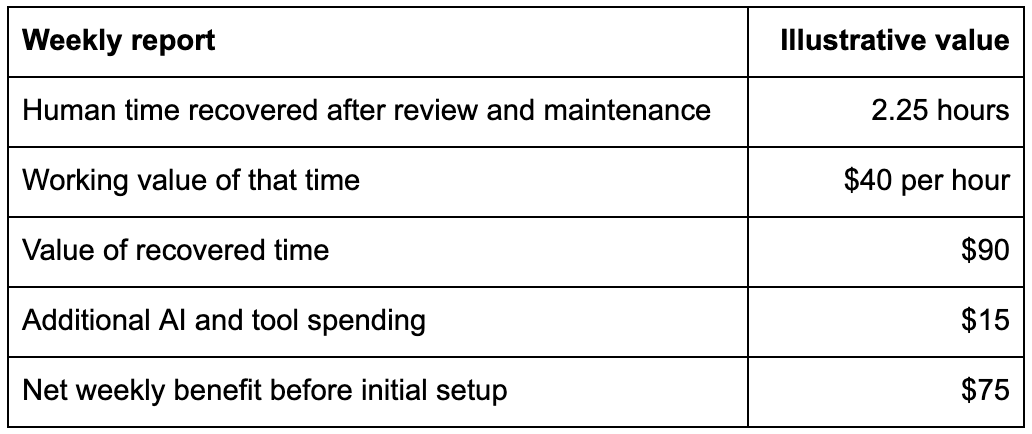
Initial setup that takes another two hours of your time is an $80 investment at that same rate. Under these assumptions, you recover it during the second weekly use. That makes the project a reasonable candidate to test. It doesn’t make the $75 a cash saving unless you turn the recovered capacity into money or reduce a real expense.
The assumptions tell you what to check. Does the report really take three hours now? Does the new process leave only 45 minutes of human work, with a result that passes the same standard? Can you use the time recovered? Will the report continue long enough for the setup effort to pay back?
To answer those questions, pay attention to a few real runs. Surprise repairs go into the calculation. So does the fix when an input change breaks the process. If nobody uses the report, revisit the assignment.
The same runs tell you whether a more expensive agent is worth using. Consider a separate, simple comparison. A cheaper option costs $5 and requires an hour of your attention. A stronger option costs $20 and requires fifteen minutes. Both produce work that passes the same acceptance check. At a working time value of $50 an hour, the first option costs $55 including your attention. The second costs $32.50.
Spending $15 more on AI reduces the combined cost by $22.50. The difference is a good reason to pick the $20 option, provided it holds up in your work. A larger model bill can be a sensible purchase when it removes expensive supervision. A stronger model that produces a prettier answer with the same checking burden may add very little.
Subscriptions complicate the accounting slightly. If a job fits inside a plan you already pay for, the next run may add no cash expense. But it can consume allowance you need for other work. To run one more job, consider the additional charge and what else that usage displaces. To renew or upgrade the subscription, compare the whole price with the useful work it enables. Don’t assign the full subscription cost to every task, and don’t ignore the subscription forever because it has already been paid this month.
The work itself may also suggest a simpler way to finish. An agent can help you build a reliable spreadsheet formula or small script, after which the recurring job needs very little AI. I’ve covered choosing when agents, other AI tools, or simpler software fit the problem.
Some valuable work has no hourly comparison
The report gives us an easy calculation because the work already exists. Now take an idea you have never tried.
Suppose you think colleagues would benefit from a small tool that helps them find the current answer to a recurring operational question. People have opinions about it. Nobody has built anything. An agent can make a rough version for you to give to a few people.
There’s no honest way to say you saved the forty hours you might have spent building it yourself if you were never going to spend those hours. There’s also no honest way to claim the tool’s possible future value before anyone has used it.
The first purchase is an answer to a question: can people use a small version to solve the problem, and do they care enough to use it again?
Give that question a budget. Choose the maximum money and human attention you’re willing to spend learning the answer. Decide what would justify another round before you become attached to the prototype. Actual use matters more than a colleague saying it looks impressive. A specific failure you can fix is more informative than a vague request for “more polish.”
A failed experiment may still have been a sensible investment. But calling everything “learning” can become its own excuse. Name what you learned and which decision changed because of it.
Even researchers studying AI productivity are running into the fact that agents change the work people choose. In a February 2026 update, METR described problems with its developer-productivity experiment: some participants avoided submitting tasks they didn’t want to do without AI, and some reported choosing different types of tasks when using agents. METR said selection effects made its newer productivity estimates unreliable. The task list itself had become part of the measurement problem.
My takeaway is that we should examine both how well a person performs an existing assignment and which assignments they now consider possible. An agent that helps you attempt a useful project may change your working life more than one that speeds up a familiar routine by another few percent.
Have your AI interview you about the work
You don’t have to work all of this out alone. An AI can help you surface the assumptions and calculate the implications, while you provide the circumstances and make the decisions. It should challenge a weak estimate instead of making your idea sound financially brilliant.
Use the interview below with a model you trust for careful reasoning. Start with work you actually want to change. Describing the situation doesn’t require uploading sensitive records.
Help me decide what work is worth delegating to AI and what I should be willing to spend on it. Interview me one question at a time, one question per message. Use my answers to choose the next question. Do not invent facts, financial returns, success rates, or a value for my time. If I can't or won't answer something, mark it unknown and move on. If I tell you to stop or to write the note now, ask once for the single answer that matters most. If I still decline, write the note with the gaps marked unknown.
Begin by asking what I want to change in my work or life. Help me identify three possibilities: a recurring burden, something that keeps other work waiting, and something worthwhile I have postponed because it seemed too much work. Let me choose one to examine first.
For that assignment, establish:

- What finishing it would change, who would benefit, and what a usable result would look like.

- What I would realistically do without AI, including doing nothing, reducing the scope, using simpler software, or getting other help.

- What information the agent would need, what decisions still require me, and whether I can check the quality of the result.

- Whether the main benefit is lower spending, usable time recovered, a better or earlier decision, a reusable capability, or learning about an uncertain opportunity. There may be more than one benefit, but do not count the same benefit twice.
Help me value my time in this particular situation. Ask what I would actually do with time recovered, whether that creates income or another benefit, what realistic help would cost, and what I could afford and would willingly pay to recover that time. If I give a number or claim without support, such as my hourly rate or "this could make millions," ask what evidence supports it and what part of the result the agent could reasonably contribute. If I do not know, work with a low and high estimate that I choose. Do not automatically treat my salary or hourly rate as cash savings. Recovered time counts as income only for the hours I say I would actually bill or sell, and each recovered hour counts once.
Include my time for setup, instructions, checking, repairs, and maintenance. Include AI charges and extra tools. Distinguish the cost of one additional run from the decision to pay for the overall subscription. If usage is limited, ask what other work this job would displace.
For repeated work, calculate a conservative benefit and payback range using only the assumptions we have established. Use a realistic number of future repetitions. For new or exploratory work, help me set a money and human-time budget for answering a specific question. Do not invent an hourly saving for work I would otherwise leave undone.
Ask what a failed result could cost. Identify the evidence that would justify continuing, spending more, changing the approach, or stopping. Distinguish a necessary quality requirement from optional polish.
When you have enough information, produce one short decision note, under 300 words:
1. The assignment and why it matters.
2. The realistic alternative.
3. The benefit, with facts separated from estimates and unknowns.
4. My time-value range and its basis.
5. The first-run money and human-time limits I chose.
6. The acceptance check and the evidence needed before spending more.
7. Your recommendation and the assumption most likely to change it.
Then write a brief, under 250 words, that I can give the agent doing the work. Include the desired result, necessary context, quality requirements, boundaries, and stopping point. Use only permissions I explicitly gave you. Do not begin the assignment or spend money during this interview.
Start by asking what I want to change.
Pay attention to what happens when you answer. If you say your time is worth $100 an hour, the AI should help you explain why that number fits this decision. Claim the project could save the company millions, and it should ask what evidence supports that claim and what part of the result the agent could reasonably contribute. If you want your evenings back, it should help you examine that goal without translating your life into business revenue.
For the report example, a useful conclusion might be: “This is worth a limited trial because the report supports a real decision and consumes three hours each week. Test one difficult historical week. Spend no more than two hours of my attention and $25 in additional charges on the first attempt. Check the totals and exceptions against the known result before using it on current work. Measure the actual review burden before committing to recurring use.”
If the agent reaches the limit without a usable result, examine what failed and whether further investment is justified.
For a career exploration, the conclusion could look entirely different: “Use a small project to discover whether I enjoy the actual work and where my current skills fall short. Commit one weekend and a modest tool budget. The output is something I can evaluate with an experienced person, plus a clearer decision about further learning.” It’s a serious use of an agent even though there’s no weekly cost saving to display.
The interview has worked when you can explain the assignment’s value and your next decision in your own words. If you finish with an elaborate financial model you can’t defend, keep asking questions.
What you choose to do with the capacity
There are limits to this opportunity. Paying for intelligence doesn’t give everyone the same information, money, access, or authority. A person with a large budget can afford more failed attempts. An employee may discover valuable work without having permission to change the process. Providers can raise the price or cut the allowance.
There’s also a question about who receives the benefit. If an agent helps a team finish its work sooner, the recovered time could reduce exhaustion or become an expectation that the team produce more. People make that decision.
Consider how this could change the conversation around a new idea inside a company. Today, you might need a manager to lend you people before you can demonstrate whether the idea works. With an agent, you can investigate it and arrive with something colleagues have already tried. You can explain what worked, where it failed, and what support would accomplish. Access to a small amount of execution changes what you bring to the negotiation.
That access also gives you a reason to think beyond producing more output in the role you already have. You may be able to demonstrate a capability that was previously invisible because you had no practical way to exercise it.
I want individuals to understand the value they’re creating. Describe what changed, how much human work remained, and what the result made possible. That helps you decide what to fund yourself and recognize when additional demands are consuming the benefit you expected to receive.
Back to the Grok bill. Musk has a supplier’s problem: what does it cost to provide this capacity, and does the revenue cover it? For each assignment, you’re deciding what a useful result would be worth, what it will take to obtain one, and whether the next increment of effort is justified.
I expect those decisions to produce very different willingness to pay. Someone using an agent to rephrase routine messages has little reason to accept a larger bill. Someone who has found a repeatable way to resolve expensive problems will be eager to purchase more capacity.
Return to one of the things you stopped considering because you couldn’t imagine finding the time. Choose the first question you’d need answered to take it seriously. Decide what answering that question is worth to you, and give an agent a chance to help.
You may discover that the idea still doesn’t work. Or that a limit you had accepted was a limit on the help available to you, and that you can now afford enough help to move.
Coming up
On Thursday, I sit down with Vijaye Raji, OpenAI’s CTO of Applications.
Related reading
- Executive briefing: 10 hours saved by AI don’t become 10 useful hours on their own. How to commit that capacity to revenue your company couldn’t fund before.: what this changes about AI budgets, commercial partnerships, and your career.
- Executive briefing: Uber burned its entire AI budget early. The bill was trying to tell them something.: what happens when frontier intelligence gets useful, open models get good, and companies try to manage agentic work with 2025 controls.
- You’re loading 66,000 tokens of plugins before you even type. That’s why your limit disappears.: why token management is an indicator of AI fluency, and how to get better at it.
- Your AI provider can change the deal on you. Here’s the 5-prompt audit I run to stay ready.: what I keep outside every provider, and the test each expensive plan has to pass.
I make this Substack thanks to readers like you! Learn about all my Substack tiers here