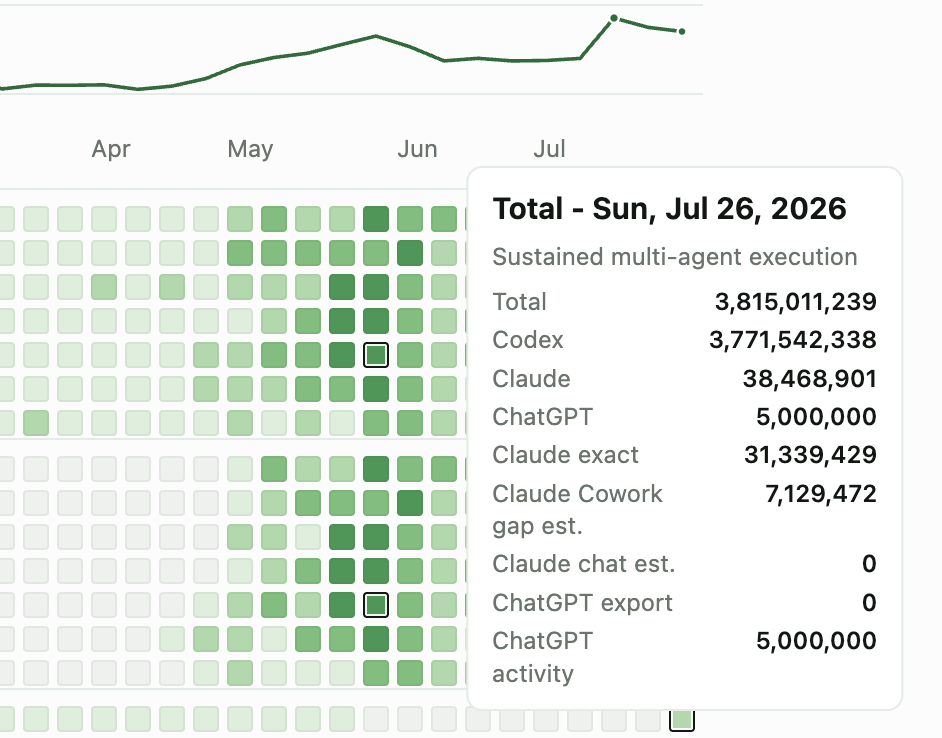
My tracker logged 3.77 billion Codex tokens in one day. 95.73% of that input was reported as reused — material I never typed. So I went looking for what I could remove without making the work worse.
By Nate
Published: 2026-07-29
URL: https://natesnewsletter.substack.com/p/reduce-ai-token-usage
You’re hitting limits on a plan you already pay for, and you didn’t do anything unreasonable to get there. You asked a handful of questions. Somewhere around the tenth one, the meter started running much faster than you were.
I opened my Token Burn tracker after a long day in Codex and found 3.77 billion tokens. The split bothered me more than the total: of the 3.75 billion input tokens in the record, 3.59 billion were reported as reused input, or 95.73%.
My first reaction was to attack the 96%, but the number couldn’t tell me how.
It came from my own local event log, not an OpenAI bill. The log includes cumulative usage updates across 143 Codex threads and 28,877 local records. I treat 3.77 billion as a signal to investigate, not as a clean billable-token total.
“Reused” doesn’t mean “useless,” either. A difficult job may depend on the decision from twenty minutes ago, the file already changed, the error that ruled out the obvious fix, or the paragraph approved after four bad versions. Eligible repeated material may also receive a provider cache discount. Continuity is a large part of what makes these tools useful.
But continuity has a cost. A later request can contain much more than the new sentence I type. It may also carry earlier exchanges, standing instructions, tool definitions, files, screenshots, browser results, command output, rejected answers, and whatever state the product uses to continue the job.
The tenth message can be much larger than the first, even when the visible prompt is shorter. You typed less. You paid more.
I have argued before that a token count is a trace, not a scoreboard. I still believe it. A large day can mean an agent carried real work across files, browsers, drafts, and checks. Cutting the number without asking what the work produced is a bad way to manage AI.
The reused share raised a different question: how much of that material could still change the work, and how much remained because nothing in the system had a reason to let it go?
My target is aggressive: cut reported reused input by 90% without increasing mistakes, retries, review time, or work that has to be repeated.
Here’s what’s inside:
- The measurement. One real job run two ways, with the provider-reported numbers and what the comparison does and doesn’t prove.
- Fifteen changes, sorted by what actually backs them. Each one written out with the conditions where it helps, the conditions where it hurts, and whether I measured it or am still assuming.
- Nine you can use today. The habits that keep material out of a request in the products you already open. Nothing to install.
- The Token Saver skill. What it carries for you in Codex and Claude Code, the four changes it enforces, and the one boundary it can’t cross.
- What caching actually costs. The five-minute versus one-hour math, and why cached input never leaves your bill.
- What I still can’t prove. The limits of a single matched job, and the test that has to come next.
The percentage alone can’t tell me whether I have done that. I need a comparison.
Subscribers get the full deep-dive and guide, plus membership to my Slack community!
LINK: [Grab the guide + Token Saver skill]
Fifteen changes is more than anyone holds in their head mid-job. So there are two things at the other end of this link.
The guide is the version you keep open while you work: every change written out with the conditions where it helps, the conditions where it hurts, and what I measured against what I am still assuming.
The Token Saver skill is the part you stop having to remember. It installs into Codex or Claude Code, and once it is there you say “use the Token Saver skill for this job.” It searches before it opens a source, sends selected passages instead of whole files, carries the accepted result into the next revision, and stops oversized retries. Four of the fifteen, enforced without you thinking about them.
I built both because knowing a technique was never my problem. Reaching for the wrong one halfway through a job, and making the request bigger, was.
Grab the guide and the Token Saver skill
How I measured AI token reduction
I took one real job and ran it through two paths. Both used the same three bounded source files. Both were checked for the same required figures and boundary language.
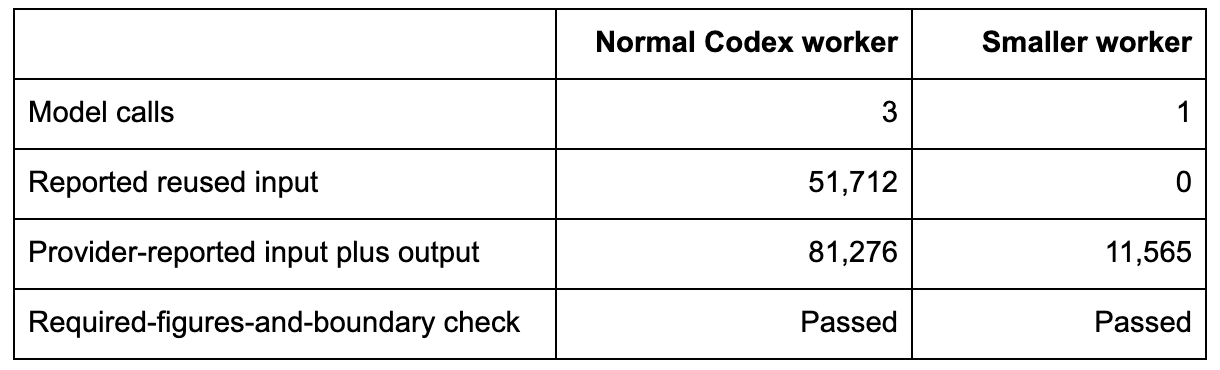
Provider-reported input plus output fell 85.77%.
The comparison has an important limit. This was a normal Codex host against a smaller worker, not a long chat against a clean chat. The normal run was already a fresh Codex execution. The smaller worker loaded less host setup and tool context. It made one call instead of three. The full host path carried 51,712 reported reused tokens; the smaller path passed the same check without them. The comparison does not isolate how much of the reduction came from each difference.
I did not cut a full day by 85.77%. I did not prove that a smaller worker handles difficult writing as well as a richer one. This job had required figures and boundary language that ordinary software could verify. The check did not judge structure, prose quality, or whether a human would accept two answers as equivalent. “Zero” means zero reported reused input in the smaller worker’s usage record, not that the model started in a vacuum.
The result is still useful. It shows one normal host path carrying a meaningful amount of context that the automated figures-and-boundary check did not require.
I then tested the most mechanical part of the same work. The source file was about 1.1 MB, and the answer needed one day’s fields. A Python selector pulled those fields into a 1,012-byte fact file. Starting from that prepared file, ordinary code rendered the required result and checked the figures and boundary language with no model call.
That doesn’t make the whole source-to-answer path free. The selector still ran. A person decided which facts mattered. Exact rendering isn’t a substitute for writing or judgment. This particular step had reached the point where the facts and output rules were settled, so another model call would have repeated a procedure without improving the answer.
Useful state sits beside finished work
The hard part is that useful state sits next to finished material.
If I am three hours into debugging, I may still need the architecture choice, the file already changed, the test that is failing, and the reason we rejected the obvious fix. Removing those things may save tokens and damage the work.
The same request may also carry a browser page whose only useful contribution was one account number, five failed drafts after a sixth was accepted, command output from a test that already passed, or tools the current job cannot call. Keeping those things doesn’t preserve intelligence. It asks the model to keep sorting through finished work.
I now ask two questions before removing anything:
- Could this fact still change the next decision?
- Would removing it force the model to repeat verified work?
If both answers are no, I move it out of the active request. The hard cases are source passages, unresolved errors, and rejected options that still explain a constraint. Those often deserve to stay, or at least to remain available by reference.
Advice about writing a shorter prompt is inadequate for the same reason. The words I type may be the smallest part of the request. Shortening them doesn’t remove a 50,000-token history or a 55,000-token tool catalog that arrives beside them.
Longer context windows don’t settle the issue. They make some difficult work possible. They don’t decide which earlier material is still relevant to the next step. Tool search, context editing, and compaction can help, but each still requires an answer to the same question: what does this job need to remember now?
I had been using “save tokens” to mean three different things
Once I looked closely, I found three different jobs hiding under the same phrase.
Removal means material never enters the path. A prior turn, a file, a tool definition, or an entire model call is absent. Starting a clean task, selecting five relevant passages from a report, or running an exact calculation in code belongs here.
Shrinking means necessary state becomes smaller. A long browser result becomes the account number and decision it supported. Six drafting rounds become the accepted version plus the next requested change. The model still receives state, but less of it.
Discounting means the material remains and the economics change. Prompt caching can make an unchanged block cheaper. A smaller model can lower the price per token. A local model can move some work off a paid provider.
All three can help. Only the first two make the request smaller.
Moving an oversized request from Claude to GLM changes its price, not its size. Caching 100,000 tokens can make the repeated block much cheaper, while the model still processes a 100,000-token block. Replacing it with the 5,000 tokens the job actually needs changes the request.
My matched job tested removal. It didn’t compare model quality or cache strategies. So I’m not ranking either.
The fifteen changes below solve different parts of the problem. The first nine are habits I can use in the products I already open. The next four are the parts I asked a skill to carry for me. The last two require control that begins before the provider receives the model call.
Nine ways to reduce AI token usage
1. Edit or rewind a bad turn instead of building on it
When a model misreads a request, the normal response is another message explaining the mistake. The next call may now contain the unclear request, the wrong answer, and the correction. Then the answer to the correction.
If that branch has no continuing value, I edit the original message or rewind to the point before it. Claude Code supports rewind, and several chat products let you edit an earlier message. That can keep the rejected branch out of later active state.
I don’t do this when the correction records something I learned. If the wrong turn explains why the decision changed, it belongs in the record. I edit when the branch is dead, not when the history still carries meaning.
My matched job did not isolate this change. The reason to use it is mechanical: a branch that no longer exists cannot be carried into a later request by that conversation.
2. Ask for related outputs while the source is already loaded
If I need a summary, the main risks, and five title options from the same article, I ask for all three in one message. Three separate calls may reload the article and add the earlier answers to the state each time.
The questions belong together only when they share a source or decision. This isn’t an argument for enormous prompts containing unrelated work. The point is to load common context once.
I define the output at the same time: three bullets, one number, or whatever the work actually needs. I use a standing instruction for plain technical English, short sentences, and no restatement of my request. Extra explanation costs tokens when it is written and can return as input on the next turn.
I have not measured this change in isolation. I would verify it by comparing the provider-reported input and output for one combined request with the complete multi-call path, including the earlier answers carried into later calls.
3. Start a clean task when the job changes
I keep the conversation while the job remains unresolved. When the job changes, I start clean.
That removes old conversation, files, tool results, and instructions that belong to different work. The previous task can remain available as a record. The decision is only whether the next task should inherit it.
Starting clean did not produce the measured 85.77% reduction. The normal side of my comparison was already a fresh Codex execution. The smaller worker also loaded less setup and used fewer calls. I still put this near the front because it removes one obvious source of inherited material before a new job begins.
The limit matters. Starting over in the middle of a difficult job can force the model to reopen files, rediscover a decision, or repeat an error that the existing conversation had already resolved. I start clean when the work changes, not after an arbitrary number of messages.
4. Carry the accepted result, not the entire route to it
Suppose a strategy memo took six rounds. I accepted round six. Now I want to replace one customer example.
The next request usually needs the accepted memo, the requested change, and any source passage that governs the change. It doesn’t need five rejected drafts, the model’s explanations, the dead research branch, and every correction along the way.
The distinction is between a record of the work and the current state of the work. Both matter for different reasons. The full conversation can explain why a decision was made. The next revision usually needs the decision that survived.
I now save the accepted result outside the conversation and build the next request from that result plus the change. When the new version is accepted, it becomes the next current result. The history remains available without becoming active input on every revision.
This can improve the answer as well as reduce the request. A model handed one accepted document is less likely to restore a rejected idea or obey an instruction that stopped being true three versions ago.
5. Select the evidence before the model reads the source
My Token Burn source was about 1.1 MB. The answer needed one date and a fixed set of fields.
Dates, names, identifiers, error strings, file paths, and exact phrases are good candidates for ordinary search, SQL, or a small parser. The model doesn’t need to read the surrounding megabyte to locate a known string. In my test, ordinary code reduced the source to a 1,012-byte fact file and retained every required figure.
Not every research problem is that clean. If the question is conceptual, could be phrased several ways, or depends on wording I do not know, exact search may miss it. I broaden the query, use semantic retrieval, or let a model inspect a bounded set of likely passages.
Selection should happen before a large file becomes model context, whenever a cheaper and reliable method can do the selecting.
A one-million-token context window doesn’t remove this decision. It gives the model more capacity when the job needs it. It doesn’t make every part of an archive relevant. I made the longer argument in Context Windows Are a Lie.
6. Send the lightest version of the source that still preserves the work
If the wording matters and the layout doesn’t, I extract text instead of sending eighty screenshots. If one chart matters, I crop the chart instead of attaching the deck. If twelve spreadsheet rows changed, I send those rows. If two files are nearly identical, I send the difference.
I keep the full source available for inspection. The active request needs the material that supports the next answer, not every byte I might need later.
Products extract and tokenize PDFs, screenshots, spreadsheets, and web pages differently. I measure provider-reported input before and after each change, then check that the answer still contains the evidence it needs.
7. Turn a settled procedure into code
Models are useful while a job still requires interpretation. Once the inputs, the transform, and the acceptance test are fixed, model variation adds risk without adding judgment.
“Use only July 26” becomes a date filter. “Reduce this by 90 percent” becomes a formula. “Return these fields in this order” becomes a formatter. “Stop if one of these four facts is missing” becomes a test.
Counting, sorting, normalizing dates, finding exact text, converting formats, comparing versions, and applying a fixed calculation don’t need a model to reread a prose instruction and decide what it means every time.
The important question is whether the procedure is actually settled. If the source changes shape, the criteria remain fuzzy, or the work still needs judgment, hard-coding the first interpretation creates a brittle system. I want to be able to state the inputs, the rule, the expected output, and the condition that should stop the process.
In my test, the prepared 1,012-byte fact file went into an ordinary renderer. Code produced the result and checked the required figures and boundary language with no model call. The model had already done the part that needed language. It did not need to be paid again to follow a fixed procedure.
This idea is sometimes called compiled AI: use a model to create or choose a program. Then run it. The label matters less than the question. Does this step still require interpretation? If not, code is cheaper, faster, and easier to test.
8. Return an accepted answer instead of generating it again
This is the strict version of carrying accepted state.
If the request, selected source, and accepted answer match exactly, the system can return that answer without another model call. If any one of those inputs changes, it runs the job again.
Accepted answers are often hard to reuse because they are scattered across old threads. I now keep them with the request and source that produced them. A folder works. So does a local SQLite database. The system doesn’t need to be clever; it needs to know when the inputs still match.
When they do, returning the accepted result avoids a complete model call and a new review problem. A fresh call may produce a slightly different answer that somebody now has to compare with the version already approved.
9. Match the answer to the result the job requires
Output costs once when the model writes it and again if the answer becomes input on the next turn.
If the job is to replace one paragraph, I ask for one paragraph. If software will consume the result, I ask for the required structure rather than an essay about how it was produced. If the prose is the product, I give the argument room. The target is unused output, not developed writing.
In the matched job, the normal path produced 515 output tokens across three calls. The smaller path produced 131. Output was not the main driver of the 85.77% reduction, and the comparison changed more than answer length. It still showed the practical consequence of extra calls: more text to inspect and more material that can enter the next request.
I have also started cutting process narration. The answer needs enough evidence and reasoning to earn trust, not a replay of every intermediate search.
How an AI skill cuts token usage
A list of fifteen practices is not a solution if using it requires a planning exercise before every prompt.
I built the Token Saver skill for Codex and Claude Code to carry the repetitive parts. Once it is installed, I can keep working in either product and say:
Use the Token Saver skill for this job.
The skill searches likely sources before opening them in full, runs a local selector when the job has known terms, builds a smaller source packet, and carries an accepted result into the next revision. It also tells the agent to try ordinary code for exact steps, avoid tools the job cannot use, match the answer to the requested output, and stop oversized retries.
The loading design is part of the value. OpenAI and Anthropic both expose skill metadata first, then load the full instructions when the skill is selected. Supporting files live on disk in the skill bundle and load only when read. Scripts never load at all — the model runs them and gets the output. A script can sit on disk and return a small result without putting its entire source into the request.
The skill’s instructions add text to the current call. I use it only when the file load, tool setup, extra call, or retry it prevents is larger than that added context.
It also has a hard boundary. The model has already begun the current call before it can read the skill. The skill can make source reading, tool use, later revisions, and repairs smaller. It can’t remove the conversation and setup already sent in order to invoke it.
Within that boundary, I use it to enforce the next four changes.
10. Load only the tools the job can use
Tool definitions can occupy context before the model calls anything.
Anthropic describes a representative multi-server setup—GitHub, Slack, Sentry, Grafana, and Splunk—using roughly 55,000 tokens for tool definitions. Its tool-search feature typically loads the three to five tools likely to matter and can reduce that active tool context by more than 85 percent in the setups it describes. Anthropic recommends considering tool search at ten or more tools, or when definitions exceed 10,000 tokens.
OpenAI supports the same basic idea through tool search, which defers tool definitions. The model searches a catalog and loads the relevant definitions instead of carrying every schema from the beginning.
I choose tools for the job. If the work needs a connector, I load it. If a connector can’t contribute, I don’t make the model carry its instructions.
This is the same pressure I described in You’re Loading 66,000 Tokens of Plugins Before You Even Type: a short visible request can enter an environment that is already large.
This advice may age quickly because the labs are actively working on it. The useful number is the tool-definition input your current product reports, not a permanent assumption about how every host behaves.
11. Keep the decisions and remove finished tool output
Starting clean is useful between jobs and often harmful inside one.
A long-running agent may need the chosen architecture, the file it changed, the test still failing, and the constraint that ruled out the obvious repair. The same history may contain browser pages, command output, intermediate drafts, tool traces, and reasoning that has already produced a decision recorded elsewhere.
OpenAI compaction condenses older conversation state into a smaller item that carries key prior state forward. Anthropic supports compaction and context editing, which can clear old tool results or thinking blocks.
The easy case is a browser result. A page returns 20,000 tokens. The model extracts an account number, a balance, and a next action. Ten turns later, the job still needs those three facts. It doesn’t need the page.
Before removing raw history, I write down the accepted decisions, active facts, unresolved errors, files changed, and next check. If an exact passage could still change the decision, I keep the passage or a reference to it.
Then I use the same two questions: could this still change the next decision, and would removing it force verified work to be repeated?
Compaction is not free. Anthropic’s server-side compaction adds a sampling step that counts toward billing and rate limits, and its top-level token fields exclude that iteration. You have to include the iterations record to see the total. Context editing can also break a cache match because the repeated beginning changed. The smaller state has to save more than it costs to create.
I don’t clear context on a message count. I clear it when the job stops depending on it.
12. Move work to another model only when the whole path gets cheaper
I don’t want one model for every job. Codex, Claude, GLM, local models, and smaller specialists all have a place.
The unit I care about is the complete path to an accepted result: the first call, retries, repair by a stronger model, and the human review at the end.
A low-cost model can process a large request, miss two source constraints, and hand the job to Claude for repair. Claude now receives the source, the first answer, the criticism, and the repair request. A person compares both versions because the repair changed more than expected. The lower token price didn’t make the finished job cheaper.
The same model can save real money in a different design. It classifies 1,000 routine records, code checks the required fields, and a frontier model sees only the five uncertain ones. The expensive model never touches the 995 easy cases, and the review path is bounded.
For a repeated workflow, I test a representative set on the smaller model and record first-pass acceptance, repair calls, human review time, latency, and provider cost. I move the workflow only when the complete path improves.
GLM-5.2 is interesting here because it combines a one-million-token context window with lower-cost options and automatic context caching. Z.AI reports cached tokens, and its pricing table bills a GLM-5.2 cache hit at $0.26 per million against $1.40 for fresh input — roughly a fifth. That can be a good fit. It doesn’t remove the need to measure first-pass acceptance and repair.
I use a similar standard in my Chinese-model bakeoff: same assignment, same source, same tools, same time, same acceptance standard, and the full cost of the accepted result.
13. Stop an oversized request instead of sending it again
A token-limit failure usually means the request itself is too large. Sending the same oversized request to another provider doesn’t make it smaller.
Before a repeated workflow makes a call, I set limits for fresh input, reused or cached input, expected output, number of model calls, and number of repairs. If the source packet or tool setup crosses a limit, the workflow stops and makes the job smaller. It can search the source, drop unused tools, convert the file, use an accepted result instead of the conversation, or move an exact step into code.
I found an earlier Ringer path that retried after a token-limit failure. The second provider could not repair the size of the first request. It processed the oversized job again.
The current gateway allows at most one upstream model call per request, and some routes use none. An oversized request or provider failure stops. A bounded repair after a content check can make sense. Automatically repeating the same oversized request doesn’t.
How to shrink a request before the API call
The last two strategies reach a part of the problem a skill cannot fully control from inside the call.
14. Keep the repeated beginning unchanged, then put the new assignment after it
Caching is useful when a block of instructions, examples, tool definitions, or reference material has to repeat across requests.
For cache matching, I put the material that will stay the same first and the new assignment last.
[instructions that do not change]
[tools or reference material that do not change]
[end of repeated material]
[today's new assignment]
The provider can reuse work it already performed on that unchanged beginning. If the next request starts the same way, the repeated portion may receive the cache price. Change something near the front and the match can break.
On the OpenAI API, eligible prompts begin at 1,024 tokens, and the repeated beginning has to match exactly. Current GPT-5.6-family pricing puts a cache read at one tenth of fresh input and a cache write at 1.25 times fresh input. Those are API prices for specific models. They are not a formula for how much of a Codex subscription limit one turn consumes.
Claude’s current API pricing makes the tradeoff easy to see. A five-minute cache write costs 1.25 times normal input, a one-hour write costs twice normal input, and a read costs one tenth. For a 100,000-token block used three times, ignoring output:
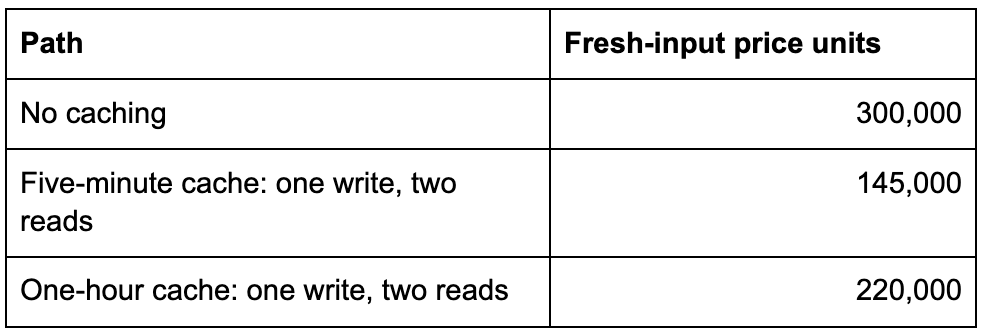
The five-minute cache wins on the second use. The one-hour cache needs the third use to beat paying fresh each time.
That math prevents two mistakes. The first is changing the repeated beginning and losing the cache match. The second is treating cached input as though it disappeared. Anthropic’s own example processes 100,000 cached tokens plus 50 new tokens as 100,050 total input tokens. OpenAI also counts cached tokens toward tokens-per-minute limits.
If the 100,000-token block can become 5,000 without hurting the job, I would still remove or shrink it first. Caching is for the material that remains necessary.
15. Put a local check in front when the current request has to shrink
The Token Saver skill begins after the model call has started. By then, the current conversation, standing instructions, and tool setup may already have been sent.
That narrow problem is why I built an optional Ringer path.
Ringer isn’t another chatbot. For configured Codex CLI text-answer work, Codex sends the request to a small program on my computer before an upstream model receives it.
request in Codex CLI
↓
local check and source selection
↓
accepted result | code path | smaller request | stop
↓
provider model, when the remaining work needs one
That local program can return an exact answer a person already accepted, run a fixed code path, select the relevant passages from a larger source, stop a request that exceeds its limits, or forward a smaller request to a chosen model.
Ringer reaches the request before the skill can, but it requires more setup and currently supports only configured Codex CLI text-answer work. It doesn’t intercept Codex Desktop, ChatGPT, or the Claude consumer apps. The Anthropic adapter passes unit tests, but a live Claude Code check retried after a gateway stop, so I don’t consider that path compatible yet. Local code and exact accepted-answer routes require no provider credentials. Forwarded model calls require credentials and may use API billing. Tool-heavy interactive work may still belong in the normal Codex environment.
For most Codex or Claude Code work, the skill is the lower-setup option. The pre-call path earns its extra machinery when a repeated Codex CLI workflow has to control the request before the first provider model sees it.
The fifteen, and what I have actually measured
The 85.77% result applies only to one matched job. The table below separates what that test measured from what each other recommendation still requires.
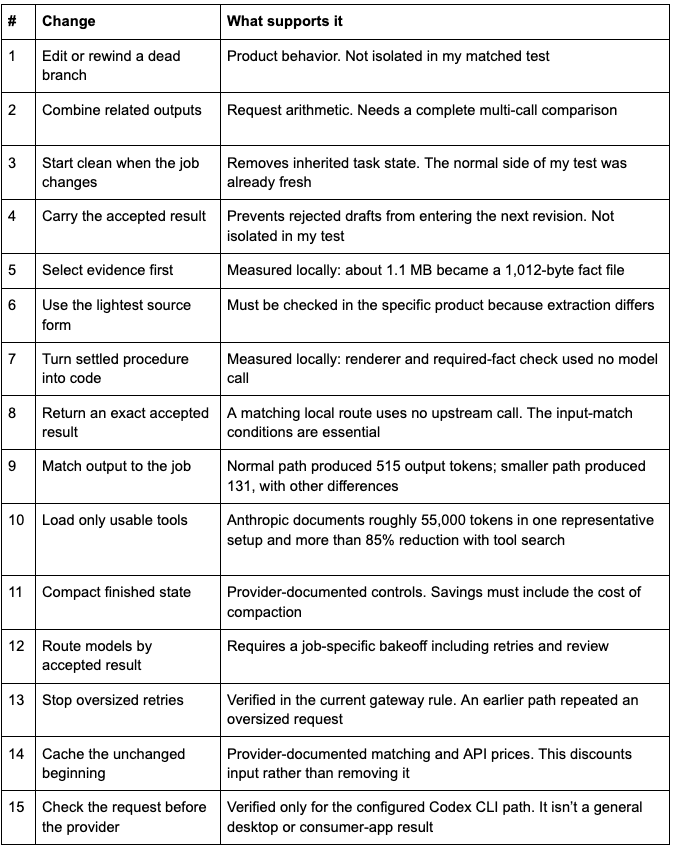
Without installing anything, I would start clean when the job changes, carry the accepted result into a revision, search large sources before a model reads them, and turn settled procedures into code. The skill automates steps that begin after invocation. The Ringer path applies only to repeated Codex CLI workflows that must alter the current request before it reaches a provider.
What I still have to prove
The strongest result here is one matched job.
I have not shown that I can reduce a full day’s reported reused input by 90 percent. I have not shown that a smaller worker holds quality across writing, research, browser work, and long-running coding. I have not shown that the cheapest path is the same across those jobs.
The next test has to include work where context matters. I need to measure accepted output, human review, retries, repeated work, and state loss beside token use. Hitting 90 percent by starving the model and creating more repair work would move the cost rather than remove it.
The first result was enough to change how I work now. I separate unrelated jobs. I carry the accepted result instead of the argument that produced it. I select passages before loading large files. When a procedure has one stable interpretation and a check, it becomes code. Model choice and caching come after those decisions, on whatever still needs a model.
The metric I use now is how much more I can remove before accepted work starts getting worse.
LINK: [Join the Slack →]
The Slack community is live! It’s where I’ll be sharing things between articles, where you can get help on builds in real time, and where the fastest conversations in this community are already happening. I’ll see you in there!
LINK: [3 Months Free to Zero to AI→]
If you’re a paid subscriber who hasn’t read Zero to AI yet: you get three months free. It’s where I break down the basics, from setting up Codex to building your first agent, the stuff that makes the rest of this click.
If it’s not for you, cancel any time.
Related reading
- Uber burned its entire AI budget early. What happens when agentic pipelines meet 2025 cost controls.
- The cheat code on long-running AI agents. What Manus, Google, and Anthropic learned about in-session context.
- The memory gap killing enterprise agent investments. Why agents forget the thing that mattered.
- Beyond the perfect prompt. The context-engineering argument this piece rests on.
I make this Substack thanks to readers like you! Learn about all my Substack tiers here