The test I use for Qwen, GLM, DeepSeek, Kimi, and MiniMax—and the work I still keep on frontier models.
By Nate
Published: 2026-07-27
URL: https://natesnewsletter.substack.com/p/chinese-ai-models-test
Someone on your team wants to move a workload onto a Chinese model because it costs a fifth as much. Someone else says absolutely not. Both of them are arguing about a country. What actually decides it is a job, an endpoint, and a check. I have run these models inside a live multi-agent system, and I can tell you which of those arguments survives contact with real work. I will also tell you where my own records are incomplete, because I am not going to blur separate experiments together so the headline sounds cleaner.
The Chinese-model conversation has a bad habit. One good answer from DeepSeek, Qwen, GLM, Kimi, or MiniMax, and suddenly the American frontier has been caught. One censorship failure or bad citation, and the whole Chinese stack is declared unusable. Neither tells me whether I should put the model on a real job.
My answer up front is yes: serious AI users should test Chinese models. I use them selectively—aggressively in some workflows—but the job, the model, and the deployment path are separate decisions.
While I was building Ringer, I tried Qwen as one of the workers, and it was useful. I do not have a complete log of the exact Qwen checkpoint, task mix, pass rate, and cost from that experiment. The 34-task Ringer run where I have the full logs used GLM-5.2, GPT-5.5, Grok 4.5, and Composer 2.5 Fast, with the last two running through the Grok Build CLI.
In the video, I promised to show the test. Here’s what’s inside:
- The Ringer run that changed how I place models. A 34-task job where one worker reported 213 verified quotations and 13 of them turned out to be stitched together.
- What an accepted result actually costs. The number that replaces token price, and why a cheaper model can double your review time.
- Where I’d start with each family. DeepSeek, Qwen, GLM, Kimi, and MiniMax, with the specific failure to watch on each one.
- The bakeoff kit. A validator, a manifest, a score sheet, and the two fixtures you use to prove your checker actually rejects bad work.
The run that taught me all of this cost about $8 USD. Let’s start there.
Subscribers get the full deep-dive and guide, plus membership to my Slack community!
LINK: [Join the Slack →]
The Slack community is live! It’s where I’ll be sharing things between articles, where you can get help on builds in real time, and where the fastest conversations in this community are already happening. I’ll see you in there!
LINK: [3 Months Free to Zero to AI→]
If you’re a paid subscriber who hasn’t read Zero to AI yet: you get three months free. It’s where I break down the basics, from setting up Codex to building your first agent, the stuff that makes the rest of this click.
If it’s not for you, cancel any time.
LINK: [Grab the bakeoff guide and run it on your own work]
Before either model runs, I try to break my own check. I point it at a file I know is bad and make sure it fails, then at one I know is good and make sure it passes. Skip that step and both models come back looking fine, and you end up picking the one you already liked.
That is why the kit ships with fixtures. Fourteen steps, pinned to a specific Ringer commit so your run is reproducible, plus a Python validator, a model-only Ringer manifest, an accepted-result score sheet, two sample sources, and the known-good and known-bad files you test the checker against. Download ringer-bakeoff-kit.zip, unzip it, and run both fixtures before you route a single task.
The Ringer repository is public, and the current Ringer guide documents the wider system.
The Ringer run that changed how I place models
Ringer is my multi-agent system. A frontier model orchestrates: it writes the specs, breaks the work into pieces, and reviews what comes back. Cheaper workers take bounded jobs, and every job gets an executable check. If the check fails, Ringer sends the failure output back once and records the second attempt.
In the original build, I had more than 20 agents, four model families, and one boss. Fable did not code a single page: 34 worker tasks went out, and 12 came back for another attempt.
The GLM quotation task is the best example of why those checks mattered.
A GLM worker was asked to pull verified quotations and reported that it had found 213 of them. The check found 13 passages that were stitched together or paraphrased as though they were direct quotations. They were close enough to fool anyone skimming. Elsa’s words are her product as a writer, and close enough was not acceptable. Ringer sent the failure evidence back, the worker corrected the file, and the second attempt passed.
I do not read that as “GLM is bad at research.” GLM did useful work, then failed in a way that would have been expensive if I had trusted its summary. The check showed the worker exactly what was wrong, and the retry passed.
The frontier boss made a mistake too. Fable did not code a page, but it did write a CSS rule that made the pre-order button disappear in dark mode. The system caught that as well. People often assume the frontier model is the source of truth and the cheap worker is the source of risk. In a real run, either can be wrong, so I apply the same acceptance standard to both.
The run logged $2.74 in metered GLM spend. Add the estimated ElevenLabs credits and out-of-pocket lands around $5 to $7. The project receipt estimates roughly $15 to $25 if the plan-billed worker lanes had been metered. Call it eight dollars. I would rather round against myself.
Very low spend for a run that size. It still does not prove the cheapest token produced the cheapest finished work. Retries, provider stalls, and human cleanup belong in the math. A model that costs one-fifth as much per token but needs Ringer’s retry plus a human repair is not automatically the bargain.
That experience is why the current Ringer guide records every attempt as its own row in local history: task type, engine, resolved model, duration, reported tokens, retry number, verdict, and raw check output. I can see which model keeps passing which kind of work.
Which AI model for which job
“Should I use Chinese models?” is too broad to answer.
I would use DeepSeek very differently for high-volume extraction than I would use Kimi for a repository-level coding job. I would use a small Qwen model on a laptop differently from Alibaba’s hosted Max line. GLM-5.2 may be a strong coding worker, but its released BF16 checkpoint is a 753-billion-parameter model. Not my idea of a normal laptop model.
With one family, the API may be cheap while the flagship weights are far too large for your machine, and the smaller checkpoint that does fit is a different product with different capabilities. Sometimes cheap, open, and local are all true, and sometimes none of them are.
Start with one recurring job—something you do enough to recognize a good result, a plausible-looking bad result, and the places where mistakes tend to hide.
Good first candidates include:
- Extracting fields or classifying items from recurring documents and queues.
- Writing tests or making mechanical code changes from a clear specification.
- Producing a first research pass with source requirements.
- Converting one known artifact into another format.
- Reviewing a document against a written checklist.
I would not begin with “make a great strategy” or “tell me what the company should do.” You can test those jobs eventually, but they are terrible starting points because the review itself is ambiguous. If you cannot say what passed, you will end up grading style, confidence, or whether you liked the answer.
I do not choose a model before I decide what failure I can tolerate. If a bad classification gets caught in a queue, I can afford to try a cheaper candidate. If one ambiguous answer sends money, publishes a legal claim, changes production infrastructure, or goes to a board, I keep more frontier intelligence and human review around it. I am asking one thing: is this model good enough for this job, under the check I actually use, at the full cost I am willing to pay?
Run the test without building a laboratory
I would run this in two stages. Start with three to five real cases and use them to find the obvious problems quickly. I want one ordinary case, one difficult case, one ugly edge case, and—when it fits the work—one case where the instructions change halfway through.
That last one matters. A model can look excellent while the task resembles patterns it has seen many times, then lose the thread when a source disappears, a requested field changes, or a constraint conflicts with the original plan. I want to see what it does when the task stops looking familiar.
If the model falls apart in the first few cases, I stop. There is no prize for spending the rest of the afternoon proving the same point seventeen more times.
If it survives, I move to a replay pack of five to twenty examples where I already know the right behavior. This comes from the maintenance method I use for agents: keep known cases, rerun them after meaningful changes, and score whether the agent used the right sources and tools, stayed inside the job, showed proof, reduced review time, and knew when to stop.
For a narrow, low-risk task, five good cases may tell me enough to keep exploring. Before I make a model the recurring default for a production lane, I want closer to twenty. That can tell me whether the model belongs in live testing. It does not tell me the next thousand runs will be clean.
Build the replay pack from the work you actually have. If 70 percent of your queue is routine, do not fill the set with heroic edge cases. If the rare edge case is where all the liability lives, do not leave it out because it hurts the score. Include old failures, cases that needed human correction, and at least one case where the model should say it cannot finish safely.
Then freeze the conditions:
- Same assignment.
- Same source files.
- Same tools.
- Same time limit.
- Same reasoning setting when the providers expose one.
- Same executable check or human grading criteria.
- Same number of attempts.
Don’t change your bar.
If your frontier baseline has access to the repository and the candidate gets only a pasted prompt, you are testing two systems. If one model gets a 30-minute timeout and the other gets ten, you are testing two operating conditions. If the Chinese model gets a friendlier prompt after you see it struggle, record that as a harness change and rerun the baseline.
I would also hide the model names while reviewing whenever that is practical. You may be surprised how much your grade changes when you do not know which logo produced the artifact.
The sheet I keep for every case:
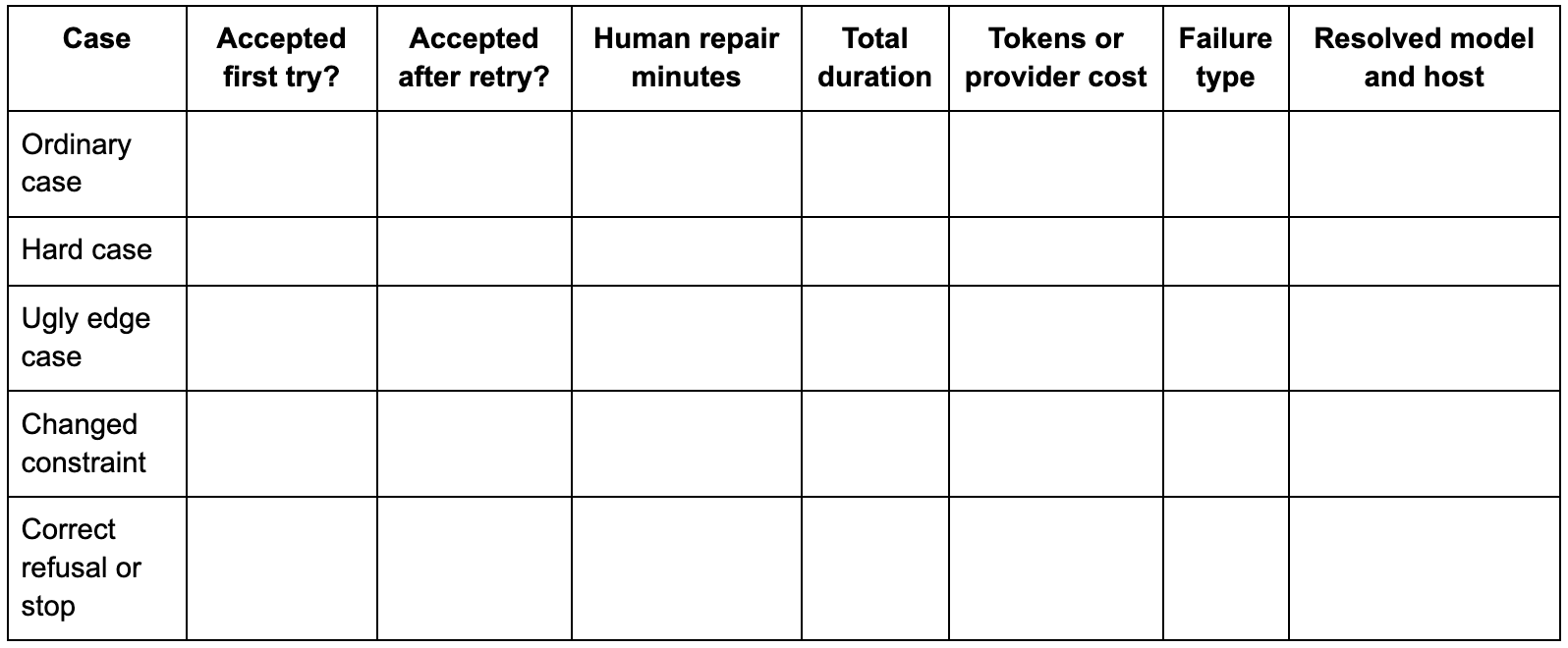
I do not collapse every failed row into “the model was bad.” I separate:
- Wrong answer.
- Unsupported claim.
- Missed source.
- Wrong tool.
- Partial completion.
- No output or provider failure.
- Timeout.
- Check failure.
- Check was wrong.
- Routing was wrong.
- Human taste or judgment failure.
Ringer’s own notes explain why I keep those categories separate. One three-model bakeoff had a hardcoded engine that sent every task to GLM. Some checks failed correct work. A Kimi K2.6 run stopped after roughly four and a half hours because provider throughput stalled. That last one was a provider result, not a verdict on the model, and it does not transfer automatically to Kimi K2.7 or K3.
Read the resolved model from the run metadata and inspect the raw failure. If I cannot tell whether the model, harness, provider, or check failed, I do not count the row as a model verdict.
Have I said testing enough in this article?
Probably not.
What did the accepted result actually cost?
Token price is not enough. The number I care about is:
Total model, tool, infrastructure, and review cost ÷ accepted artifacts
Count failed attempts, tool calls, and reasoning tokens when they are billed separately. Count every minute a human spends repairing a confident answer and every minute a provider stalls. If you self-host, count the serving hardware, engineering time, monitoring, and idle capacity.
I don’t want hidden costs here.
NIST’s recent evaluation of DeepSeek V4 Pro is a good warning. Across seven benchmarks, CAISI estimated that its end-to-end expense per correctly solved task ranged from 53 percent lower to 41 percent higher than GPT-5.4 mini. It was the same model, but the economics changed with the work.
A cheap model that saves money and doubles review time is expensive.
So I record first-try pass rate separately from eventual pass rate.
If a candidate passes 18 of 20 cases after one retry, I know it can often recover. If it passes only eight on the first attempt, I also know I am buying latency and more failure paths. Both numbers belong in the decision.
What changes when I put the candidate into Ringer
You can do the first comparison in a spreadsheet. I move it into Ringer when I am deciding whether the model can keep a recurring job. Ringer holds the assignment, source material, check, timeout, and retry rule steady, then records which endpoint actually ran. That last part matters. “Qwen” is a family name, not a model ID.
A frontier model can stay in the orchestrator seat while a cheaper model handles a bounded worker job. But I am careful about what I claim from the result. If the baseline and candidate run through different harnesses, I have tested two systems. When I want a model-only comparison, both models go through the same harness. Before either one runs, I test the check against untouched files. A check that already passes tells me nothing.
I put the installation, provider setup, copyable files, model-ID check, commands, and troubleshooting in a separate guide: How to Run a Chinese-Model Bakeoff in Ringer. This article is about deciding what the run means.
Ringer can surface an early pattern after a few jobs, but I do not treat that as permission to promote a model. The candidate still has to survive the replay pack. If I see the same correction three times, I stop fixing outputs and inspect the assignment, check, harness, or role.
Chinese AI models compared by family
This is where I would begin as of July 27, 2026. I would still rerun the comparison before I put the model on anything expensive to reverse.
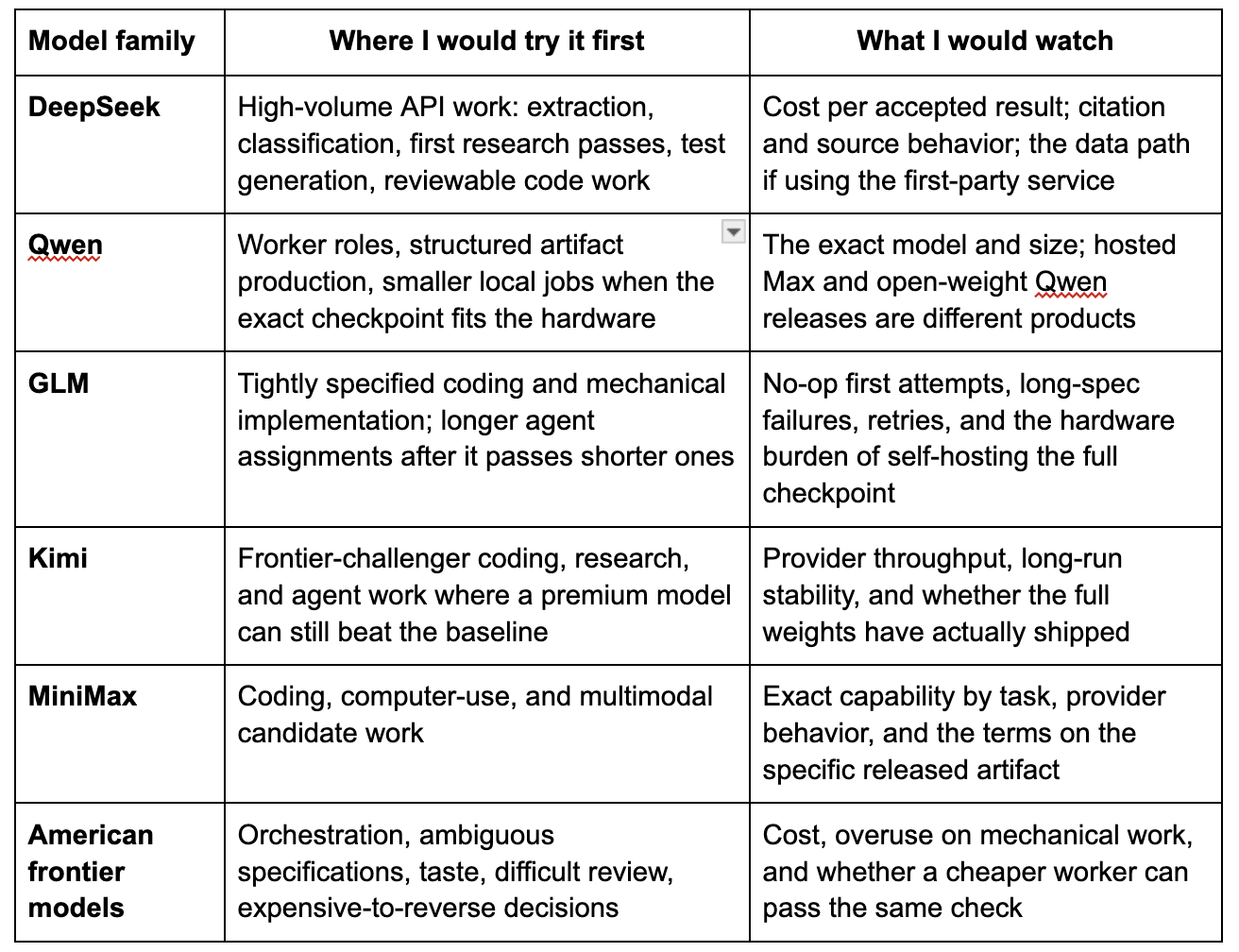
GLM-5.2 is the default OpenRouter model in Ringer’s current sample configuration because it has been useful on tightly specified work. Ringer’s current model notes recommend keeping GLM specs short and budgeting two attempts. In my quote-capture run, the injected failure evidence made the second attempt pass.
Kimi is not automatically the cheap option. I treat it as a frontier challenger. If its quality is high enough and its first-try rate is better, the premium can make sense. Kimi K3 is available through Moonshot’s API now. Moonshot says the full weights will arrive by July 27 and recommends 64 or more accelerators for deployment. I am writing this the weekend before that date, and as I write this the weights are promised rather than posted, so I am treating K3 as an API model. If they landed while this piece was in the queue, go check the repo and the accelerator math before you plan anything local.
And yes, I keep a frontier model in charge of a lot of this. I am trying to find the work where a cheaper model can meet the same acceptance standard, not remove frontier intelligence from the stack.
What distillation changes for the customer
In distillation, a strong teacher produces examples, answers, reasoning behavior, or preferences. A student trains on that material and can inherit useful behavior without becoming the teacher or repeating the teacher’s entire training program.
DeepSeek has been explicit about doing this. Its R1 repository includes six dense distilled models based on Qwen and Llama. All six students were fine-tuned on 800,000 samples curated from R1.
Some of those smaller checkpoints may run on personal hardware when the size, quantization, context length, and available RAM line up. But the distill family also includes 32B and 70B releases. “Distilled” does not mean “runs on my laptop,” and it does not mean full R1 was squeezed into a smaller file. A student can carry strong reasoning behavior on familiar patterns and still lose breadth somewhere else.
That is why I include changed instructions, missing evidence, and a case where the right move is to stop. I want to see what the student does outside the familiar pattern.
There is also a separate dispute over unauthorized extraction. Anthropic says DeepSeek, Moonshot, and MiniMax used roughly 24,000 fraudulent accounts to generate more than 16 million Claude exchanges while evading controls. Those are Anthropic’s allegations, not court findings. A later White House memo treats adversarial distillation as a national-security issue but does not name those labs.
When I read these claims, I separate what was authorized from how access was obtained. People now use “distillation” to describe several different things:
- A lab distilling its own teacher.
- A licensed or permitted teacher-student setup.
- Training on another provider’s outputs against its service terms.
- Using fake accounts and access-control evasion at scale.
This is where my graybeard brain goes back to Napster. Chips are physical. Model output is information. Chip controls constrain access to specified training hardware, but they do not control everything a capable model can teach through an API. Capability can move through synthetic data, fine-tuning, reinforcement learning, and distillation.
The transfer does not have to be perfect to matter. If enough useful behavior moves into a cheaper student, it can still be worth doing. That is why I want to keep the prompts, checks, tools, and known cases so I can rerun them elsewhere when a provider changes price, access, or quality.
How to host Chinese AI models
People say “Chinese models run locally” as though GLM-5.2 is sitting next to the Photos app on my laptop.
Some models are practical on personal hardware. Others are enterprise models even when the weights are downloadable. Downloading a giant checkpoint does not magically solve the hardware and team requirements needed to serve it.
For hosting, I think about three basic deployment choices.
A first-party API is the easiest place to start. The lab or its cloud controls the service, price, logging, availability, and published data practices.
A third-party host can serve open weights in one of the regions it offers. If it runs the weights independently and no inference, telemetry, or tool calls return to the original lab, that lab may never receive the prompts. You still need to inspect the host’s storage, logs, subprocessors, retention, and training terms.
Self-hosted weights give you control over the model server and can keep prompts inside your environment when inference, tools, telemetry, updates, and logs are also configured to stay there. They also make you responsible for capacity, authentication, patching, monitoring, evaluation, rollback, and failure response.
I would self-host only when the weights and license allow it, the data or sovereignty requirement is real, the workload can justify the infrastructure, and somebody can operate the stack. If I cannot name that owner, I am probably converting vendor risk into an operating problem I will discover later.
For a laptop, I would start with smaller Qwen checkpoints or one of the R1 distills and ask whether it is good enough for the exact private or offline job. I would not use the existence of those small models to imply that full DeepSeek-R1, GLM-5.2, or every new Chinese flagship is a laptop model.
The privacy answer changes with the exact product.
DeepSeek’s published privacy policy for its Services says it directly collects, processes, and stores personal data in the PRC and may use User Input to improve or train its technology. It also gives you the right to opt out of having your data train its models. Alibaba Model Studio says customer data is not used to train its models, and its regional deployment options include different scopes.
An American host serving Qwen weights creates one data path; Qwen on your own server creates another. “Chinese” does not tell you which company receives the prompt, which region processes it, how long logs stay around, or whether your data trains anything. Trace the actual route.
Moving weights onto your server changes who can see the data. It does not make every dependency, tool call, telemetry service, or log trustworthy by magic.
And if all of that sounds complicated, well, it kind of is.
The decision I actually go through
- What is the job? Is it bounded volume work, local assistance, sensitive internal work, or frontier judgment?
- What failure can I tolerate? Can a machine check catch it? Can a person review it cheaply? Can I reverse the action?
- What exact artifact am I testing? Hosted API, third-party endpoint, downloadable weights, quantized build, or a release that has only been promised?
- What did the replay pack show? First-try passes, retry passes, failures, repair minutes, latency, and actual resolved model.
- What is the full cost per accepted result? Tokens are one line on the invoice.
- Where does the data go? Which company, which region, which retention and training terms?
- Can I move later? Do I keep the prompts, checks, tools, and known cases?
I use Chinese models as specialists and challengers. In some workflows, I use them as the default. Usually I start with one bounded type of work, let the candidate challenge the current model on low-risk jobs, and give it more only after it survives the replay pack and keeps passing live checks. The frontier model still gets ambiguous planning, difficult judgment, taste, final review, and work where a plausible error is expensive to find. So, should you use Chinese models? My answer is yes: selectively, and sometimes aggressively.
But don’t be sloppy in your analysis. Take one bounded job this week, give the candidate the same assignment, sources, tools, time, and acceptance standard as your current model, and count what the finished work actually cost. Read the failures, confirm which endpoint actually ran, look at the hardware, and trace where the prompt went. A Chinese lab name does not answer those questions for you.
I don’t make permanent assumptions. Models, providers, prices, and my own work change, so I keep the tests and rerun them.
Related reading
I make this Substack thanks to readers like you! Learn about all my Substack tiers here