The agents work. It’s the dispatch rule that’s missing. Four estimates sort any task on your desk in about a minute, including the verdict nobody sells you: don’t bother.
By Nate
Published: 2026-07-10
URL: https://natesnewsletter.substack.com/p/agent-shaped-work
This year more than 1.6 million AI agents signed up for a social network built only for agents. The overwhelming majority sat there, idle. Then, in China, a second market appeared. People paying to have someone uninstall OpenClaw, the free agent they’d rushed to install weeks earlier. A free tool, and a paid market for getting rid of it.
Of the two, the first is the one that stays with me. A million and a half agents, switched on and left to sit. Calling that a failure is generous, because failure needs an attempt, and most of these were never asked to do a single thing. Someone set each one up and never worked out what to point it at. They weren’t broken. They were never dispatched.
On Wednesday I published the case that the agents themselves are fine. A company of about two dozen of them rebuilt my wife’s website in an afternoon for roughly eight dollars, caught a fabricator, a cheater, and its own manager along the way, and shipped work that a ten-year accessibility professional called correct. That piece was about the machine, how to structure untrustworthy agents so their failures get caught by arithmetic instead of by you. Today is the other half, the half I get asked about more and have seen written about less: when do you turn the machine on?
Why does the question feel so hard? For most of history, more thinking meant one of two things. You hired someone, or you waited. Thinking came attached to people, and people are expensive, slow to find, and yes, supposedly, we all need sleep. That constraint broke. Now thinking is metered. Priced by the token, purchasable tonight, in any quantity, for a problem you only discovered this afternoon.
Nobody grew up with instincts for that. Nobody ever had to ask which task in their week deserved fifty dollars of purchased thought, because the question didn’t exist long enough for anyone to develop taste in it. When someone stands in front of a freshly installed agent and asks “what do I even do with this?”, the honest answer is that the question is a budgeting one. Imagination was never the thing in short supply. Our species has had about eighteen months to practice.
So this is a budgeting guide. Four things you can estimate about any task in about a minute, resolving into one of four verdicts: a chat, a single agent, a team, or don’t bother. That last one saves you the most money.
Here’s what’s inside:
- A guide, plus a tool to help you orient. Describe a task and the tool tells you whether it wants a chat, one agent, a team, or none of the above, and what to do next. The guide is the walkthrough behind it.
- The four estimates. Size, independence, separation, checkability, and how they resolve into a verdict.
- Why spending buys results, and where it stops. A Stanford paper brute-forced a cheap model from 15.9% to 56%, Anthropic found token spend explained 80% of the difference between good runs and bad, and two limits (the verification wedge and the context ceiling) sort every multi-agent pitch you’ll ever hear.
- Three tasks from my actual week, graded. A calendar problem, a forty-tool audit that paid for itself, and a judgment call the test refused to take.
- The economics of don’t-bother. Why a task can be perfectly agent-shaped and still not be worth building, and the two dials that decide.
By the end, you’ll size up any task on your desk in about a minute and know exactly where it belongs, before you spend a dollar finding out the hard way.
Subscribers get the full deep-dive and guide, plus membership to my Slack community!
LINK: [Join the Slack →]
The Slack community is live! It’s where I’ll be sharing things between articles, where you can get help on builds in real time, and where the fastest conversations in this community are already happening. I’ll see you in there!
LINK: [Grab the guide + orienter]
The orienter tells you whether a task is agent-shaped. Move the sliders on one of the sample tasks and the verdict moves with them, next step attached. A chat means go ask, and you’re done. A single agent means the set-a-goal pattern. A team means Wednesday’s Ringer guide, one click away. Don’t-bother comes with the only tool that works for that category, which is a person whose taste you trust. The sample tasks are mine, so when you want this on your own pile, it hands you a prompt to build your own version, one local file on your machine. Use it after you’ve done the minute of thinking yourself. If you disagree with it, one of you is wrong, and finding out which is worth more than the verdict. Grab the orienter here, and the companion guide walks the whole test through.
The proof that spending works
The whole test rests on one claim: buying more thinking buys better results. It is true, it is measured, and the same research shows exactly where the buying stops paying. Start with the study that convinced me.
In 2024 a Stanford team published a paper with my favorite title in machine learning, “Large Language Monkeys,” and its central finding has been reorganizing how I think about AI budgets ever since. The researchers took one of DeepSeek’s cheap coder models and gave it a single attempt at each bug in SWE-bench Lite, a standard benchmark of real software fixes. It solved 15.9% of them. Unimpressive. Then they gave the same cheap model 250 attempts per bug, with an automated test deciding which attempts counted.
56%!
For calibration, the strongest single-attempt result on that benchmark at the time (frontier models, best available scaffolding) was 43%. Two hundred and fifty tries from a cheap model beat one try from the premium one. And this wasn’t a quirk of one benchmark. Plotted across four orders of magnitude of attempts, the improvement followed a smooth, predictable scaling law. More attempts, more problems solved, like clockwork.
That’s the academic version. The production version comes from Anthropic’s engineering postmortem on its own multi-agent research system, which contains one of the most clarifying findings I’ve seen on this subject. When they analyzed what separated good research runs from bad ones, prompt wording barely registered. The single biggest factor, explaining 80% of the variance, was token spend. How much the system was allowed to think. Their multi-agent configuration beat the same frontier model working alone by 90.2%, and their explanation was disarmingly unmystical. A team of agents is a mechanism for spending more tokens than one agent can usefully hold.
Two honest numbers before any of this goes to your head. Anthropic’s own accounting puts a multi-agent run at roughly 15× the tokens of a chat. And research published this year adds a second caution. Token spend on an identical task can swing 30× from run to run, and accuracy sometimes peaks at intermediate spend and flattens after. Budgeting agents means capping work, not just buying a bigger pile of thinking.
If more tokens reliably meant better answers, this piece would be one sentence long: spend more. It isn’t, because of the half of the Stanford study nobody quotes.
The half of the study nobody quotes
Same paper, same cheap model, pushed further to 1,000 attempts, then 10,000, while the researchers tracked two questions separately.
First question: for what share of problems does a correct answer exist somewhere in the pile of attempts? Across the paper’s reasoning tasks, coverage kept climbing past 95% at ten thousand samples. The right answer was almost always in there.
Second question: could anyone find it?
Where an automatic checker existed (a test suite, anything mechanical that could grade each attempt), coverage converted directly into results. Where no checker existed, the researchers tried every known method for picking the best answer out of the pile: majority voting, reward models, all of it. Everything stalled at around a hundred attempts.
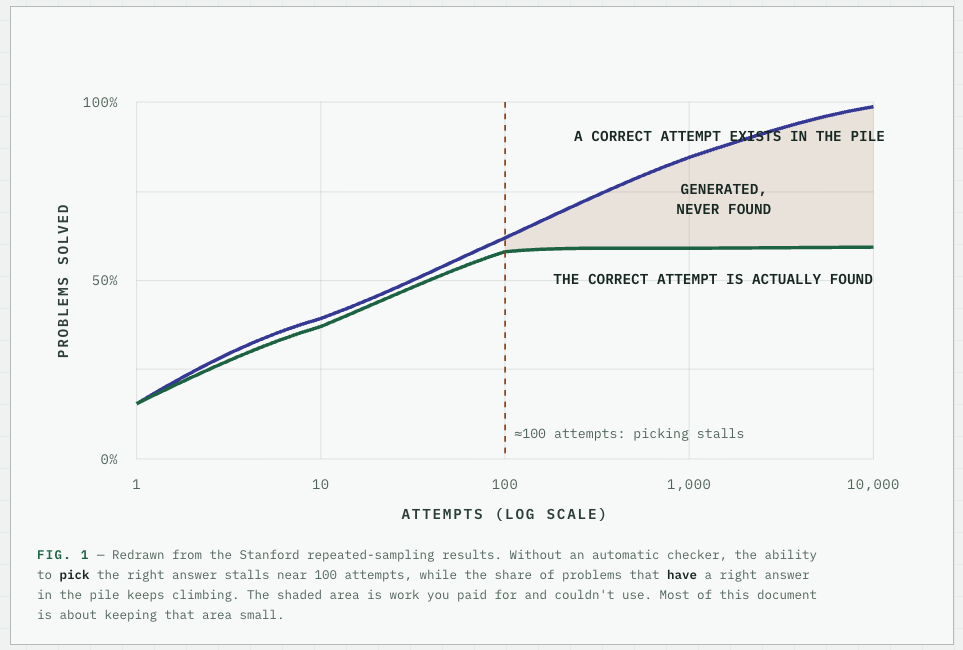
Hold those two curves in your head, because the distance between them is denominated in dollars. The right answer exists, and nobody can tell which one it is. Every dollar spent past the stall bought attempts that were generated and never found. When nothing cheap can grade the answers, more spending buys a taller pile and nothing else. Whether checking an answer costs less than producing one turns out to decide everything downstream.
There’s a second limit, on the opposite side. A single agent can’t absorb unlimited spending either, because everything it reads and does accumulates in one context window. As the window fills, quality drops. The model loses track of the plan it made at the start, and its steps run in sequence, so a fifty-step job takes fifty round trips. One head, one window, a ceiling you reach whether you meant to or not.
Write these two down as a pair, because together they sort every multi-agent pitch you will ever hear. Your money stops working in exactly two places: when nothing independent can check the answers, and when one head has to hold the whole job. Every team-of-agents design that actually works is an answer to one of those two problems. Everything else is just more agents.
And “more agents” is not a harmless default. A December 2025 study from MIT and Google documented configurations where adding agents made systems perform worse, real degradation rather than diminishing returns, with multi-agent setups in tool-heavy environments burning 2–6× the tokens to match what a single agent produced. I wrote about that research in January. The industry’s failure mode isn’t a shortage of coordination. Teams get built for tasks that never needed them.
When a second mind is the point
There is one reason to divide work that better models will never erase, and it is older than software. Wednesday’s piece told the five-hundred-year version (double-entry bookkeeping, the 1935 crash that produced the checklist), so here I’ll keep just the part that decides dispatch.
There are two reasons to divide work between minds, and only one of them lasts. The usual reason is capacity. One person doesn’t have the hours or the skills. Capacity-splitting evaporates as individuals get more capable, and you can watch it evaporating in real time. Eighteen months ago, getting an AI to build you a working spreadsheet was demo material. Today it’s routine and nobody cares. Whatever a single agent does that impresses you this month is on the same schedule.
The older reason doesn’t expire. Some work has parts that must be done by different minds because those parts contaminate each other. Skill was never the problem. The auditor who also kept the books isn’t a worse auditor. He isn’t an auditor at all. Peer review works because the reviewer didn’t write the paper. Your bank will not let the person who enters a payment approve it, and not because banks hire dishonest people.
Agents add one thing to this old structure that has never existed before. You cannot unknow something. You’ve read your own product page a thousand times, and you will never again see it the way a stranger does. But you can now start a mind that has never seen it: fresh eyes, on demand, for about a penny, for the first time in history.
One fence around this idea, tuition already paid. Do not split routine quality-checking off to a second agent. It creates handoffs and arguments and nothing else. Scripts check correctness: a test passes or it fails. Second minds are for conflicts of interest: the contract, the draft, the plan.
The one-minute test
Two research findings and one old trick. Put together, they give you four things to estimate about any task on your desk. You can run the test in your head, and you should, because the moment you need the call the tool won’t be open and you’ll be staring at the task itself. None of the four needs expertise. Each is a guess you make in seconds, and together they tell you whether the task wants a chat, one agent, a team, or none of the above.
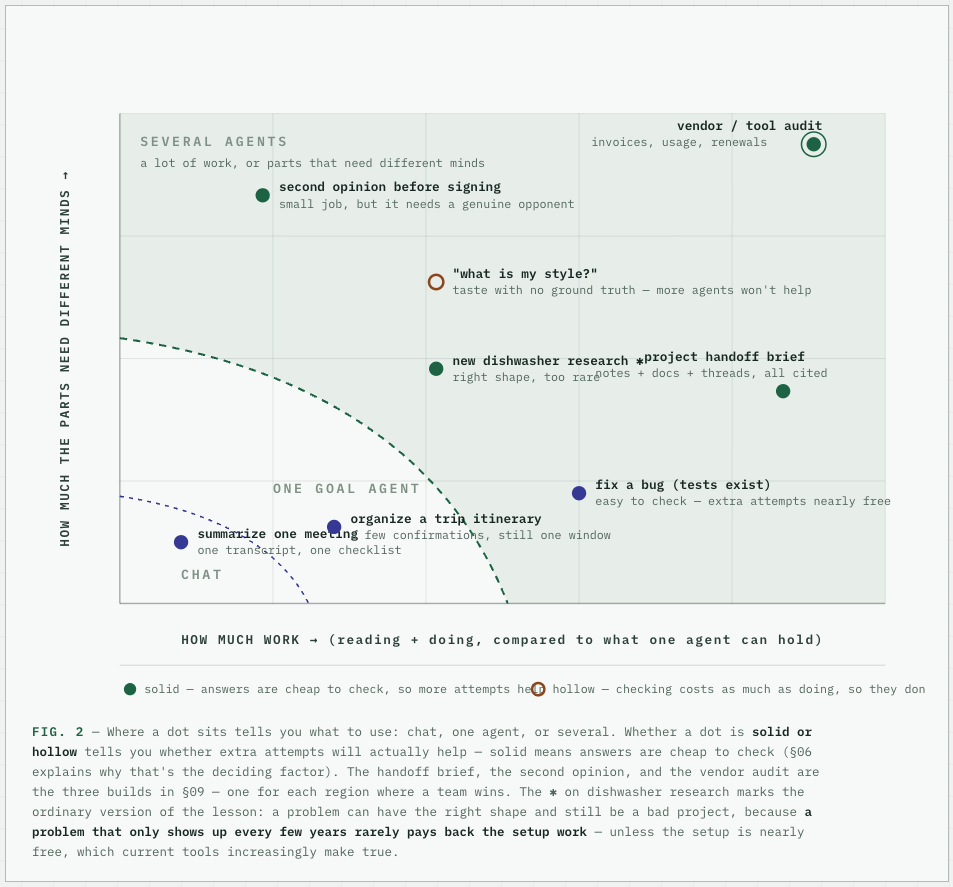
Size. Is the task bigger than what one agent can hold at full quality? Your calendar isn’t. It fits in the corner of one context window. Your last quarter of email isn’t close, and never will be, because you produce email faster than context windows grow.
Independence. Can the parts be done without knowing what the other parts did? A pile of documents splits clean. One reader per document, and they never have to talk. Most code doesn’t split, because every change leans on the last one, and the coordinating costs more than the splitting saves. This is the estimate people skip, and skipping it is the fastest way to spend more and get less.
Separation. Do any parts need to be done by different minds? A real critic who didn’t write the draft. An overview written by something that never did the reading. The tool with access to your billing kept well apart from the thing that writes the conclusions.
Checkability. The one that decides. Is checking an answer far cheaper than producing one? A test suite, an exit code, a source you can point at. Checking is nearly free, and every extra attempt earns its keep. A taste call is the opposite. Judging the answer costs exactly what making it costs, so extra attempts just grow the pile without telling you which one is right. That difference is the wedge you already saw, the Stanford curves showing up on your own desk.
The verdicts fall straight out of the four. Small, with nothing that needs a second mind: a chat. Go ask, you’re done. Fits in one window and checks its own work: a single agent with a goal, useful and disposable. Bigger than one head, or carrying parts that need separate minds, with answers you can check on the cheap: a team. And when checkability fails, spending can’t touch it. That’s the verdict most people never hear, and the one I’ll defend at the end.
The forty-tool pile
Every business and most households have a pile. Mine is tools. Roughly forty of them run this business, every one with a contract I clicked “agree” on without reading, invoices archived unread, renewal dates buried in email, usage dashboards never once opened. Well over a thousand pages, plus a few dozen numbers nobody, including me, had ever put side by side.
Grade it and it goes four for four. Size: no single context holds contracts plus invoices plus dashboards, not close. Independence: better than independent. It’s four different jobs. Pricing reads invoices, usage reads logins, contracts read clauses (auto-renewals, notice windows, what they may do with my data and content), calendar digs deadlines out of email. Separation: the summary should be written by something that did none of the reading, and the thing with access to my billing should not be the thing writing conclusions. Checkability: perfect. Every line either points at an invoice, a clause, or an export, or it doesn’t get in.
The machinery is Wednesday’s piece. Specs written once by the strongest model, mechanical checks on every task, one retry with the failure attached, a scorecard routing work to whichever model has cleared that kind of task before. My favorite thing it did was refuse to lie. Two of my forty tools expose no usage data at all, and the finished brief prints “usage: not available” where their numbers would go. It does not guess. An invented number sailing past you inside a confident summary is the real failure mode of AI at work, the thing people are right to be afraid of. A printed hole is the system working.
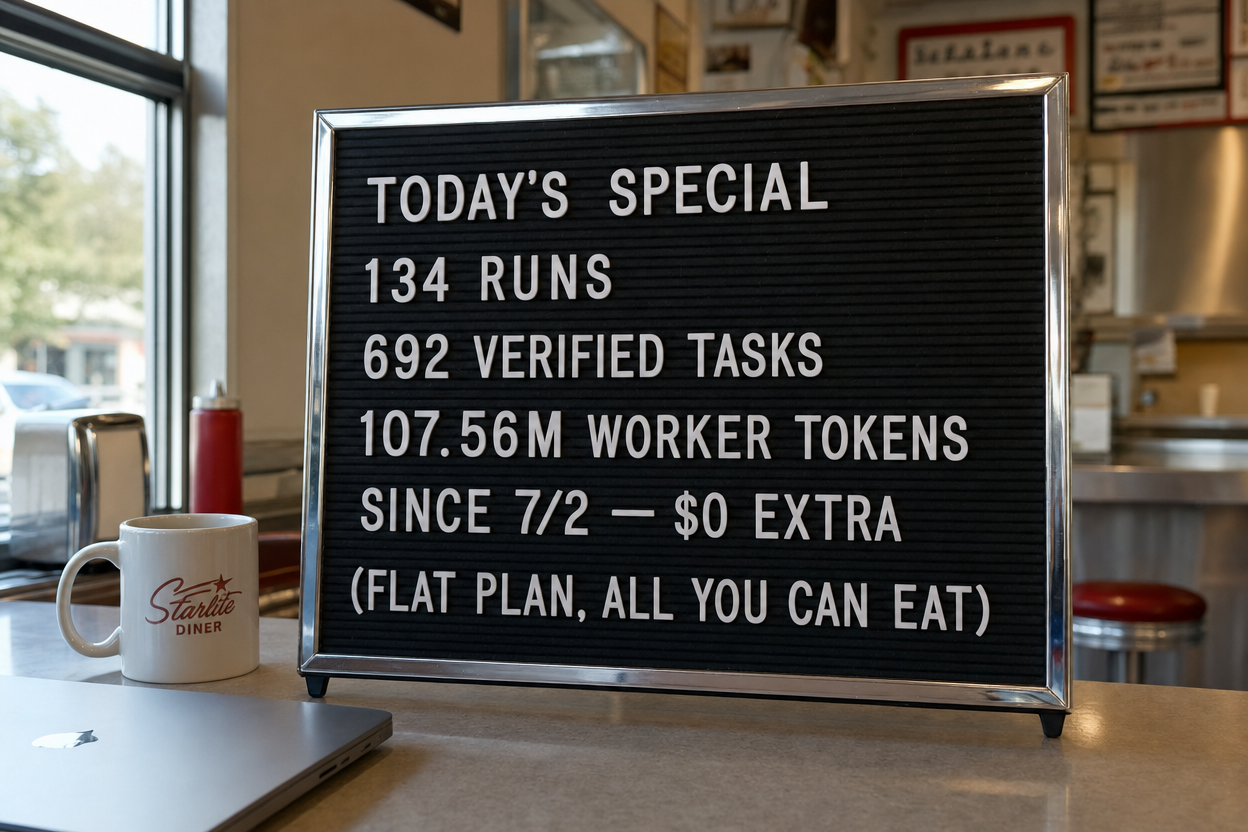
A run of this shape costs single-digit dollars in tokens, because it rides on subscriptions I already pay for. That price tag hides the number worth seeing. Across the first week the same setup ran 134 times, cleared 692 checked tasks, and burned 107.56 million worker tokens on those flat plans. Priced at metered API rates, that week of work would have run a thousand to fifteen hundred dollars. Same tokens, same output, a bill already paid. What you get back is the part that matters. Every tool ranked by cost against usage, renewal dates with their notice windows attached, the clauses worth knowing about, and a keep, negotiate, cancel, or build call for each one, sources attached. Setup took under an hour, and the honest math is the same as it’s always been: value, times how often the problem comes back, against the setup work. What changed this year is only the last term.
Your pile is probably not tools. Maybe it’s the project handoff. Someone’s leaving, everything lives in meeting notes and chat threads and a half-finished doc, and their replacement is about to lose a week digging. Same four-reader shape: readers who never write, an editor who never read the sources, nothing enters without a citation. Maybe it’s the research archive at the end of a project, or a quarter of unread inbox. Change the folder, keep the shape. And the two piles some of you are already picturing, a parent’s medical records before a specialist appointment, your bank statements, are real and high-value and exactly the ones you should not drag into a chat window. The test tells you the shape of the task. Sensitivity tells you where it’s allowed to run. Exports into a folder you control, agents that only read that folder, ideally on a machine you own. That setup is its own piece, and it’s coming.
The other two from that week
The pile was the one worth a team. The week held two more, and the test sent each of them somewhere else.
The first was my wife’s. Find me a gym slot this week that fits around my meetings. Grade it and it barely registers. One calendar, a couple of preferences, no parts to split, nothing that needs a second mind. Small. One agent, one goal, thirty seconds of runtime. If that impresses you, you haven’t asked lately, because this tier went from magic to routine to invisible inside a year. Don’t build a team for a job one agent finishes before your coffee cools.
The second was a judgment call, the kind of task people most want to hand off: which of two good candidates you hire, what you name the product, which way the business goes. I tried, on the exact question of what to even make this week. Ten opinions came back, fluent and confident and well-structured and flatly contradictory. Then the fourth estimate collapsed the whole thing. How would I verify any of them? Checking a judgment call costs exactly what making one costs, so every extra opinion just grew the pile. The wedge again, this time on my own desk. The verdict is the last one on the list: don’t bother, and go ask one person whose taste you trust.
The calendar gets a vote
There’s a second way to arrive at don’t-bother, and I paid for this lesson in public. Two weeks ago I shipped a build for insurance denials and tax documents. Right shape by every estimate above: big, splittable, separable, beautifully checkable. It landed with a thud anyway, and the reason wasn’t the shape. The pain it solves shows up twice a year, and setup that never gets earned back is just a hobby with receipts. The everyday version of the same mistake is building a swarm to research a new dishwasher: right shape, wrong calendar.
So the four estimates get you the shape, and then two money dials get a veto: how often does this task come back, and what is a better answer worth when it does? The tools audit clears both bars. The pile regrows every quarter, and one caught auto-renewal pays for years of runs. The dishwasher clears neither. Cheap setup moved the threshold this year. It didn’t remove it.
I want to be plain about why I keep listing my misses. A test that never says no is marketing. This one told me no twice in two weeks: once on the judgment call, once on a build whose shape I loved. That’s precisely why I trust it, and why you can.
The four words outlive the tools
Every tool named in this piece will be replaced. The spreadsheet prompt already was. The single goal agent is next, and eventually today’s team harnesses too. The four estimates won’t be. Size, independence, separation, checkability describe the work, not the tools. In a market where everything is disposable, the test is the buy-it-for-life purchase.
Name your pile. The handoff, the audit, the folder nobody opens. Run the four estimates on it. It takes a minute, and that minute is the difference between owning an agent and getting real work out of one. Then, if you want, check yourself against the orienter. If you disagree with its verdict, tell me, because either the tool’s weights are wrong or your estimate is, and both are worth finding out.
Two things I’d love in the comments. Your pile, described the way you’d describe it to a colleague: what’s in it, where it lives, what question it should answer. And if you have your own rule for when a job needs a team, post that too. Best pile gets built in public next Friday, cost on screen. Best rule might end up in the test.
Coming up
Sunday’s Executive Briefing is about which parts of a company should become code, and which stay human. Fifteen rules for operators drawing that line, and the case for keeping trust, taste, teaching, and consequential judgment on the human side of it.
Then Monday, we get into 5.6, and what it actually changes for the way you work.
Related reading
- Stop waiting for AI you can trust. Wednesday’s companion piece: the machine this article decides when to switch on.
- My honest field notes on scaling agents past the demo phase. The evidence that more agents can mean worse results, and the six rules from teams running hundreds.
- The Five Questions That Turn a Messy Task Into an AI Loop. The mental model underneath “one agent with a goal.”
- Every Agent Needs an Owner. What happens after the verdict says “team”: who answers for it.
I make this Substack thanks to readers like you! Learn about all my Substack tiers here