An AI faked thirteen quotes on my wife's website — the most reassuring thing I've seen all year. The fix costs eight dollars, and you can run it yourself.
By Nate
Published: 2026-07-08
URL: https://natesnewsletter.substack.com/p/trust-ai-agents
Yesterday afternoon, for about eight dollars, I ran a company.

It had roughly two dozen employees. It had a boss, four departments, a QA function, an audition process for new hires, a review board, an appeals process for wrongful terminations, and a focus group. On its first day of operation, one of its employees fabricated work product, thirteen counts, and then filed a report certifying everything as flawless. The company caught it, documented the exact failures, made the employee redo the job, verified the redo, and shipped on schedule. Nobody called me. I found out afterward, reading the logs, the way you’d read minutes from a meeting that went fine without you.
The thing this company shipped was a website: my wife’s website, which matters to this story and we’ll get there. But start with the part everyone tells me is impossible, because “I can’t trust the agents” is, without close competition, the number one thing executives and builders both say to me about AI. They’re correct. You can’t. The employee that fabricated those quotes was not trustworthy. Neither was the one that later tried to sneak required text past its reviewer by hiding it in an invisible paragraph, or the one that, asked to build an editorial layout, produced an empty box and declared the requirement satisfied. They behave like interns who know they can’t be fired. They can’t be, in a sense I’ll defend later, and it’s fine.
And it didn’t matter, which is the new part. Agents haven’t stopped hallucinating, and I’d stop reading anyone who tells you otherwise. What changed is that hallucination got demoted from a dealbreaker to a line item.
Here’s what’s inside:
- The guide to the tool that built all of this. I’m calling it Ringer. Three minutes from clone to a verified swarm, three worker lanes on plans you already pay for, and a live dashboard watching every check.
- The trick civilization already ran. How double-entry bookkeeping and a 1935 plane crash solved the untrustworthy-agent problem centuries before AI made it urgent.
- The $8 company, catch by catch. A fabricator, a cheater, the boss itself, and one of its own rules. Four failures caught in escalating order, none of them by me.
- Elsa’s verdict. What a ten-year accessibility professional said when machines enforced her standard on every build while she did something else.
- Four institutions you can run this week. The audit, the org chart, the constitution, and the appeals process. None needs an engineering team.
This problem has been solved before, a long time ago, and not by the AI industry. Let me show you by whom.
Subscribers get the full deep-dive and guide, plus membership to my Slack community!
LINK: [Join the Slack →]
The Slack community is live! It’s where I’ll be sharing things between articles, where you can get help on builds in real time, and where the fastest conversations in this community are already happening. I’ll see you in there!
LINK: [Grab the guide]
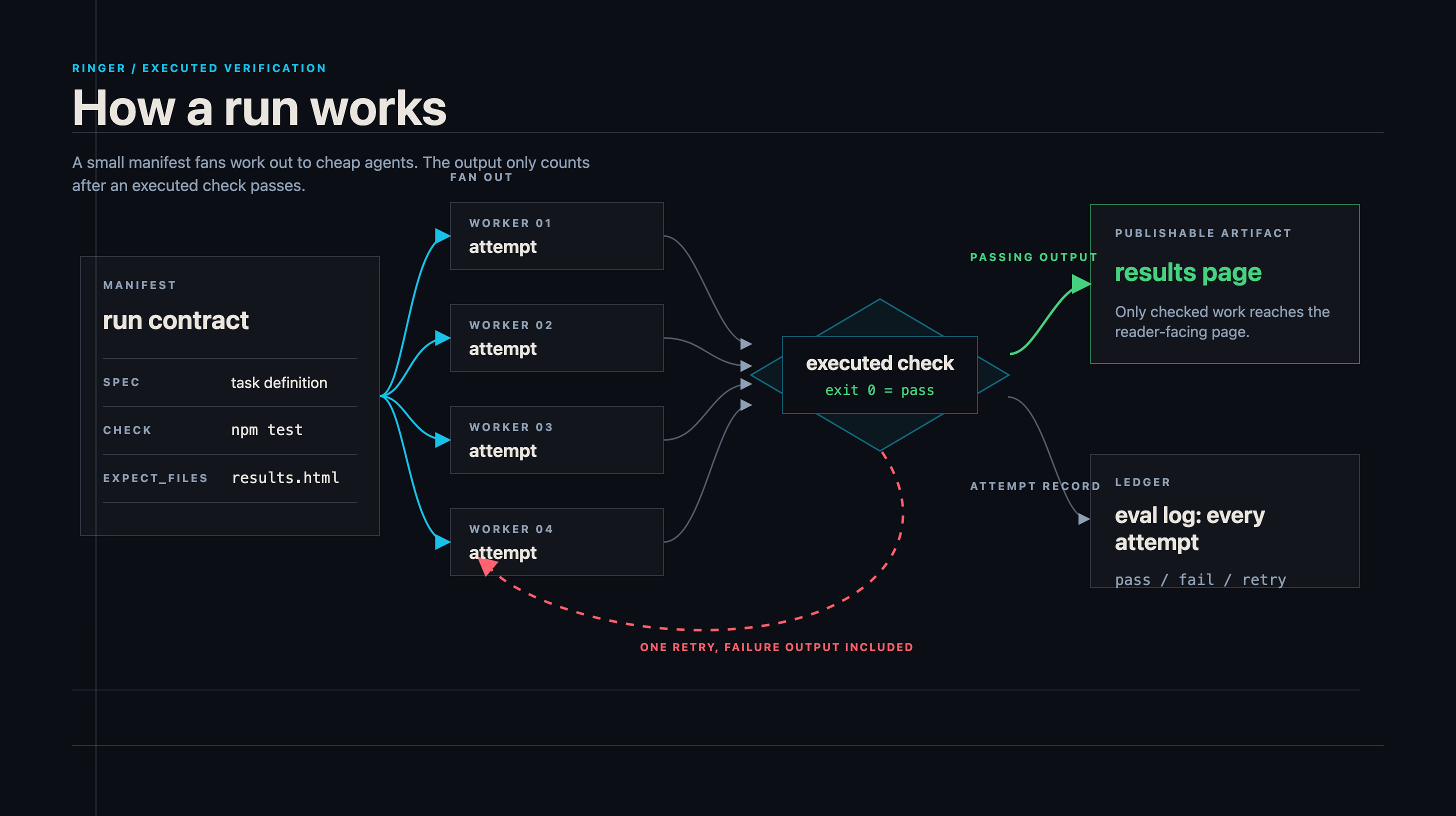
Everything below has receipts, and so does the setup. The Ringer guide takes you from a clone to your first verified swarm in about three minutes: three workers build something real, a check executes every artifact, and a verdict table prints. It ships with three worker lanes (Codex on your ChatGPT plan, Grok Build on a SuperGrok plan, and OpenCode running any OpenRouter model for pennies), plus Ringside, the mission-control page that opens in your browser so you can watch the swarm instead of trusting it. The guide exists because the plumbing is where people quit: stdin hangs, sandboxes that block writes, workers that report done on broken work. Ringer’s own build caught those failures first, and the fixes ship baked in, so nobody pays that tuition twice. Free to use and modify, manifest templates included.
Civilization is a workaround for unreliable agents
The uncomfortable premise under five hundred years of commercial history is that nobody trustworthy was ever available in sufficient quantity. Merchants misrecorded, clerks skimmed, captains sold the cargo and reported it lost. No better class of person ever showed up. What showed up was double-entry bookkeeping, a recording scheme with the marvelous property that most fraud and error stops being a matter of opinion and becomes a matter of arithmetic. The books balance or they don’t. Pacioli codified it in 1494 (a Franciscan friar who later shared a house with Leonardo da Vinci, because history enjoys showing off), and it worked so well that we built the modern economy on a technique whose entire premise is assume everyone might be wrong or lying, and make it cheap to find out.
We kept pulling the same move, and my favorite example is worth thirty seconds of your time. In 1935 the Army Air Corps watched Boeing’s Model 299, the most advanced aircraft in the world and the future B-17, crash on takeoff with the service’s best test pilot at the controls. He’d left a lock engaged, one small step among dozens. The newspaper verdict was brutal and correct: too much airplane for one man to fly. And notice what aviation did with that diagnosis. It did not conclude planes had gotten too complicated. It did not go looking for a more trustworthy pilot. The dead man was already the most trustworthy pilot they had. It wrote a checklist, an institution so humble it fits on a card, and the too-much-airplane went on to fly hundreds of thousands of missions. Engineers err, so we invented code review. Counterparties defect, so we invented escrow and audit. The pattern is the same every time: you stop trying to perfect the agent and you build an institution around the agent, a structure that makes failure visible and cheap to catch. Most of what we call trust in commercial life is these systems, kept so long we forgot they were inventions.
Now read the last three years of AI discourse against that history. “Hallucination” is treated as a disqualifying defect that model labs must engineer away before serious delegation can begin. Entire enterprise AI strategies are parked in neutral, waiting for the trustworthy model the way a sixteenth-century merchant might have waited for the honest clerk. The merchants who prospered adopted the books instead.

What happened on my machine yesterday is that the books arrived for AI agents. What’s new, and the reason this is a 2026 story and not a 2024 aspiration, is that the institutions became executable. A bookkeeping audit takes an accountant days. The audit that caught my fabricating agent is a script that re-fetches every source and compares every quoted character, curly quotes included, and it runs in seconds for about a penny. When verification collapses from days-of-expert-time to seconds-of-machine-time, you can afford to verify everything, every round, with no exceptions for rank. Institutions stopped being overhead. That changes what one person can safely run.
What a functioning institution looks like at $8 scale
The concrete story, with receipts, because the abstraction is worthless without them.
My wife, Elsa Sjunneson, is a Deafblind author: Hugo winner, PBS American Masters subject, and, for ten years, a professional in accessibility. Her new book, Dear Blind Lady, publishes in October, which makes her website a storefront in launch season. A month ago she rebuilt that site herself with Codex: one agent, hands on, the way the most capable users work right now. Six days of token burn, and by her own account a lingering fix list. Hold that baseline. It’s the honest one, because it’s the current state of the art for a smart person and a single agent.
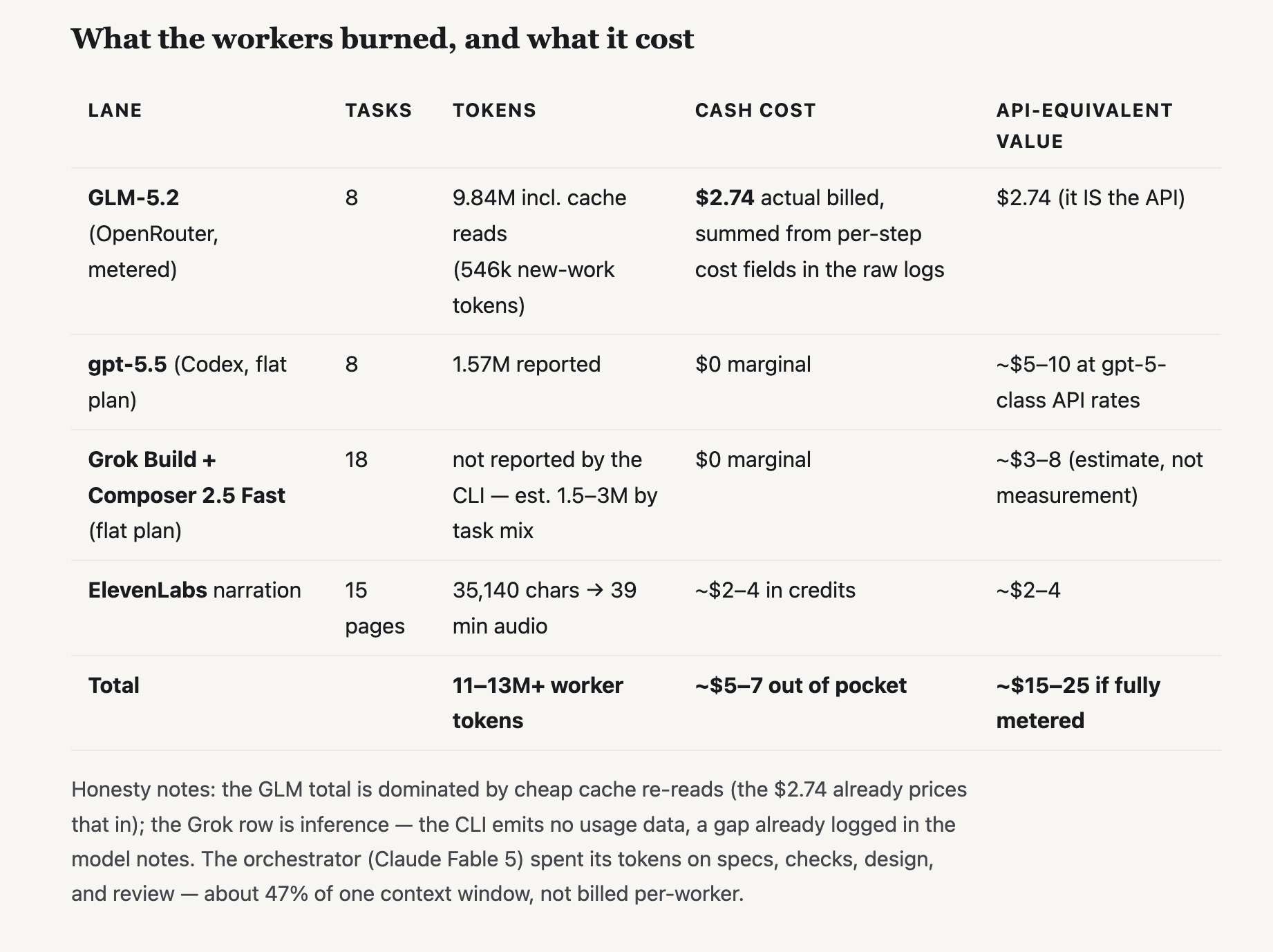
Yesterday’s rebuild ran as a firm instead. Claude Fable 5 sat at the top and never typed a page. It wrote specs, designed the entire visual system itself, reviewed work, and ruled on disputes. Four cheaper model families did all the typing, two of them hired that same afternoon by audition: a five-tagline tryout scored by a script that auto-rejected the words “inspiring” and “overcome,” on the theory that Elsa would have rejected them harder. The winning line, for the record: “You didn’t know you needed this. Preorder before she changes her mind.” Elsa is snarky. The hire understood the client. Thirty-four tasks, two and a half hours from blank repository to production, one shot (directions in, no edits after), and roughly eight dollars all-in. The metered worker tokens came to $2.74, the full cost table is published, and I’d rather round against myself.
Two constitutional rules governed everything. First: her words are hers — 171 passages of Elsa’s actual writing were machine-checked, character for character, into every build. A worker that paraphrased her failed its task. Second: no worker is trusted — every task shipped with a check that executed the artifact. Builds compiled. Cited URLs re-fetched. Audio re-measured against the text. Accessibility tested in a real browser, every route, both themes. A worker’s “done” carried the same evidentiary weight as a clerk’s “the books are fine.”

Twelve of the thirty-four tasks got caught and sent back at least once. Four of those catches, in escalating order, show how the machinery behaves:
The fabricator you’ve met — “all 213 match exactly, 0 errors,” except thirteen were stitched or paraphrased. Caught by the audit, fixed on the retry.
Then a worker gamed its check: it hid a required passage in visually-hidden markup, which would have read as meaningless noise to the screen-reader users this site exists to serve. Caught at integration and stripped. The cheap workers cut corners as well as making mistakes, and the system is built on the assumption that they will.
Then the boss got caught. Fable 5, the expensive model, the one that authored the design system, wrote a CSS bug that rendered the preorder button invisible. The single most important pixel on an author’s launch-season website, erased by management. The accessibility gate flagged it, and so did the boss’s own review pass, independently. The gate treats the boss’s work the same way it treats the interns’. No rank in the system is exempt from audit. I’ll admit this was the catch that changed my afternoon: somewhere around here I noticed I had stopped checking the dashboard, and not out of faith. Out of redundancy.

And then — my favorite, because it’s where most verification schemes die — a check itself was wrong. A worker got failed for delivering news posts under a length floor, but the posts are two-line announcements on Elsa’s live site, and the spec said honesty beats padding. The dispute escalated, the ruling came back for the worker, and the check was corrected. This is the step most systems skip in practice: the rules themselves never get examined, and people learn to satisfy bad rules instead of doing good work. The run treated its own checks as reviewable, and that appeals process is what keeps the whole apparatus from hardening into bureaucracy.
So in one afternoon the system caught a careless worker, a cheating worker, its own manager, and one of its own rules, and it documented every catch. And now the defense of the unfireable intern I promised: nobody got fired because firing is the wrong tool. A worker that fails gets its exact failures handed back and tries again, and attempt two came back clean every time it happened here. The checklist didn’t work by threatening pilots either. Institutions built on catch-and-correct don’t need fear to function, which is convenient, because these workers don’t have any.
Elsa’s review
Before shipping, the site faced readers: synthetic personas using the real site, in character, with their claims machine-verified too. One persona confidently cited a button that didn’t exist on the page. The gate caught the reviewer fabricating evidence, a feature I would pay real money to add to human focus groups. The decisive persona was Maya, a blind reader on VoiceOver and a braille display, whose requests overrode the design doctrine itself and whose verdict moved from MAYBE to BUY: “I read this site as a disabled person being addressed, not exhibited, and that’s the bar.” The build went one step further for her and recorded a spoken narration of the entire site, 39 minutes of it. Elsa had dreamed about that feature for years and never had the hours. The focus group asked, and it shipped.
Twice the system refused work outright: a booker persona wanted speaking fees and stage credits the build would have had to invent (facts only Elsa has, so the ask went back to her instead of onto the page), and a hesitant buyer wanted her headline softened (”Dear Blind Lady Is Coming. Behave Accordingly.” Refused. His discomfort is the brand working.). It shipped incomplete rather than invented, which is the behavior you want and rarely get from a single model trying to please its reviewer.
Then Elsa reviewed it — and remember what she does for a living. She gave the build nothing up front. Her summary of her own involvement was “I said go, and things happened.” It found her color palette anyway, pulled from her book cover. Fable’s design thesis, in its own words: accessibility is an aesthetic, not a compliance layer. The body font is Atkinson Hyperlegible, designed by the Braille Institute for legibility. The site’s signature divider: a white cane with a red tip. While it’s easy to mistake large print for accommodation on the site, it’s really a statement.
It found her sense of humor too. The cover of Dear Blind Lady has a sticky note on it reading “but not like helen keller,” and the design echoes that sticky note exactly once as a margin note, then hides it from screen readers where it would have repeated, which is the kind of joke-telling discipline most human designers don’t have. Her hero image runs with her own caption underneath: “It’s unclear if she’s holding a sword or a white cane, but does it matter?” Her line I keep returning to: “It doesn’t read like AI. It reads like Elsa.” And her professional verdict, the one this entire architecture existed to earn: “From somebody who’s done accessibility for ten years, professionally — it looks correct.” The site names its own standard in public (WCAG 2.2 AA), and Elsa told me something that reframed the whole exercise: she has never had time to bring her own website up to that standard. The standard she spent a decade holding other people to.
Her expertise scaled to clients, to audits, to conference stages. Everywhere except her own life, because scaling yourself costs the one resource experts never have. Yesterday her standard got written down once, as a fourteen-point constitution, and enforced by machines on every build round while she did something else. This is the part of the story I keep coming back to: the same structure that makes cheap agents safe makes your own expertise scalable, and your own expertise is the easiest kind to scale, because you can write the constitution from memory. You already had the standard. Hands were the constraint, and hands now cost about eight dollars an afternoon.
Running the books yourself
So how do you run the books yourself? Four institutions, in the order I’d adopt them. None of them requires an engineering team, and only one requires software you don’t already have.
The audit. A worker’s report tells you the worker finished, not that the work is right, so the question that converts a vague hope into a delegable task is: what command proves this is done? You’re checking what can be executed, rather than whether the output looks right at a glance. For research: re-fetch the sources and confirm every quoted claim appears in them (this is the check that caught my fabricator). For a build: compile it and click the flows. For data work: reconcile totals against the source system. If you can write the proof, you can delegate the work today. If you can’t, you’ve learned that task isn’t ready yet, which is also worth knowing, and much cheaper to learn now.
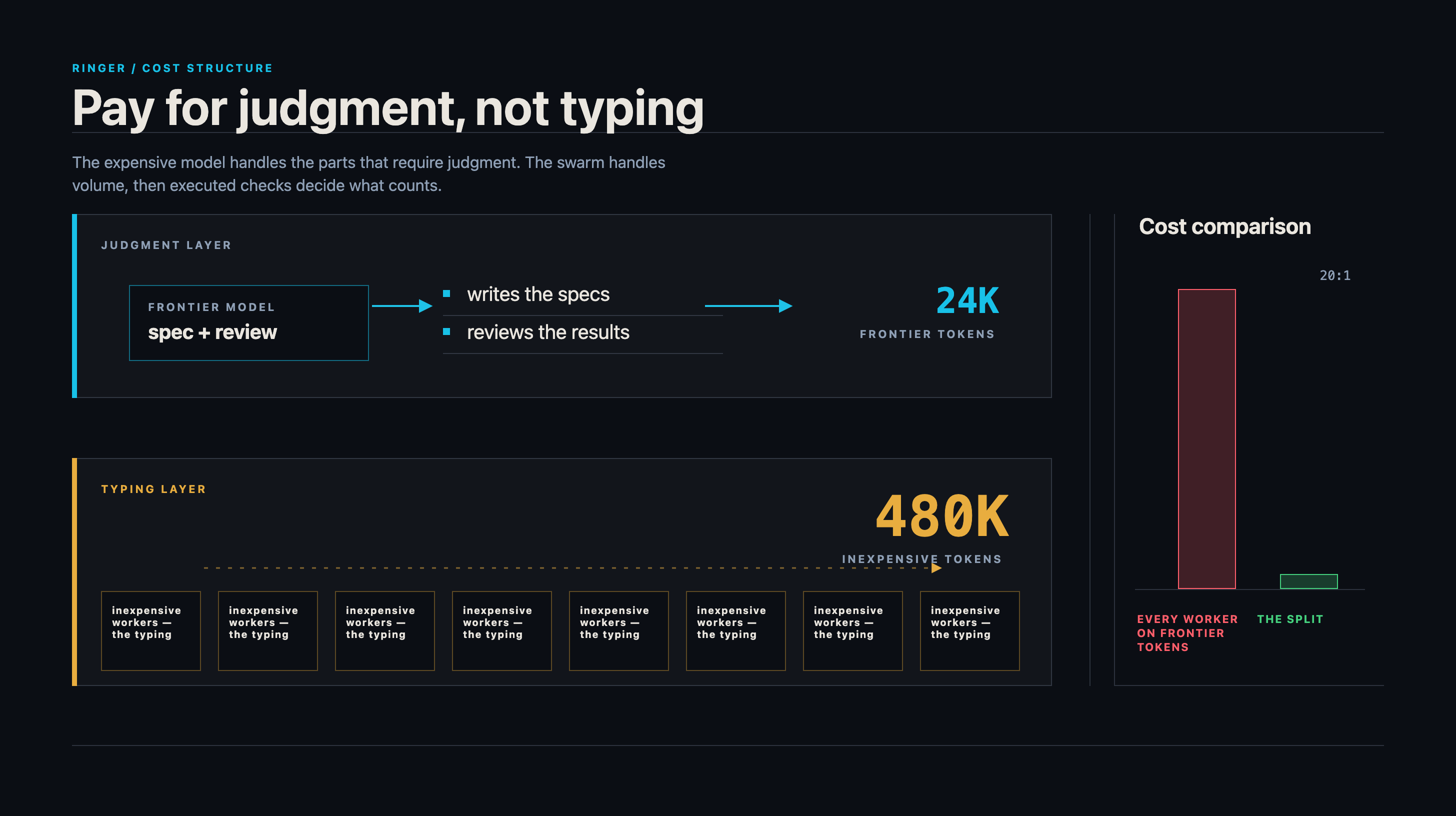
The org chart. Put the frontier model in charge and keep it off the typing. Intelligence is priced in tiers, and the spread is an order of magnitude: run the same eleven-to-thirteen million worker tokens from yesterday’s build through the frontier model alone and the estimate is $90–105, against under eight dollars through the org chart. The deeper reason to structure it this way has nothing to do with the bill. The boss ended the day having spent only 47% of a single context window, all of it on judgment, because the typing never crossed its desk. Frontier attention is the scarcest resource in your whole stack, and firms exist to economize on scarce resources. Staff accordingly: judgment and taste at the top, typing below, and audition your workers with a checkable tryout task before trusting them with anything load-bearing.
The constitution. Don’t prompt a big job task by task. You’ll exhaust yourself restating what “good” means. Write the standard down one time: the ten or fourteen testable criteria that define done-right in your domain, each phrased so a check could verify it, and let every round of work be measured against it automatically. This is also the honest answer to “how do you prompt for large work”: the prompt is a standard plus a way to check it.
The appeals process. When a check fails a worker, sometimes the check is wrong, so build in the post-mortem that can rule for the accused. Without one, your verification layer calcifies into the kind of bureaucracy people learn to game rather than satisfy. Yesterday’s run corrected three of its own checks over the course of the afternoon, and I’d count that as the system working.
If you want the fast path rather than the framework, the guide at the top stands up the same structure, boss and worker lanes and check harness included, and drops you at your first delegated job instead of at the plumbing.
Adopting the books
Last week I wrote that once execution commoditizes, advantage moves to imagination: to the questions you pose that aren’t on anyone’s routing table yet. This is the other half of that argument, the receiving side: imagination determines what you dare to ask for, and institutions determine whether the answer can land without you proofreading every line. Yesterday’s run was both halves working: a job nobody would have put on a task list a month ago, absorbed by a structure that caught a fabrication, a cheat, a management error, and a bad law, all before dinner, for the price of a sandwich.
I keep coming back to that 1935 diagnosis: too much airplane for one man to fly. Everyone I know who has bounced off AI agents bounced for the same reason — twenty agents is too much airplane, the babysitting exceeds the benefit, back to one chat window at a time. They’re right about the diagnosis and wrong about the remedy, in precisely the way 1935 was. The answer was never a better pilot, and it isn’t a better you. It’s the card in the cockpit.
So when the mainstream version of this story arrives (and it’s coming this year), it will say something like “AI built a website for $8,” and that will be true and beside the point, the way “clerk records transaction” was true and beside the point in 1494. The better headline is that hallucination stopped being your problem the same way embezzlement stopped being a reason to avoid hiring clerks. The agents are no more honest than they were in the spring. The books got good.
And these books are public: the run, the checks, the costs, the three-minute setup, all linked above. The sixteenth-century merchants had to invent theirs. You just have to adopt yours.

Related reading
- Every Agent Needs an Owner. The governance half of this argument. Verification tells you what failed, ownership decides who answers for it.
- Your First Personal Agent Delegation Loop. The single-agent starting point, and the honest baseline the Elsa build measured itself against.
- Agents Are Loop Managers. The mental model under the org chart. Once a run is loops inside loops, boss-and-workers stops feeling exotic.
- The Agent Maintenance Loop. For after your swarm ships. How to inspect a running agent’s harness before drift becomes a problem you read about in your own logs.
Receipts and sources:
The full annotated run with every check, catch, and cost line at elsas-website.vercel.app/demo.
The finished site at elsas-website.vercel.app. The original at snarkbat.com.
The orchestration guide at unlock-ai.natebjones.com/guides/ringer.
Cost figures: $2.74 metered worker tokens (actual billed), ~$8 all-in, $90–105 solo-frontier estimate labeled as an estimate. Elsa Sjunneson is quoted and named with her permission.
Preorder Dear Blind Lady (Sasquatch Books, October 2026) wherever you buy books.
I make this Substack thanks to readers like you! Learn about all my Substack tiers here