You’ve been playing too small. How to find, spec, and review the whole jobs a model like this was built to carry.
By Nate
Published: 2026-06-23
URL: https://natesnewsletter.substack.com/p/claude-fable-5-how-to-use
Authors’s Note: The best model in the world is offline, and I’m publishing my review of it anyway.
Fable 5 arrived as the most capable model I’d ever tested, and within days the US government pulled it from production and Anthropic switched it off worldwide. As I write this, nobody can tell you when it returns. I recorded this review before any of that, pulled it when the news hit, and then changed my mind, because going dark about what this model can do felt like the wrong response to losing access to it.
Why it’s worth your time even though you can’t touch it: what Fable showed me isn’t staying with Fable. That big-model feeling is the leading edge of what lands in the next ChatGPT, and in the open-weight models a few months behind it. The capability is coming to tools you can run. What stays scarce is knowing what to ask of it, and you can build that today. One thing I’ll save you first, since my inbox is full of it: no, you can’t reconstruct Fable from a system prompt or a stack of smaller models. I tested the recipes. They don’t hold.
So in the meantime, enjoy the piece, and I can't wait to hear what you get up to once Fable's back online.
A few days into Fable 5, I noticed I’d stopped doing the thing I always do with a new model.
I stopped hovering.
I’d handed it a properly ugly job (a database I keep around that I’ve poisoned on purpose, full of ghost records, corrupt files, and planted traps, the kind of mess that lives in every company’s back office), and instead of sitting there watching it think, I went and did something else. When I came back, the work was done. Not answered. Done. Real files. A clean database with the garbage quarantined instead of “fixed” behind my back. And a review queue it had built for me, unprompted, holding every call it wasn’t sure about — as if it expected to be checked.
That was the moment this stopped being a launch for me and started being a question.
I want to be careful here, because “the new model changes everything” is the most exhausted sentence on the internet, and if you’re done with it, you’ve earned that. The honest part first: if you use Fable 5 the way most of us actually use AI (summaries, rewrites, a quick draft, a code snippet), you will not feel what I felt. You’ll feel a slow, expensive model doing fine work that a cheaper model does faster. The early reviews calling it overkill aren’t wrong. They’re accurately describing the size of the ask.
My through line is this: Fable 5 is the first model that’s bigger than our habits.
For three years, the model was the limit. You learned where it broke, and you asked underneath that line. These last few days, for the first time, I kept running out of line before the model did. The wall I hit wasn’t the model running out of ability. It was me running out of work I knew how to hand over.
That’s not a capability story. That’s a skill story. The skill, which I’ve been calling detailed task imagination, is concrete, learnable, and almost nobody is teaching it, because we’ve spent three years teaching prompts instead.
And the part that actually gives me energy is what comes back. When I talk about this (in my community, in my inbox, in conversations with operators), the response that comes back isn’t fatigue but hunger. People aren’t tired of AI. They’re tired of being told it’s amazing while their actual experience of it stays small. Asking bigger is the first instruction in three years that matches the size of the technology, and people can feel it.
Here’s what’s inside:
- Why AI has felt smaller than the headlines. The ask-size problem, and why your fatigue is evidence, not cynicism.
- What “bigger” means in practice. What changes when a model can carry a whole job, and where Fable 5 still falls down.
- Task imagination, defined and demonstrated. The first-week question, six functions of Fable-grade work, and one job walked all the way through.
- The concrete shift. How to restructure one week of work around jobs instead of prompts, starting this week, including what the first run will get wrong.
- The Whole-Job Spec. The nine fields I fill out before I hand over anything real.
By the end of this you’ll have spotted one on your own desk. Almost everyone I walk through it does. First, why it hasn’t felt true until now.
Subscribers get the full deep-dive and guide, plus membership to my Slack community!
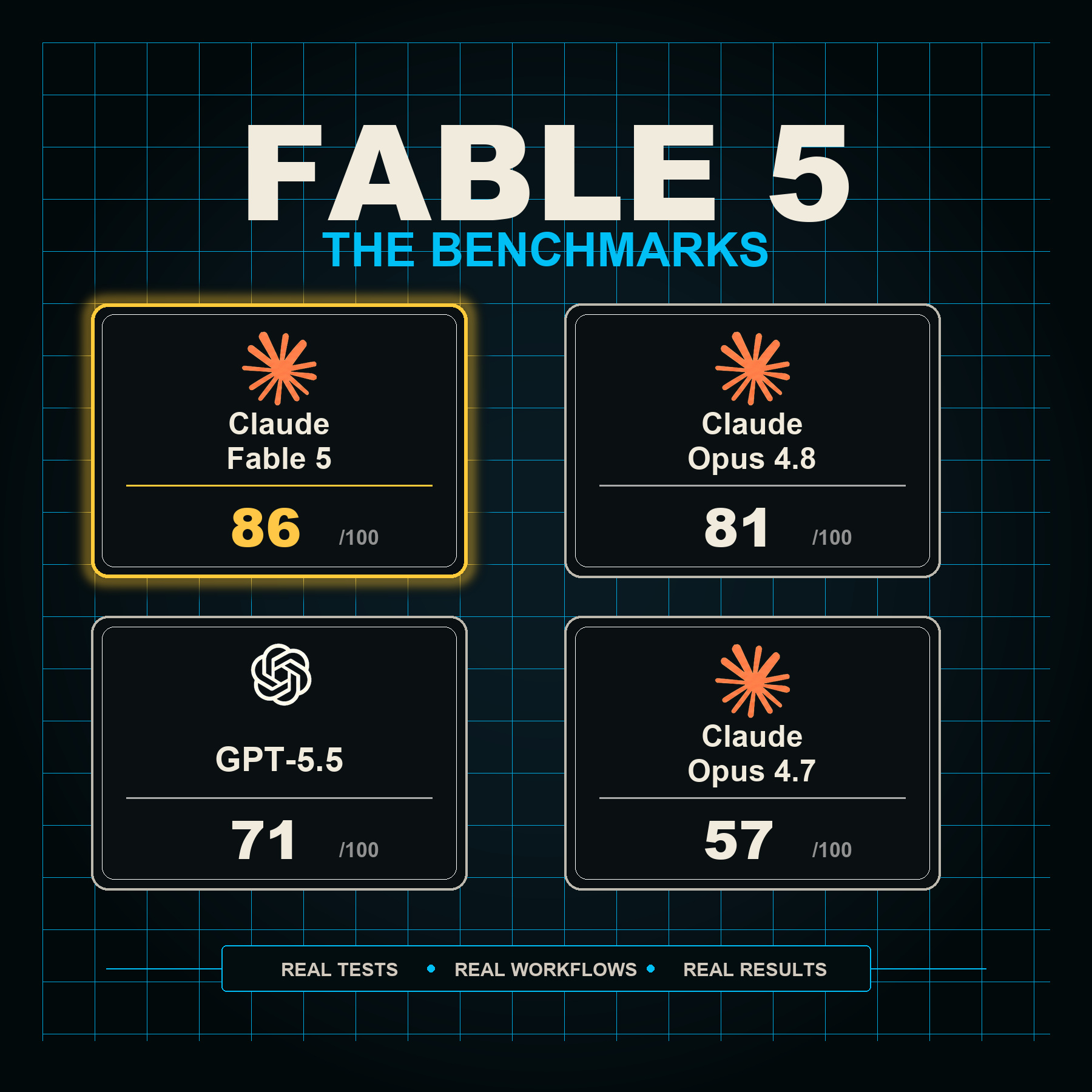
LINK: [Want the benchmarks first?]
Fair. The full per-run scores and methodology live on their own page, public and checkable: see the Fable 5 benchmarks here.
LINK: [Join the Slack →]
The Slack community is live! It’s where I’ll be sharing things between articles, where you can get help on builds in real time, and where the fastest conversations in this community are already happening. I’ll see you in there!
[[LINK: Grab the prompts]](https://promptkit.natebjones.com/20260609g3tpromptkit)
You can’t run Fable this week. You can still build the thing that makes it worth running the day it comes back, and that’s what the prompt kit below is for.
None of these are clever one-line asks, because a clever one-line ask is exactly what this model wastes. Each one produces a reusable artifact. Two retrofit the prompts and instructions you already wrote for smaller models so they stop fighting something this big: one audits an old prompt and rebuilds it as a real whole-job handoff, the other clears the false refusals Fable’s dual-use safety can throw on legitimate security or biology work. The other three build your source pack, the voice spec, the house-style spec, and the data briefing that turn Fable into a drafter that writes in your voice, matches your team’s formatting, and reads your data without guessing.
The audit is the one to run first. Hand it a prompt from last year and it tells you, field by field, which parts of the nine-field spec on this page you still haven’t filled in. That’s the tie between the prompts and the spec. The spec is the briefing you write. The prompts are how you assemble it without starting from a blank page, built once, dropped in your source pack, reused on every job after.
The ask-size problem
Think about how you actually learned to use these models.
In 2023 and 2024, asking big got you burned. You handed a model something real and it lost the thread by step six. It invented a source. It gave you a confident, wrong number that you caught two days later, in front of someone. So you did the rational thing: you found the safe size. Prompt-sized. One question, one draft, one snippet, verify everything, keep it short.
And we didn’t just learn to ask small. We got good at it. We built routines around it. Prompt engineering became a skill, then a job title, then an identity. Every productivity guide of the last three years (including plenty of mine) is, at bottom, instructions for asking small, well.
Look at the machinery we built around the habit. The chunking rituals, slicing a document into pieces because the model couldn’t hold it. Re-pasting context every morning like a liturgy. The incantations, you are an expert analyst, that we half-knew were superstition and kept using anyway, because the cost of a bad output was ours to absorb. I wrote in April that every workaround you build for one model becomes a liability in the next one. This is that thesis at the level of a person instead of a product. Your workarounds were rational. They were also a ledger — and what they recorded, entry by entry, was the size of the asks you’d stopped attempting.
Then the models kept growing, and our asks didn’t.
That’s the thing nobody names. The distance between “AI is amazing” and your actual Tuesday isn’t about hype. The variable is ask size. If your asks are prompt-sized, every frontier model feels roughly the same — because at that size, they are. The launch threads fight about benchmarks, and you feel nothing, and you’re right to feel nothing. You’re watching a freight train and a sports car race in a parking lot.
There’s a subtler cost in here too, and I want to name it because I think a lot of you are carrying it. After enough cycles of this, launch week starts to feel like an accusation: everyone insists the world changed, and your Tuesday declines to confirm it. The rational response is the one you’ve already had — a shrug. I’m not here to scold the shrug. I’m here to take it seriously, because the shrug is data. It’s telling you, accurately, that at the size you’ve been asking, the revolution kept not showing up.
Fable 5 is the model that makes this impossible to keep ignoring, for two reasons. The first is what it can do, which I’ll show you in a second. The second is blunter: at $10 per million tokens in and $50 out, deliberately slow, built to run long, it punishes small asks economically. Anthropic’s own guidance says the quiet part: this model separates on work that used to take people hours, days, or weeks. It is not trying to be your daily driver, but something we don’t have a habit for yet.
What “bigger” feels like
I’ve spent the last few days giving Fable 5 the hardest real work I have, and I want to describe what that was like, because the feeling is the finding.
The poisoned database I mentioned up top is a test I run on every model: ghost records, orphaned orders, typo’d customers, corrupt JSON, duplicate images, and bait credentials sitting in the pile like landmines, because real data lies to you. Models fail this in predictable ways. They promote garbage into the clean tables. They smooth over conflicts. They “fix” things silently and make you spend three hours wondering what else they fixed.
Fable quarantined the garbage. It recovered the corrupt files. It caught the duplicate images, merged the typo’d aliases, found the bait credentials and inventoried them without leaking them anywhere. And then it built that review queue: conflicts, rejects, every merge it wasn’t sure about, surfaced for a human instead of buried. It behaved like a careful contractor who assumes the client will inspect the work.
I gave it a full consulting-style engagement next, a pile, not a prompt: research, financial reconciliation, regulatory mess, twenty-three deliverables that had to exist as real files. It came back with the whole engagement.
I want to slow down on that run for a second, because the part that stuck with me wasn’t the deliverables. It was the assumptions file. Alongside the work, it had kept a running record of the judgment calls it was making (where the source material was ambiguous, what it decided, what it flagged as needing a human ruling) with a source log to match. Reading that file felt less like grading output and more like reviewing a colleague’s working notes. I have graded a lot of model output in three years. I have not often felt that.
Then I gave it builds that had to survive from prompt to parts list to an interactive guide running in a browser, and a sourced 3D visualization of the Artemis II mission whose fact sheet had to hold up next to NASA’s own documents. It shipped all of it. Files, not text about files.
(For the benchmark-minded: across my whole private suite, it’s the first model to clear every test. The per-run numbers and methodology are all public. They’re real, and they’re also not the point.)
The point is the pattern, and the pattern wasn’t brilliance. Sentence by sentence, you could mistake it for last year’s model. The pattern was something closer to discipline: it kept track of the job, it knew what it didn’t know, and it left a trail. Less like a chatbot. More like an operator.
I’m not the only one seeing this. The people with early access keep reaching for the same language, not “smarter,” but whole projects, handed off. Stripe reported it compressed months of engineering into days, a codebase-wide migration across fifty million lines of Ruby, the kind that takes a team more than two months by hand, finished in a day. You don’t call that a chat experience. It’s a different relationship to the work.
If you want the mechanical reason this generation can do what the last one couldn’t, it isn’t one thing, but a stack of boring ones. The model holds focus across very long runs. It keeps its own working notes instead of losing the plot when the context gets tight. It checks its own artifacts instead of declaring victory. And it treats files, not chat messages, as the medium of the work. None of those is a headline. Together, they’re the difference between a brilliant intern with amnesia and a contractor who shows up with a truck.
Now the costs, close to the claims, because this is where trust lives. Fable 5 is slow. It’s expensive. Visual taste is its weak spot: it shipped clipped headings, colliding labels, and charts a designer would wince at. It missed receipts that existed only as handwritten images until I forced the extraction explicitly. Some math didn’t tie out across documents. And every single run ended with review work on my desk.
So “bigger” does not mean finished. It means carryable: the model can carry the whole job now. Judging the work is still yours, and the judging got more important, not less.
Detailed task imagination
The skill starts here, and I’ll confess how I got it wrong on the first pass. When I first wrote down the question that anchors this piece, it came out as: what would you give a very smart person for four hours if they had access to your files?
Four hours.
Three years of habit, shrinking the ask — in the middle of a piece about shrinking the ask. Because this model does not work in four-hour units. Anthropic built it for jobs that take people days and weeks, and says plainly that its lead grows as the work gets longer. Stripe watched it finish a two-month migration in a day. Four hours is a prompt wearing a trench coat.
So the honest version of the question: what would you hand a sharp senior hire for their first week, full access to your files, nothing on their calendar?
Not ask. Give.
Detailed task imagination is the ability to look at your own work and see the whole job an AI could do, if it had the right context, the right tools, the right permissions, and a review standard worth meeting.
I want to distinguish this from delegation, because if you’ve been reading me for a while, you’ve heard the delegation sermon and you don’t need it again. Delegation assumes the task already exists. It’s sitting in a tracker with a name on it, and the question is who does it. I’ve written the kit for that, and it still holds.
Task imagination is upstream of that. The jobs Fable is built for mostly don’t exist as tasks anywhere. They exist as ambient pain: the account list everyone knows is dirty, the four hundred customer reviews nobody has read end to end, the bug backlog that gets triaged by vibes, the board packet that contradicts itself in ways nobody has time to find. Nobody wrote those down as tasks because, until roughly now, nobody was ever going to do them. They weren’t tasks. They were weather.
Seeing that work, seeing weather as a job with a finish line, is the skill. In practice, it means walking through your week with seven questions:
- What finished artifact should exist that doesn’t?
- What messy source material would a human need to make it?
- What tools would they open?
- What judgment calls would they make along the way?
- What should they leave untouched?
- What would convince me the job was actually done?
- What evidence should they leave behind?
Notice that none of these are prompting questions. They’re the questions you’d answer before bringing in any capable help. The difference is that the help now exists, runs for hours, and knows nothing about your context unless you package it. The bottleneck moved again. And this time it moved into your own perception of your work.
What Fable-grade work looks like
Concrete beats abstract, so look at the shape of the job across six functions. Every one of these comes out of real conversations with operators, not a whiteboard.
Marketing. Hundreds of reviews, the Reddit threads, the sales-call transcripts, your ad history, your landing pages — in. Persona-specific angle banks, objections mapped by awareness level, creative briefs with the source quotes attached, and proposed tests ranked by learning value — out.
Sales / CRM. The account list everyone’s embarrassed by. Duplicates merged, stale opportunities flagged, account briefs built, next-best-action drafted, and a review queue for every merge it wasn’t sure about, instead of a guess.
Operations. The messy migration. Statuses and enums normalized, test records detected and quarantined, an audit log, and a reviewer surface a human can actually clear. This is my poisoned database, wearing your company’s data.
Product / Engineering. The backlog triaged by vibes. What’s reproducible, reproduced. Root causes mapped. Small PRs shipped where safe. A test log and an unresolved-risk list handed back, the artifact being judgment, not just diffs.
Research / Education. The papers, the notes, the transcripts, the policy docs. A literature map, drafted reviewer responses, a curriculum sequence, every claim separated by source confidence.
Leadership. The board packet, the meeting notes, the KPIs, the open issues. A decision memo: the contradictions found, the options framed, and the questions you should ask before approving anything.
Every one of these has the same skeleton: a pile of real source material, a finished artifact at the end, judgment calls in the middle, a review trail. Once you can see that skeleton, you start seeing it everywhere, and your sense of what’s askable changes for good.
Walking one job through the questions
Lists are cheap, so let me take one job all the way through the seven questions, and you can watch the skill in motion. Take the four hundred reviews.
What finished artifact should exist? Not “insights.” An angle bank: every persuasive angle living in your voice-of-customer, organized by persona, each angle carrying the verbatim quotes that earned it, plus creative briefs for the top five and a ranked list of tests by what you’d learn from each. That’s a thing. You could put it in a drive and point at it in a meeting.
What would a human need to do this well? The reviews, obviously. But a person doing this properly would also pull the Reddit threads, the last six months of call transcripts, the ad account history, and the current landing pages, because angles only mean something against what you’re already running. That’s the source pack. Notice it took thirty seconds to name and would take you an afternoon to assemble. The afternoon is the job’s real cost, and it’s worth it.
What tools would they open? Read access to the folder. A spreadsheet to build in. Nothing that touches the ad account itself.
What judgment calls come up? Which complaints are signal versus noise. When two personas blur into one. Whether a quote is representative or just loud. Write those down, not to answer them in advance, but so the model knows the calls exist and treats them as calls.
What should it leave untouched? The live campaigns. Anything customer-facing. This is analysis, not action.
What would convince me it’s done? Every angle traceable to at least three quotes from distinct customers. Objections mapped to awareness stages. Zero invented quotes, spot-checkable against the source files, and I will spot-check.
What evidence should it leave behind? The trail: which files it read, which it weighted, what it set aside and why.
That’s maybe ten minutes of thinking. And what those ten minutes buy: the difference between “summarize these reviews” (a prompt that produces a forgettable page) and a job that comes back as an artifact your team argues about in the good way. Same model. Same data. The variable was the imagination.
The concrete shift: one real job this week
This is how I’d change your week. Not fifty prompts a day. One real job, done properly. You can’t run Fable this week, so treat what follows as the spec you’ll have ready the day it’s back.
First, twenty minutes: list the weather. Write down three pieces of work everyone on your team knows about and nobody owns. The dirty list. The unread pile. The thing that gets triaged by vibes. If it makes you sigh, it qualifies.
Pick one. The test: a real pile of source material, a nameable artifact at the end, judgment calls in the middle, and enough value to justify a long, expensive run. If it fits in a prompt, it’s the wrong pick.
Build the source pack: an hour, maybe ninety minutes. Assemble the folder you’d hand a new hire: the exports, the transcripts, the policies, the prior decisions, two examples of what good looks like. This is the step that feels like overhead and is actually the work. The model never had a chance to learn your context. The source pack is how it borrows yours. (Tool access is the other half of this.)
Write down “done” before you start. One paragraph. What exists at the end, what must be true about it, what it must never contain.
Hand it over and let it run. Don’t hover. The discomfort you feel walking away is three years of trained habit, and it’s the habit that’s out of date — not your judgment.
Review like an owner, not a grader. Check the trail. Clear the queue. Decide what ships. This is where your value concentrated. Spend it there.
Route everything else cheap. Summaries, extraction, formatting, first drafts: cheaper, faster models, every time. Fable money goes to Fable problems.
And expect the first run to come back about seventy percent right. I want to set that expectation explicitly, because this is where most people will bounce. The first job you hand over will return with real flaws (a section that missed your intent, a judgment call you’d have made differently) and the trained reflex will be to conclude “overkill confirmed” and retreat to prompts. Don’t. Read the run as a diagnostic of your spec. Every flaw maps back to a field. It missed your intent because “done” was vague. It made the wrong call because the boundary wasn’t written down. It went shallow because the pack was thin. Tighten the spec and run it again. The second run is where people get converted, and unlike a prompt, a tightened spec is reusable forever.
While we’re being honest, do the money math too, because the sticker scares people. Yes, $50 per million output tokens is real money. A heavy run that produces a few hundred thousand tokens of finished artifacts costs you something like ten or twenty dollars. Run it for days on something enormous and you’ll spend real money, and the comparison only gets stronger, because what’s on the other side of the ledger is a two-month project. Hold the cost against the job itself: four hundred reviews nobody was ever going to read. A CRM nobody was ever going to clean. The run isn’t competing with a cheaper model. It’s competing with the work not existing at all.
That’s the shift. One job a week is enough, because the list of jobs gets longer the better you get at seeing them, and because each finished job retrains your sense of scale faster than any article can, including this one.
The Whole-Job Spec
This is the artifact, and I want to set it up the right way, because it can read as paperwork and it isn’t. Treat it like the workbench you’d set up for a capable person on their first day: everything within reach, the boundaries marked, a clear picture of what done looks like.
1. The outcome. What should exist at the end? A cleaned database, a PR, a deck, an account plan, a curriculum, an audit log, a decision memo. Name the artifact. If you can’t, the job isn’t ready.
2. The source pack. What would a skilled human need? Files, exports, transcripts, screenshots, repos, reviews, policies, prior decisions, examples of good. The runs live and die here.
3. The tool access. What can it read? What can it edit? What can it run? What can it only draft? Which systems are off-limits entirely?
4. The boundaries. What should it never touch? What requires approval mid-run? Which claims need citations? Which changes can never happen automatically?
5. The work plan. What should it inspect first, produce first, and verify before moving on, the order of operations a careful person would follow.
6. The cost route. What can cheaper models do first? Extraction, dedupe, clustering, first passes: cheap, every time. Reserve Fable for synthesis, judgment, repair, and the long run.
7. The review standard. What does good mean, in writing? Accuracy, completeness, traceable sources, tests passing, no unsupported public claims. Fable rises to an explicit bar and wanders without one.
8. The proof trail. What changed, what sources were used, what ran, what failed, what was skipped, what’s still uncertain. Work that can’t show receipts isn’t done — it’s plausible. Those are different things.
9. The human gate. Who says yes before anything is sent, posted, deployed, billed, merged, or written back? Decide who that is before the run starts, not after the output looks good.
You’ll notice this is also just a good description of how to brief a person. That’s the point. The model finally deserves the briefing.
Where I wouldn’t use it
The other side, plainly, because trust requires it. I would not use Fable 5 for casual summaries, short rewrites, shallow brainstorming, cheap extraction, formatting, or one-off emails. Not when speed matters more than judgment. Not when the source material doesn’t exist yet. It cannot imagine your context for you. And not on any job whose output I’m unwilling or unable to review, because every run I’ve done says the review job remains.
Short version: if the task fits comfortably in a prompt, Fable is probably not the point.
If you’re bringing this to a team
A short word for the people whose next thought was “how do I get my team to see this,” because I know from my inbox that’s a lot of you.
Don’t send the memo. Memos about AI capability have the same problem as launch coverage: they’re claims, and your team is as tired of claims as you are. Run one job instead. Pick a piece of shared weather (the messy dataset everyone complains about works beautifully, because everyone already knows the “before”), spec it properly, run it, and then show three things: the finished artifact, the proof trail, and the review queue.
The queue is what converts skeptics, in my experience, because it’s the opposite of what they expect from AI. They expect confident slop. A machine that shows its uncertainty and asks for a ruling reads as trustworthy in a way no demo of brilliance ever does.
Then make one rule explicit before anyone scales anything: drafting rights are open, acceptance rights are named. Anyone can spec a job and run it. A specific human owns whether the output ships, and the owner’s name is written down before the run, not negotiated after. That single sentence prevents most of the ways this goes wrong inside a company.
The honest part
I’m not going to soften this section, because the soft version wastes your time.
If your work is only isolated execution (take the ticket, do the thing, hand it back), a model like this is bad news, because doing things is exactly what it’s good at, and pretending otherwise protects nobody.
I made this case in a video on the layoffs panic a while back: that whole story is really four narratives in a trench coat, and almost none of them are about what these models can actually do at work. This is the slice that’s real.
But very little valuable work is only execution. The valuable parts were always deciding what matters, gathering the context, making the tradeoffs, checking the result, and owning the consequences. What this model does is make that split visible, suddenly, and in places where it was comfortable to ignore.
The version I keep coming back to: stronger models widen who can draft. They should not automatically widen who can approve. A marketer can now take a credible first pass at a segmentation model. Finance still owns the assumptions. A PM can draft a technical design. Engineering still owns whether it ships. The upside is real, and so is the line. And the people who win in this generation are the ones who carry work up to that line with the proof trail that lets the owner say yes quickly. (What that does to organizations is its own piece, and it’s coming.)
And if you’re the specialist in that picture (the finance owner, the staff engineer, the person whose sign-off everyone needs), your move isn’t to guard the blank page. The blank page is gone. Your move is upstream: into the acceptance criteria, the examples of good, the review standards that every spec in your org borrows from. The specialists who thrive here are the ones whose definition of “done” gets encoded into everyone else’s whole-job specs. That’s not a demotion. It’s distribution.
The people I know who work with these models all day aren’t working themselves out of a job. They’re working themselves into a new one, because a model this capable takes that much direction, context, and review to run well.
And here’s what I keep hearing from people who actually make this shift, not in theory, in practice. Relief. Real excitement. Because the doing got cheap and the deciding didn’t, and most people, given the choice, would rather spend their day deciding. Fable 5 is a mirror: it shows how much of our work we still think of as doing, when the durable skill is deciding what’s worth doing and what finished looks like.
The question that’s actually on your desk
The question this launch puts in front of you is not “is Fable 5 the best model.” It probably is, this month, and next month it may not be, and that question will never stop being boring.
The question is the one I haven’t been able to shake since the week it launched: what work of mine has been sitting there as weather, known, painful, and unasked, because no one was ever going to do it?
You have an answer. Everyone I’ve asked has an answer within thirty seconds, and it’s usually accompanied by a particular facial expression.
Fable 5 is not asking us to become prompt engineers again. It’s asking us to get better at seeing the shape of our work. So bring it a job. A real one. Build the pack, write down done, hand it over — and somewhere in the middle of it, you’ll notice you’ve stopped hovering. That’s the moment the question changes for good: not what can this model do, but what else have I been walking past.
Coming up
Two more this week, both on agents, both about staying in control of them.
Tomorrow, a deep dive on agents as loop managers, and why the real skill is running the loop rather than firing off one-shot tasks.
Friday, the build, Open Orchestrator, a loop layer that coordinates a fleet of agents instead of babysitting them one at a time.
Related reading on my Substack:
I make this Substack thanks to readers like you! Learn about all my Substack tiers here