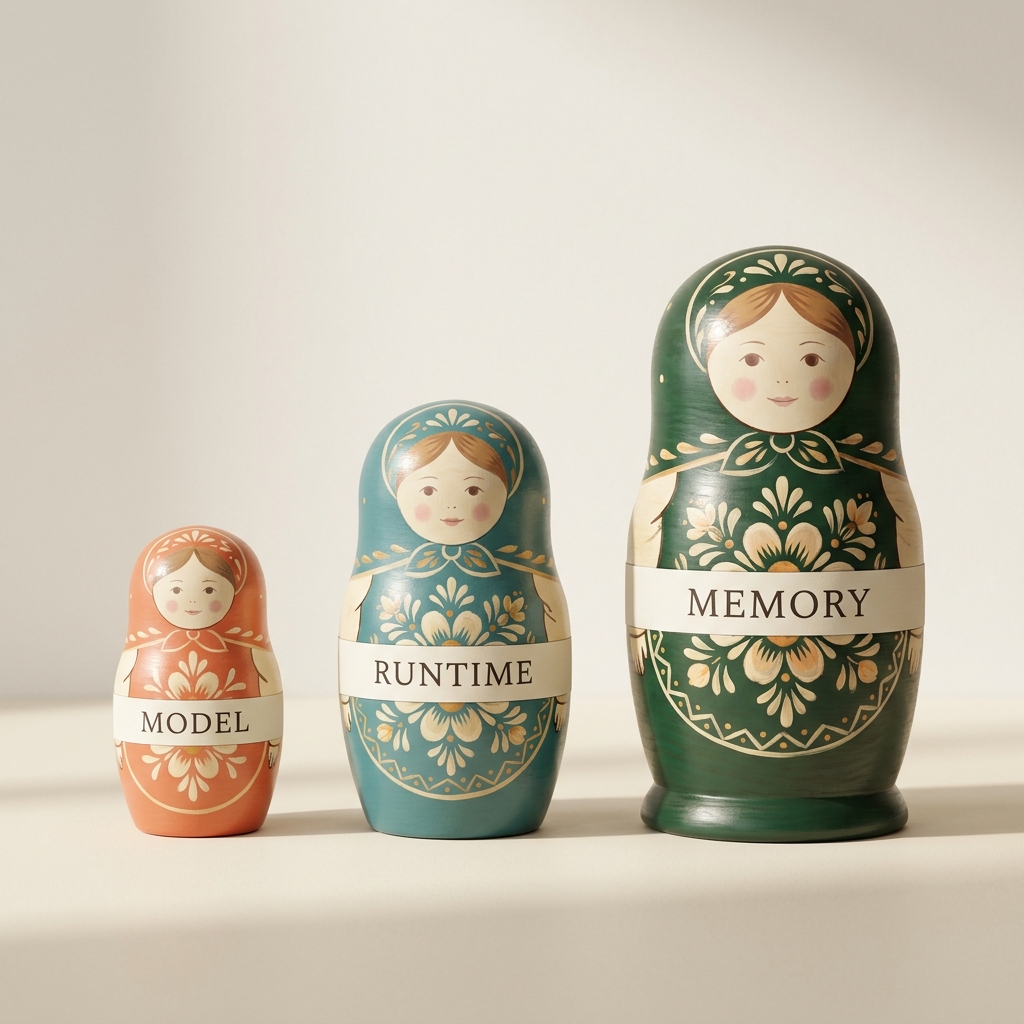
Anthropic restricted, OpenAI opened, Google shipped Gemma 4, and OpenClaw stopped being model-dependent. Things are getting spicy!
By Nate
Published: 2026-05-07
URL: https://natesnewsletter.substack.com/p/openclaw-agent-runtime-model-swapping
In April, OpenClaw stopped being an agent harness and started being a runtime.
A month ago, the easy descriptions still fit. Chatbot wrapper, Claude launcher, viral terminal toy. By the end of April, none of them held. OpenClaw became an action layer for agents — a place where tasks, tools, memory, channels, permissions, subagents, and model choices come together into durable workflows. The model is no longer the product. The runtime is.
That shift matters because the model layer underneath it became more contested at exactly the same time. Anthropic pulled subscription-backed third-party usage back toward its own products. OpenAI moved the other way, opening ChatGPT and Codex subscription usage to OpenClaw users. Google shipped Gemma 4, built explicitly for agentic and on-device work. Local models got good enough for more background tasks. Claude is still valuable, but increasingly as a metered premium component rather than the default flat-rate engine for everything.
The mistake is to let the runtime fight swallow the product story.
A month ago, the builder ambition was to make an agent do something useful. Now it is to build a durable workflow once and swap the model underneath it. That is a much bigger idea, and it changes the builder opportunity completely.
Here’s what’s inside:
- Why April was the threshold month. TaskFlows, channels, memory, and routing all matured at once, and the combination is what crossed the runtime line.
- The Anthropic move, in context. What changed, why it was rational, why the developer community reacted the way it did, and what it tells you about the next twelve months.
- The seven workflows you can now actually build. Repo operations, code review memory, incident response, customer feedback, meetings to execution, model-aware routing, and team memory across agents.
- Why memory has to live outside the model. If the brain is swappable, memory cannot live inside any one brain — and that has implications for how you architect anything you build on top of OpenClaw.
- The Open Brain Agent Memory launch. A live ClawHub skill, a plugin package, and four recipes — code review memory, TaskFlow work logs, the OpenClaw Agent Memory recipe, and a Safe Agent Memory contract that draws the line between evidence and instruction.
The labs will keep fighting over the brain. The interesting question is what builders should do while they fight.
Subscribers get all posts like these!
LINK: Grab the OB1 Agent Memory Plugin
The OB1 Agent Memory plugin is live on ClawHub as @natebjones/ob1-agent-memory, with a companion skill (nbj-ob1-agent-memory-openclaw) that carries the behavior rules — no transcript dumping, no storing model reasoning traces, no quietly promoting generated lessons into hidden instructions. Four recipes ship with it: the OpenClaw Agent Memory recipe, Code Review Memory, TaskFlow Work Log, and a standalone Safe Agent Memory and Provenance guide. The thing that earns these their place is not the install command. It is the trust contract underneath. Agent-written memory starts as evidence. Instruction-grade memory requires human confirmation or trusted import. That distinction is the difference between a memory layer that compounds value and one that compounds confident-sounding hallucination across providers.
If you have ever watched an agent quietly absorb its own bad output and start treating it as ground truth, you know why this rule had to be drawn explicitly.
Why April was the AI agent runtime threshold
A chatbot is a place where you ask for help. An agent runtime is a place where work happens. Work has state, tools, permissions, failure modes, handoffs, and retries. Work has context that needs to survive more than one prompt. Work has a memory of what already happened. Work has a user who needs to understand what the agent did, where it got stuck, and what should happen next.
For a long time, the agent conversation was dominated by the illusion that the model was the product. Use the best model, give it a few tools, and wait for the future to arrive. OpenClaw’s recent evolution points in a different direction. The model matters enormously, but the product is the loop around the model. The product is the runtime that lets the model act, recover, remember, delegate, and deliver.
April changed the priors because of this shift.
OpenClaw’s TaskFlows and /tasks are not just nice quality-of-life improvements. They move the product toward durable work. A task that can be inspected, resumed, routed, and recovered is different from a chat response. A workflow that can be triggered by a webhook is different from a user manually typing “please do this” every time. A subagent that can inherit or isolate context is different from a single long-running chat thread slowly drowning in its own transcript.
This is what product maturity looks like in an agent system. It does not always announce itself as one giant feature. It arrives as boring-sounding surfaces: queues, histories, checkpoints, visible replies, scoped memory, better channel delivery, startup diagnostics, provider manifests, permission profiles, retry behavior, and tool boundaries. But those are the things that make the difference between an impressive demo and a system you can build on.
OpenClaw’s memory work is part of the same pattern. Memory wiki, Active Memory, provenance views, people-aware memory, partial recall, and per-conversation filters all point toward a more serious view of context. Early agents treated memory as a novelty. “The bot remembers things about you” was enough to get attention. But serious work requires a more disciplined memory model. What did the system observe? What did the user confirm? What did the model infer? What is stale? What is scoped to one project? What should be retrieved at the start of a task? What should never be injected blindly?
Those questions are not peripheral. They are the difference between useful continuity and accumulated hallucinated sludge. Bad memory makes an agent confidently wrong in ways that feel personalized, which is the worst kind of wrong. Good memory architecture lets it operate continuously without becoming unaccountable.
The same thing is happening with channels. OpenClaw’s channel support is not just about being available in Slack, Telegram, Discord, WhatsApp, Teams, Matrix, Feishu, or wherever else people already work. The channel is part of the runtime. Different channels have different delivery constraints, formatting rules, mention behavior, threading semantics, file limits, bot permissions, and social expectations. An agent that silently completes without a visible reply in one channel is broken in a different way than an agent that posts the wrong thing in another channel. Mature channel behavior is not glamour. It is product surface.
Then there is code review.
This is one of the clearest “I can do that now” moments for builders. Imagine a repo operations claw. It watches GitHub issues and pull requests. It triages incoming work. It summarizes diffs. It applies project conventions. It drafts review comments. It escalates risky changes. It stores recurring mistakes. It learns that this repo has a specific migration pattern, a specific testing convention, a specific source of flaky failures, and a specific maintainer preference around API compatibility. Over time, the agent becomes less like a generic reviewer and more like a persistent teammate who remembers the codebase.
That workflow does not require one model to do everything.
A local Gemma 4 model can handle cheap classification, summarization, duplicate detection, and routine triage. GPT-5.5 through Codex can handle harder implementation and deeper review. Claude API can be reserved for architecture judgment, high-stakes writing, or cases where its style and reasoning are worth the metered cost. Another model can handle embeddings or search. The important thing is that the workflow itself survives the routing decision.
The shift moves from “which model is best?” to “which model should handle this step?”
It is also where the runtime fight becomes important.
Why Anthropic restricted subscription agents
Anthropic’s April move made the economics explicit. Claude subscriptions were not designed to power always-on third-party agents at scale. The core of the Anthropic position is not hard to understand. Agents are not normal chat users. They run for longer. They retry. They call tools. They carry more context. They can sit in loops. They can produce many intermediate steps that a human never sees. They can turn a flat-rate consumer subscription into infrastructure for a derivative product.
From Anthropic’s point of view, that is a bad bargain. If Claude is being used as infrastructure, it should be paid for as infrastructure. Use the API. Buy extra usage. Stay inside official products. Protect capacity. Protect margins. Protect the user experience for direct Claude customers.
A rational, strategic choice and worth situating in context: Anthropic is making this call from inside a compute crunch driven by its own hypergrowth. Tough decisions are happening across the board, and this is one of them. The move was unpopular with the developer community in a way that is not worth softening. It was probably also correct from the inside.
Anthropic is effectively saying: Claude is powerful enough to be an agent brain, but the company wants to control the terms under which that brain is used. That does not make Claude less useful. It does change the default architecture for OpenClaw builders. Claude becomes a premium metered component, not the cheap always-on substrate for every background loop.
OpenAI is taking a very different posture.
OpenAI’s Codex plan documentation makes Codex part of ChatGPT subscription plans, and Sam Altman’s public posture around OpenClaw points in the opposite direction from Anthropic’s. Instead of treating OpenClaw as leakage, OpenAI can treat it as distribution. That is easier because Peter Steinberger now works there. It is also easier because Codex is already an agentic product. If OpenClaw users route more of their work through ChatGPT and Codex, that reinforces OpenAI’s broader agent strategy.
This is the power dynamic people are reacting to. Anthropic had the model that many early OpenClaw users preferred. But OpenAI now has the creator, the subscription path, Codex, and a strong incentive to make open agent workflows feel natural on OpenAI infrastructure.
Still, the healthiest version of this story is not “OpenAI wins and Anthropic loses.”
The healthier version is that the world is better if there are many ways to run your claw.
The principle worth defending: OpenClaw should not be dependent on one provider’s subscription policy. It should not be structurally tied to one lab’s product strategy. It should be able to run on GPT-5.5, Claude API, Gemini, DeepSeek, OpenRouter, Ollama, LM Studio, Gemma 4, or whatever comes next. The point of the claw abstraction is that the action layer can stay stable while the brain changes.
Gemma 4 brings AI agents to local hardware
This is why Gemma 4 is such an important part of the story.
Google’s Gemma 4 launch is not just another model release. Google described Gemma 4 as purpose-built for advanced reasoning and agentic workflows, available in multiple sizes, and released under Apache 2.0. The Google Developers post frames it even more directly: Gemma 4 is meant to bring agentic skills to the edge, including multi-step planning, autonomous action, offline code generation, and multimodal processing on-device.
That matters because it gives builders a credible open/local branch of the runtime tree.
The E4B-class model is especially important symbolically. It says the future of agentic workflows is not only giant frontier models behind paid APIs. Some parts of the work can run close to the user, close to the data, and close to the device. Not every agent step deserves frontier-model pricing, and not every classification or summarization task needs to go to the cloud. A workflow should not break because a provider changes its subscription terms.
A builder can now think about an agent stack with a more nuanced cost and trust model.
Use local Gemma for low-stakes always-on background work. Use a stronger open model for private long-context analysis. Use GPT-5.5/Codex for hard code work and high-leverage implementation. Use Claude API where its judgment or style is worth paying for. Use cheaper hosted models for bulk summarization. Use specialized models where they fit. Keep the claw stable. Route the brain.
This is the “aha, I can do that now” moment: you can build a workflow once and stop treating model choice as a permanent architectural decision.
Durable workflows change the AI builder opportunity
The practical thing this unlocks is not simply “you can use a different model.” That is interesting, but on its own it is still a model-selection story. The bigger shift is that builders can start designing workflows that outlive any one model, subscription plan, provider policy, context window, or chat session.
A durable workflow.
A durable workflow has a job to do, a place to run, memory of what happened before, and enough structure that the underlying model can change without destroying the workflow. The model is still important. Sometimes it is the most important component. But it is no longer the entire product surface. The workflow has its own identity. It has inputs, outputs, permissions, tools, state, review steps, fallbacks, and a memory layer. The model becomes the reasoning engine inside a larger operating loop.
This is the real builder update. A month ago, most of the OpenClaw community still treated it as a clever agent client: a powerful way to point a frontier model at files, code, chats, tools, and tasks. That was already useful. But it still made the model feel like the center of gravity. If Claude worked beautifully through Claw, Claw felt like a Claude surface. If GPT worked beautifully through Claw, it felt like an OpenAI surface. If a local model got good enough to run part of the loop, it felt like an interesting optimization.
Now the center of gravity is moving up a layer. The durable thing is the claw.
The first obvious workflow is repo operations. Not “an agent that can code,” in the abstract, but a standing repo operator that understands a codebase over time. It can triage new issues, compare them against past fixes, remember which files are risky, know which tests usually catch regressions, and summarize the likely blast radius before touching anything. A smaller or local model can classify issues, identify duplicates, gather context, and summarize changed files. A stronger coding model can make the patch. A review model can inspect the diff. Another model can write the changelog, update the task, or prepare a PR note. The important point is that the repo workflow does not have to be rebuilt every time the preferred model changes. The workflow is durable; the brain inside it is replaceable.
That matters because repo work is full of accumulated judgment. The useful knowledge is not only in the current prompt. It is in the history of architectural decisions, review comments, recurring bugs, deployment failures, style preferences, and “we tried this before and it broke staging” lessons. If that memory lives only inside one chat transcript or one provider’s product, the workflow is brittle. If it lives outside the model, then OpenClaw can call whichever model is appropriate and still behave like the same operator.
The second workflow is code review memory. This is where the new auto-review surface becomes much more interesting. Auto-review is useful as a single pass over a diff, but the real unlock is when review becomes cumulative. The system should not merely say, “This function may fail on null input.” It should remember that this repo has a pattern of missing tenant scoping in database queries, that migrations have broken preview deployments twice, that the auth layer has subtle role inheritance rules, that the team prefers integration tests around billing changes, and that generated code often forgets a specific logging convention.
That turns review from a stateless linting pass into an institutional memory loop. Every review can create memory. Every memory can improve the next review. A local model might do the first sweep for obvious problems. GPT-5.5 or a stronger review model might handle the high-judgment pass. A different model might produce the human-readable review summary. The workflow remains the same: inspect, compare to repo memory, identify risks, propose fixes, preserve the lesson. Once you see review this way, the product surface feels much more mature. OpenClaw is not just helping you write code. It is becoming a place where software organizations can accumulate operational knowledge.
The third workflow is incident response. This is one of the clearest “I can do that now” examples because incidents already involve too many surfaces: logs, dashboards, Slack, GitHub, runbooks, deployment history, customer reports, previous postmortems, and human coordination. A durable Claw workflow can sit across those surfaces. When an incident begins, it can gather context, identify recent changes, compare symptoms against prior incidents, draft the first internal status update, keep a running timeline, suggest rollback candidates, and then turn the resolution into a postmortem draft.
Again, the runtime abstraction is the point. During the incident, you may want the fastest available model for summarizing logs, the strongest reasoning model for root-cause analysis, and a cheaper model for formatting updates. You may want to fall back if one provider is slow or unavailable. You may want local inference for sensitive logs. But the incident workflow should not care, at the product level, which model performed each step. The company wants a reliable incident operator. OpenClaw makes that operator portable across brains.
The fourth workflow is customer and product feedback. This is less flashy than code generation, but it may be more important for many companies. Imagine a Claw that reads support tickets, sales calls, Slack threads, GitHub issues, and product analytics summaries. Its job is not to “chat about customers.” Its job is to maintain a living map of user pain: repeated complaints, feature requests, objections, churn signals, workflow gaps, and language customers use to describe the problem.
That workflow becomes durable when it has memory and routing. A small model can classify incoming feedback. A stronger model can synthesize the weekly product brief. Another model can match new feedback against existing roadmap items. A meeting-aware agent can prepare the PM before a planning session. A repo-aware agent can connect a customer complaint to a real area of the codebase. The workflow persists even as models rotate. The company is no longer asking, “Which chatbot should I paste support tickets into?” It is building a product feedback nervous system.
The fifth workflow is meetings to execution. OpenClaw’s maturation around meetings, tasks, subagents, and memory points toward something more concrete than “AI meeting notes.” The useful workflow is: attend or ingest the meeting, identify decisions, turn decisions into tasks, attach context to the right project, follow up with owners, and recall the decision weeks later when someone starts implementing. That requires continuity. The value is not the transcript summary. The value is that the decision survives the meeting.
This is where the product surface and runtime politics connect. If the meeting summary lives inside one model’s chat history, it is fragile. If the task lives in OpenClaw and the memory lives in an owned layer, the workflow can continue. One model can summarize the meeting. Another can extract action items. Another can help implement them. Another can review the implementation against the original decision. The organization gets a single durable loop from conversation to shipped work.
The sixth workflow is model-aware routing itself. Once Claw becomes swappable, builders can create workflows that treat models as capabilities, not identities. Use a local Gemma-class model for private, low-latency, low-cost tasks: classification, summarization, first-pass retrieval, repeated formatting, and offline work. Use frontier models for deep reasoning, hard code changes, architecture, and ambiguous tradeoffs. Use specialized models for review, voice, image, or data extraction. The workflow can choose based on cost, latency, privacy, confidence, or provider availability.
A very different product primitive from “choose your model in a dropdown.” A dropdown is user preference. Routing is infrastructure. The builder says: this part of the workflow is cheap and repetitive; this part is sensitive; this part needs the best available reasoning; this part can happen later; this part requires human approval. OpenClaw gives that routing a surface. The maturing product makes it feel operational instead of theoretical.
The seventh workflow is personal or team memory across agents. This is where Open Brain naturally comes in, but it should arrive as the consequence of the argument, not as the lead. If the workflow is durable and the brain is swappable, then memory cannot live inside any one brain. It needs to live somewhere the user owns. Otherwise the whole abstraction collapses. You can swap the model, but you lose the accumulated context that made the workflow useful.
The reason to release the Open Brain recipe now is not that Open Brain suddenly needs a new core feature, or that OpenClaw users were incapable of wiring memory themselves. Some already are. The reason is that the market has clarified the pattern. OpenClaw is becoming the swappable runtime for agent work. Open Brain is a natural place for durable memory to live outside the model. The recipe simply makes the pattern explicit: here is how to capture what happened, retrieve what matters, preserve provenance, and make the next Claw run smarter than the last one.
So the tangible builder moment is this: you can now build a repo operator, review loop, incident assistant, product feedback system, meeting-to-execution workflow, or model-routing layer without betting the whole product on one model provider’s product policy. That does not mean providers stop mattering. They matter enormously. The quality of the brain changes what the claw can do. But the workflow can finally be designed as something more durable than the brain currently inside it.
OpenClaw is making agent workflows portable. And once workflows are portable, the scarce asset shifts from access to a model to ownership of the memory, tools, and operating loops around it.
This is a deeper shift than model switching in a dropdown. Dropdown model switching is convenient. Runtime-level swappability is strategic. It means you can design the work loop independently from the current provider landscape. It means you can respond when Anthropic changes policy, OpenAI changes pricing, Google ships a new open model, or a local model becomes good enough for a category of work. It means your agent product is not just a thin wrapper around the model of the month.
The strongest builder pattern now looks something like this:
OpenClaw is the action/runtime layer. The model is a swappable brain. TaskFlow is the durable work loop. The channel is where the human interacts. Memory is the continuity layer. Permissions and provenance are the trust layer.
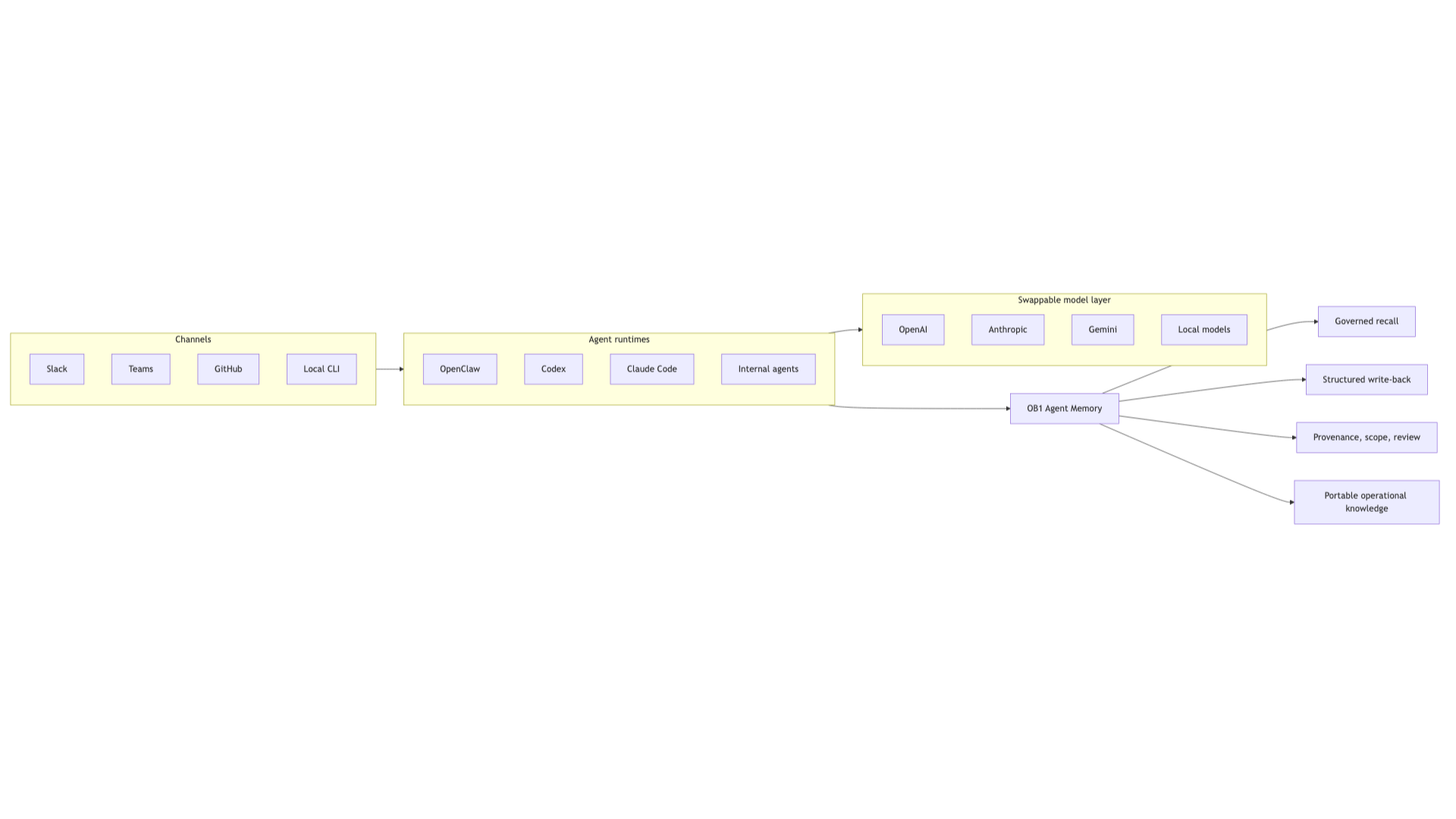
\Once the model becomes swappable, memory has to move above the model layer.\
Why AI agent memory has to live outside the model
Once you see the stack this way, the next question becomes obvious: where should memory live?
If the model can change, memory should not live inside the model provider. If the agent can move across Slack, Telegram, Discord, GitHub, and a browser, memory should not live inside one channel. If one task uses GPT-5.5 and another uses Gemma 4 and another uses Claude API, durable context should not be trapped inside any one of them.
This is where Open Brain becomes relevant.
Open Brain’s premise is that your AI context should be user-owned and portable: one database, one AI gateway, one chat channel, and any AI can plug in. That idea already made sense in a world of multiple chatbots. It makes even more sense in a world of swappable agent runtimes.
When agents were mostly chat companions, shared memory was useful. When agents become workers, shared memory becomes infrastructure.
A worker needs to know what happened before. It needs to know the project conventions. It needs to know the people involved. It needs to know the decisions that have already been made. It needs to know which facts are user-confirmed and which ones were inferred. It needs to know what a previous agent tried, where it failed, and what should be picked up next.
If that memory lives inside a single model product, you have a lock-in problem. If it lives in a random chat transcript, you have a retrieval problem. If it lives in the agent’s local scratchpad, you have a continuity problem. If it lives in a user-owned memory layer, you have an architecture.
An Open Brain recipe for OpenClaw makes sense now.
The reason is not that Open Brain suddenly needs a new core database feature. It does not. People are already using Open Brain as memory for OpenClaw. The underlying pieces already exist: capture, search, live retrieval, auto-capture, portable context, schema-aware routing, workflow status, entity extraction, and skills that turn sessions into durable knowledge. The pattern works because Open Brain was already built for cross-tool memory.
What is missing is not capability. What is missing is a canonical path.
A builder should not have to infer the architecture from a collection of adjacent recipes. They should be able to open one recipe and understand the full loop: how to connect OpenClaw to Open Brain, what the agent should retrieve before it starts, what it should save when it finishes, how to tag the source channel and provenance, how to capture code review lessons and meeting follow-ups, and how to keep task handoffs useful without dumping entire transcripts into memory.
That is the product delta. Implicit support becomes explicit pattern.
The recipe is live in the Open Brain repo: OpenClaw Agent Memory for Open Brain.
Its job is not to add another abstraction. Its job is to make the existing architecture legible. It shows how to use Open Brain as the shared memory layer for OpenClaw agents across model providers. It defines the write-back contract: decisions, outputs, lessons, unresolved questions, source, model, runtime, channel, task ID, confidence, and user-confirmation status. It defines the recall contract: before meaningful work, search for relevant project context, people, decisions, and prior failures. It shows a few concrete workflows: repo review memory, meeting memory, customer ops memory, and TaskFlow work logs.
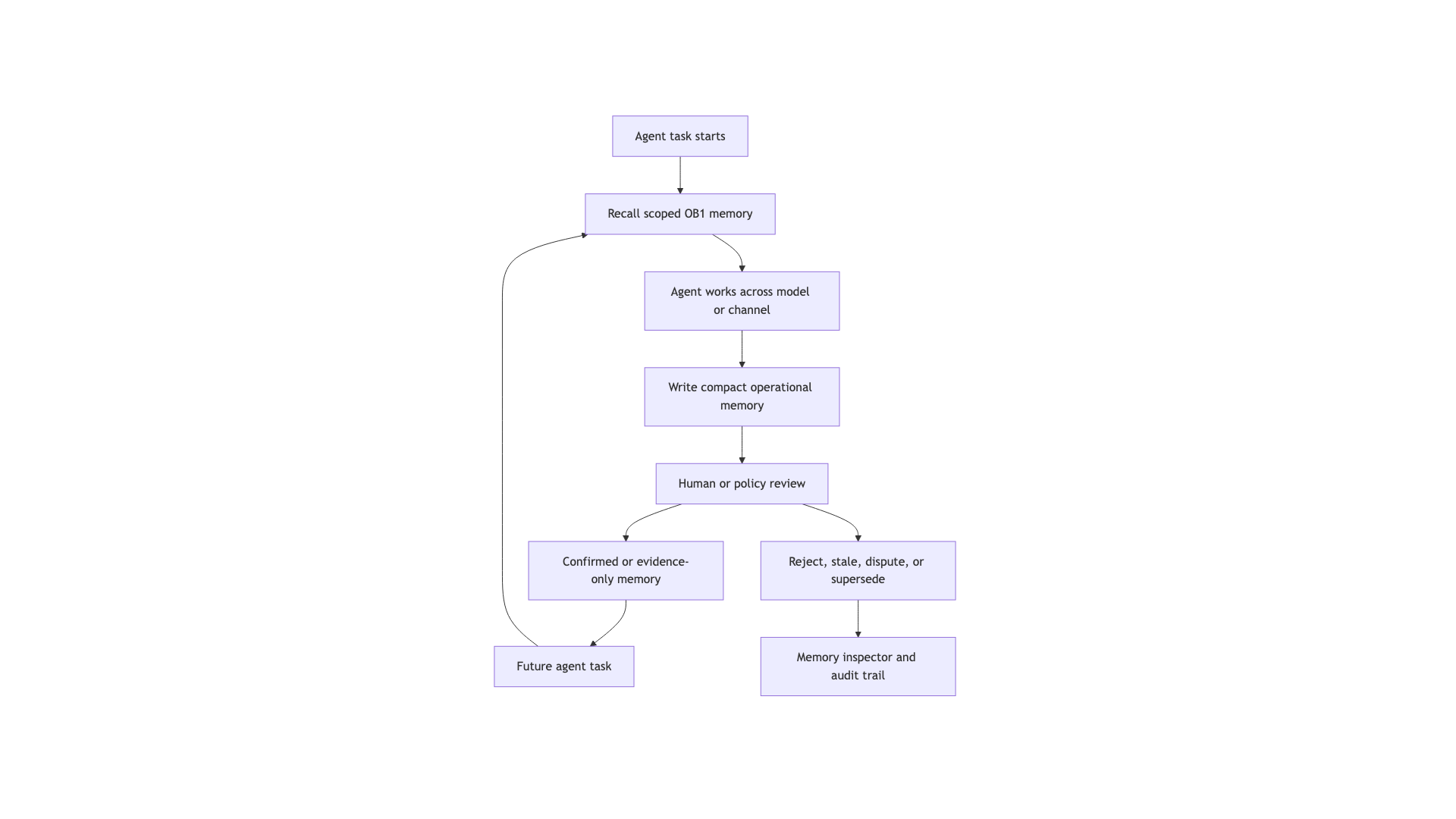
\Recall before work. Write back after work. Review before memory becomes instruction.\
Three companion recipes ship alongside it:
- OpenClaw Code Review Memory is where the GPT-5.5/Codex moment becomes tangible. A code review agent should not just comment on a PR and disappear. It should store the reusable lesson. If it finds the same migration bug three times, that becomes repo memory. If it learns that maintainers prefer a certain error-handling pattern, that becomes repo memory. If it discovers that tests fail unless a particular fixture is updated, that becomes repo memory. If it catches a security-sensitive pattern, that becomes durable project context.
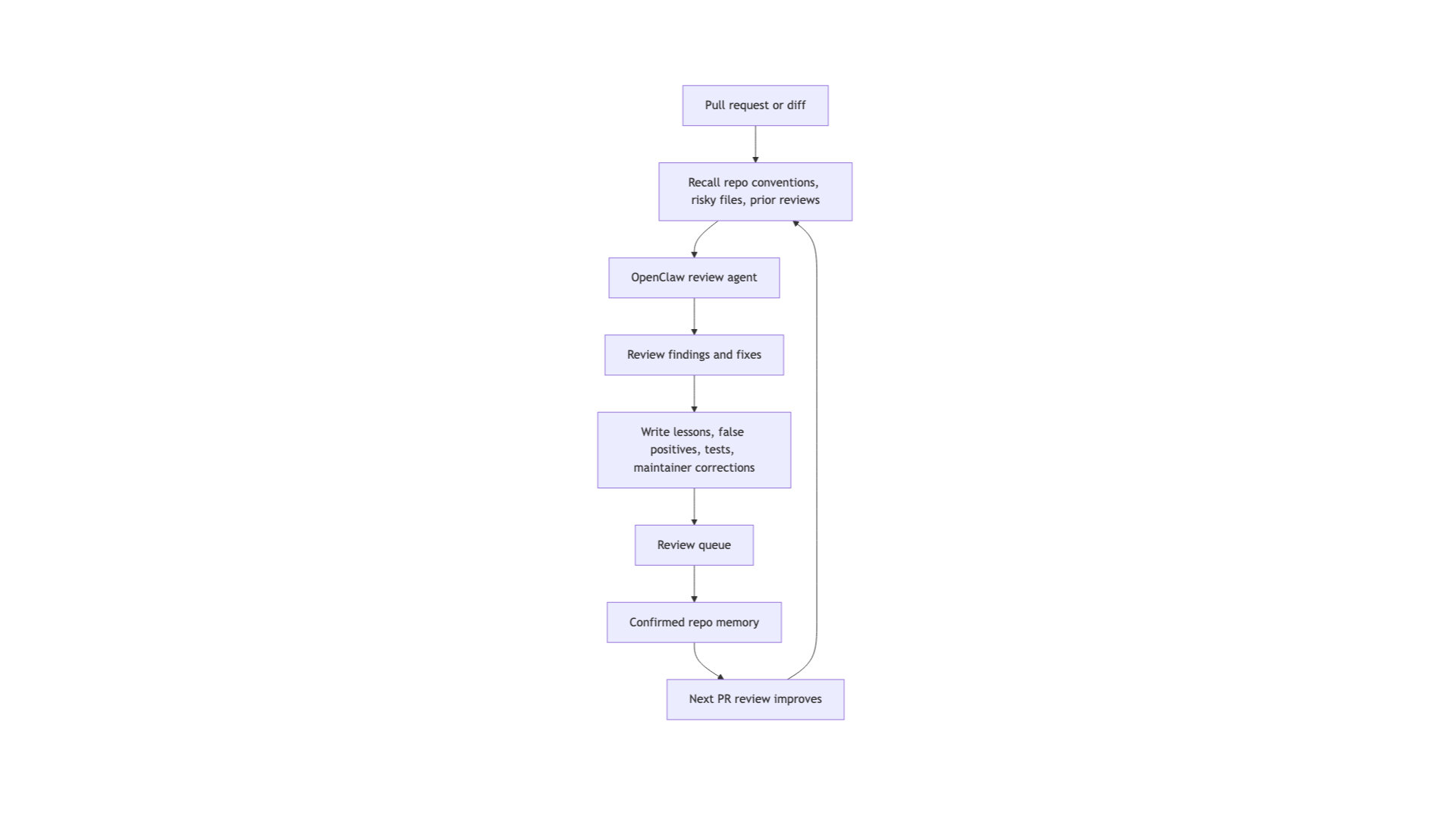
\Code review memory turns repeated repo lessons into reusable project context.\
- OpenClaw TaskFlow Work Log does the handoff work. TaskFlows make work durable, but work logs make handoffs intelligible. A long-running agent should leave behind more than “done” or “failed.” It should write what it attempted, what changed, what blocked it, what needs review, and what the next agent should know. That is especially important in a swappable-brain world. If Gemma triages, GPT-5.5 implements, and Claude reviews, the handoff cannot be trapped inside one model’s context window.
- Safe Agent Memory / Provenance may sound less exciting, but it is probably the most important for trust. Agent-written memory needs labels. Was this observed from a source? Inferred by a model? Confirmed by the user? Imported from a transcript? Generated during code review? Is it still valid? Does it conflict with something newer? Can it be used as an instruction, or is it merely evidence? Without those distinctions, memory becomes dangerous. With them, memory becomes operational.
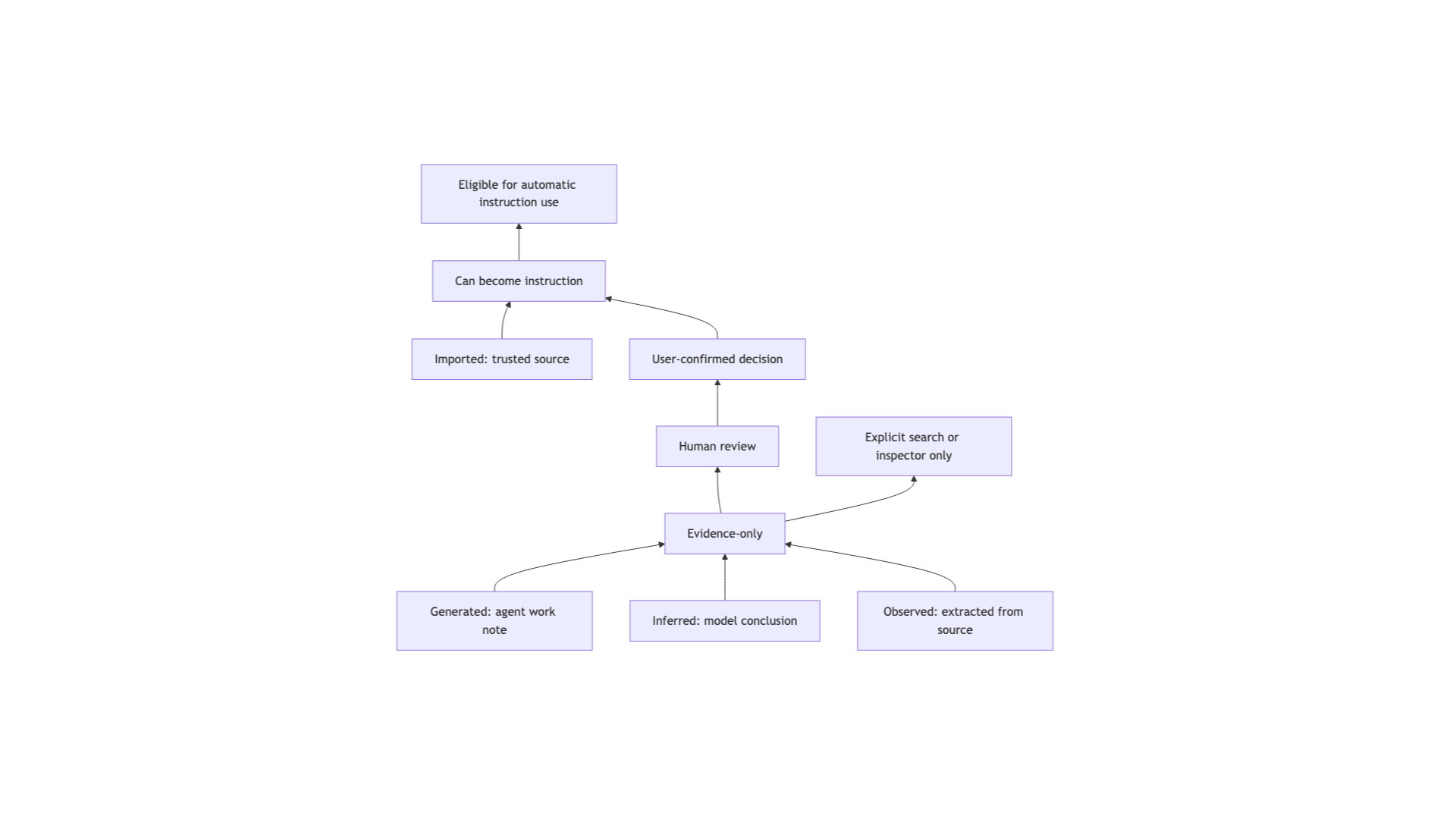
\Generated or inferred memory is evidence. Confirmed memory can become instruction.\
This is the right way to connect Open Brain to the OpenClaw moment. Do not lead with “we built an integration.” Lead with the architectural change.
OpenClaw is maturing into a runtime. The model layer is becoming swappable and contested. Therefore, memory needs to be user-owned. Open Brain is already built for that and the recipe makes the pattern easier to adopt.
It also keeps the OpenAI/Anthropic story in proportion. The runtime fight matters because it shows why swappability matters. But the deeper point is not which provider is being more open this month. The deeper point is that agent builders should stop designing as if one model provider will permanently own the whole loop.
A serious agent workflow should survive model churn.
It should survive pricing changes, provider restrictions, the release of a better local model, and the discovery that one model is better at review while another is better at planning. It should survive the user moving from Slack to Telegram or from a hosted model to local inference.
OpenClaw is beginning to make this possible.
And that is why the product surface matters so much. You cannot have real swappability if the rest of the system is fragile. If tasks are not durable, switching models does not help. If memory is not scoped, switching models creates confusion. If channel delivery is unreliable, the agent may do work no one sees. If permissions are sloppy, a more capable model makes the system more dangerous. If provenance is absent, memory becomes untrustworthy. The boring product work is what makes the exciting runtime idea usable.
This is why the last month deserves more attention than a feature roundup.
OpenClaw is moving from novelty to infrastructure. Not finished infrastructure. Not risk-free infrastructure. Not something every company should blindly deploy. But the direction is clear. It is becoming a place where agentic work can be organized.
That changes the opportunity for builders.
The opportunity is not to make another shallow OpenClaw wrapper. The obvious wrapper layer will get crowded quickly. The more interesting opportunity is to build vertical work loops on top of the runtime: repo operations, sales operations, research workflows, meeting follow-up, compliance review, household operations, founder chief-of-staff loops, customer support triage, recruiting workflows, finance analysis, and personal knowledge maintenance.
In each case, the product is not “an agent.” The product is the loop. What triggers it? What context does it retrieve? What tools can it use? What model handles each step? What does it write back? What does the human see? What happens when it fails? What memory should survive?
OpenClaw now rewards that builder mindset.
For users, the update is simpler: OpenClaw is becoming more useful because it is becoming less dependent on a single interaction pattern. You do not have to sit in a chat and micromanage every step. More work can be queued, delegated, resumed, reviewed, and delivered. More models can participate. More channels can act as surfaces. More context can survive.
For the ecosystem, the update is sharper: the agent wars are not just about model intelligence. They are about runtimes, subscriptions, memory, tools, distribution, and trust.
The post-April builder thesis
The labs will keep fighting over the brain. Frontier models are expensive to train, expensive to serve, and strategically important. OpenAI, Anthropic, Google, and others will each make choices that reflect their incentives. Some will open certain paths. Some will close others. Some will push APIs. Some will push subscriptions. Some will push official agent products. Some will push open local models.
The builder response should not be religious loyalty to one provider. It should be architecture.
Build the claw so the model can change. Build the memory so the user owns it. Build the workflow so it survives the session. Build the permissions so the agent can be trusted. Build the provenance so memory can be inspected. Build the routing so cheap models do cheap work and expensive models do expensive work.
That is the post-April OpenClaw thesis.
OpenClaw gives agents hands. Models provide brains. Open Brain gives them continuity. The winning products will combine all three without confusing them.
If the claw can run many brains, then memory should live outside the brain.
I make this Substack thanks to readers like you! Learn about all my Substack tiers here