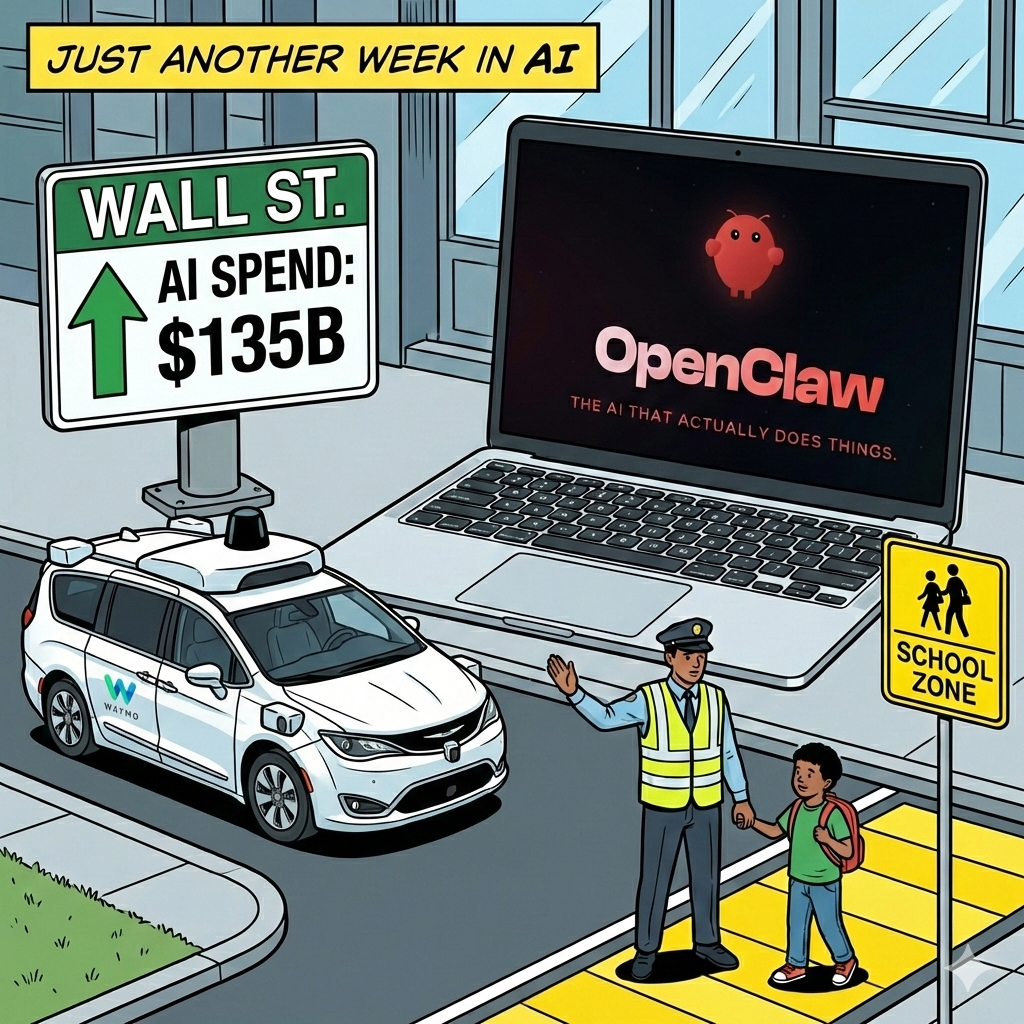
This week in AI news, the patterns get clearer. AI is no longer an abstract thing companies are talking about--it's everywhere.
By Nate
Published: 2026-01-31
URL: https://natesnewsletter.substack.com/p/135-billion-in-capex-a-robotaxi-in
This was the week a robotaxi hit a child, a weekend coding project hit 100,000 GitHub stars, and Wall Street decided that spending $135 billion on AI infrastructure was either genius or insanity depending on which earnings call you listened to.
Strip away the noise and there’s a single thread running through all of it. AI is no longer a thing companies talk about doing. It’s a thing that happens now—in school zones, on your laptop, across factory floors where Model S sedans used to roll off the line. The abstraction layer is gone. What remains is consequence.
Here’s the thing: if you’re watching the takes, this looks like chaos. If you’re watching the capital flows, it’s coherent. The earnings divergence tells you who controls their AI destiny. The federal investigations tell you that autonomy and accountability can no longer be separated. The infrastructure deals tell you the buildout is accelerating. And the pivots—Tesla killing its flagship sedans, a weekend hack reaching 100K GitHub stars—tell you the category boundaries are collapsing.
Commitment, not capability, is the story this week. The decisions being locked in are irreversible at low cost. And most of them just happened.
Top Stories this week:
- Meta and Microsoft both beat expectations; Meta’s stock jumped 10%, Microsoft’s dropped 10%—the divergence tells you everything about how the market is pricing AI control
- A Waymo robotaxi struck a child near an elementary school in Santa Monica; NHTSA opened a formal investigation as regulatory scrutiny intensifies
- Nvidia invested $2 billion in CoreWeave to accelerate 5 gigawatts of AI data center capacity by 2030; Microsoft signed a $750 million Foundry deal with Perplexity
- Tesla announced it will discontinue the Model S and Model X, converting Fremont factory lines to produce one million Optimus robots per year
- OpenClaw—formerly Clawdbot, then Moltbot—crossed 100,000 GitHub stars in a week, signaling explosive demand for open-source autonomous agents
Five stories. At least three will affect how you think about your roadmap.
Subscribers get all posts like these!
Grab the Prompts
The gap between "I read the news" and "the news changed what I do" is where most strategic awareness goes to die—you absorb the headlines, nod at the implications, and then Monday happens and nothing shifts. This prompt exists because I've watched too many smart people treat something like the Meta-Microsoft divergence or OpenClaw's explosive growth as interesting rather than actionable. It forces you to name where you actually capture value, then pressure-tests which of these five stories matters for your specific situation. If you can't answer the context questions clearly, that's diagnostic: you don't have a sharp enough picture of your own position to know which windows are closing on you.
Story 1: The Market Can’t Decide What AI Spending Means
What happened:
Meta and Microsoft reported earnings within hours of each other this week. Both beat expectations. Both announced ungodly sums for AI infrastructure. One stock jumped 10%, the other dropped 10%.
Meta posted $8.88 EPS against expectations of $8.16, with revenue clearing $59.9 billion—a 24% year-over-year increase. More striking was the 2026 capex guidance: $115 to $135 billion, up from $72 billion in 2025. That is not a typo. Meta is nearly doubling its infrastructure spend in a single year. And investors cheered.
Microsoft told a different story. Revenue hit $81.3 billion, beating the $80.3 billion consensus. Azure grew 39%, which sounds excellent until you remember it grew 40% last quarter. A single percentage point of deceleration shouldn’t matter, but context does. Microsoft also disclosed that 45% of its $625 billion commercial backlog is tied to OpenAI commitments. Nearly half of Microsoft’s contracted future revenue depends on a company it doesn’t control.
The stock dropped 7% in after-hours trading, then fell another few points the following day—a combined loss exceeding $350 billion in market value.
Who’s involved:
Meta wins because it can point to where the money goes. Its recommendation algorithms already run on AI. Its advertising engine—the actual business—improves measurably with each model generation. When Zuckerberg spends $130 billion, shareholders can trace a line from that capital to revenue. The story Zuck is telling now is simple: if you have a wallet, AI is going to make it possible for you to spend on Meta. Investors love that.
Microsoft is structurally exposed to OpenAI’s execution. CFO Amy Hood acknowledged capacity constraints will persist “at least” through the end of the fiscal year. CEO Satya Nadella emphasized that customer demand continues to outpace supply. But the market’s concern isn’t demand—it’s dependency. Deutsche Bank described 2026 as “make or break” for OpenAI, with $80 billion in deferred commitments coming due.
Why it matters:
The market’s message was clear: spending on AI is fine. Spending on AI you don’t own is a different bet entirely.
This distinction will define enterprise AI strategy for the next two years. Companies face a choice between building proprietary AI capabilities—expensive, slow, but defensible—and renting frontier models from labs whose economics remain unproven. Microsoft chose the latter. Meta chose the former. The street is pricing them accordingly.
The instructive parallel is Apple’s recent deal with Google. Apple is choosing not to invest heavily in foundation models because Anthropic reportedly pushed too hard on pricing for Claude to power Siri. Apple went with a longtime partner in Google because Google was willing to offer Gemini on better terms. If you’re going to rent your AI, make sure you rent it from a provider where the street sees a clear path to success.
What to watch:
Track how OpenAI’s deferred commitments resolve through 2026. If OpenAI executes on its commercial targets, Microsoft’s discount may look temporary. If execution stumbles, the concentration risk becomes a structural drag. Monitor whether Meta’s capex converts to sustained 20%+ revenue growth—if it does, the case for proprietary AI investment strengthens across the industry.
Story 2: Autonomy Meets Accountability in a School Zone
Content note: This section discusses a vehicle collision involving a child who sustained minor injuries.
What happened:
On the morning of January 23, a Waymo robotaxi struck a child near Grant Elementary School in Santa Monica during drop-off hours. The child sustained minor injuries. By January 29, NHTSA had opened a formal preliminary evaluation into the incident.
This was not Waymo’s only federal investigation this week. The NTSB had already opened a separate inquiry into the company’s Austin operations, where Waymo vehicles have illegally passed stopped school buses at least 19 times since the school year began. Waymo recalled over 3,000 vehicles in December to update the software after the school bus incidents, but five more violations occurred after the update.
On January 25, a separate incident in Los Angeles saw a Waymo Zeekr vehicle crash into several parked cars near Dodger Stadium. Waymo clarified that the vehicle was being operated in manual mode by a human specialist at the time.
Who’s involved:
Waymo’s response to the Santa Monica collision was technically sophisticated and rhetorically defensive. The company cited a peer-reviewed model suggesting a human driver placed in the same situation would have struck the child at 14 mph, while the Waymo vehicle braked from 17 mph to under 6 mph before contact.
This may be true. It also misses the point.
NHTSA’s Office of Defects Investigation is now examining “whether the Waymo AV exercised appropriate caution given, among other things, its proximity to the elementary school during drop-off hours, and the presence of young pedestrians and other potential vulnerable road users.” The investigation will assess the vehicle’s “intended behavior” in school zones during pick-up and drop-off times.
Why it matters:
Autonomous vehicles aren’t competing against the median human driver. They’re competing against public tolerance for machine error. A human driver hitting a child is a tragedy. A robot hitting a child is a policy question. The same outcome carries different weight depending on who—or what—caused it.
Waymo has logged tens of millions of autonomous miles. By most statistical measures, its vehicles are safer than human-operated cars. But statistics don’t set regulatory frameworks; incidents do. When incidents cluster—a child collision, nineteen school bus violations, a crash in LA—they create narrative momentum that raw safety data struggles to counter.
The underlying fear about autonomous vehicles and autonomous robots in general is accountability. Who’s responsible when things go wrong? We can’t just say “it’s more rare, the humans are worse.” We need to answer that question directly or we won’t get societal acceptance.
What to watch:
Monitor whether the NHTSA and NTSB investigations result in material consequences—fines, operational restrictions, mandatory geofencing around schools—or get absorbed as cost of doing business. Track Waymo’s expansion timeline; if regulatory friction increases, deployments may slow. Watch for legislative responses at the state level, particularly in California and Texas.
Story 3: The Infrastructure Arms Race Has a New Front
What happened:
Nvidia invested $2 billion in CoreWeave on January 26 at $87.20 per share. The money will accelerate CoreWeave’s buildout of AI-optimized data centers with a target of five gigawatts of capacity by 2030.
Five gigawatts. For context, that’s roughly the power consumption of a mid-sized city, dedicated to running AI inference and training workloads.
Jensen Huang called it “the largest infrastructure buildout in human history.” He’s not wrong. As part of the expanded partnership, CoreWeave will deploy multiple generations of Nvidia infrastructure including the Rubin platform, Vera CPUs, and BlueField storage systems.
Separately, Microsoft signed a $750 million three-year deal with Perplexity, giving the AI search company access to OpenAI, Anthropic, and xAI models through Microsoft’s Foundry platform. Perplexity was careful to note that AWS remains its primary cloud provider—a hedge against overreliance on any single hyperscaler, particularly notable given Perplexity’s ongoing legal fight with Amazon over its “agentic” shopping feature.
Who’s involved:
CoreWeave’s stock jumped nearly 6% on the Nvidia news. DA Davidson upgraded the company to “Buy” with a $110 price target; Jefferies reiterated its “Buy” rating at $120. The market has decided that picks-and-shovels plays in the AI gold rush are worth paying up for.
Nvidia’s investment raises familiar questions about circular financing—the chip giant investing in customers who then buy Nvidia chips—but the company clarified the cash will go toward land, power, and workforce expansion rather than GPU purchases. The strategic logic is clear: by propping up CoreWeave, Nvidia builds a “shadow cloud” that allows it to bypass hyperscalers whenever they push their own internal chips.
Microsoft’s Perplexity deal reinforces Azure’s positioning as a multi-model hub. Satya Nadella emphasized during the earnings call that “our customers expect to use multiple models as part of any workload. And we offer the broadest selection of models of any hyperscaler.” Over 1,500 Foundry customers are already mixing OpenAI and Anthropic models.
Why it matters:
These deals reveal a maturing infrastructure market. The first wave of AI spending went to model development. The second wave is going to the physical and logical layers that make model deployment possible at scale. Companies like CoreWeave and platforms like Microsoft Foundry are becoming essential plumbing for the AI economy.
The question is whether this infrastructure buildout is sized correctly. Five gigawatts assumes demand curves that no one can predict with confidence. If AI adoption accelerates faster than expected, current investments will look prescient. If adoption stalls—or if efficiency gains reduce compute requirements—they’ll look like expensive bets on a future that didn’t materialize.
None of the hyperscalers want to risk leaving cash on the sidelines.
What to watch:
Track CoreWeave’s ability to execute on the 5GW target while managing debt levels. Monitor whether the Nvidia-CoreWeave partnership draws antitrust scrutiny as the circular financing pattern becomes more visible. Watch Perplexity’s AWS commitments—if they shift meaningfully toward Azure, it signals a broader rebalancing of cloud dependencies across the AI startup ecosystem.
Story 4: Tesla Is Now an AI Company That Sells Cars
What happened:
Tesla’s Q4 2025 earnings call wasn’t really about cars. It was about robots, AI investments, and dismantling product lines that no longer fit the company’s direction.
The company is discontinuing the Model S and Model X. The factory lines that produced them at the Fremont facility will convert to Optimus robot production, with a target of one million units per year. Model S and Model X production winds down by the end of Q2 2026; custom orders are expected to close soon.
Tesla also announced a $2 billion investment in Elon Musk’s xAI. Grok is now deployed across the Tesla vehicle fleet. The company disclosed 1.1 million active Full Self-Driving subscriptions—a 38% increase year-over-year. Robotaxi service is expanding to Dallas, Houston, Phoenix, Miami, Orlando, Tampa, and Las Vegas in the first half of 2026.
The financials: $0.50 EPS against $0.45 expected, with 20.1% gross margin beating the 17.1% estimate. But this was Tesla’s first annual revenue decline since inception, with automotive revenues down 10% year-over-year.
Who’s involved:
“It is time to bring the Model S and Model X programs to an end with an honorable discharge,” Musk said on the call. “It’s part of our overall shift to an autonomous future.”
The Model S and Model X were low-volume products—less than 3% of deliveries in late 2025—that consumed factory capacity better used for higher-margin opportunities. Killing them frees resources for bets Tesla considers more important.
The $20 billion 2026 capex plan—nearly double Wall Street estimates—signals the scale of those bets. Tesla is building AI training infrastructure, robotic manufacturing capacity, and autonomous vehicle deployment networks simultaneously. It’s a portfolio approach to a technology transition that most companies are barely beginning to navigate.
Why it matters:
Add it up and you get a company that has decided its future lies in AI and robotics, not premium sedans. Tesla is repositioning itself as an AI and robotics company that happens to sell cars, rather than a car company that happens to use AI.
Whether Tesla can execute on this vision is an open question. The company has a history of ambitious timelines that slip. But the strategic direction is clear. And it is significant that Tesla would rather be in the robotics industry at scale than the car industry at scale. That’s something worth thinking about.
The third generation Optimus robot—described as Tesla’s “first design meant for mass production”—is expected to debut this quarter. Musk noted the robot uses an entirely new supply chain with nothing carried over from existing vehicle production.
What to watch:
Monitor Optimus production ramp through 2026. Tesla has repeatedly missed robotics timelines, but the factory conversion creates hard commitments. Track FSD subscription growth—if it maintains 30%+ annual growth, the recurring revenue model becomes increasingly valuable. Watch for competitive responses from traditional automakers as the industry digests Tesla’s pivot.
Story 5: A Weekend Project Became Infrastructure
What happened:
Two months ago, Peter Steinberger hacked together a weekend project. This week, it crossed 100,000 GitHub stars and drew 2 million visitors in seven days.
OpenClaw—formerly Clawdbot, then Moltbot after Anthropic raised trademark concerns over the similarity to “Claude”—is an open-source AI agent that runs locally on user hardware. It connects to WhatsApp, Slack, Discord, Telegram, iMessage, and Microsoft Teams, enabling autonomous task execution across a user’s digital life: email management, calendar updates, file operations, web browsing, any kind of cross-platform automation.
The rebranding to OpenClaw came on January 30, with the project’s developers announcing “the lobster has molted into its final form.” New integrations include Twitch and Google Chat, additional model support (including KIMI and Xiaomi MiMo), and dozens of security-related code changes.
Who’s involved:
The appeal is obvious. Instead of using AI through a chat interface—which feels cumbersome—users can deploy an agent where you just text it and it does stuff. The tagline captures it: “Your assistant. Your machine. Your rules.”
The risks are equally obvious. OpenClaw requires broad system access to function. Security researcher Simon Willison described this as the “lethal trifecta” of AI agent design: access to private data, exposure to untrusted content, and the ability to take external actions. When those three capabilities combine, attackers don’t need to target the agent directly. They can embed malicious instructions in content the agent is asked to process, and the agent may follow those instructions as if they came from the user.
IBM researchers noted this week that OpenClaw challenges the assumption that autonomous AI agents must be vertically integrated by large enterprises. “It can also be community driven,” said Principal Research Scientist Kaoutar El Maghraoui.
Platformer’s review was blunt: “Maybe someday you’ll have a genie in your laptop working for you 24/7. Today is not that day.”
Why it matters:
This is both promise and warning. The democratization of agentic AI means more people can build and deploy autonomous systems. It also means more systems will be deployed without adequate security review, by users who don’t fully understand the attack surfaces they’re creating.
But 100,000 GitHub stars suggest a lot of people are willing to try anyway.
The growth reminds me of the early days of music piracy, when startups said music wants to be free and kept shipping despite regulatory concerns. Humans are excited about AI agents being autonomous. They’re just going to keep doing it. If it’s at 100,000 stars now, it may hit a million within a couple of months. The growth is hyper-exponential.
This changes the conversation around security on the internet. We’re going to need to think more and more about what happens when autonomous agents are operating on the net at scale.
What to watch:
Track OpenClaw’s adoption curve and whether security incidents emerge that force behavioral changes. Monitor responses from incumbent AI labs—if they launch competing local-first agent frameworks, the market could fragment quickly. Watch for regulatory interest; if agents begin taking consequential actions at scale (financial transactions, legal filings, healthcare decisions), governance frameworks will follow.
The Through-Line Is Commitment
The common thread connecting these stories isn’t technology. It’s commitment.
Microsoft is committed to OpenAI at a scale that shapes its financial structure—45% of its backlog. Meta is committed to infrastructure spending that assumes AI will transform its core business—nearly doubling capex to $135 billion. Waymo is committed to autonomous deployment at a scale that invites regulatory scrutiny, and is willing to be defensive about a human tragedy. Tesla is committed to a pivot so dramatic it’s discontinuing its flagship products. And hundreds of thousands of developers are committed to running autonomous agents on their laptops despite known security risks.
None of these commitments are reversible at low cost.
The abstraction phase of AI—when companies could talk about potential and optionality—is ending. What remains is execution against bets that have already been placed.
Consider what happened with Anthropic this month. The company closed a funding round above its initial $10 billion target at a $350 billion valuation—nearly double its September valuation of $183 billion. Coatue and Singapore sovereign wealth fund GIC led the financing. CEO Dario Amodei told CNBC the company generated close to $10 billion in revenue last year. That’s roughly the market cap of Walmart being assigned to a private company that’s four years old.
The valuation reflects a bet that safety-focused development will produce more capable and deployable systems than approaches that optimize purely for performance. Anthropic is building AI to build AI—working on models internally that will accelerate their own model development. If that bet is correct, the valuation may look cheap in retrospect. If not, $350 billion will look like a monument to hype.
Every signal points toward the former. Every signal points toward continued rapid scaling.
So if I leave you with one thing: figure out which windows matter to you, and decide before they close.
If you’re building on cloud infrastructure, the Meta-Microsoft divergence just told you that owning your AI capabilities matters more than renting them. If you’re deploying autonomous systems, Waymo just told you that statistical safety doesn’t equal societal acceptance—accountability structures need to come first. If you’re in enterprise software, Tesla just told you that category boundaries are collapsing and robotics may eat adjacent markets faster than expected. If you’re building agents, OpenClaw just told you the demand is real, the security problems are real, and the market will move regardless.
The news this week wasn’t chaos. It was consolidation. Make sure you’re on the right side of it.
I make this Substack thanks to readers like you! Learn about all my Substack tiers here and grab my prompt tool here