The $125 billion reason behind one of the biggest layoffs in Amazon's history.
By Nate
Published: 2026-01-30
URL: https://natesnewsletter.substack.com/p/amazon-isnt-replacing-workers-with
Amazon isn’t cutting 30,000 jobs because they have too many managers.
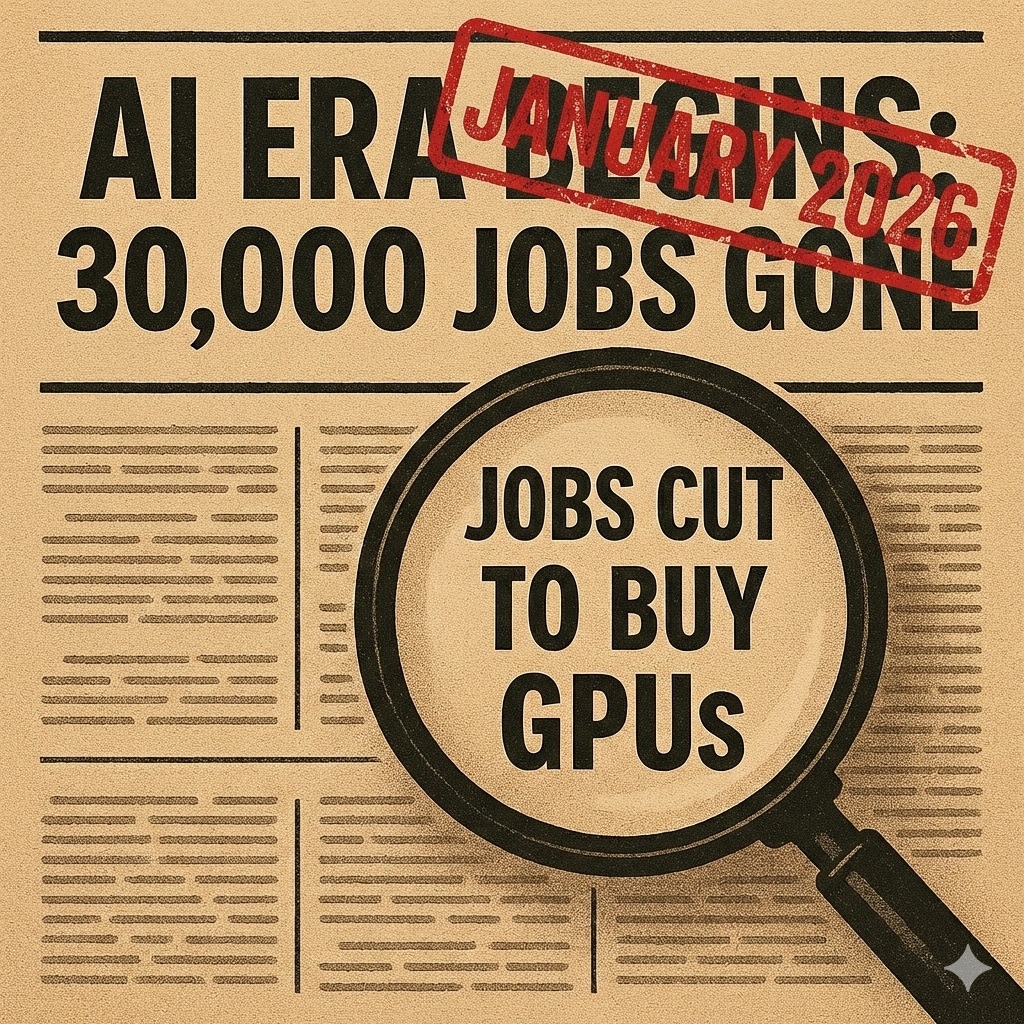
They’re cutting 30,000 jobs because they need the money to buy GPUs.
That’s the story nobody wants to tell you. Not Andy Jassy on the earnings call. Not the business press dutifully repeating the “culture” narrative. Not the analysts who’d rather talk about AWS growth rates than the brutal arithmetic reshaping Big Tech from the inside out.
When Amazon cut 14,000 people in October, I argued the real story was capital reallocation—freeing cash to fund the AI infrastructure race, not robots replacing workers. The second wave, 16,000 more this week, makes the pattern undeniable. And now we have the numbers to prove it.
Here’s what actually happened: Amazon’s quarterly free cash flow went negative—negative $4.8 billion—at the exact moment their capital expenditure hit $125 billion, the highest of any company on Earth, with 75% of it going directly to AI infrastructure. They raised $12 billion in debt this year to fund data centers. And then they eliminated 10% of their white-collar workforce.
This isn’t a layoff. It’s a capital reallocation. Human headcount converted to compute capacity. Salaries transformed into silicon.
And if you understand why Amazon is making this trade, you understand something important about what’s coming for the entire technology industry.
Subscribers get all posts like these!
Get the AiCred Assessment
The people who navigate this transition well won’t be the ones who panicked, and they won’t be the ones who ignored it. They’ll be the ones who understood where they actually stood and closed the gaps that mattered.
I built AiCred to help you close that gap. The assessment takes 20-30 minutes and works like a real conversation—not a multiple-choice quiz you can game. You’ll get a quantified fluency score across five competencies, a brutally honest breakdown of where you’re strong versus where you’re fooling yourself, and a personalized learning path built around your actual gaps. The evaluation costs one credit; all the training modules that follow are free.
You guys here on Substack get a steep discount:
- 40% off for 1 test:
BEAT8POINT9
- 60% off for 3 tests:
341
- 60% off for 12 tests:
STOCKUP
Grab the Prompts
Every major layoff announcement comes with a story—and the story is almost never the whole truth. These prompts exist because I've watched too many smart people accept "AI automation" as an explanation when the balance sheet tells a completely different story. The Follow the Money Kit gives you two tools: a research pipeline that forces you to check stated rationale against actual financial evidence before you believe a headline, and an assessment prompt that helps you read the same capital pressure signals at your own company—before you find out about them in an all-hands.
The Numbers That Don’t Add Up
Let’s start with the contradiction that should make you suspicious of every official explanation you’ve heard.
Amazon just posted one of its strongest quarters in years. Revenue hit $180 billion—up 13% year over year. AWS is growing at 20%, the fastest clip since 2022. Net income surged 38%. The stock jumped 10% after earnings. By every conventional measure, this is a company firing on all cylinders.
And then they fired 30,000 people.
Not warehouse workers. Not seasonal fulfillment staff. Corporate employees. Engineers. Product managers. The people who build things. In what will become the largest layoff in Amazon’s thirty-year history, the company is eliminating roughly 10% of its white-collar workforce—14,000 in October, another 16,000 this week.
CEO Andy Jassy wants you to believe this is about culture. “The announcement was not really financially driven, and it’s not even really AI-driven,” he told analysts on the Q3 earnings call. “It’s culture.” Too many layers. Too much bureaucracy. Amazon needs to operate like the world’s largest startup.
It’s a compelling narrative. It’s also carefully constructed to obscure what the balance sheet makes obvious.
Follow the Cash
Amazon’s free cash flow tells a story that Andy Jassy would rather not discuss on earnings calls.
In 2024, Amazon generated $38 billion in free cash flow. That sounds healthy until you understand what happened next. As of Q3 2025, quarterly free cash flow went negative. The trailing twelve-month figure dropped 61% year over year. Free cash flow margin collapsed from 8.73% of sales to just 2.7%.
What changed? Capital expenditure exploded.
Amazon spent $83 billion on CapEx in 2024. In 2025, that number jumped to $125 billion—a 61% increase. CFO Brian Olsavsky has already told investors to expect even higher spending in 2026. Roughly 75% of this goes directly to AI infrastructure: GPUs, custom Trainium chips, data centers, and the power systems to run them.
To put these numbers in perspective: Amazon is now spending more on infrastructure in a single year than the entire GDP of Morocco. They’re adding 3.8 gigawatts of data center capacity annually—enough to power three million homes. They’re on track to double their total computing power by 2027.
This is not a company with excess cash lying around. This is a company that went to the debt markets and raised $12 billion in bonds specifically to fund infrastructure investments. When Bank of America’s credit strategists analyzed hyperscaler spending, they found that aggregate CapEx among the big five—Amazon, Microsoft, Google, Meta, and Oracle—now consumes 94% of operating cash flows after dividends and buybacks. That’s approaching the theoretical maximum a company can spend without taking on significant leverage.
Amazon isn’t cutting people because the culture is broken. Amazon is cutting people because they need the money.
The Arithmetic of Elimination
Let’s do the math that Amazon’s PR team hopes you won’t do.
Thirty thousand corporate employees, eliminated. What does that actually save?
Amazon’s median total compensation for corporate roles runs around $217,000 per year. That includes base salary, stock grants, and benefits. Assume the layoff pool skews slightly below median—call it $200,000 per head all-in.
Thirty thousand employees times $200,000 equals $6 billion in annual savings.
Now, $6 billion sounds like a rounding error against $125 billion in CapEx. But that’s the wrong comparison. The relevant comparison is free cash flow—the actual money available to fund investments after you’ve paid for everything else.
When your quarterly FCF is negative $4.8 billion, an extra $6 billion per year matters. A lot.
That $6 billion is roughly what Amazon spent building Project Rainier, its massive AI computing platform packed with 500,000 custom Trainium2 chips. It’s enough to fund half of their annual investment in new data center campuses. It’s the difference between issuing more debt and funding expansion internally.
The Pragmatic Engineer argued against this thesis when the first wave of layoffs hit in October. His analysis pointed to Amazon’s $93 billion in cash reserves and $32 billion in trailing free cash flow, concluding that the layoffs “won’t make a big difference to how much it can invest in data centers.”
But that analysis used backward-looking metrics. The cash flow picture had already deteriorated. Quarterly FCF was negative. CapEx guidance had increased by $7 billion. And Amazon had just raised $12 billion in debt—something they wouldn’t need to do if they were swimming in excess cash.
The numbers don’t lie. Amazon is under financial pressure, not because the business is weak, but because the AI infrastructure race demands capital at a scale that even Amazon’s profit engine struggles to generate.
The Culture Narrative Is Cover
Understanding why Jassy frames this as a culture problem rather than a financial reallocation reveals something important about how CEOs communicate during technological transitions.
There are three audiences Jassy has to satisfy, and each one needs to hear a different version of reality.
For employees, “we’re cutting you to buy more GPUs” is a brutal message. It implies your work doesn’t matter—that you’re simply a line item to be optimized away. The culture framing is gentler. It suggests the cuts are about organizational effectiveness, not your individual value. You weren’t eliminated because you cost too much. You were eliminated because there were too many layers between you and the customer.
For investors, admitting financial pressure is dangerous. Amazon trades at a premium because the market believes AWS and AI will generate massive returns. If Jassy said “we’re cash-constrained and need to cut headcount to fund infrastructure,” the stock would crater. The culture narrative lets him position the cuts as proactive optimization rather than reactive cost-cutting.
For regulators and the public, the AI replacement story creates problems. If Amazon admits these layoffs are about freeing capital to build AI systems, they invite scrutiny. Congressional hearings. Labor activism. Bad headlines. Better to frame it as routine corporate restructuring.
The tell is in Jassy’s own contradictions. In June 2025—just four months before the first layoffs—he sent a memo to employees explicitly warning that AI would mean Amazon needs “fewer people doing some of the jobs that are being done today.” That memo is still on Amazon’s public blog.
But by the October earnings call, the message had shifted. “Not AI-driven, not right now, at least.” The hedge in that sentence—”not right now, at least”—reveals the tension. Jassy knows AI is part of this story. He just can’t say it out loud when analysts are listening.
The Culture Narrative Isn’t Wrong—It’s Incomplete
To be fair to Jassy, the culture story isn’t fabricated. It’s just not the whole truth.
Amazon did overhire during the pandemic. Between 2017 and 2022, the company’s corporate headcount tripled. When you grow that fast, you inevitably add layers. Middle managers accumulate. Decision-making slows. The ownership culture that defined Amazon’s early years gets diluted across too many people in too many meetings reviewing too many documents.
Jassy has been talking about this problem for over a year. In September 2024, he mandated return to five days in the office and set an explicit goal: every major organization had to increase its ratio of individual contributors to managers by at least 15%. He created a “no bureaucracy email alias” where employees could flag unnecessary processes. That initiative generated 1,500 responses and led to 450 changes.
So when Jassy says these layoffs are about culture, he’s drawing on a real diagnosis. Amazon did become bloated. The company does move slower than it used to.
But here’s what the culture narrative doesn’t explain: timing.
If the problem was pandemic overhiring, why didn’t Amazon fix it in 2023, when everyone else did? They laid off 27,000 people that year. If the bureaucracy problem persisted, why wait until late 2025 to address it with the largest workforce reduction in company history? And why announce these cuts the same week you’re telling investors that capital expenditure will hit $125 billion?
The culture problems are real. But they didn’t suddenly become urgent in October 2025. What became urgent was the cash.
The Hyperscaler Arms Race
To fully understand what’s happening at Amazon, you have to zoom out and see the competitive landscape driving this spending.
The AI infrastructure buildout is the largest capital deployment in the history of technology. Goldman Sachs projects that the top hyperscalers will spend $1.15 trillion on infrastructure between 2025 and 2027—more than double what they spent in the previous three years combined. For 2026 alone, aggregate CapEx among the big five will exceed $600 billion.
These are not discretionary investments. They are existential.
The companies that build the most advanced AI infrastructure first will capture the majority of enterprise AI spending for the next decade. The companies that fall behind will find themselves locked out of the most lucrative technology market since cloud computing itself. Microsoft has OpenAI. Google has Gemini. Amazon has Anthropic and its own Nova models. Each of them is racing to build the compute capacity that will run the AI applications every business needs.
This is why nobody is pulling back. Meta just raised its CapEx guidance to $100 billion for 2026. Microsoft’s capital intensity has hit 45% of revenue—historically unthinkable for a software company. Oracle, which barely registered in cloud five years ago, is now deploying tens of billions in AI infrastructure.
Amazon’s position in this race is particularly acute. AWS remains the dominant cloud platform, but it has lost ground to Microsoft Azure and Google Cloud in AI-specific workloads. The perception that Amazon was slow to AI—late to partner with leading model providers, late to ship competitive AI services—has weighed on the stock. The $38 billion OpenAI infrastructure deal announced in January helps address that perception, but it also represents yet another enormous capital commitment.
When you’re in an infrastructure arms race and you need every dollar you can find, cutting $6 billion in annual headcount isn’t just attractive. It’s necessary.
What This Means for Everyone Else
The Amazon layoffs matter beyond Amazon for two reasons.
First, they reveal the true cost structure of the AI transition. Every hyperscaler is facing the same pressure: how do you fund $100+ billion in annual infrastructure spending while maintaining profitability? The answer, increasingly, is that you fund it by cutting everywhere else. Research budgets. Experimental projects. Moonshot bets. And yes, people.
This isn’t about AI replacing workers in the sense most people imagine—robots doing your job while you collect unemployment. The more immediate reality is that AI creates capital demands so enormous that companies have to shrink their human workforces simply to afford the infrastructure. You’re not being replaced by an AI. You’re being replaced by the need to buy GPUs.
Second, the Amazon cuts signal something broader about tech sector employment. The industry added workers at an unsustainable rate during the pandemic, and the correction that started in 2023 is not over. Microsoft cut 15,000 people. Meta continues its “year of efficiency.” Intel eliminated 24,000 positions. The Challenger data shows over 1.1 million job cuts across the economy in 2025—the highest since the pandemic itself.
What makes this cycle different is that the companies doing the cutting are not struggling. They’re not losing money. They’re not fighting for survival. They’re some of the most profitable enterprises in human history. But their capital allocation priorities have shifted decisively from human labor to physical infrastructure, and that shift is structural rather than cyclical.
The workers who remain will be expected to do more with less. Amazon employees report that managers now track AI tool usage via dashboards. Performance reviews increasingly factor in how effectively you leverage automation. The implicit bargain is clear: justify your existence by being more productive than the machines that might otherwise replace you.
The Uncomfortable Truth
There’s a version of this story that’s optimistic. Amazon is investing $125 billion in infrastructure that will power the next generation of AI services. Those services will create new businesses, new jobs, new value. The short-term pain of layoffs will give way to long-term gains as AI unlocks productivity improvements across the economy. History suggests that technological transitions, however painful in the moment, ultimately create more prosperity than they destroy.
Maybe. But that’s not a guarantee. It’s a bet.
What we know for certain is that Amazon is making a deliberate choice. They’re choosing GPUs over people. Data centers over headcount. Infrastructure over organization. And they’re making that choice not because their business is weak, but because the competitive dynamics of artificial intelligence demand capital at a scale that forces hard tradeoffs.
Andy Jassy will keep talking about culture. He’ll keep invoking the startup mentality and the ownership mindset and the need to move faster. Those things matter, and some of the organizational changes Amazon is making are probably overdue.
But the real story is in the numbers. Free cash flow going negative. CapEx hitting $125 billion. Thirty thousand people out the door. A $12 billion bond offering to fund what cash flows can’t cover.
This is the equation that’s reshaping Big Tech: Human capital out. Compute capital in.
And if you think Amazon is alone in making this calculation, you haven’t been paying attention. Every major technology company is running the same arithmetic. The only question is who announces their layoffs next.
LINK: Financial Data Sources
The financial data in this piece is drawn from Amazon’s Q3 2025 earnings, SEC filings, and analyst reports from Bank of America, Goldman Sachs, CreditSights, and others. Compensation estimates are based on data from Levels.fyi and company disclosures.
I make this Substack thanks to readers like you! Learn about all my Substack tiers here and grab my prompt tool here