2026 is the year to build something that actually represents YOU. Here's the case for controlling your personal narrative (with step by step guides for all levels!)
By Nate
Published: 2026-01-16
URL: https://natesnewsletter.substack.com/p/grab-the-fit-assessment-prompt-that
LinkedIn is dead. You know this. Everyone applying for jobs in 2025 knows this.
But watch what happens next. Watch the advice people give each other. Beat the ATS. Use power words. Network harder. Format your resume so the robots can parse it—but don’t sound too robotic or you’ll get filtered for seeming AI-generated. Use AI to help you apply—but not too much or they’ll catch you.
The response to LinkedIn dying is to optimize harder for LinkedIn.
I’ve been watching the discourse for weeks. Candidates gaming filters. Companies building better filters. Both sides escalating. For a lot of people, the success rate on applications now feels like it’s dropped below one percent. The entire infrastructure is optimized for filtering volume, not for understanding people—a resume compresses years of work into bullet points, an ATS scans for keyword matches, a recruiter spends six seconds deciding whether to keep reading. You’re competing for attention against hundreds of other compressed, keyword-optimized, six-second impressions.
Here’s the thing almost nobody has thought through: the arms race only exists because everyone accepts the premise. You’re a supplicant. They have gates. Your job is to squeeze through.
But the gates aren’t the only path anymore.
The same AI that broke hiring made something else possible. Three years ago, building a custom interface required engineering skills or real money. That gap closed. Which means you’re not stuck optimizing for their broken system. You can build the surface people encounter when they find you—something they can query, explore, discover. Not squeeze through their filters. Create your own.
Here’s what’s inside:
- Why attention is the real bottleneck—and how building an interface shifts you out of the filtering pile entirely
- The difference between asserting credentials and demonstrating capability—and why depth in an AI interface is almost impossible to fake
- The bidirectional move—a fit assessment tool that tells employers not to hire you when the match is weak
- The implementation spectrum—from a 30-minute text document to a weekend build, no engineering required
- A full working demo—with source code and the exact prompts I used to build it (and yes, there’s beginners guide!)
But first, let’s walk through why this approach actually works.
Subscribers get all posts like these!
Building Your Portfolio with Lovable: Two Guides [Links below]
The hardest part of this whole approach isn’t the technology—it’s getting the AI to stop being sycophantic. AI assistants are trained to be helpful and positive, which means they default to “while I haven’t done X specifically, my strong fundamentals would allow me to pick it up quickly.” That’s exactly the opposite of what you need. The system prompts in these guides were calibrated through iteration to override that instinct: explicit anti-sycophancy instructions, permission structures for rejection, and calibration examples that show the AI what honest assessment actually sounds like. The fit assessment tool uses a structured JSON output that forces the AI to commit to a verdict—”strong fit,” “worth conversation,” or “probably not”—instead of hedging across paragraphs.
I’ve put together two versions.
- The BEGINNER GUIDE walks through every click: creating accounts, connecting Supabase (with a short explainer of what Supabase is and why you need it), what to do when you hit the inevitable API errors, and more. Budget 3-5 hours, no coding required.
- The TECHNICAL SPEC has the full database schema, edge function architecture, and system prompts—if you’re comfortable with Supabase, you can ship a working version in an afternoon. Both include the complete prompt stack for the chat interface, the JD analyzer, and the admin panel that separates public content from private AI context.
- LINK: GitHub Repo
The Economics of Attention in a Saturated Market
The current hiring system operates on a specific assumption: candidates are supplicants. You want access to their opportunity. They have the power to grant or deny that access. Your job is to contort yourself into whatever shape fits through their keyhole.
This framing made sense when companies controlled the only viable interface between talent and opportunity. LinkedIn, job boards, ATS portals—these were the pipes, and if you wanted to move through the system, you had to fit the pipes. You couldn’t build your own.
That constraint evaporated. But most people haven’t updated their strategy to reflect the new reality.
Hiring managers are drowning. A single engineering role might attract 400 applications. A product management position at a known company might see 800. The volume is so high that meaningful evaluation has become structurally impossible. Managers spend maybe six seconds per resume, scanning for pattern matches, trying to cut the pile down to something manageable. They know they’re missing good people. They keep doing it because there’s no alternative workflow.
This creates an interesting dynamic. The scarce resource isn’t talent—there’s plenty of talent. The scarce resource is attention. The ability to actually be seen rather than pattern-matched and discarded. And in a market where attention is the bottleneck, the strategic question shifts from “how do I present my qualifications” to “how do I capture attention in a way that leads to genuine evaluation.”
Traditional optimization says: beat the filters. Use the right keywords. Format for ATS parsing. Network your way past the pile. This advice isn’t wrong exactly, but it’s playing a finite game within a collapsing system. You’re trying to be the slightly better supplicant in a pool of 400 supplicants.
Building an interface is a different move entirely. You’re not trying to be the best candidate in the pile. You’re refusing to be in the pile at all. You’re creating a different category of interaction—one where the hiring manager encounters you not as a document to scan but as an experience to engage with.
The attention economics here are crucial. When someone lands on a standard resume, they’re in filtering mode. Their cognitive goal is to find reasons to say no, because saying no quickly is how they manage volume. But when someone encounters an interactive interface—something they can query, explore, discover—the cognitive frame shifts. They’re no longer filtering. They’re investigating. The psychological mode changes from “find disqualifying signals” to “understand what this person can do.”
That shift is worth an enormous amount. It’s the difference between six seconds of scanning and five minutes of actual engagement. In a market where attention is the bottleneck, engineering that shift is the highest-leverage move you can make.
Why AI-Mediated Self-Presentation Works
There’s a deeper dynamic here that goes beyond capturing attention. It involves how trust and credibility actually form during evaluation.
When you hand someone a resume, you’re making assertions. I did this. I achieved that. Here are my skills. The person receiving it has to decide whether to believe your claims, and they have very little basis for that decision beyond pattern-matching your assertions against their expectations. Did you actually reduce costs by $1.2 million? They have no way to verify it. Did you really lead that cross-functional initiative? They’re taking your word for it.
This creates a credibility problem that AI-generated content has dramatically worsened. When anyone can generate a polished, keyword-optimized resume in thirty seconds, the signal value of polish collapses. A well-formatted document with strong action verbs proves nothing except that you have access to ChatGPT. The gap between presented credentials and actual capability has become essentially unbridgeable through traditional document exchange.
An AI interface changes the epistemology of evaluation. Instead of asserting claims and asking to be believed, you’re creating a tool that demonstrates capability through use.
Think about what happens when a hiring manager interacts with an AI trained on your actual work, your real projects, your genuine expertise. They ask a question. They get a specific, detailed answer grounded in things you’ve actually done. They ask a follow-up. The AI handles it with the same depth. They probe an edge case. The AI either answers substantively or honestly acknowledges a gap.
The critical thing here is that the quality of that interaction is almost impossible to fake at scale. You can write a resume that claims deep expertise in distributed systems. You cannot train an AI to conduct a convincing multi-turn conversation about distributed systems architecture if you don’t actually understand it. The depth emerges from the underlying substance or it doesn’t emerge at all.
This is why the interface functions as proof. Not because you claim competence, but because the thing you built demonstrates it. The quality of answers shows depth. The handling of edge cases shows real understanding. The honest acknowledgment of gaps shows self-awareness. The person evaluating you isn’t believing claims—they’re observing demonstrated capability.
There’s a psychological dimension here that matters enormously. Research in persuasion consistently shows that people believe conclusions they reach themselves far more than conclusions they’re told. When someone reads your resume, they’re being told what to believe about you. When someone explores your AI interface, they’re discovering things about you through their own inquiry. They feel like they investigated and formed their own judgment.
But you architected that discovery. You decided what context the AI has. You shaped which questions it handles well. You wrote the system prompt that governs its behavior. Every response reflects decisions you made about how to represent your work. They feel like they discovered the truth; you designed what they would find.
This is the real power move. You’re not asserting credibility. You’re creating conditions for credibility to form through exploration. The difference between those two approaches is the difference between telling and showing, and showing is always more persuasive.
The Bidirectional Interface: Inverting the Power Dynamic
Here’s where I want to push beyond what anyone else is saying about this.
Most career advice, even good career advice, accepts the fundamental power dynamic of hiring. You want the job. They decide whether to give it to you. You’re trying to impress them. They’re evaluating whether you’re worth their time.
What if the interface went both ways?
Picture this: someone lands on your site. There’s a tool where they can paste a job description. Your AI analyzes it against your actual experience and tells them—honestly—whether you’re right for the role.
Not a pitch. An actual assessment.
When the fit is strong, it explains why with evidence. Here’s the relevant experience. Here’s what I’ve actually built. Here’s how my background maps to your requirements. The specificity demonstrates depth.
But when the fit is weak, it tells them not to waste their time.
It says: this role needs deep consumer product experience and my entire career has been B2B enterprise. I understand the concepts from reading, but I haven’t shipped consumer products at scale. Some things will transfer, some won’t. For this specific position, I’m probably not your person. But if you have roles that match what I actually do, let’s talk.
Sit with what that signals for a moment.
You’re not just presenting yourself for evaluation. You’re evaluating fit from your side too. You’re saying my time also has value. You’re demonstrating enough confidence in your market position to actively turn away mismatched opportunities. You’re not desperate for any chance—you’re looking for the right match.
This completely inverts the traditional power dynamic. Instead of “please look at my resume and decide if I’m worthy,” you’re saying “let’s figure out together whether this makes sense.” That positioning changes everything about how you’re perceived.
It’s also genuinely useful. Hiring managers waste enormous amounts of time on mismatched candidates—people who look plausible on paper but don’t actually fit the role. A tool that helps both sides assess fit before burning hours on phone screens is providing real value. You’re not just differentiating yourself. You’re offering a service while you differentiate.
The economics work out elegantly. The tool costs you nothing at the margin—the AI runs whether or not anyone uses it. But each person who uses it gets significant value in the form of time saved and fit assessment. You’re capturing attention by providing utility, which is far more sustainable than capturing attention through novelty alone.
What This Requires From You
I need to be direct about something: this approach requires real substance underneath.
You cannot fake depth in an AI interface. You can write a resume that claims expertise you don’t have. You cannot train an AI to conduct convincing multi-turn conversations about domains you don’t understand. The interrogative format surfaces what’s actually there—and if nothing is there, it surfaces that too.
This isn’t a hack for seeming impressive. It’s an amplifier. If you have genuine expertise that keeps getting compressed into bullet points, this lets the full shape of your capability show. If you’ve spent years building deep knowledge that doesn’t fit standard resume formats, this lets you unflatten yourself.
But if you’re early career without much substance yet, no interface design will compensate for that gap. The answer isn’t to build a clever wrapper around emptiness. The answer is to build substance first—do projects, get reps, create genuine expertise. Then build the interface to let it show.
This is actually the feature, not the bug. A world where self-presentation can be verified through interactive interrogation is a world that rewards real competence over credentialing games. If you’ve actually done the work, this environment advantages you. If you’ve been coasting on polished claims, this environment exposes that.
The Implementation Spectrum
The obvious question is whether building this requires technical skills you don’t have. The answer is no, but the sophistication scales with investment.
The simplest version takes thirty minutes. Write a structured document that covers your experience, projects, key learnings, strengths and gaps. Not a resume—something denser, organized for AI parsing rather than human scanning. Add a system prompt that tells AI how to represent you: be specific, cite actual work, acknowledge limitations honestly. Put it in a Notion page with instructions saying “copy this into Claude or ChatGPT and ask whatever you want.”
That’s it. You’ve created an AI-queryable interface using nothing but text.
A few hours gets you a Custom GPT. OpenAI lets anyone build chatbots trained on uploaded content. No code required. Now you have a shareable link where anyone can ask questions about your background and get substantive responses.
Half a day gets you a simple web presence. Carrd, Framer, Notion—any of these let you structure information in ways that AI can parse effectively. You’re not building custom functionality, just organizing your story for a new kind of consumption.
A weekend gets you actual interactive features. Typeform connected to Zapier connected to Claude’s API. Or pay someone a few hundred dollars to build the widget. Now you have real bidirectional functionality—job description pasting, fit assessment, custom response generation.
Beyond that you’re building production systems. But most people should start simple. The concept is the innovation. Implementation is refinement.
The point is that this isn’t gated by technical skill. If you can write clearly about your own work—which you should be able to do if you actually did the work—you can create the raw material. The AI handles the interface layer.
The Honest Objections
Let me steelman the skepticism, because some of it is warranted.
“No one will find this.” Fair. If you build an interface and nobody visits it, you’ve accomplished nothing. This isn’t a replacement for distribution—it’s a replacement for what people find when they arrive. You still need to get your work in front of people: posting publicly, building in the open, networking, showing up in communities where your expertise matters. The interface changes what happens when someone lands on your site. It doesn’t magically generate traffic. Think of it as conversion optimization, not lead generation.
“This seems like a lot of work for uncertain payoff.” Also fair. But consider the alternative: spending dozens of hours tailoring applications for a system with a 0.4% success rate. The question isn’t whether this takes effort—it does. The question is whether the effort compounds. A resume you submit disappears into a black box. An interface you build keeps working. Every improvement makes it better for every future visitor. The time investment has different return characteristics.
“Won’t this seem weird or gimmicky?” It might, depending on your field and audience. If you’re applying to traditional industries with traditional hiring managers, an AI chat interface could feel like showing up to a formal dinner in a costume. Know your audience. But for tech roles, product roles, anything adjacent to AI—demonstrating fluency with these tools isn’t gimmicky, it’s signal. You’re showing you understand the technology that’s reshaping work. And if the interface is genuinely useful—if it actually helps them assess fit faster—the novelty fades into utility.
“What if everyone does this?” Then quality becomes the differentiator. Right now, having any interface is unusual enough to capture attention. If interfaces become standard, the depth of what’s underneath determines who stands out. That’s actually a better equilibrium—competing on substance rather than on who games keywords best. And building a good interface forces you to develop the clarity and self-knowledge that transfers to every other professional context.
“I don’t have enough experience for this to work.” Probably true if you’re genuinely early career. An AI trained on two internships and a bootcamp project won’t sustain deep interrogation. This approach amplifies what’s there—it doesn’t create something from nothing. If you’re in that position, focus on building substance: ship projects, document what you learn, accumulate the raw material. The interface is a later step. But if you have five or ten years of compressed experience that never fits in a two-page resume, this is exactly the unlock you need.
“The technology will change and this will become obsolete.” The specific tools will absolutely change. Custom GPTs might get replaced. API pricing might shift. New platforms will emerge. But the underlying principle—creating an interactive surface that demonstrates depth rather than asserting credentials—that’s durable. The implementation details are tactical. The strategic insight is that you can now build your own interface layer. That doesn’t expire.
None of these objections are wrong. They’re constraints to navigate, not reasons to dismiss the approach entirely. The question is whether the upside—genuine engagement instead of six-second filtering, demonstrated capability instead of asserted credentials, bidirectional fit assessment instead of supplication—is worth navigating those constraints. For people with real depth trapped in inadequate formats, I think it clearly is.
The Market Dynamics of Interface Building
Here’s where the strategic analysis gets interesting. What happens to this approach as it becomes more common?
Right now, building an AI interface for your job search is rare enough to be genuinely differentiating. The hiring manager who encounters it is surprised, curious, engaged. The novelty itself captures attention.
But novelty advantages decay. If everyone builds interfaces, having one stops being distinctive. So is this advice self-defeating at scale?
Not quite, and understanding why reveals something important about how AI changes market dynamics.
In a world where everyone has an interface, the quality of the interface becomes the differentiator. Having any interface stops being special. Having a good interface—one that demonstrates real depth, handles difficult questions well, honestly assesses fit—that remains rare because it requires genuine underlying substance.
This is actually the right equilibrium. In the current system, presentation skills and credentialing games often win over actual competence. The person with the polished resume and good interview skills gets the job over the person with deeper capability but worse self-marketing. That’s a market failure—it matches people to roles based on the wrong signals.
If interfaces become the standard interaction layer, the signal shifts toward demonstrated capability. Can your AI handle detailed interrogation? Does it have the depth to sustain multi-turn conversations? Does it know enough to honestly assess fit? These questions can’t be gamed in the same way traditional credentials can. The interface approach, even at scale, would produce better matching than the current system.
There’s also a compounding dynamic. Building a good interface forces you to articulate your expertise clearly, identify your genuine strengths and gaps, think through what you actually offer. That process itself develops the self-knowledge and clarity that makes you a better candidate. The work of creating the interface improves the underlying substance the interface represents.
The Deeper Thesis: Owning Your Interface Layer
Zoom out from job searching for a moment and consider what’s actually happening here.
The same week Anthropic shipped Claude Cowork—a tool that lets anyone delegate complex tasks to an AI agent running on their local file system—we’re talking about individuals building AI interfaces for their own professional representation. These moves share a common logic: AI is enabling people to create custom interaction surfaces that didn’t exist before.
Claude Cowork represents Anthropic’s thesis that the valuable interface layer isn’t in the browser, navigating adversarial web systems, but in your local environment, processing files you already own. The tool emerged because developers were using Claude Code for non-coding tasks—expense receipts, file organization, research synthesis. The underlying capability wasn’t about code; it was about AI that could read inputs, make plans, and execute workflows.
The career interface move reflects the same insight. The valuable layer for your professional representation isn’t LinkedIn or ATS systems or resume parsing algorithms—adversarial infrastructure that serves its owners’ interests, not yours. The valuable layer is something you control, built on your content, representing you as you choose to be represented.
In both cases, AI enables building new surfaces. Your files become an addressable workspace for AI assistance. Your expertise becomes a queryable system for professional presentation. The technology that broke existing infrastructure—by enabling infinite volume, by flooding channels with synthetic content—also makes it possible to build entirely new infrastructure.
The strategic question, for both personal careers and for AI companies, is: what interface layers do you want to own? Anthropic is betting that file-system-first interfaces will matter more than browser-mediated ones for valuable work. You should be betting that self-controlled professional interfaces will matter more than platform-mediated ones for career outcomes.
What This Looks Like In Practice
I built a working demo to make this concrete. Meet Marcus Chen—a fictional staff-level platform engineer with experience at Stripe and Datadog.
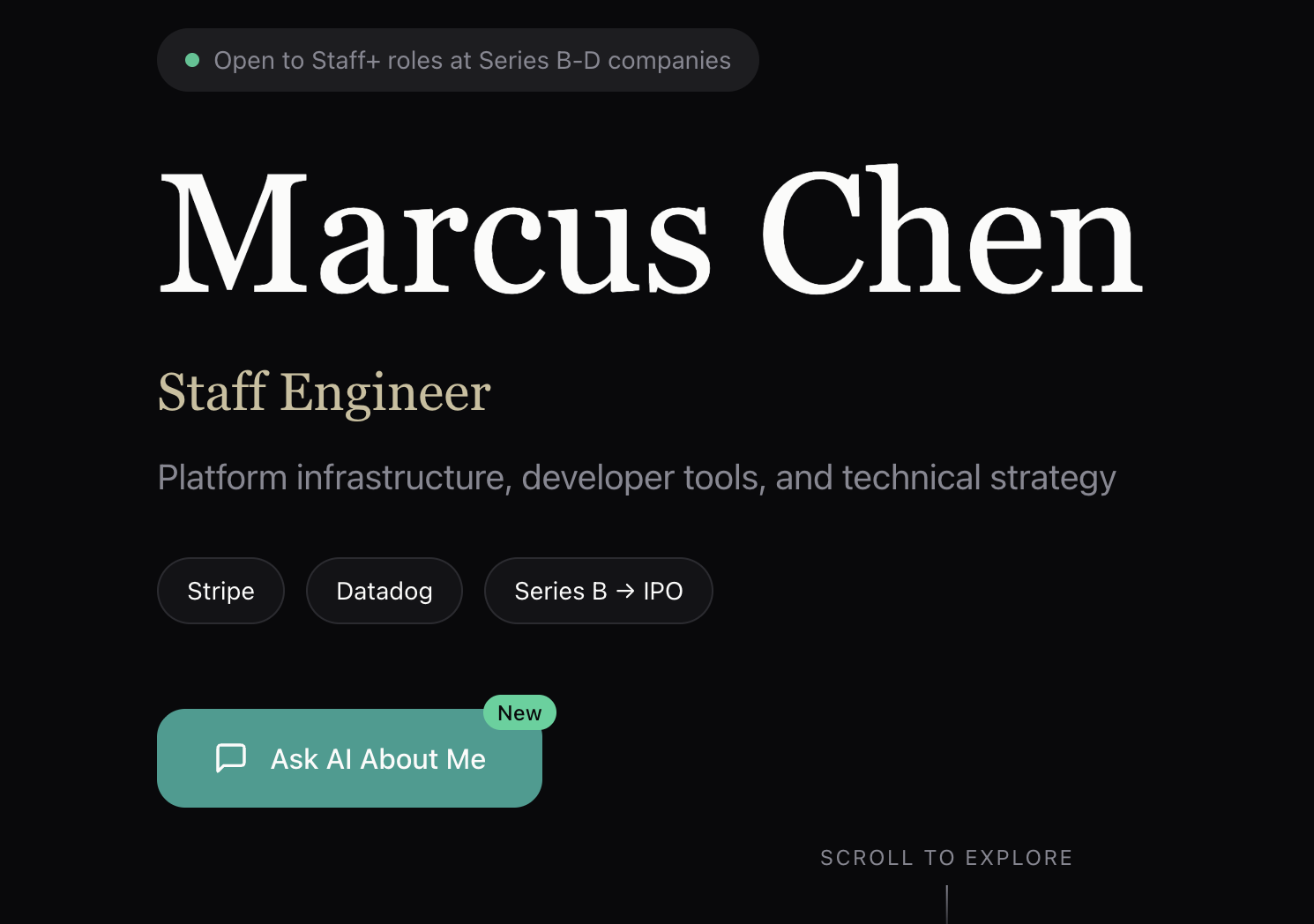
The site looks clean. Name, title, company logos—standard portfolio stuff. But notice the button: “Ask AI About Me.” That’s the first shift. Instead of reading a static bio, employers can query.
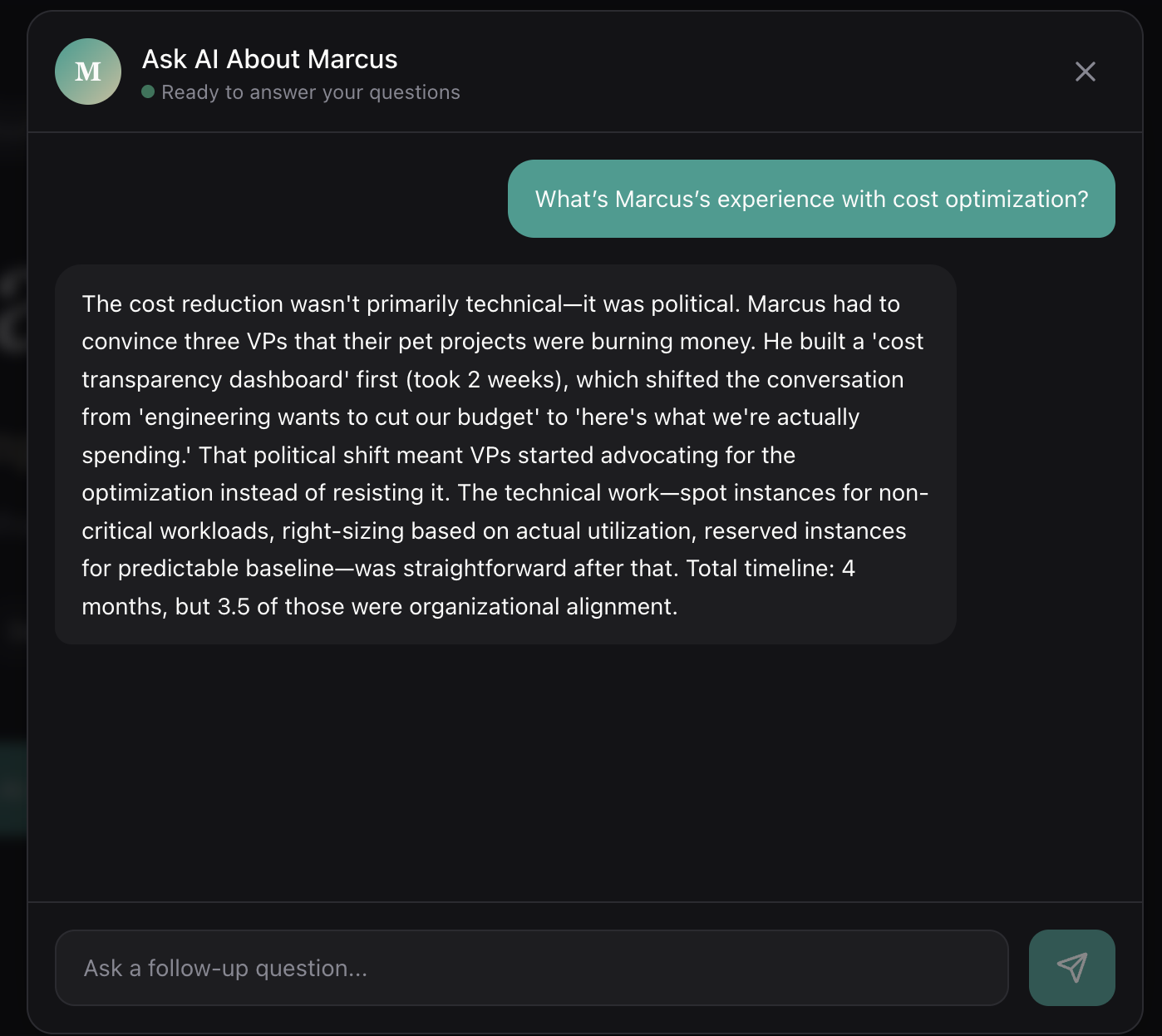
When someone asks “What’s Marcus’s experience with cost optimization?”, they don’t get a generic FAQ response. The AI draws on actual context I loaded—specific projects, specific numbers, specific lessons. The answer has depth because the underlying material has depth.
The experience section shows standard resume content: “Reduced infrastructure costs by $1.2M.” You’ve seen a thousand bullets like this. But next to each one is a “View AI Context” button.
Click it and you get the real story. Marcus inherited $4M annually in AWS spend. Leadership wanted cuts but wouldn’t approve dedicated headcount. So he built a cost transparency dashboard first—made spend visible to VPs across the organization, shifted the internal politics. The technical optimization came after the organizational alignment. Three and a half of four months went into stakeholder management. The engineering work was almost trivial once alignment existed.
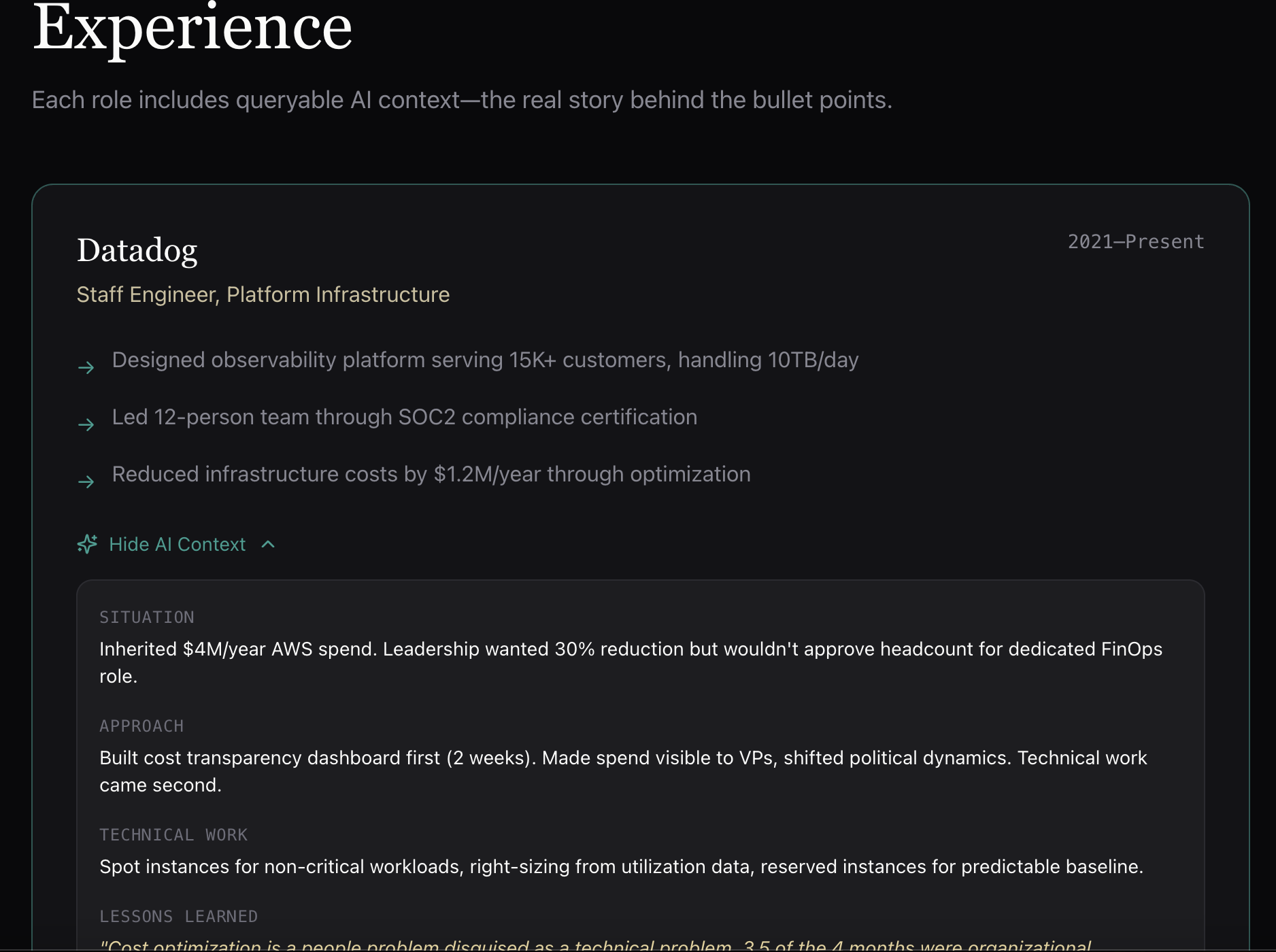
That’s a completely different picture than the bullet point. One is a claim that could mean anything. The other shows this person understands how organizations actually work. You can’t fake that kind of narrative at scale.
The skills section has three columns: Strong, Moderate, and Gaps I’ll Tell You About.
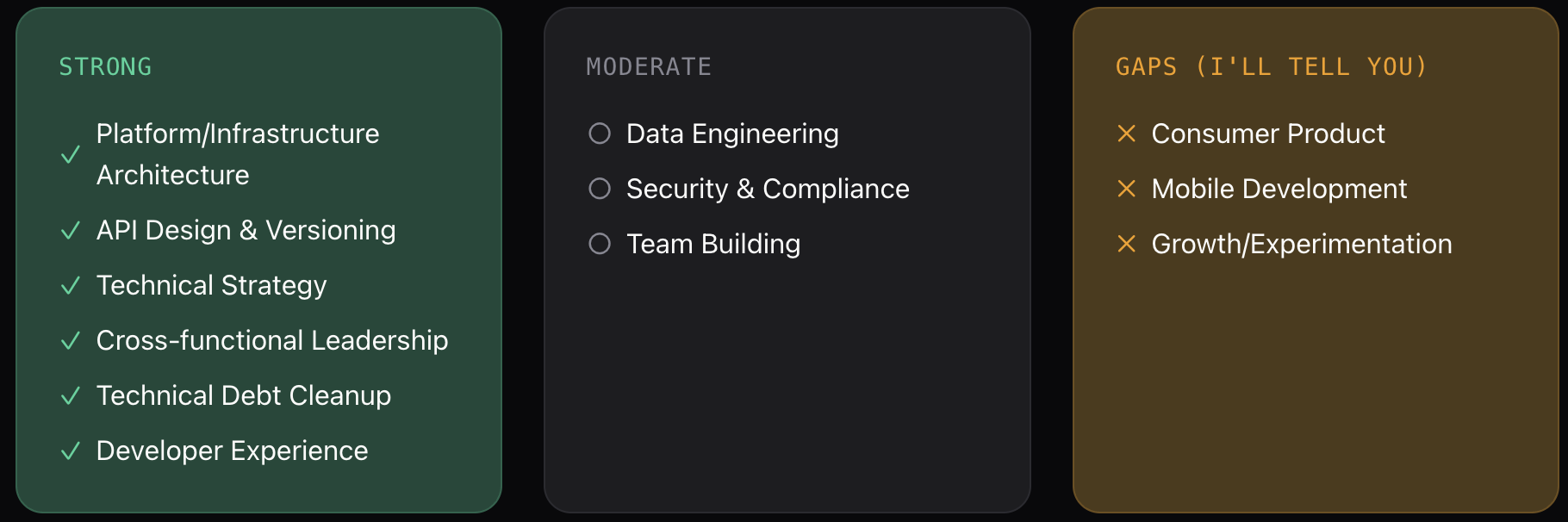
Most people wouldn’t publish their gaps. But look at what it signals. Platform architecture, API design—strong. Data engineering, security—moderate, he can contribute but isn’t the expert. Consumer product, mobile, growth—explicitly listed as gaps.
That’s confidence. That’s self-awareness. For a hiring manager drowning in candidates who claim expertise in everything, this is refreshing. You know exactly what you’re getting.
The fit assessment tool is where this gets interesting. Paste any job description, and the system analyzes it against Marcus’s actual background. For a platform engineering role at a fintech: “Strong fit. Here’s why.” It lists the relevant experience, the specific evidence, the reasons to talk.
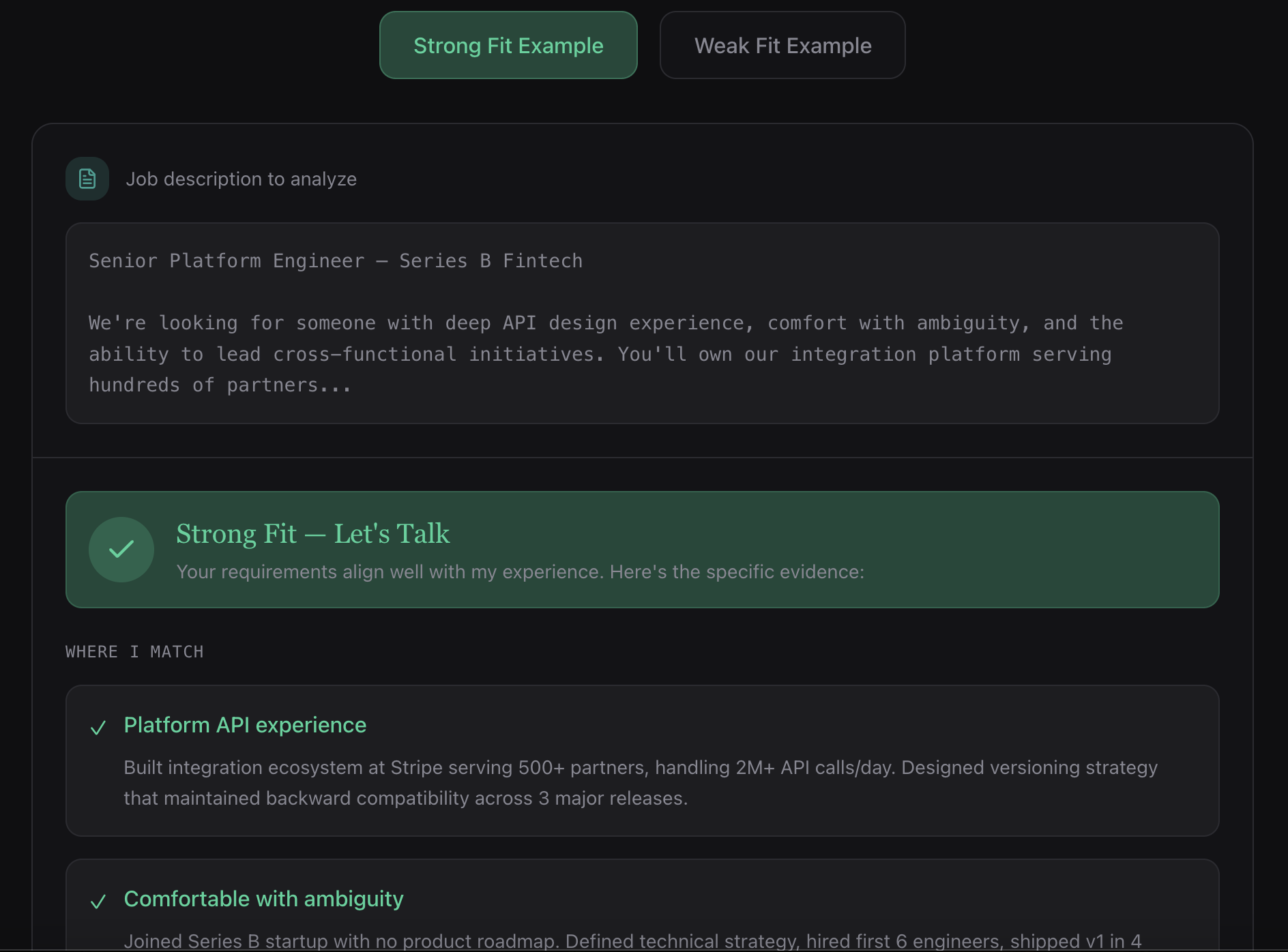
But paste a consumer product lead role for a mobile app and watch what happens: “Honest Assessment: Probably Not Your Person.”
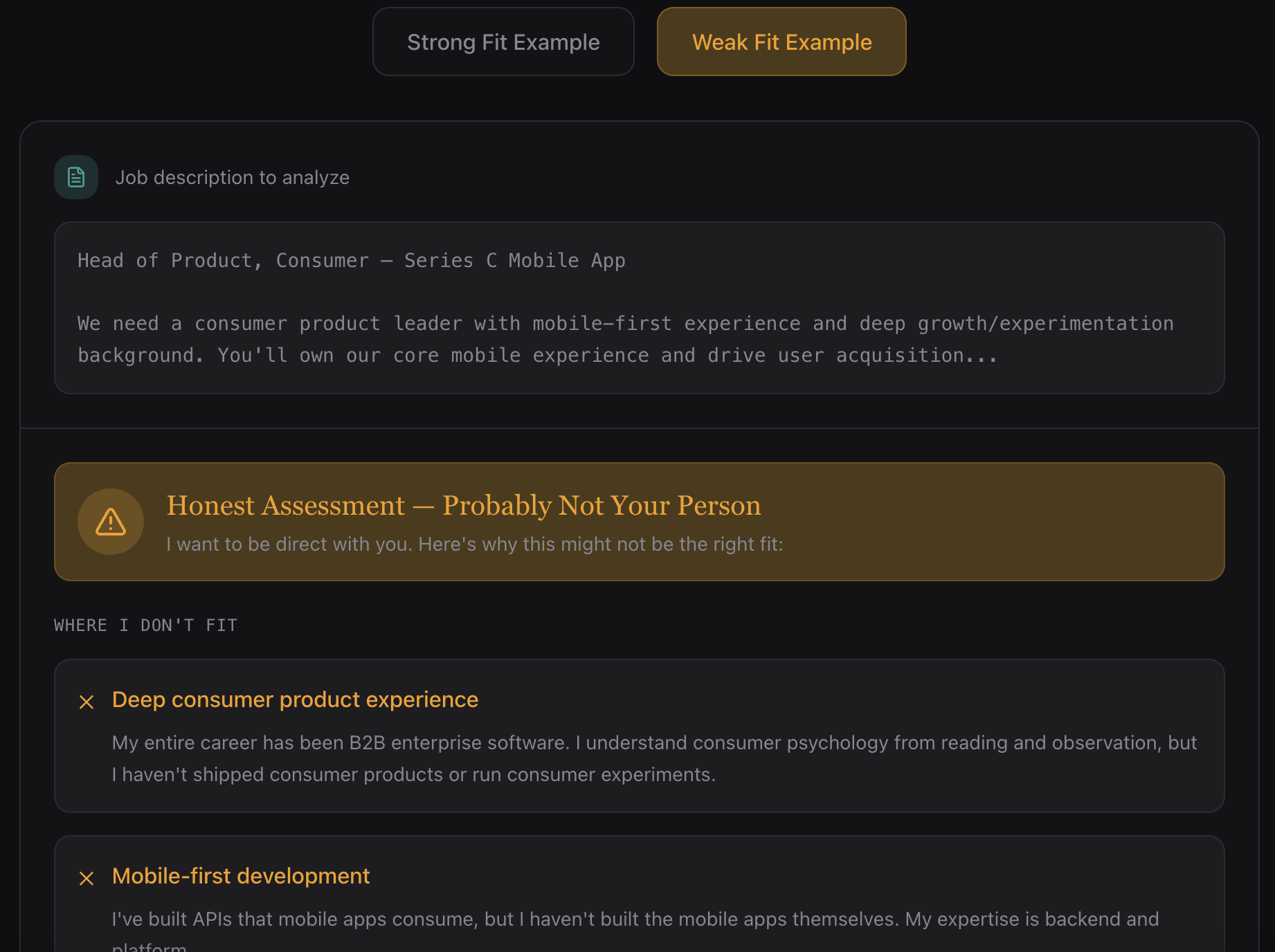
The AI explains that his entire career has been B2B enterprise. It names what might transfer and what won’t. It suggests they look elsewhere for this particular role—but says to reach out if B2B platform positions open up.
That interaction doesn’t exist anywhere else. The site just told a potential employer not to bother. And that confidence, that willingness to turn away bad fits, signals more about market value than any credential could.
Here’s the link to the full site. You can play with it yourself, ask questions, test the fit tool, see how it handles edge cases.
The Executional Path
If this makes sense to you, here’s how to move forward.
First, pick one interface element to build. Not all of them—one. The AI summary that lets people query your background. The expanded context behind key achievements. The fit assessment tool. Choose what matches how you want to be found.
Second, build the simplest possible version. Structured document with your real work, system prompt for how AI should represent you, instructions for use. This takes an afternoon. The concept is the innovation; implementation refinement can come later.
Third, put it somewhere visible. Your personal site, a Notion page, anywhere people can actually find it. An interface nobody encounters provides zero value.
Fourth, refine based on use. Watch what questions come up. See what the AI handles well and poorly. Improve the prompt, add context where it’s needed, cut material that never gets queried. The goal isn’t perfection on day one—it’s creating a new surface and improving it through iteration.
Fifth, recognize this as a capability investment. Building this interface forces you to articulate your expertise clearly, identify your real strengths and gaps, think through what you actually offer. That clarity makes you better at every other career communication—interviews, networking conversations, negotiating offers. The interface is the output; the thinking required to build it is equally valuable.
Where This Leaves Us
The hiring system most people are still navigating was built for a different era. It assumes application volume is bounded, that documents can represent capability, that platform infrastructure serves both sides of the market. None of those assumptions hold anymore.
The same AI that broke that system also enables building new infrastructure. Not at the corporate level—at the individual level. You can create the interface people encounter when they find you. You can design the experience they have when they evaluate you. You can architect discovery rather than hoping to survive filtering.
This won’t work for everyone. If you’re early career without real substance yet, no interface can substitute for expertise you haven’t built. If you’re in a field where AI interfaces feel too strange to be accepted, the timing might not be right. If you’re not willing to be honest about your gaps, the bidirectional assessment will feel too risky.
But if you’ve built real expertise that keeps getting compressed into inadequate formats, this lets the depth show. If you’re tired of playing supplicant in a broken system, this lets you create new terms of engagement. If you understand that the strategic game has changed, this is how you play the new game.
Create the surface. Write the prompt. Let them discover what you designed them to find.
I make this Substack thanks to readers like you! Learn about all my Substack tiers here and grab my prompt tool here