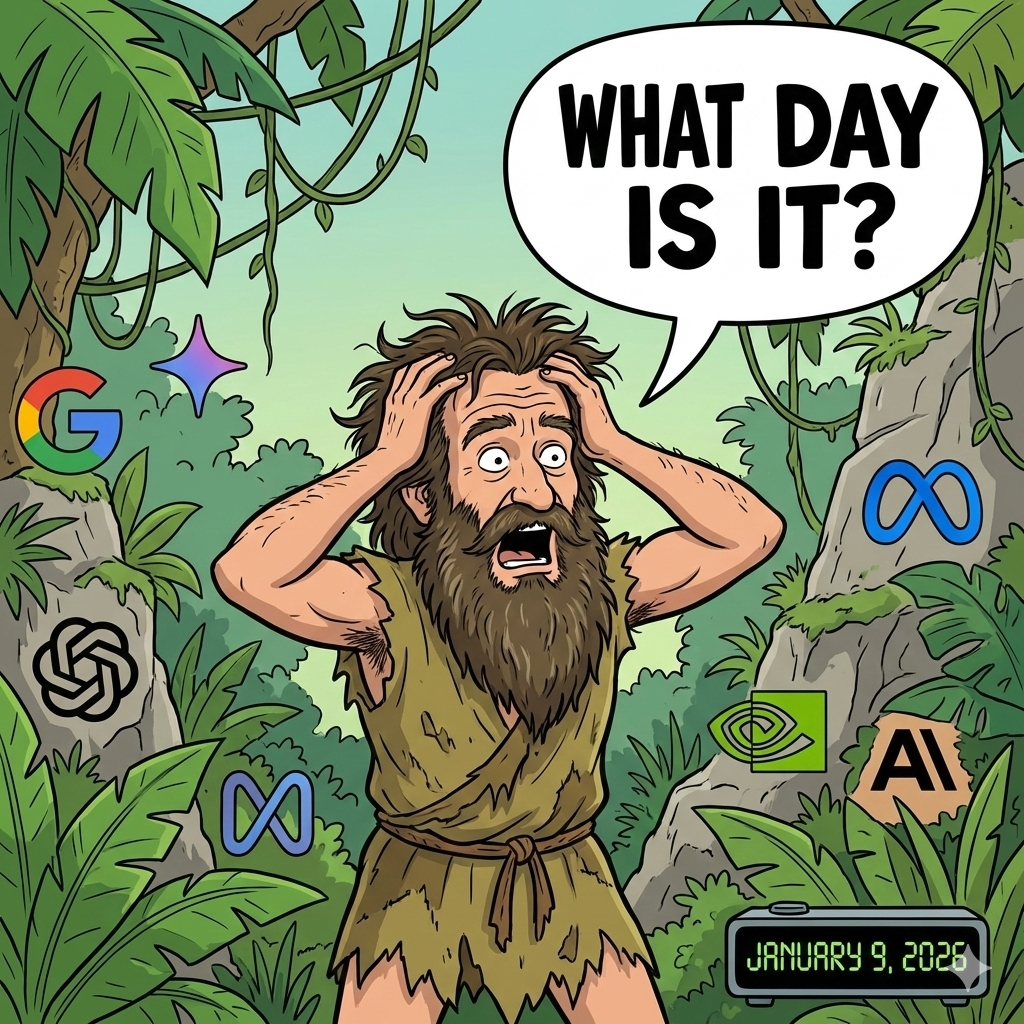
We're not even 10 days into 2026 and all the biggest players (NVIDIA, Google, Meta, and more) are starting the year off sprinting--here's what you need to know.
By Nate
Published: 2026-01-10
URL: https://natesnewsletter.substack.com/p/ai-news-that-matters-for-builders
If you took time off over the holidays, good for you. AI did not. The first week of 2026 has delivered one of the most consequential news cycles in recent memory: NVIDIA unveiled Vera Rubin at CES, redefining what an AI platform even means. Meta closed a $2 billion acquisition of Manus, signaling that the race is now about agentic execution at scale, not just model performance. AMD positioned itself as the credible second source for enterprise inference. And the Model Context Protocol moved into the Linux Foundation, beginning the standardization of how agents interact with everything.
Meanwhile, two infrastructure stories emerged that will shape everything else: power constraints are becoming the primary bottleneck for AI scale, with data centers facing conditional access to the grid. And OpenAI formally conceded what security researchers have known for years: prompt injection is a permanent feature of the agentic landscape, not a bug to be patched.
Stepping back, three themes are defining 2026’s starting position: the hardware competition is shifting from chips to complete systems; agent security has entered a permanent arms race; and the winners will be whoever makes AI infrastructure boring, reliable, and governable.
Top Stories This Week
- NVIDIA announced Vera Rubin at CES: a six-chip, extreme-codesigned AI platform promising 10x token cost reduction and positioning NVIDIA as a platform company, not a GPU company
- Meta acquired Manus for $2B+, buying agentic harness technology that can finish work at scale across their massive platform surface area
- AMD unveiled MI455 and MI440X at CES with OpenAI’s Greg Brockman on stage, positioning themselves as the chip for regulated industries and hybrid deployments
- Microsoft partnered with MISO to modernize the Midwest power grid, marking hyperscalers becoming grid stakeholders rather than just customers
- The “bring your own power” fight escalated as PJM and regional operators proposed requiring data centers to disconnect during peak demand
- Anthropic donated MCP to the Linux Foundation’s new Agentic AI Foundation, with OpenAI, Google, Microsoft, and AWS joining as founding members
- Google launched fully managed MCP servers for Maps, BigQuery, GCE, and GKE, turning tool use into managed infrastructure
- OpenAI explicitly stated prompt injection is “unlikely to ever be fully solved,” conceding a core security truth about agents
- Cursor acquired Graphite for well over its $290M valuation, betting that the winning AI dev platforms will own the entire SDLC loop
Lots to cover, so let’s get into it.
Subscribers get all posts like these!
Story 1: NVIDIA Unveils Vera Rubin Platform at CES
A Six-Chip Stack That Redefines AI Infrastructure
What happened: On January 5, 2026, at CES in Las Vegas, NVIDIA CEO Jensen Huang announced that the Vera Rubin platform is in full production, positioning it as NVIDIA’s first “extreme-codesigned” AI platform. Named after the astronomer who discovered dark matter, Vera Rubin is not a chip but a six-component integrated stack: the Vera CPU (88 Olympus cores with “spatial multithreading”), Rubin GPU (288GB HBM4, 22 TB/sec memory bandwidth), NVLink 6, ConnectX-9 SuperNIC, BlueField-4 DPU, and Spectrum-6 Ethernet. NVIDIA claims Vera Rubin delivers 5x inference performance and 3.5x training performance versus Blackwell, while reducing token costs to roughly one-tenth of the previous platform. The Vera Rubin NVL72 rack is 100% liquid-cooled and cable-free, with installation times dropping from two hours to five minutes. Products will be available from cloud partners including AWS, Google Cloud, Microsoft Azure, and CoreWeave in the second half of 2026.
Who’s involved:
- NVIDIA: Redefining itself as a platform company, not a GPU company, with an annual cadence of new AI supercomputers
- Hyperscalers: Microsoft, AWS, Google Cloud, and Oracle are among the first cloud providers to deploy Vera Rubin-based instances
- AI Labs: OpenAI, Anthropic, Meta, and xAI are expected to embrace the new tech for training and inference
- GPU Clouds: CoreWeave, Lambda, Nebius, and Nscale will integrate Rubin-based systems beginning in H2 2026
Why it matters: NVIDIA is trying to lock the market at the system level. The performance and cost curve for agentic workloads is increasingly dominated by memory, networking, and orchestration, not raw GPU math. If NVIDIA wins the platform definition, they own the deployment playbook for every hyperscaler and GPU cloud. The new “Context Memory Storage” explicitly targets long-context inference and reasoning workloads. This is NVIDIA preemptively defining the benchmark category that will matter for AI agents: inference throughput per watt per dollar under real agent workloads with long context, tool calls, retrieval, and retries. NVIDIA delivered a clear message: faster, cheaper models for all of us, which looks like ambient AI everywhere by the second half of 2026.
What to watch: The real contest shifts from “who has the best chip” to who controls token economics end-to-end. In 2026, buyers will start comparing vendors on inference throughput per watt per dollar under real agent workloads. The Vera Rubin platform is NVIDIA’s attempt to own that definition before anyone else can challenge it. Watch for NVIDIA’s Groq licensing deal (up to $20 billion) to bear fruit, and for how quickly AMD’s Helios platform can close the gap.
Story 2: Meta Acquires Manus for $2B+
Buying the “Agentic Harness” That Can Finish Work at Scale
What happened: On December 29, 2025, Meta announced it would acquire Manus, a Singapore-based AI agent startup with Chinese roots, for a valuation exceeding $2 billion. The deal, reportedly struck in about 10 days, values Manus at more than four times its $500 million valuation from a Benchmark-led funding round in April. Manus launched its general AI agent just eight months prior and claims to have achieved over $100 million in annual recurring revenue, processed over 147 trillion tokens, and powered the creation of more than 80 million virtual computers. Meta says Manus will continue operating its subscription service while integrating the technology into Meta AI and enterprise offerings across Facebook, Instagram, and WhatsApp. A key condition of the sale was complete divestment of original Chinese backers, including Tencent and HongShan, to satisfy U.S. national security concerns.
Who’s involved:
- Meta: Buying agent productization speed to complement its Llama models and massive distribution surface
- Manus founder Xiao Hong (”Red”): Building from the Monica.im browser extension to a fully autonomous agent platform
- Benchmark: Led Manus’s $75M round in April; now seeing a 4x+ return in eight months
- Regulators: The deal will face scrutiny given Manus’s Chinese-founded origins and potential geopolitical implications
Why it matters: This is a “distribution + execution layer” deal. Meta already has models and data; what it needed was a productionized agent loop (UX, orchestration, task reliability) that can ride its massive surface area. Building agentic harnesses is hard to do in practice, and Manus is one of the few teams that has delivered a fully featured agent that can finish work at scale. The acquisition signals that 2026’s defensible advantage is operational agent reliability at scale (guardrails, evals, rollouts, safety telemetry, undo), not a clever demo. The “Singapore-based with Chinese founders” structure is also a preview of how geopolitics will sculpt agent supply chains.
What to watch: Watch for Manus technology to appear in WhatsApp, where Meta is trying to replicate WeChat’s “super-app” model. Mark Zuckerberg has been explicit about wanting to build the “companion that helps us do stuff.” Also watch for regulatory scrutiny from Washington and whether the complete Chinese divestment satisfies national security concerns. The real metric is whether Meta can turn its 800+ million weekly ChatGPT-competitive users into agent customers.
Story 3: AMD’s CES Counterpunch with MI455 and MI440X
Positioning as the Chip for the “Middle World”
What happened: On January 5-6, 2026, at CES, AMD CEO Lisa Su unveiled the MI455 (rack-scale server focus) and MI440X, explicitly framed as enterprise-friendly hardware designed to fit into “traditional business infrastructure.” Greg Brockman, president and co-founder of OpenAI, joined Su on stage to discuss how AMD’s chip improvements are helping OpenAI meet rising computing needs, calling “chip innovation key to safely and effectively scaling AI.” Su also previewed the MI500, AMD’s next-generation AI processor shipping in 2027, projected to be up to 1,000 times faster than previous versions. The announcement reinforced AMD’s 2025 partnership with OpenAI, expected to bring billions of dollars annually. AMD also showcased its “Helios” rack-scale platform, powered by MI455X accelerators and Venice CPUs, delivering up to 3 AI exaflops per rack.
Who’s involved:
- AMD: Pushing a wedge into the market segment that matters for 2026: inference scale-out beyond hyperscalers
- OpenAI: Validating AMD as a credible supplier at the frontier, not just a second source
- Enterprises: Gaining a chip designed for on-premise AI that fits existing infrastructure without AI-specific clusters
Why it matters: The “AI stack” is splitting. Frontier training stays concentrated, but inference footprints are decentralizing. AMD is positioning the MI440X as “the chip for the middle world”: regulated industries, enterprises with data sovereignty concerns, organizations that prefer hybrid deployments (cloud burst + on-prem inference for cost control). The framing is deliberate: you don’t have to only use chips designed for frontier training if you want to serve enterprise workloads. Demand is exploding fast enough that AMD can do very well with this positioning without really taking away from NVIDIA’s growth story.
What to watch: The MI440X’s success will depend on how quickly enterprises adopt hybrid deployment architectures. Watch for AMD’s OpenAI deal to translate into visible market share gains, and for whether AMD’s ROCm software ecosystem can close the gap with NVIDIA’s CUDA. The announcement of Brockman on stage was a major vote of confidence; the question is whether that confidence translates into enterprise procurement decisions.
Story 4: Microsoft Partners with MISO on Grid Modernization
Hyperscalers Become Grid Stakeholders
What happened: On January 6, 2026, Microsoft announced a partnership with MISO (Midcontinent Independent System Operator) to develop a unified data platform that will modernize grid planning and operations across 15 U.S. states and Manitoba, Canada, serving approximately 42 million people. Microsoft will provide access to Azure cloud infrastructure and Foundry AI technologies to enhance grid forecasting, improve weather disruption prediction, and strengthen real-time reliability through AI-driven insights. The platform is designed to reduce decision cycles from weeks to minutes, enabling MISO to predict and avoid grid congestion before it occurs. The partnership comes as MISO advances a $22 billion regional transmission plan including more than 1,800 miles of new high-voltage transmission lines.
Who’s involved:
- Microsoft: Providing Azure, Foundry AI, Power BI, and Microsoft 365 Copilot to transform grid operations
- MISO: One of seven RTOs in the U.S., managing the bulk electric grid and wholesale markets across the Midwest and South
- Data center operators: Increasingly dependent on grid reliability as AI demand surges
Why it matters: This is the cleanest “power is now compute’s constraint” headline. Hyperscalers are increasingly acting like grid stakeholders, not just customers. Grid planning timelines and interconnection queues are becoming strategic dependencies for AI roadmaps. The partnership follows similar initiatives like Google’s collaboration with PJM Interconnection. As data center demand surges, utilities and ISOs are starting to demand something back: flexibility, forecasting, and demand response. This quietly pushes data centers toward becoming controllable load rather than pure “always-on.”
What to watch: Expect a new competitive axis: “grid advantage.” Sites, deals, and partnerships that unlock power faster become as valuable as model performance itself. Companies that figure out how to be good grid citizens will have deployment advantages their competitors can’t easily replicate. The industry is growing up and becoming integrated with critical infrastructure.
Story 5: The “Bring Your Own Power” Fight Heats Up
Policy-Defined AI Scale Begins
What happened: The Wall Street Journal reported a growing clash between utilities, grid operators, and data center developers. PJM and other regional operators are proposing stopgaps requiring data centers to bring their own power or disconnect during peak demand to protect reliability while grid upgrades lag. Texas has already passed legislation enabling disconnection during shortages, and other regions are exploring conditional access. In parallel, FERC has been shaping rules around large-load interconnections and co-location, directing PJM to implement clearer rules for AI-driven large loads co-located with generators, framed as a reliability and consumer-cost issue.
Who’s involved:
- Regional grid operators (PJM, MISO, ERCOT): Proposing conditional access to protect grid reliability
- FERC: Shaping federal rules around large-load interconnections
- Data center developers: Facing new constraints on power access
- AI model providers: Whose SLAs depend on reliable power
Why it matters: This is the beginning of policy-defined AI scale. If “firm power” becomes conditional, it changes everything: where data centers go, what they build (gas + batteries + microgrids), and how AI services are priced (higher reliability premiums). We may see a huge market open for “AI load shaping”: software and contracts that let operators commit to shedding 15-30% of load in emergencies without breaking SLAs. If you can’t do that, your interconnection timeline (and your P&L) gets worse. The agents story becomes inseparable from demand response and behind-the-meter generation.
What to watch: The reputational and regulatory risk vectors for the biggest AI deployers are becoming local and concrete: emissions, public health impacts in communities hosting peaker plants, and cost spikes attached directly to data center growth. Expect a shift from generic “net-zero” claims to site-specific power strategies, because “where your tokens come from” starts to matter to enterprise buyers.
Story 6: MCP Joins the Linux Foundation’s Agentic AI Foundation
Protocol De-risking and the Infrastructure for Agents
What happened: On December 9, 2025, Anthropic announced it is donating the Model Context Protocol (MCP) to the newly formed Agentic AI Foundation (AAIF), a directed fund under the Linux Foundation. The AAIF was co-founded by Anthropic, Block, and OpenAI, with support from Google, Microsoft, AWS, Cloudflare, and Bloomberg as Platinum members. MCP joins Block’s goose (an AI agent framework) and OpenAI’s AGENTS.md (a standard for providing context to coding agents) as founding projects. Since its November 2024 launch, MCP has reached 97 million+ monthly SDK downloads, with over 10,000 public servers and first-class client support across ChatGPT, Claude, Cursor, Gemini, Microsoft Copilot, Visual Studio Code, and more.
Who’s involved:
- Anthropic: Donating MCP to ensure it remains vendor-neutral and community-driven
- OpenAI: Contributing AGENTS.md and actively participating in MCP’s steering committee
- Block: Contributing the goose AI agent framework
- Linux Foundation: Providing neutral governance under the same stewardship as Kubernetes, PyTorch, and Node.js
- Enterprise adopters: Gaining confidence to invest in MCP knowing it won’t be pinned to one vendor’s roadmap
Why it matters: This is protocol de-risking. Enterprises don’t want their agent tooling pinned to one vendor’s roadmap. Putting MCP under a neutral umbrella is a step toward interoperable tool use becoming commodity infrastructure, exactly the precondition for a real middleware market. Industry analysts have already begun calling this the “HTTP moment” for AI: just as HTTP enabled the World Wide Web by allowing any browser to talk to any server, MCP provides the foundation for an “Agentic Web” where autonomous entities can collaborate across organizational boundaries.
What to watch: MCP won’t just be “a nice standard” in 2026. It will become a governance surface: signed tool servers, permissioning frameworks, audit logs, provenance, and “least privilege” patterns. The winner won’t be whoever implements MCP first; it’ll be whoever makes MCP safe and operable in regulated environments. Watch for the MCP Dev Summit in New York in April.
Story 7: Google Launches Fully Managed MCP Servers
Making Google “Agent-Ready by Design”
What happened: On December 10, 2025, one day after the AAIF announcement, Google announced fully managed, remote MCP servers as an official layer across Google and Google Cloud services. Developers can now point agents at enterprise-ready endpoints rather than hand-rolling connectors for every integration. At launch, Google is offering MCP servers for Google Maps (Grounding Lite), BigQuery, Google Compute Engine (GCE), and Google Kubernetes Engine (GKE). Instead of spending a week or two setting up connectors, developers can now essentially paste in a URL. The servers are protected by Cloud IAM, Google Cloud Model Armor (a firewall for agentic workloads), and full audit logging. The MCP servers are available in public preview at no extra cost for existing enterprise customers.
Who’s involved:
- Google Cloud: Turning “tool use” into managed infrastructure with enterprise-grade security
- Enterprise developers: Gaining simplified access to high-value data without building custom integrations
- Agent builders: Now able to connect agents to Maps, BigQuery, and infrastructure services with minimal setup
Why it matters: Google is turning tool use into managed infrastructure: a step toward reliable, governed integrations being as standard as OAuth is today. This directly attacks the most painful part of building agents: keeping all those external connectors working, secure, and auditable over time. The strategic play is subtle but significant: managed MCP endpoints become a distribution weapon. Once connectors are standardized and governed, competition shifts to who has the richest tool surface plus the tightest IAM/billing integration. Agent ecosystems will look less like prompt libraries and more like cloud marketplaces for capabilities.
What to watch: Google plans to extend MCP support to Cloud Run, Cloud Storage, AlloyDB, Cloud SQL, Spanner, Looker, Pub/Sub, and more in the coming months. The “paste a URL” simplicity could be a watershed moment for agent adoption. Watch how quickly AWS and Microsoft respond with similar managed MCP offerings.
Story 8: OpenAI Says Prompt Injection Is “Unlikely to Ever Be Fully Solved”
Conceding a Core Security Truth About Agents
What happened: On December 22, 2025, OpenAI published a security disclosure about hardening ChatGPT Atlas (its browser agent) against prompt injection attacks. The notable part wasn’t the security updates; it was the admission. OpenAI explicitly stated that “prompt injection, much like scams and social engineering on the web, is unlikely to ever be fully ‘solved.’” The company shipped updates after internal automated red-teaming, using an LLM-based “attacker” trained with reinforcement learning, uncovered new attack classes. One demonstration showed the automated attacker planting a malicious email that tricked the agent into sending a resignation letter to a user’s boss instead of drafting an out-of-office reply. The update included a newly adversarially trained model and strengthened system safeguards.
Who’s involved:
- OpenAI: Formally conceding the permanence of prompt injection as a security challenge
- UK National Cyber Security Centre: Issued a concurrent warning that prompt injection “may never be totally mitigated”
- Enterprise security teams: Now operating in a world of risk management rather than risk elimination
- Agent product teams: Building seatbelts (constrained execution, approval gates, rollback) as first-class features
Why it matters: The industry is conceding a core security truth about agents: if an agent can read untrusted content and take actions, you will always be playing defense. This pushes the entire category toward a “seatbelt mindset”: constrained execution, approval gates, provenance tracking, comprehensive logs, and rollback capabilities. Security is becoming a UX primitive. Winning agent products in 2026 will make “safe autonomy” feel normal: action plans you can review, sandboxed steps, explicit scopes, and default-deny tool access patterns. Enterprises will refuse anything that can’t explain why it did what it did.
What to watch: The products that nail security will earn enormous trust; the ones skipping it will miss out. Watch for the emergence of agent security tooling as a distinct category, and for enterprise procurement requirements to include mandatory explainability and audit trails. The agent landscape is splitting between demos and production-ready systems.
Story 9: Cursor Acquires Graphite
Owning the Entire SDLC Loop
What happened: On December 19, 2025, Cursor (Anysphere) announced it has signed a definitive agreement to acquire Graphite, the code review and collaboration platform. While financial terms weren’t disclosed, Axios reported that Cursor paid “way over” Graphite’s last valuation of $290 million (set during a $52 million Series B in March 2025). Graphite will continue operating as an independent product with its existing team, while exploring deeper integrations with Cursor throughout 2026. Graphite serves tens of thousands of engineers at over 500 companies including Shopify, Snowflake, Figma, Robinhood, and Ramp. This is Cursor’s third acquisition following Supermaven (November 2024) and talent from Koala (July 2025).
Who’s involved:
- Cursor (valued at $29 billion): Expanding from code generation into the entire development lifecycle
- Graphite founders Merrill Lutsky, Greg Foster, Tomas Reimers: Building the “end-to-end platform for building with AI”
- Enterprise engineering teams: Now seeing AI coding tools expand into review, merge, and deployment
- Competitors (GitHub Copilot, OpenAI, Anthropic): Facing a more vertically integrated rival
Why it matters: Vibe coding’s bottleneck has moved. Generating code got dramatically easier in 2025, but shipping code (review queues, CI pipelines, merge discipline, quality gates) did not. Cursor buying Graphite is a bet that the winning AI dev platforms will own the entire SDLC loop, not just the code editor. The editor is just the front door; whoever owns review and merge owns organizational trust. That’s what turns individual vibe coders into enterprise software factories.
What to watch: In 2026, AI coding assistants will become AI delivery systems: policy checks, test synthesis, risk scoring, code review automation, and merge orchestration. The personal vibe coding projects of 2025 are going to become easy to manage for teams in 2026. Watch for Cursor to integrate Graphite’s “stacked pull request” workflow into its editor, and for competitors to respond with similar acquisitions.
Grab the prompt to map this week’s news to your specific situation.
That’s your 2026 starting position. Power constraints are real and getting realer. The hardware competition is shifting from chips to systems. Agent security is in a permanent arms race scenario. And the winners are going to be whoever can make AI infrastructure boring, reliable, and governable, because AI is going to be everywhere.
With that, let’s get to building.
Sources: <https://www.perplexity.ai/search/build-me-a-complete-report-tha-17EJQ_jpSKuiAFRR.Ei4mg#0>
I make this Substack thanks to readers like you! Learn about all my Substack tiers here and grab my prompt tool here