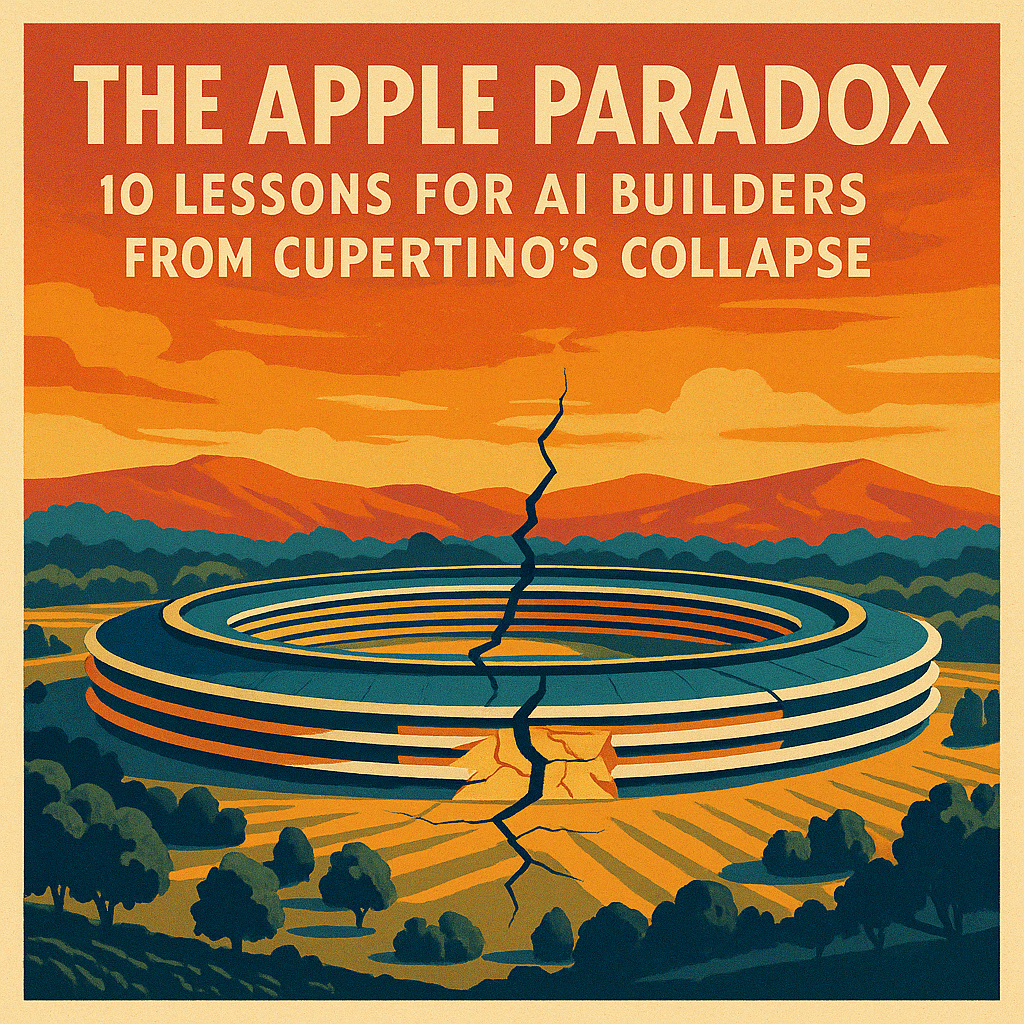
Why the company that taught us everything about building great products can't build for AI—and what their failure teaches us about shipping, speed, and the new rules of technological power
By Nate
Published: 2025-08-15
URL: https://natesnewsletter.substack.com/p/the-apple-paradox-10-lessons-for
Yesterday, Bloomberg dropped Apple's grand AI strategy: a tabletop robot for 2027. A "lifelike" Siri. Smart displays. Home security cameras.
By then, ChatGPT will be on version 7. Claude will have evolved through multiple generations. And Apple will ship... I’m betting they’ll ship a robot running yesterday's AI.
This should terrify you—not because Apple is failing, but because everything Apple taught us about building products is now wrong.
For forty years, Apple didn't just make products. They trained an entire generation—you, me, every PM, every founder, every designer—in the religion of perfection. Wait to ship until it's perfect. Control the full stack. Own the experience end-to-end. Eliminate complexity. The customer doesn't know what they want until you show them.
Sure, we heard about Y Combinator, Paul Graham, “ship fast and break things”—but in the back of all our heads loomed the expectation of Cupertino, and that obsession with quality got more and more important the more scaled our companies got. Breaking things was for small companies, and even Facebook outgrew it.
So these weren't just Apple's principles. They became our principles. The invisible assumptions behind every product decision we make. The voice in our heads saying "would Apple ship this?" or more realistically “wow this kind of sucks is it close enough to the quality bar that it will be ok?”
That instinct to lean into deterministic quality is now trying to kill your company, and it’s not because quality is bad!
Here's what nobody's saying clearly: Apple isn't randomly failing at AI. They're failing in a highly specific pattern that reveals exactly which assumptions you need to invert to succeed. Each of their failures maps to a rule reversal—a place where the old wisdom doesn't just fail, it fails catastrophically.
The products winning right now—ChatGPT, Claude, Midjourney—violate every principle Apple taught us. They shipped broken. They let users figure out use cases. They federate instead of integrate. They iterate in public. They choose capability over polish, every single time.
But this isn't just another "Apple is behind" piece. We’ve had enough of those. This is a decoder ring for the new rules. Because if you're still following the playbook Apple wrote—perfectionism, secrecy, control, curation—you're optimizing for failure. (And if you don’t think you are, I encourage you to listen in on a C-suite conversation sometime—so many of them highlight one or another of these qualities.) But those qualities won’t work anymore. Those same instincts that would have made you successful in 2007 will bury you in 2025.
The 10 lessons I’ve constructed here aren't random observations. They're the exact inversions happening right now—the places where your Apple-trained instincts are betraying you, and what to do instead in the age of AI.
Your iPhone is becoming beautiful glass for accessing ChatGPT. The Mac is becoming a premium terminal for Claude. Apple is becoming what Jobs despised most: expensive infrastructure for other people's intelligence.
Let me show you exactly why the company that perfected the art of technology can't ship AI—and the specific inversions you need to make to build anything that matters in the age of intelligence.
Subscribers get all these newsletters!
The Priesthood and the Prompt: Why Apple Can't Win the AI War
The News
This week, Bloomberg reported Apple's grand AI strategy: a tabletop robot companion for 2027, featuring a "lifelike" Siri powered by large language models. Pardon me while I choke on my coffee here.
The company also announced plans for AI-powered smart displays and home security cameras, with the unsurprising news that the new Siri integration delayed another year—now arriving "next year at the earliest."
In the time it will likely take Apple to ship this robot, OpenAI will likely release ChatGPT-5, GPT-6, and possibly GPT-7. Google's Gemini will be several generations ahead. Anthropic will have evolved Claude through multiple new iterations. The AI landscape of 2027 will make today's capabilities look quaint.
Meanwhile, Apple Intelligence—announced with fanfare at WWDC—remains in "limited beta" eight months later, with features like Genmoji and enhanced notifications trickling out to select users. Full availability has been pushed to 2026. Tim Cook tells employees AI is "as big or bigger than the internet," yet Apple's actual AI products remain perpetually on the horizon.
The phrase that gives everything away appears in multiple reports: Apple is taking a "measured approach." In an industry where OpenAI ships updates weekly and Google iterates in public, "measured" has come to mean something different to me: a euphemism for something darker—structural paralysis.
The Cargo Cult
After years in AI, announcements read like messages from a parallel universe where time moves differently. While Apple plans a 2027 robot, ChatGPT has already reached ~800 million users, Microsoft has integrated AI across Office, and Google has rebuilt search around AI and has reached hundreds of millions of users themselves with Gemini. These companies measure progress in weeks; Apple is planning in years.
The pattern is impossible to ignore. Every Apple AI announcement follows the same trajectory: ambitious reveal, delayed timeline, limited rollout, further delays, quiet scaling back of promises. Siri was going to become conversational years ago. The Vision Pro was going to revolutionize computing. Now a robot in 2027 will finally crack the code. So they say.
This isn't just being behind—it's playing an entirely different game, perfecting yesterday's solutions while others define the terms for tomorrow’s customer experiences.
The Surface Reading
The conventional analysis writes itself: Apple is "behind" in AI. While Microsoft integrated GPT into Office, while Google rebuilt search around AI, while OpenAI became a household name, Apple was still trying to make Siri understand compound sentences.
But this surface reading—Apple as merely slow—misses the deeper tragedy. This isn't a company that's failing to execute on the right strategy. This is a company whose entire cultural DNA is optimized for a world that no longer exists.
And that’s what’s interesting ot me. Because the lessons we learn from Apple are the lessons all of us need to learn as we begin to discover how companies (and products, and careers) are built in the age of AI.
Something Deeper: The Jobs Thesis
Let me suggest a reading of the Apple situation that’s deeper and more interesting. It requires us to go back in time a bit, so stay with me…
Steve Jobs built Apple on a profound insight: computers were too powerful to remain imprisoned by complexity. His solution was radical: take total control of the experience to paradoxically deliver more freedom to users. Don't make them think about drivers, file systems, or compatibility. Just let them create.
This wasn't mere product strategy—it was theology. Jobs believed in a technological priesthood where Apple's designers, through monastic dedication to simplicity, would intercede between users and complexity. The famous "1000 nos for every yes" wasn't just focus; it was a belief that Apple possessed the wisdom to know what should exist.
This thesis created four pillars of Apple culture:
- Perfection Before Permission: Never ask users what they want; show them what they didn't know they needed. Ship only when you've eliminated every friction point. This is where the obsession with chamfered edges comes from.
- A Torus of Secrets: Yes, I had fun naming this one. Development happens in secret, integration beats modularity, control the atoms to perfect the bits. 1 Cupertino Way becomes an address where the smartest engineers work on secret projects for years at a time before finally revealing something astonishing to the public (or that’s the dream).
- Taste as Competitive Advantage: One person with perfect taste beats collective intelligence. Users don't know what's good until you show them. This was Steve. This was Jony Ive. It’s definitely not Tim Cook, who came from the hardware supply chain side of things.
- Unit Economics as a Profit Driver: Every component is engineered for both perfection and scale. Unit economics matter. Engineers obsess over manufacturability as much as appearance. This is the foundation of Apple’s margins and longterm corporate value.
Every assumption here breaks or transforms in the AI era.
First, the core insight: Intelligence is obviously useful in a way computers weren’t.
Instead, intelligence is abundant but messy. Jobs' Apple was built to make scarce computing power with no obvious utility accessible through perfect interfaces. But AI flips this: today’s intelligence is so powerful that it is obviously useful. People will wrestle with terrible interfaces to access it. ChatGPT launched with a bare text box. Nobody cared. It was too useful.
Apple wasn’t built for a world where tech has that much obvious value.
Second, users are now teachers, not students. AI models learn from usage. Every prompt teaches. Apple's priesthood model—wisdom flowing one direction from Cupertino—can't comprehend a world where products get smarter through interaction. Their instinct to perfect in private means missing the feedback loops that make AI useful.
And the longer Apple delays, the worse the problem gets.
Third, value emerges from collision, not curation. The breakthrough AI applications come from users doing things creators never imagined. ChatGPT for therapy, Claude for coding, Midjourney for architecture. Apple's "we know best" culture would have prevented these use cases through over-curation.
Now, it’s still true that taste matters! I’ve written about it often. But AI is empowering a new generation of taste-makers, and the point is they aren’t limited to the white halls of Cupertino. They’re everywhere and don’t even need to be hired at a big name to be high-taste (thanks to the power of AI).
Again, Apple loses here by insisting that they have a monopoly on AI taste while the world evolves past them.
Fourth, hardware leverage is now a function of Nvidia, not Foxconn. Yes, there’s still unit economics in AI, but the economics have flipped. It’s no longer about perfecting a device to ship to hundreds of millions of people. It’s about scaling the delivery of bits via the efficient deployment of gigantic data centers. And because the value is delivered via bits, the leverage in pricing comes from smarter tokens.
Fundamentally the equation has shifted from dollar cost averaging iPhone components to figuring out the most efficient cost per intelligent token. That is not a world a hardware company is ready to handle. And the more Apple insists on fitting AI into their existing form factors, the more they are falling behind.
The River Runs Backward
Consider what users are tolerating right now to access AI:
- Hallucinations and confident incorrectness
- Daily model updates that break workflows
- Copy-pasting between different chat interfaces
- Multiple $20/month subscriptions
- Inconsistent outputs requiring prompt engineering
Apple spent forty years teaching people to demand perfection. AI is unteaching that lesson in real-time. The river that once flowed toward polish now rushes toward capability. Transformative-but-janky beats polished-but-incremental, and Apple's DNA simply cannot ship transformative-but-janky.
Apple would never have shipped the original ChatGPT. Too many errors. Too many edge cases. Too many ways for users to break it. Apple would have spent three more years in a secret lab trying to eliminate hallucinations. And the moment would have passed and we’d be talking about some other alternate AI future timeline.
The Walled Garden is a Prison
But all this isn’t the whole story. Apple has another major problem: The multi-intelligence future is the real killer. We're rapidly heading toward a world where you might want Claude for writing, GPT for coding, Gemini for research, Midjourney for images. Agents need to talk to other agents across platforms. Open standards and interoperability become essential. Value comes from orchestration, not ownership.
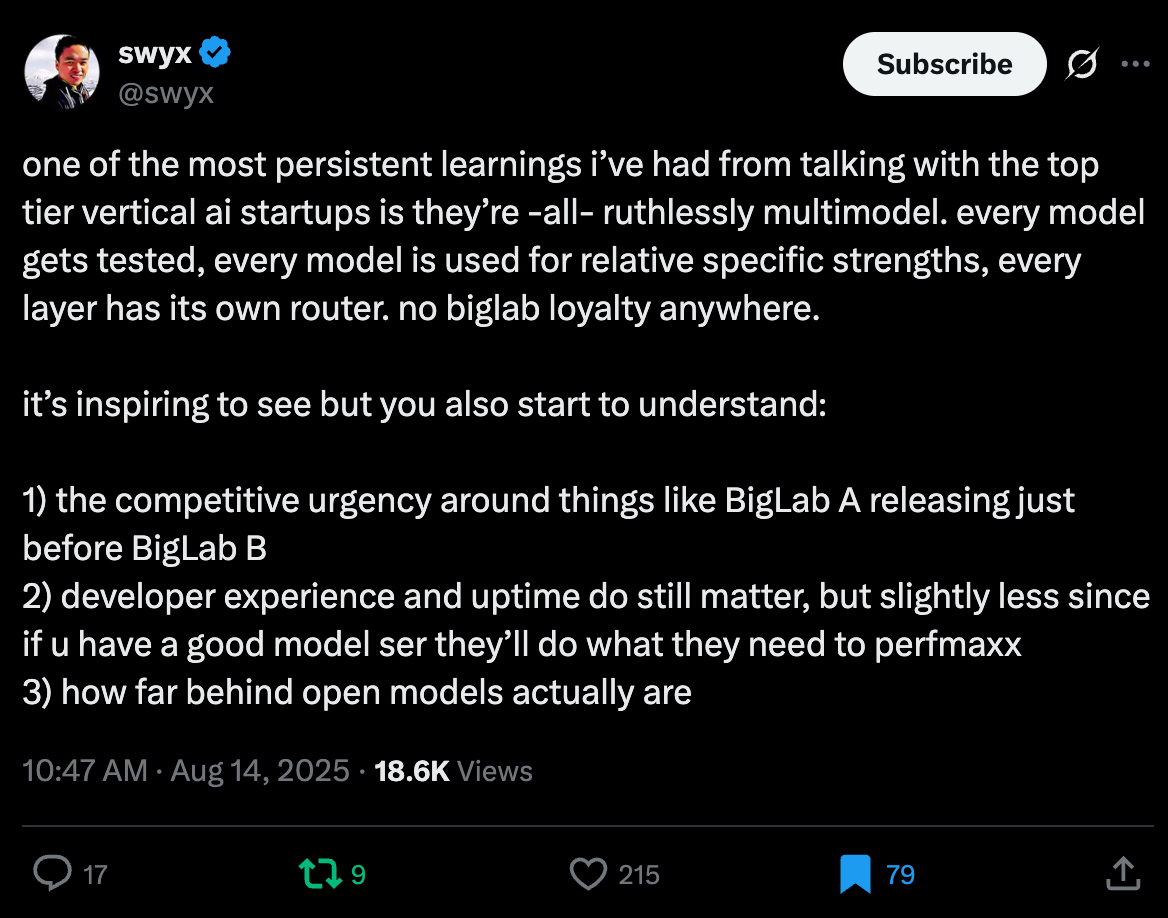
Apple's entire ecosystem philosophy—everything works perfectly as long as you stay inside—becomes a liability when intelligence needs to flow freely between systems. Their instinct is to build "Apple Intelligence" that only works with Apple products. That's like building a telephone that can only call other identical phones. (Yes, I realize this is literally what they did with the blue iMessage—that only works because of Apple’s hardware footprint.)
The walled garden made sense when the challenge was making computers work reliably. But intelligence wants to be federated. It wants to combine, recombine, and transcend boundaries. Every wall Apple has built becomes a barrier to intelligence flow. And that is turning Apple into a prison yard for intelligence.
Siri
Siri tells the whole story. Launched in 2011, it was ahead of the curve—the first mainstream voice assistant. By 2025, after fourteen years of development, Apple is still trying to make it "conversational."
Why? Because Apple approached Siri as a command interface to perfect rather than an intelligence to evolve. They focused on eliminating errors rather than expanding capabilities. They wanted predictable responses, not emergent behaviors. They built a better button when the world wanted a conversation partner.
They followed Steve’s playbook for hardware computing with an intelligence product, and it has been a disaster.
The 2027 robot repeats this error at spectacular scale. The AI already exists—GPT-5 Claude 4, Gemini (almost 3) are here now. While Apple designs hardware for 2027, competitors ship AI today and iterate hardware in parallel. Other AI labs experiment with hardware slowly while shipping software weekly. By 2027, we'll be on ChatGPT-7 while Apple ships hardware as if that’s what matters now.
Cultural Antibodies in an AI World
We talk about getting to an AI culture a lot. I hear it from executives, from team leaders, from people at all levels in companies engaged in AI transformation.
Apple is showing us the opposite: If most companies are trying to develop and evolve to fit the AI future, Apple is trying to force AI to conform to its own DNA.
Apple's culture now has antibodies against everything that makes AI work:
- Against shipping beta: But AI needs public iteration to learn and improve.
- Against messiness: But breakthrough capabilities come with rough edges that users willingly tolerate.
- Against openness: But intelligence wants to be federated across platforms and models.
- Against admitting ignorance: But AI works best when exploring together with users, not dictating from above (see Arxiv).
- Against multiple paths: But AI users need to choose their own models and approaches for different tasks.
These antibodies were Apple's greatest strength as a hardware company. They prevented feature creep, shoddy quality, and user confusion that plagued competitors. They enabled the computing paradigm we use across tech today. But now they prevent Apple from participating authentically in the AI revolution.
Becoming the Wallpaper, Becoming IBM
The real existential risk isn't that Apple fails—it's that Apple becomes what Jobs fought against: the default wallpaper when real value is created elsewhere.
Remember Windows before Satya? Technically competent, utterly unloved, pure utility. Everyone had it, nobody was excited about it. Really after Satya we don’t talk about it either. We talk about Azure. Satya likes it that way. Windows the OS was just the thing you clicked through to get to the real applications. As long as you bought it Bill Gates was happy. But that won’t be enough at Apple.
This is Apple's trajectory: premium mediocrity. And Apple is programmed to have an existential crisis if they truly become mediocre. It’s so antithetical to the culture they have been taught to strive for.
The signs are already here. Safari is a perfect warning—it works, it's private, it's efficient, and nobody loves it. It's the browser you use to download Chrome. The iPhone increasingly feels like really nice glass to access ChatGPT through. The Mac is a premium terminal for cloud services, or a place a developer grabs Cursor and Claude Code to build with. There are even well-sourced rumors that that is exactly what Apple engineers do—the irony.
Value Runs Up the Stack
One of the very longterm trends in tech value and leverage is this: value runs up the stack.
Value creation has migrated upwards for decades: Hardware → OS → Applications → Intelligence. Each migration leaves unicorns dead in its wake and makes trillion dollar companies irrelevant. Now that we have reached intelligence, Apple is the one at risk. They keep perfecting lower layers while value moves to intelligence. They're making the world's best CD player in the Spotify age (again, the irony).
The most damning metric? Where do the best AI researchers want to work? Not Cupertino. Talent flows to OpenAI, Anthropic, DeepMind, even Meta (for a price). Apple pays premium for second-tier AI talent. The priesthood can't attract new priests because the religion itself has become obsolete.
When did Apple last create genuine surprise? Users get their "wow" moments from ChatGPT responses, Claude's reasoning, Midjourney's images. Apple provides the screen; others provide the magic. The transition from "Apple announced..." excitement to "Apple responded..." exhaustion is complete.
The Historical Irony
The ultimate irony is breathtaking. Jobs built Apple to democratize computing through control. Perfect design would make computers accessible to everyone. The priesthood would interpret the complexity so users could simply create.
But AI is democratizing intelligence through chaos. Messy prompts, unpredictable outputs, experimental interfaces, public failures—everything Apple's culture rejects. Apple won by making computers human-friendly. AI wins by making humans computer-friendly, teaching us to prompt, to iterate, to work with uncertainty.
Jobs loved the metaphor of the computer as "bicycle for the mind"—a tool that amplifies human capability through elegant design. But AI isn't a bicycle. It's a conversational partner, a collective intelligence that evolves through interaction. A bicycle is predictable, controlled, perfectible. AI is none of these things.
The Last Beautiful Product
Apple stands as the last great 20th-century technology company, perfecting bicycles while others build collective intelligence. The 2027 robot will likely be beautiful, polished, and (in my view) likely irrelevant—a perfect epitaph for a company that mastered the wrong century.
The question isn't whether Apple can catch up in AI. It's whether a company built to eliminate complexity can survive when complexity is the feature. When mistakes are learning opportunities. When shipping broken products that transform the world beats shipping perfect products that don't.
The priesthood worked when users needed interpretation. But the age of prompts doesn't need priests—it needs participants. Apple's measured approach, their careful curation, their methodical perfection—these aren't bugs to be fixed. They're features of a cultural operating system incompatible with the current revolution.
The tragedy is that these very qualities made Apple great. The same DNA that created the iPhone now prevents them from competing in AI. The culture that democratized computing can't democratize intelligence because intelligence doesn't want to be controlled—it wants to be free, federated, and occasionally wrong.
Apple will likely remain profitable for years, even decades. IBM still exists. Microsoft survived missing mobile. But the center of gravity has shifted. The magic happens elsewhere now. Apple provides infrastructure while others provide intelligence.
The "measured approach" isn't caution—it's a worldview. And that worldview, no matter how beautifully executed, belongs to a world that no longer exists.
Strategic Takeaways for Builders
1. Ship Intelligence, Then Interfaces
This is nuanced, so be careful here. The most profound shift: users will tolerate broken interfaces to access transformative intelligence. Stop perfecting the UI/UX and start shipping raw capability (at least in MVP). ChatGPT launched with a bare text box and conquered the world. Your MVP should prioritize intelligence access over polish.
However! In spaces that are crowded, polished AI is going to win. This space is maturing rapidly, and the bar is beginning to shift this year and next toward polished intelligence AND polished UX. Keep your eye on this one.
2. Build for Federation, Not Ownership
The multi-model future is inevitable. Users will want Claude for writing, GPT for coding, Perplexity for research. Your product needs to be a great citizen in an ecosystem, not a walled garden.
If you build, assume you are building for a world where your users are loyal to utility, and where loyalty to brand is earned only by relentless commitment to innovate at the speed of AI.
3. Embrace Public Learning Loops
AI products get smarter through usage. Every interaction teaches. Private development cycles mean missing the feedback that makes AI useful. Apple's instinct to perfect in private is precisely why Siri remains broken after 14 years.
Get used to getting public feedback more like Paul Graham and YC than like Apple. Get used to launching and learning fast.
4. Value Emerges from Collision
The breakthrough applications come from users doing things you never imagined. Over-curation kills innovation. Apple would never have allowed ChatGPT for therapy or Claude for legal drafting.
Be careful here, but get comfortable shipping and monitoring closely in production. There’s an inherent messiness to probabilistic systems you can’t weed out.
5. Talent Flows to Experimentation
The best AI researchers aren't going to companies that ship every three years. They're going where they can experiment daily. Your hiring advantage isn't stability—it's velocity.
Reportedly, this is what Zuck used to convince the best researchers to join Meta recently. He gave them unlimited GPUs. It wasn’t the money (although hey backing up the truck is nice.)
6. Users Are Now Co-Creators
The priesthood model is dead. Users don't want to be told what's good—they want tools to create their own good. They're not waiting for your vision; they're building their own with your tools.
Get excited about remixing. Get excited about your users riffing off your own ideas. People are sharing prompts with me where they ask the AI to act like Nate—that’s cool! Very interesting. That’s the future we’re in these days.
7. Speed Beats Strategy
While Apple plans a 2027 robot, the AI landscape will have evolved through multiple generations. Their "measured approach" is structural paralysis in an exponential world.
Again go back to Paul Graham and YC: speed wins. The faster you execute the more you have a strategic edge because your decisioning increases your surface area for luck. Get excited about moving quick.
8. Broken Business Models Win
The companies transforming the world are ones traditional MBAs would never approve. Multiple $20/month subscriptions. Hallucinating products. Inconsistent outputs. Users pay for capability, not polish.
You can overlean here and turn your company upside down on unit economics, but fundamentally it remains true that AI is leaning into capital availability to scale innovation rapidly while new business models are immature.
I’m not one of those guys that thinks you can lose money forever—Uber got expensive for a reason—but I do think we’re still figuring out how to AI business models work and I’ve been through enough innovation cycles to know that at this point in the cycle you lean into the messiness and experiment with what gets you passionate customers and monetization, even if it’s weird.
9. Distribution Is Discovery
When everyone has access to the same base models, distribution becomes product discovery. How users find and access intelligence matters more than owning the intelligence.
This is where we see the advent of the creator as a core member of the founding team. The creator’s job (e.g. Cluely) is to achieve distribution by getting brand signal in a world drowning in AI noise. If you can cut through the noise, you earn distribution.
10. Hardware Is Just Glass
The iPhone is becoming beautiful glass for accessing ChatGPT. Hardware without intelligence is a commodity. The premium is in the bits, not atoms.
It’s not that hardware won’t matter, it’s that hardware will only matter where it gives you extra leverage from an intelligence perspective, and we don’t yet have the first AI native device for the AI age.
The Last Priests
We are living through the end of top-down technology design. For forty years, we waited for companies like Apple to tell us what we needed, trusting that someone knew better than us.
That age is over.
The builders who matter now aren't perfecting experiences in secret. They're shipping intelligence and letting us figure out what to do with it. They're comfortable with chaos, addicted to shipping.
This isn't just Apple's reckoning—it's ours. Every assumption about how technology should work, how products should ship, how companies should build—all trained by the old world of scarcity, secrecy, and control.
The new world rewards different virtues: speed over strategy, iteration over perfection, federation over ownership. It's messier. It's more democratic. It's infinitely more powerful.
Apple will build their beautiful robot for 2027. It will be pristine, integrated, and irrelevant. Because by then, we'll have built a thousand ugly things that change the world.
The question isn't whether you'll adapt. You will. The question is whether you'll help build it.
The tools are in your hands.
What will you ship tomorrow?
I make this Substack thanks to readers like you! Learn about all my Substack tiers here