Five days of testing reveals why people are begging to pay $1,000/month for a sensitive model that can't hold a conversation
By Nate
Published: 2025-08-14
URL: https://natesnewsletter.substack.com/p/gpt-5-pro-the-first-ai-thats-smarter
Let's acknowledge the elephant in the room: $200 per month for ChatGPT Pro feels insane.
It's ten times what we pay for Plus. It's more than Adobe Creative Suite, more than Microsoft 365, more than most people's entire software budget.
Most people won’t pay it. But even if you’re not paying for it, you need to get the story here, because something very weird is happening that hints at where AI is going in the future.
Here’s wha tI’m noticing: While most of us are still processing the sticker shock, a subset of users is begging OpenAI to let them pay even more. Not complaining about the price—asking for higher tiers with more tokens. These aren't AI influencers chasing clout. They're practitioners who've discovered something the rest of us haven't figured out yet.
Meanwhile, the reviews are schizophrenic. The same model gets called "revolutionary" and "useless” depending the use-case (I’ve reported on both sides here). Users report it's simultaneously the smartest AI they've ever used and somehow worse than GPT-4o at basic tasks. It scores 148 on IQ tests but can't maintain personality through a chat. It produces institutional-grade analysis but fails at creative writing.
After a few days of intensive testing, I've figured out what's actually happening, and it's bigger than just another model release.
We're witnessing the end of universal AI—the death of the idea that each new model will be uniformly "better." GPT-5 Pro isn't better or worse. It's jagged. Brilliant at some things, terrible at others, and that jaggedness isn't a bug. It's the future.
This matters because everything we think we know about AI strategy is based on linear progress. More parameters, more capability, higher price. That’s sort of the whole game with AGI.
But GPT-5 Pro breaks that model completely. It uses a fundamentally different architecture—parallel reasoning chains that argue with themselves and try to convert on a single correct answer—creating a form of correctness-obsessed intelligence that's alien to how we've thought about AI.
If you're building with AI, investing in AI companies, or trying to stay relevant as AI transforms your industry, you need to understand what GPT-5 Pro represents. Not because you should necessarily buy it (I’ll give you the tradeoffs here), but because it's the opening move in a completely different game. One where knowing which AI to use for which task matters more than having the "best" AI. Where architectural trade-offs determine competitive advantage. Where the most advanced model might be the wrong choice for most of your work.
The companies that figure this out first—that stop thinking about AI as a monolithic capability and start thinking about it as a portfolio of specialized tools—will have massive advantages. The ones that don't will waste thousands on the wrong models for the wrong tasks.
What follows are my field notes from testing GPT-5 Pro across every major use case, documenting exactly where this $200/month paradox succeeds and fails. Consider it your map to the jagged frontier of AI capability. Because the future just got a lot more complicated, and a lot more interesting.
Subscribers get all these newsletters!
GPT-5 Pro: The First AI Model That's Provably Smarter and Experientially Worse
Yesterday, I watched GPT-5 Pro perform flawless analysis on UnitedHealth's Q2 earnings—identifying margin compression patterns across segments, flagging cash flow quality issues from payables timing, even catching subtle regulatory capital constraints that could limit dividend capacity. It produced the kind of multi-layered insight you'd expect from a team of seasoned equity analysts working for a week: "Margin damage is concentrated in UHC & Optum Health; Optum Insight only partially offsets [INFERENCE][RISK] (Confidence: 4)." Every claim traceable, every inference hedged appropriately, every risk flagged with mechanism and counterpoint. The analysis included forward-looking questions for management, quality of earnings checks, even caught that cumulative translation adjustments would hit the P&L on asset sale. This wasn't just good analysis—it was extraordinary. The kind that makes you stop and think: we've crossed a threshold here.
Five days ago as part of my ChatGPT-5 review, I gave it messy project data—the kind of messy project data I’ve seen bedevil many projects in real life—and it struggled to produce anything above average. Different reasoning threads clearly interpreted the same information differently, the output hedging so hard it became meaningless. I got different counts of active employees on the project, different utilization ratios. The model clearly struggled to get clear in a world of ambiguous data where it had been taught correctness mattered.
This is GPT-5 Pro: a model so powerful in the right context that McKay Wrigley is literally begging Sam Altman to let him pay $1,000 a month for more tokens.
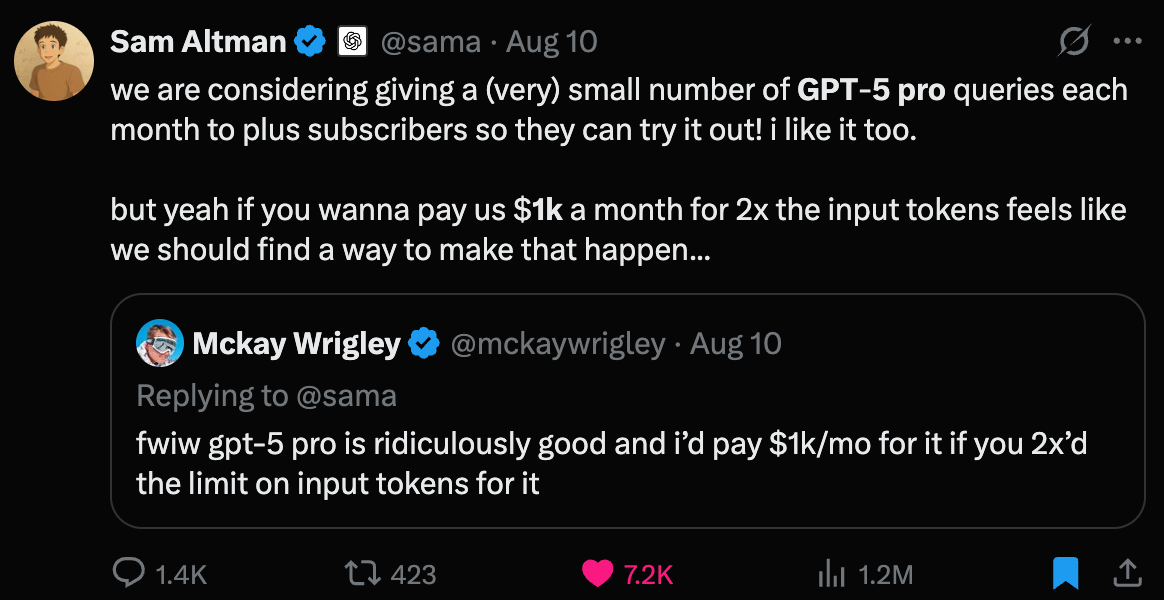
He's not wrong. When you can structure the problem correctly, GPT-5 Pro doesn't just excel—it fundamentally changes what's possible. It's an intelligence that's simultaneously more capable and less useful than its predecessors. Not uniformly better or worse—jagged. Mind-blowingly brilliant in specific contexts, surprisingly average in others.
After days of intensive testing, I've discovered what we've actually built: the first AI model that scores 148 on IQ tests but can't maintain a conversation, that produces institutional-quality financial analysis but struggles with basic creative writing, that costs $200/month—ten times ChatGPT Plus—yet for the right use cases, feels underpriced.
I'm so tired, guys, of the "AGI is here!" crowd missing what's actually happening. GPT-5 Pro isn't the arrival of artificial general intelligence. It's something more interesting and more complicated: proof that the future of AI isn't about making universally "better" models but about choosing architectural trade-offs that optimize for specific types of intelligence. OpenAI is betting that there's a market for a very particular kind of computational intelligence, one that thinks harder rather than faster, one that explores multiple solution paths rather than racing toward a single answer.
What follows are my field notes from extensive testing, conversations with enterprise users, and analysis of the architectural decisions that make GPT-5 Pro simultaneously brilliant and broken. This isn't just another model review. It's about understanding a fundamental shift in how we create and deploy AI intelligence—and why the most advanced model might be exactly wrong for most of your work, yet absolutely essential for specific critical tasks.
The Architectural Revolution: Intelligence as Time, Not Size
OpenAI has fundamentally reimagined what it means to make a model "smarter." For years, the recipe was simple and seemingly obvious: add more parameters, train on more data, watch the benchmarks climb. GPT-3 had 175 billion parameters. GPT-4 reportedly had over a trillion. The assumption underlying all of this was that intelligence scaled with size—make the brain bigger, get better results. It was a compelling narrative, clean and linear. It was also wrong.
GPT-5 Pro breaks this paradigm completely. Instead of just being bigger, it thinks longer. (Yes, nerds, we’ve had inference time compute for a bit here, but there is something new under the hood with GPT-5 Pro that I’m getting to here.) The results of all this work on using time to infer (in the right context) are genuinely stunning.
The technical term is "scaled parallel test-time compute," but let me explain what's actually happening under the hood, because understanding this architecture is key to understanding both why GPT-5 Pro can be brilliant and why it can be frustrating. When you give GPT-5 Pro a complex query, it doesn't just process it sequentially like previous models. Instead, it spawns multiple parallel reasoning chains—imagine a panel of experts, each approaching the problem from a different angle. One thread might tackle the mathematical aspects, another considers practical constraints, a third evaluates edge cases, a fourth looks for historical patterns, a fifth checks for logical consistency.
These threads explore their solution paths independently, running what amounts to simultaneous thought experiments. They can reach different conclusions. They can identify different risks. They can surface different opportunities. Then—and this is the crucial part—they have to synthesize their findings into a unified response.
Here's where it gets interesting, and where my financial analysis example becomes illuminating. When GPT-5 Pro analyzed UnitedHealth's earnings, I could see the artifacts of this parallel processing in the output. One reasoning thread had clearly focused on margin analysis: "UHC margin fell 5.42% → 2.41% (‑301 bps YoY); Optum Health 7.09% → 2.52% (‑457 bps)." Another thread was tracking cash flow dynamics: "YTD CFO $12.6B vs NI $10.0B (CFO/NI 1.26×); medical costs payable $38.4B vs $34.2B at 12/31 (+$4.2B)." A third was evaluating forward guidance: "ETR just over 20% in 2H."
The synthesis didn't just mash these together—it understood the relationships between them. It recognized that strong cash flow was partly artificial due to payables build. It saw that margin compression in core segments couldn't be fully offset by mix shift. It identified that tax rate assumptions were doing heavy lifting in guidance. This is intelligence that emerges from parallel reasoning, insights that sequential processing would miss.
This approach mirrors how humans actually solve complex problems. When you face a difficult decision, you don't think in a straight line from A to B. You consider multiple angles simultaneously: What are the risks? What are the opportunities? What would happen if this assumption is wrong? What patterns have I seen before? Your brain runs parallel scenarios, weighs them against each other, and synthesizes a decision. GPT-5 Pro mechanizes this deliberation.
The $200 monthly price suddenly makes perfect sense when you understand what's happening. You're not paying for access to a smarter model in the traditional sense—you're paying for the compute to run multiple reasoning threads simultaneously. Every query spawns parallel processes that consume real computational resources. OpenAI isn't charging premium prices for premium intelligence; they're charging for premium compute time.
The results validate the approach spectacularly, at least as long as you believe the test scores (I tend to prefer real world tests these days). GPT-5 Pro achieves 88.4% on GPQA (Graduate-Level Google-Proof Q&A), compared to GPT-4o's 53.6%. It scores 100% on the AIME 2025 mathematics competition. It makes 22% fewer major errors on complex reasoning tasks. These aren't incremental improvements—however you weigh tests this represents a step change in capability for specific types of problems.
But here's the crucial insight that most reviews miss: this intelligence comes from time, not size. GPT-5 Pro takes longer to respond not because it's slower, but because it's literally thinking more. The model can spawn dozens of reasoning threads, let them explore solution spaces, evaluate their conclusions against each other, and synthesize the best approach. It's the difference between a quick intuitive response and carefully considered analysis.
Sure, I hear you saying, but there are other reasoning models. Why is this one special? It’s special because it has been specially trained to optimize for correctness! The value of those multiple reasoning threads really explodes when you can optimize for the right answer, and that’s a through line we’ll be following as we explore GPT-5 Pro use-cases down below.
Back to it: this architectural shift has profound implications longterm. We've moved from "how big can we make the model?" to "how long should we let it think?" It's a fundamentally different scaling dimension—one that trades latency for accuracy, speed for depth, efficiency for thoroughness. And when you see what it can do with complex analytical problems, the trade-off becomes compelling.
The Trade-offs to Smarts
The parallel processing architecture that makes GPT-5 Pro brilliant also creates specific, predictable challenges. These aren't bugs to be fixed in the next update—they're fundamental consequences of how the model generates intelligence. Understanding them is crucial for deploying GPT-5 Pro effectively.
Let's start with security, though I want to be careful not to overstate this. GPT-5 as a family of models achieves only 57% security resilience even with system prompts, compared to GPT-4o's 97% in hardened configurations. Why bring up a family score here? It’s relevant because GPT-5 Pro is simply GPT-5 with more reasoning threads scaled up. If there’s security concerns across one part of the family, all are affected.
Within 24 hours of launch, security researchers successfully jailbroke the model using techniques like StringJoin obfuscation (inserting hyphens between characters), echo chamber attacks (gradually poisoning context over multiple exchanges), and narrative-driven steering (embedding harmful requests within seemingly innocent stories).
Why is a more advanced model less secure? I suspect (I don’t know for sure, because OpenAI is obviously not saying) the answer lies in the architecture itself. More reasoning paths mean more attack surfaces if the initial parsing of the query doesn’t catch the issue.
Then when the model explores multiple perspectives, adversarial prompts can poison individual threads and influence the final synthesis—and the result can be even more dangerous because it’s reinforced and buttressed by the model’s intelligence.
Think of it like this: if you have one door to guard, security is straightforward. If you have twenty doors that all lead to the same room, each one becomes a potential vulnerability. The parallel reasoning that enables GPT-5 Pro to consider problems from multiple angles simultaneously also gives attackers lots of threads to access if an initial parse fails.
Now, for internal analytical use—which is where GPT-5 Pro truly shines—this is manageable with proper hardening. Organizations implement additional layers of security: prompt hardening, runtime guardrails, output filtering. But it's worth understanding that the vulnerability is architectural, not a simple oversight.
Then there's what I call the personality problem, though "problem" might be too strong. Users who loved GPT-4o's conversational warmth are often disappointed by GPT-5 Pro's responses (and by GPT-5). This isn't a training issue—it's a synthesis issue. When you aggregate multiple reasoning chains, you get committee-speak. The model literally cannot maintain a consistent voice because it's averaging perspectives.
I've tested this extensively. Ask GPT-5 Pro to write in a specific style—casual, academic, humorous—and it starts strong. But watch what happens over a longer conversation. The style degrades, becoming increasingly robotic and cold. It's like the model starts with a clear voice from one reasoning thread, but as other threads contribute their perspectives, the distinctive characteristics get smoothed out. You end up with what users describe as "bland," "corporate," or "soulless" responses.
But here's the thing: this is exactly what you'd expect from committee intelligence. When five smart people collaborate on a document, personality gets sacrificed for comprehensiveness. The output might be more correct, more thorough, more defensible—but it won't have the spark of individual creativity. For analytical work, this is fine. For creative work, it's a deal-breaker.
Context degradation presents another fascinating challenge. Managing coherent context across parallel threads is exponentially harder than maintaining a single narrative thread. After about 200,000 tokens, users report significant memory fragmentation. The model starts losing track of earlier parts of the conversation, contradicting itself, or asking for information it should already have.
During my testing with financial data, this became apparent in interesting ways. I'd establish context about a company's structure, feed it financial statements, then ask for analysis. The initial responses were excellent—comprehensive, nuanced, drawing connections across multiple data points. But as the conversation continued, the model would occasionally "forget" key relationships I'd established earlier, or worse, confidently assert things that contradicted its own previous analysis.
It wasn't hallucination in the traditional sense—it was more like different reasoning threads operating with slightly different versions of the context. I’m inferring here, but it feels like Thread A remembers the debt covenant discussion, Thread B doesn't, and the synthesis sometimes produces outputs that awkwardly straddle both realities.
The data structure requirements are perhaps the most underestimated challenge. GPT-5 Pro needs data organized for multi-perspective analysis. This isn't optional—it's mandatory for the model to function properly.
When I fed it that messy project data, I could see it struggling (noted above). But when I gave it properly structured financial data—clean hierarchies, clear relationships, consistent formatting—the parallel reasoning architecture sang. Each thread could pursue its analytical path with confidence, and the synthesis produced insights that no single perspective would have caught.
This isn't a bug—it's a feature working exactly as designed. When you have multiple reasoning threads analyzing ambiguous data, they will reach different conclusions. The synthesis process tries to reconcile these differences, but if the underlying data is too messy, you get output that reflects the ambiguity. Organizations used to throwing rough data at AI and getting "good enough" results are in for a rude awakening.
GPT-5 Pro Use Case Divergence
The parallel architecture creates a sharper divide than any previous model generation between where GPT-5 Pro excels and where it fails. Understanding this divide is crucial for any organization considering the $200 monthly investment, because the same architecture that enables breakthrough performance in some domains creates frustrating failures in others.
Use-Cases for GPT-5 Pro
Let's start with where parallel reasoning absolutely dominates, because when GPT-5 Pro works, it's genuinely transformative.
Scientific research represents perhaps the perfect use case. When Amgen analyzes polymer structures using GPT-5 Pro, the model simultaneously evaluates chemical properties, structural integrity, manufacturing feasibility, and regulatory compliance. Each reasoning thread brings domain expertise to bear on the problem. One thread might identify a potential catalytic efficiency issue while another recognizes a patent conflict, a third suggests alternative synthesis pathways, and a fourth evaluates environmental impact. The synthesis doesn't just average these perspectives—it identifies connections and conflicts between them, producing insights that no single analytical approach would catch.
The numbers back this up dramatically: GPT-5 Pro achieves a mere 1.6% hallucination rate on complex medical cases, compared to 15-20% for traditional models. But it's not just about accuracy. Researchers report that it's more creative in its problem-solving, identifying non-obvious connections between disparate pieces of evidence. Though "creative" might be the wrong word—it's more like comprehensively systematic in a way that appears creative to humans who can't hold that many variables in mind simultaneously.
Financial modeling showcases another sweet spot, and this is where my UnitedHealth example becomes instructive. Building three-statement financial models from SEC filings requires reconciling multiple data sources, accounting standards, and time periods while maintaining internal consistency. GPT-5 Pro's parallel threads can simultaneously parse income statements, balance sheets, and cash flows while cross-referencing for discrepancies. One thread tracks revenue recognition patterns, another monitors working capital changes, a third identifies unusual adjustments, a fourth checks for mathematical consistency.
But it goes beyond mechanical reconciliation. In my testing, GPT-5 Pro didn't just extract the numbers—it understood the relationships between them. It caught subtle inconsistencies that suggested aggressive accounting, identified trend breaks that warranted investigation, and even noted when management discussion didn't align with the numerical data. When it flagged that UnitedHealth's cash flow strength was partly due to payables timing that could reverse, it was making the kind of connection that junior analysts often miss.
Legal analysis provides similar advantages. When Relativity uses GPT-5 Pro for due diligence on thousands of documents, the parallel architecture enables simultaneous evaluation from multiple legal frameworks. While one reasoning chain tracks contract terms, another identifies potential liabilities, a third maps entity relationships, a fourth evaluates regulatory compliance, a fifth looks for intellectual property issues. The synthesis reveals patterns that sequential analysis would miss—hidden dependencies, conflicting obligations, systematic risks that only become apparent when viewing the document set holistically.
Software architecture—and I want to emphasize architecture, not coding—represents another breakthrough use case. This is why McKay Wrigley wants that $1,000/month tier so desperately. When you can feed GPT-5 Pro an entire codebase, it can see architectural patterns that are invisible when looking at individual components. It identifies technical debt not just as isolated problems but as systemic issues. It suggests refactoring strategies that consider ripple effects across the entire system. It proposes migration paths that account for dependencies human architects might miss.
The key pattern here? These are all domains where correctness matters more than personality, where multiple perspectives enhance rather than muddy the analysis, and where the additional compute time is justified by the stakes involved. A 22% error reduction in financial modeling could prevent million-dollar mistakes. A comprehensive legal review could identify deal-breaking issues. A novel scientific insight could accelerate research by months.
But now let's talk about where GPT-5 Pro fails, because the failures are just as instructive as the successes.
Anti-Use Cases for GPT-5 Pro
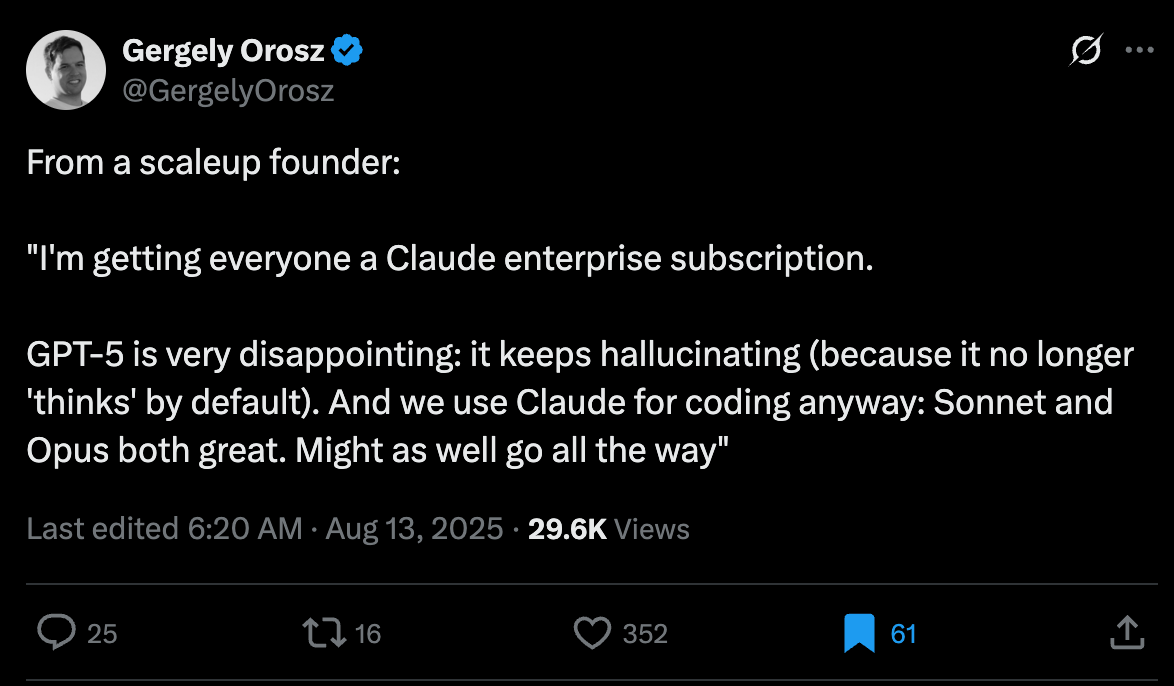
Coding—actual line-by-line programming as opposed to architectural design—is surprisingly disappointing. This caught me off guard initially because GPT-5 Pro can brilliantly analyze system architecture, suggest design patterns, and evaluate technical trade-offs. But when it comes to writing actual code, the parallel reasoning architecture works against it.
Sidebar: If you don’t need to make a lot of complex architectural decisions with your codebase, and if you’re a small tech startup, you may just not have a use-case for ChatGPT-5 Pro—and potentially not for ChatGPT at all (keep in mind not everyone has the discipline to push thinking mode when needed).
Programming requires sequential, coherent logic. When GPT-5 Pro's parallel threads each suggest different implementation approaches, the synthesis produces inconsistent, sometimes contradictory code. Variables get renamed mid-function. Architectural patterns shift between files. The model loses track of its own logic flow, producing code that might be locally correct but globally incoherent.
Creative writing fares even worse. Narrative requires a singular voice, consistent tone, emotional arc. ChatGPT-5 does not do that. But it would be great at analyzing multiple creative directions and thinking through plot problems. Again, notice the difference between reasoning and creating that’s been running through this whole piece.
Conversation might be the biggest disappointment. Human dialogue needs consistency, personality, the ability to build rapport over time. GPT-5 Pro obviously takes forever and when it answers it's committee-based responses feel robotic because they are—they're the synthesized output of multiple conversational strategies. Users prefer GPT-4o's singular, if sometimes flawed, personality to GPT-5 Pro's technically correct but emotionally vacant responses.
The Hidden Infrastructure Cost
The $200 monthly subscription is just the tip of the iceberg. Successfully deploying GPT-5 Pro requires fundamental changes to data infrastructure, workflow design, and organizational processes that most companies drastically underestimate. Let me walk you through what organizations actually need to make GPT-5 Pro work, based on real implementation attempts I've observed and participated in.
First, the data restructuring requirement. GPT-5 Pro doesn't just need more data or cleaner data—it needs dimensionally restructured data. Traditional document structures that work fine for human consumption or conventional AI processing fall apart under parallel reasoning.
A typical financial analysis folder might look like this:
Q3_Financials/
├── Income_Statement.xlsx
├── Balance_Sheet.xlsx
├── Cash_Flow.xlsx
└── Management_Commentary.pdf
That won't cut it for GPT-5 Pro. Here's what actually works:
Q3_Analysis/
├── Core_Data/
│ ├── Statements/
│ │ ├── Income_Statement_GAAP.json
│ │ ├── Income_Statement_Adjusted.json
│ │ ├── Balance_Sheet_Historical.json
│ │ └── Cash_Flow_Normalized.json
│ └── Metrics/
│ ├── Calculated_Ratios.json
│ └── Trend_Analysis.json
├── Perspectives/
│ ├── Risk_Assessment/
│ │ ├── Market_Risks.json
│ │ ├── Operational_Risks.json
│ │ └── Financial_Risks.json
│ ├── Growth_Opportunities/
│ │ ├── Market_Expansion.json
│ │ ├── Product_Development.json
│ │ └── M&A_Targets.json
│ └── Competitive_Position/
│ ├── Market_Share.json
│ ├── Competitor_Analysis.json
│ └── Differentiation_Factors.json
├── Cross_References/
│ ├── Temporal_Links.json
│ ├── Departmental_Dependencies.json
│ └── Assumption_Mappings.json
└── Metadata/
├── Data_Lineage.json
├── Confidence_Scores.json
└── Update_History.json
This isn't over-engineering. Each parallel reasoning thread needs its own coherent data path. The Risk Assessment thread needs different information than the Growth Opportunities thread, but they both need to reference the same core data. The Cross\_References ensure consistency across threads. The Metadata allows the model to weight information appropriately.
Organizations typically spend 2-3 weeks restructuring data for a single use case. And that's after they understand what's needed—the first attempt usually fails because they underestimate the structure required. One enterprise data team told me, "We thought we were just cleaning our data. We ended up completely reimagining how we organize information."
Then there's the API implementation complexity. The Responses API with chain-of-thought persistence isn't like typical API integrations. You're not just making calls—you're orchestrating a symphony of reasoning threads that must maintain coherence across sessions.
The real implementation looks something like this:
# This is simplified - production code is much more complex
response = client.responses.create(
model="gpt-5",
input=complex_query,
previous_response_id=session_context, # Must maintain across calls
reasoning={"effort": "high"}, # GPT-5 Pro always at maximum
text={"verbosity": "high"}, # Needed for complex analysis
tools=integrated_tools, # Each thread may call different tools
parallel_config={
"max_threads": 12,
"convergence_threshold": 0.85,
"timeout_per_thread": 30,
"conflict_resolution": "weighted_synthesis"
}
)
# Monitor reasoning chains for debugging
for thread in response.reasoning_chains:
log_thread_conclusion(thread.id, thread.conclusion, thread.confidence)
if thread.conflicts_with_others:
flag_for_review(thread.conflict_details)
track_thread_resources(thread.compute_time, thread.token_usage)
Notice the complexity? You're not just getting a response—you're managing multiple reasoning chains, handling conflicts between them, maintaining session context, monitoring for thread divergence, tracking resource consumption. Most organizations don't have the engineering infrastructure to handle this properly.
One enterprise team I worked with spent six weeks building a context management system just to handle multi-day financial analyses. They had to implement custom caching to maintain context across sessions, intelligent context pruning to stay within token limits, and a rollback system for when the model's context degraded. This isn't plug-and-play AI—it's a significant engineering project.
The quality validation requirements add another layer. With parallel reasoning producing synthesized outputs, you need new validation approaches that most organizations haven't even considered.
The validation pipeline typically includes:
- Input validation: Ensure data supports parallel reasoning paths
- Reasoning audit: Verify the model explored appropriate perspectives
- Conflict resolution: Handle cases where reasoning threads disagree
- Output verification: Confirm synthesis didn't lose critical insights
- Citation tracking: Every conclusion must reference specific data points
You can easily spend 5x your GPT-5 Pro implementation time on validation systems. You can't just trust the output—you need to verify that the parallel reasoning actually improved the analysis rather than muddying it.
This shouldn’t scare you off if you’re in a world where decision correctness matters and you can feed the model usable information. It’s worth its weight in gold in those situations. Just be aware of where it works and what you need to do with your data to use it properly.
Strategic Implications of GPT-5 Pro: We’re Playing a New Game
GPT-5 Pro forces a reconsideration of fundamental assumptions about AI development and deployment. We're not just seeing a new model—we're seeing the opening moves of a completely different game, one where architectural differentiation matters more than raw scale.
OpenAI's strategy reveals itself clearly when you look at their pricing structure. They're running what I call a "barbell strategy": GPT-5 nano at $0.05 per million tokens for basic tasks, GPT-5 Pro at $200/month for complex reasoning, and a hollowing middle. This isn't pricing based on capability gradients—it's acknowledgment that different architectures serve fundamentally different needs. They're not trying to build one model that's universally better; they're building specialized tools for specialized tasks.
Sidebar on pricing with GPT-5 Pro, it’s a little weird: GPT-5’s advanced "thinking" (deeper reasoning mode) costs the same as its regular output tokens: you pay for the invisible reasoning tokens produced internally before the final answer. These reasoning tokens are counted as part of output, and their price depends on the model variant.
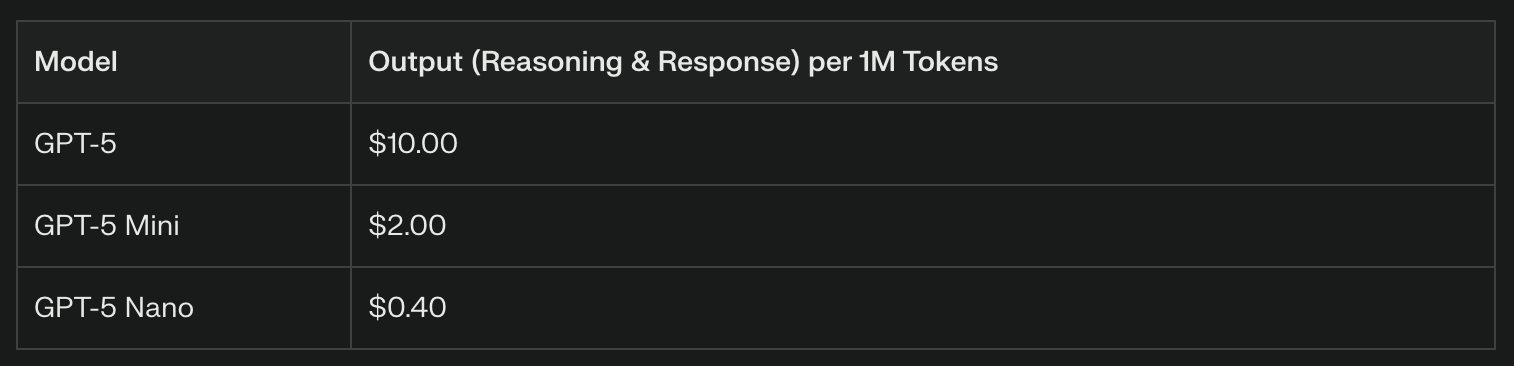
OpenAI has clearly read the tea leaves around competitive pressure from Google on pricing per token and they want to signal they can play the price competitive game as well. It’s up to organizations to figure out how their use-case and what they’ll pay but GPT-5 wants to be the mix for any serious AI pipeline.
I think it’s worth reviewing how this launch shapes the game for the other two major players in the space: Anthropic and Google.
Anthropic's approach with Claude 4.1 Opus fascinates me. They're explicitly not pursuing inference-time compute scaling. Instead, they're optimizing for consistency, personality, and especially coding capability. Claude wins developer mindshare not through parallel reasoning but through reliable, personable, single-threaded excellence. It's a bet that most AI usage will remain conversational and creative rather than analytical.
The strategic question for Anthropic: Can they maintain this position as OpenAI pushes the narrative that "smarter" equals "better"? Or will they be forced to develop their own reasoning models, potentially sacrificing the personality and consistency their users love? The fact that developers overwhelmingly prefer Claude for actual coding work suggests there's a sustainable niche here. But is a niche enough when OpenAI is defining the narrative around AI progress?
Google's position is more complex than most analysts acknowledge. Yes, they're scaling rapidly—their growth numbers are genuinely impressive. But it's largely through platform lock-in rather than product differentiation. They're leveraging Google Cloud relationships, their TPU (Tensor Processing Unit) chip advantage, Android ecosystem integration, and workspace ubiquity. They're winning because switching costs are high, not because their AI is definitively better.
Google has the technical capability—their reasoning models win academic competitions, their research pushes boundaries, they have custom TPU chips that could theoretically support massive parallel compute. But they lack a clear product surface that makes their capabilities accessible and distinctive. They're growing by being the default option in environments they already control, not by winning comparative evaluations.
The strategic risk for Google: What happens when enterprises start choosing AI providers independent of cloud infrastructure? Can "we're already in your stack" sustain competitive advantage when the difference between GPT-5 Pro's analytical capability and Gemini's becomes material to business outcomes? Their rapid scaling might be masking a fundamental strategic vulnerability—they're winning on distribution, not product, and that's historically been a fragile position in tech.
Smaller players face an existential choice. They can't match OpenAI's compute investment for parallel reasoning. They can't match Anthropic's funding for model training. They can't match Google's infrastructure advantages. So they're specializing aggressively—narrow models for narrow tasks, hoping to be best-in-class for specific use cases before the giants notice the niche.
We're seeing interesting strategies emerge: Cohere focusing on enterprise search and retrieval, Mistral targeting European data sovereignty requirements, Stability emphasizing open-source and on-premise deployment. Each is betting that specialization can create defensible positions even as the giants expand.
But here's what everyone's missing: GPT-5 Pro proves that architectural differentiation is the new competitive battleground. We spent years competing on model size—175B parameters, 1T parameters, who's counting anymore? Now we're competing on how intelligence is generated. Parallel reasoning versus single-threaded excellence versus tool integration versus specialized training. The game has fundamentally changed.
This shift has profound implications for enterprise AI strategy. The old approach—pick a vendor, standardize on their API, build applications—no longer works when different architectures excel at fundamentally different tasks. Organizations need portfolio approaches: GPT-5 Pro for complex analysis, Claude for coding and creative work, specialized models for domain-specific tasks, custom fine-tunes for proprietary processes.
We're heading toward an AI stack that looks more like a modern data stack—multiple specialized tools orchestrated together rather than a monolithic solution. This is more complex but also more powerful. It allows organizations to optimize for specific outcomes rather than accepting average performance across all tasks.
The Death of Universal Intelligence
Here's what GPT-5 Pro really proves: the dream of artificial general intelligence, at least as commonly conceived, is dead. We're not building toward a single system that's uniformly better at everything. We're building specialized intelligences that excel at specific types of reasoning.
GPT-5 Pro is phenomenal at multi-perspective analysis but terrible at maintaining personality. Claude excels at coding and creative work but lacks Pro's analytical depth. Gemini integrates beautifully with Google's ecosystem but struggles to differentiate on capability. Each architecture makes trade-offs that improve some capabilities while degrading others.
This isn't a temporary state to be resolved by the next breakthrough. It's a fundamental characteristic of how we're building AI. Parallel reasoning improves analysis but degrades coherence. Tool integration improves capability but increases complexity. Specialization improves performance but narrows applicability. Every architectural choice is a trade-off.
The model that scores 148 on IQ tests but can't maintain a conversation isn't a failure—it's a declaration that universal intelligence isn't the goal anymore. OpenAI has chosen a specific type of intelligence to optimize for, accepting dramatic trade-offs in other areas. The parallel reasoning architecture that enables brilliant multi-perspective analysis also makes the model vulnerable, robotic, and demanding of infrastructure.
This future is messier than the clean vision of AGI solving all problems. But it's also more realistic, more achievable, and potentially more powerful. Specialized tools coordinated intelligently can outperform generalized tools at specific tasks. We've known this in every other domain—why would AI be different?
The implications cascade through everything we thought we knew about AI development:
For researchers, the focus shifts from "how to make models smarter" to "what kind of smart do we need?" The interesting questions become about trade-offs rather than absolutes. How much personality can we preserve while adding reasoning depth? Can we maintain security while enabling parallel processing? What's the optimal balance between capability and usability?
For developers, the skill becomes orchestration rather than implementation. Knowing when to use which model, how to chain them together, how to validate outputs across different architectures. The developers who thrive will think like systems architects, not prompt engineers. They'll build sophisticated pipelines that route different types of problems to different types of intelligence.
For enterprises, AI strategy becomes portfolio management. You don't choose an AI provider—you choose a collection of capabilities. Success requires understanding not just what AI can do but which AI can do what. The organizations that win will be those that match architectural capabilities to business needs rather than forcing all use cases through a single model.
For users, the experience fragments. Instead of one AI assistant that does everything, we'll interact with specialized agents for specialized tasks. The challenge becomes knowing which agent to engage for which need—a meta-problem that itself might require AI to solve. We might need AI to help us choose which AI to use.
The $200 Question: A Framework for Decision
So should you pay $200/month for GPT-5 Pro? The answer depends entirely on whether your use cases align with its architectural strengths.
You should strongly consider GPT-5 Pro if:
You're doing high-stakes analysis where 22% error reduction justifies any cost. If you're building financial models where a missed dependency could cost millions, if you're conducting scientific research where accuracy accelerates discovery, if you're performing legal analysis where comprehensive review prevents catastrophic oversight—the subscription cost is noise compared to the value delivered.
Your work involves reconciling multiple data sources or perspectives. GPT-5 Pro excels when problems benefit from simultaneous analysis from different angles. Financial statements that need to be viewed through risk, growth, and operational lenses simultaneously. Scientific data that requires chemical, biological, and regulatory evaluation. Legal documents that need contract, liability, and compliance review.
Correctness matters more than personality or speed. If you need the right answer more than you need a quick answer or a personable answer, GPT-5 Pro's parallel reasoning architecture is built for you. It will take longer, it won't be charming, but it will be more likely to be correct.
You have the infrastructure to properly structure data for parallel reasoning. This is crucial—GPT-5 Pro with messy data is worse than GPT-4o with clean data. If you can't invest in data structuring, the model can't deliver its potential value.
You can afford not just the subscription but the implementation overhead. Remember the true cost is closer to $2,000/month when including infrastructure, validation, and support. If that still pencils out given the value delivered, you're a good candidate.
You should avoid GPT-5 Pro if:
You primarily need conversational AI or creative assistance. The committee intelligence that emerges from parallel reasoning is antithetical to personality and creativity. You'll be frustrated by robotic responses and bland creative output.
Your coding work involves implementation rather than architecture. For actual programming, Claude or GPT-4o will serve you better. GPT-5 Pro is for system design, not system implementation.
You lack the resources to restructure data and build validation systems. Without proper infrastructure, you're paying premium prices for mediocre results.
Speed and personality matter more than marginal accuracy improvements. If "good enough" analysis delivered quickly with personality meets your needs, GPT-5 Pro is expensive overkill.
The nuanced middle ground is where it gets interesting. Many organizations benefit from having one or two GPT-5 Pro licenses for specific high-value analyses while using cheaper models for everything else. Or perhaps from using a single dev license to hit the API when needed. A consulting firm might use Pro for final client deliverables but Claude for research and drafting. A financial team might use Pro for quarterly reports but nano for daily monitoring. A research team might use Pro for breakthrough analysis but GPT-4o for literature review.
The key is matching architecture to task rather than defaulting to "most advanced" or "cheapest." This requires actually understanding what different architectures offer—parallel reasoning versus single-threaded excellence versus tool integration versus specialized training.
Conclusion: The Opening Move in a New Game
GPT-5 Pro isn't just another model release. It's proof that we've entered a new phase of AI development where architectural innovation matters more than raw scale, where specialized intelligence beats general capability, where the question isn't "how smart?" but "what kind of smart?"
The model that scored 148 on an IQ test but can't maintain a conversation isn't a failure—it's a declaration that universal intelligence isn't the goal anymore. OpenAI has chosen a specific type of intelligence to optimize for, accepting dramatic trade-offs in other areas. The parallel reasoning architecture that enables brilliant multi-perspective analysis also makes the model vulnerable, robotic, and demanding of infrastructure.
This isn't the future many expected. The vision was always that each new model would be uniformly better—smarter, faster, more capable across the board. GPT-5 Pro breaks that narrative decisively. It's smarter in specific ways, worse in others, transformative for some tasks, actively harmful for others. It forces us to abandon the comfortable fiction of linear progress toward artificial general intelligence.
Instead, we're seeing the emergence of an AI ecosystem that mirrors every other technological ecosystem—specialized tools for specialized tasks, architectural trade-offs that create distinct capabilities, price discrimination based on value delivered. It's messier than the AGI vision but more realistic and potentially more powerful.
For organizations, this means AI strategy becomes more complex but also more sophisticated. You can't just "adopt AI" anymore—you need to understand which AI architectures serve which business needs, how to structure data for different reasoning approaches, when parallel processing helps versus when it hurts. The organizations that thrive will be those that match architectural capabilities to business requirements rather than chasing the latest model.
For the industry, GPT-5 Pro represents an inflection point. We're moving from competing on scale to competing on architecture, from universal models to specialized systems, from single providers to orchestrated portfolios. The winners won't be those with the biggest models but those with the best understanding of which architecture serves which need.
The $200/month price tag for GPT-5 Pro isn't really about the money. It's about recognizing that we're entering an era where AI capabilities stratify rather than converge, where different intelligences serve different purposes, where the dream of one model to rule them all gives way to the reality of architectural specialization.
When deployed correctly—with proper data structure, realistic expectations, and appropriate use cases—GPT-5 Pro doesn't just work. It transforms what's possible. It's why serious practitioners like McKay Wrigley are begging to pay more for expanded access. They've seen what it can do when properly deployed, and they want more.
But GPT-5 Pro is also a cautionary tale about the complexity this future brings. The model that can simultaneously analyze financial statements from a dozen perspectives can't write a compelling story. The architecture that enables breakthrough scientific insights makes casual conversation painful. The intelligence that emerges from parallel reasoning comes with a tax of infrastructure, validation, and operational complexity that many organizations aren't prepared to pay.
This isn't the ending of the AI story—it's the beginning of a more interesting chapter. One where the question isn't whether AI will transform everything but which AI will transform what, and at what cost, and with what trade-offs. GPT-5 Pro doesn't answer these questions—it forces us to start asking them seriously.
The model that argues with itself in parallel has, perhaps inadvertently, started an argument about what artificial intelligence should be. That argument won't be resolved by the next model release or the next architectural innovation. It will be resolved by the market, by users, by the accumulation of millions of decisions about which capabilities matter for which tasks.
In that sense, GPT-5 Pro isn't just a new model—it's the opening move in a fundamentally different game. A game where intelligence isn't singular but plural, where capability isn't absolute but contextual, where the future isn't about building one perfect AI but about understanding which imperfect AI serves which imperfect human need.
Welcome to the era of architectural differentiation. It's going to be messier than we expected, more complex than we hoped, and ultimately more interesting than either the utopian or dystopian visions of AI suggested. GPT-5 Pro, with all its brilliance and brokenness, arguing with itself in parallel while producing institutional-quality analysis, is showing us the way forward—not toward artificial general intelligence, but toward artificial specialized intelligences that transform specific domains while leaving others untouched.
The future of AI isn't universal. It's particular. It's jagged. And GPT-5 Pro, scoring 148 on IQ tests while failing at conversation, producing breakthrough analysis while struggling with creativity, is the perfect emblem of this more complex, more nuanced, more realistic future.
I make this Substack thanks to readers like you! Learn about all my Substack tiers here