AI Agents are THE defining technology trend of 2025—and I've finally written the comprehensive implementation guide that simply doesn't exist anywhere else on the internet. Long read, but worth it!
By Nate
Published: 2025-06-17
URL: https://natesnewsletter.substack.com/p/the-definitive-guide-to-ai-agents
Why I Wrote This (And Why You Should Care)
For six months now, I've been getting the same question over and over: "Nate, where's the definitive guide to AI agents?" And every time, I've had to give the same frustrating answer: "It doesn't exist yet." The agent space has been moving too fast, with architectures spinning up and spinning down, bitter fights breaking out over technical approaches, and a fundamental confusion about what agents even are.
Most people—CEOs, marketers, PMs, almost everyone other than engineers (and some of them too)—genuinely don't understand that an AI agent is simply an LLM plus tools plus guidance. That's it. I've had executive conversations where leaders ask me if they need agents when they don't even have basic chatbots working yet. The hype is so far ahead of understanding that we're setting ourselves up for massive disappointment and wasted budgets.
But something shifted recently. We've finally seen enough real implementations—both spectacular successes and expensive failures—to start drawing meaningful patterns. Wells Fargo's 245 million interactions without human handoffs. MD Anderson's $62 million loss on IBM Watson. McDonald's drive-thru disaster with viral TikTok failures. These aren't just isolated incidents; they're data points that reveal the architecture decisions separating success from catastrophe.
I've watched this unfold while trying to be helpful with a few companies here and there, and with lots of operators fielding questions from practitioners who need real answers, not marketing promises. The agent articles that come and go focus on the shiny new features or the latest model capabilities. And I love all the model maker agent guides, but it’s hard to write for the industry when you’re also a model maker. What about a third perspective? I don’t think it exists, at least not at this level of detail. None of them tackle the fundamental question every organization faces: How do you actually implement this stuff without burning money and credibility?
This guide is my attempt to create the one-stop resource I wish existed six months ago. It's necessarily long—about 30 pages—because the problem is complex and the stakes are high. If agents are going to be the most hyped topic of 2025 (and they are), then we need to start these conversations from a foundation of actual understanding, not wishful thinking.
This isn't about avoiding AI agents. It's about approaching them with the technical vocabulary and strategic frameworks needed to separate the signal from the noise. Because the window for competitive advantage is narrowing, and the organizations that get this right early will have sustainable advantages that late movers simply can't replicate.
Note: This article is written like a series of three nesting dolls for clarity. It’s written in a slightly different voice as well, and that’s on purpose. Think of it as Nate + a little bit of those classic 1997 super factual computer manuals.
Why? Because I’m tired of hype I think. I just want something very dry and very clear that people can refer to. So here it is! This is what you can expect:
- The TLDR gives you a 1 minute read of the heart of the article.
- The Executive Summary gives you a 3 minute read of the key decision levers.
- The remainder of the article lets you dive deep on agents and agentic frameworks.
What You'll Find Inside This Guide
AI Agent Architecture Deep Dive: Complete technical breakdown of single vs. multi-agent systems, including performance benchmarks, cost implications (3-10x difference), and decision frameworks for choosing the right approach for your use case.
Memory Management & State Architecture: Advanced strategies for working memory, episodic memory, and long-term memory systems, plus security considerations for memory poisoning attacks and data protection in production AI agent deployments.
Buy vs. Build Strategic Framework: Comprehensive total cost of ownership analysis comparing ready-made AI agent solutions (Zendesk, Salesforce Agentforce, ServiceNow) versus custom development, with real implementation timelines and resource requirements.
Production AI Agent Security: Enterprise-grade security architecture covering prompt injection defense, data exfiltration prevention, compliance requirements (HIPAA, GDPR), and AI-specific threat models beyond traditional cybersecurity.
AI Agent Integration & Tool Management: Technical specifications for API management, rate limiting, the Model Context Protocol (MCP), and production-grade error handling and recovery mechanisms for enterprise AI agent systems.
Failure Mode Analysis & Mitigation: Detailed case studies of AI agent failures (MD Anderson's $62M loss, McDonald's drive-thru termination) and proven strategies for avoiding common technical and organizational pitfalls in AI agent implementations.
AI Agent Monitoring & Observability: OpenTelemetry GenAI conventions, production KPIs, debugging complex multi-turn conversations, and continuous optimization strategies for enterprise AI agent performance.
Real-World Implementation Patterns: Verified case studies including Wells Fargo's 245M interaction success, technical decision trees, vendor evaluation criteria, and step-by-step deployment strategies for sustainable AI agent adoption.
Obviously, information is duplicated across these three layers at appropriate points. The key is giving you a desk reference for AI agents that is complete at each section and that you can turn to when tackling AI agent questions. My goal is that you walk away with genuine clarity on the levers and where to begin the conversation on AI agents in 2025. Yes, you can implement them! This article paints a path forward.
Subscribers get all these pieces!
TLDR: AI Agents Strategic Reality
Mid-2025 Reality Check: AI deployment is maturing rapidly, but success metrics are evolving faster than organizational capabilities.
The AI agents market has reached $7.92 billion in 2025—on track for $236 billion by 2034—yet 42% of businesses are strategically abandoning AI initiatives that no longer meet elevated ROI standards, up from 17% in 2024. While AI maturity scores have declined 9 points as organizations measure themselves against agentic AI capabilities, 67% report gross margin increases averaging 11%, with investment expectations growing 8.6% for the coming fiscal year. The apparent paradox reveals a market transitioning from experimentation to production-grade deployment, where failure rates reflect strategic selectivity rather than technological inadequacy.
The Strategic Implication
The real story of 2025 isn’t about AI failure—it’s about AI sophistication. Organizations are simultaneously becoming more successful with AI (67% seeing margin improvements) and more willing to kill projects that don’t meet new standards (42% abandoning initiatives). This represents exactly the kind of disciplined approach that separates sustainable AI adoption from hype-driven investment.
The companies succeeding in this environment aren’t those avoiding failure—they’re those failing fast and frequently while maintaining clear ROI standards and governance frameworks. The declining maturity scores paradoxically indicate rising sophistication, as organizations benchmark themselves against possibilities that didn’t exist in previous assessment cycles.
The execution gap is everything. Wells Fargo processed 245 million interactions with zero failures. MD Anderson lost $62 million on IBM Watson without treating a single patient. The difference? Architecture decisions, gradual deployment, and understanding the technical complexity.
Your strategic choice: Buy ready-made solutions (14-32 weeks, $50K-$200K+ licensing) for standard processes, or build custom (32-64 weeks, $100K-$1.5M+) for competitive differentiation. Most organizations overestimate their need for custom development.
Critical insight: Single-agent architectures cost 3-10x less than multi-agent systems while delivering faster implementation. Memory architecture determines intelligence level—not model selection. Security requires AI-specific defenses beyond traditional cybersecurity.
The window for competitive advantage is narrowing. Early movers with proper execution establish durable advantages. Late movers face commoditized solutions and vendor lock-in. Success requires narrow initial scope, privacy-first architecture, and equal investment in technology and organizational change management.
Bottom line: This isn't a technology problem—it's an execution problem. The frameworks exist to get it right the first time.
Executive Summary: AI Agents Implementation Reality Check
The Bottom Line Up Front
The AI agent market is at a critical inflection point where execution trumps hype. While the market is projected to grow from $5.4B to $50.3B by 2030, 42% of businesses scrapped most AI initiatives in 2024—up from 17% in 2023. The difference between Wells Fargo's 245 million successful interactions and MD Anderson's $62 million failure isn't technology—it's understanding the technical complexities and implementation patterns that separate success from catastrophe.
Key insight: Only 1% of companies consider themselves "mature" in AI deployment. This isn't a technology problem—it's an execution problem.
Four Critical Decision Points
1. Architecture Choices Drive Everything
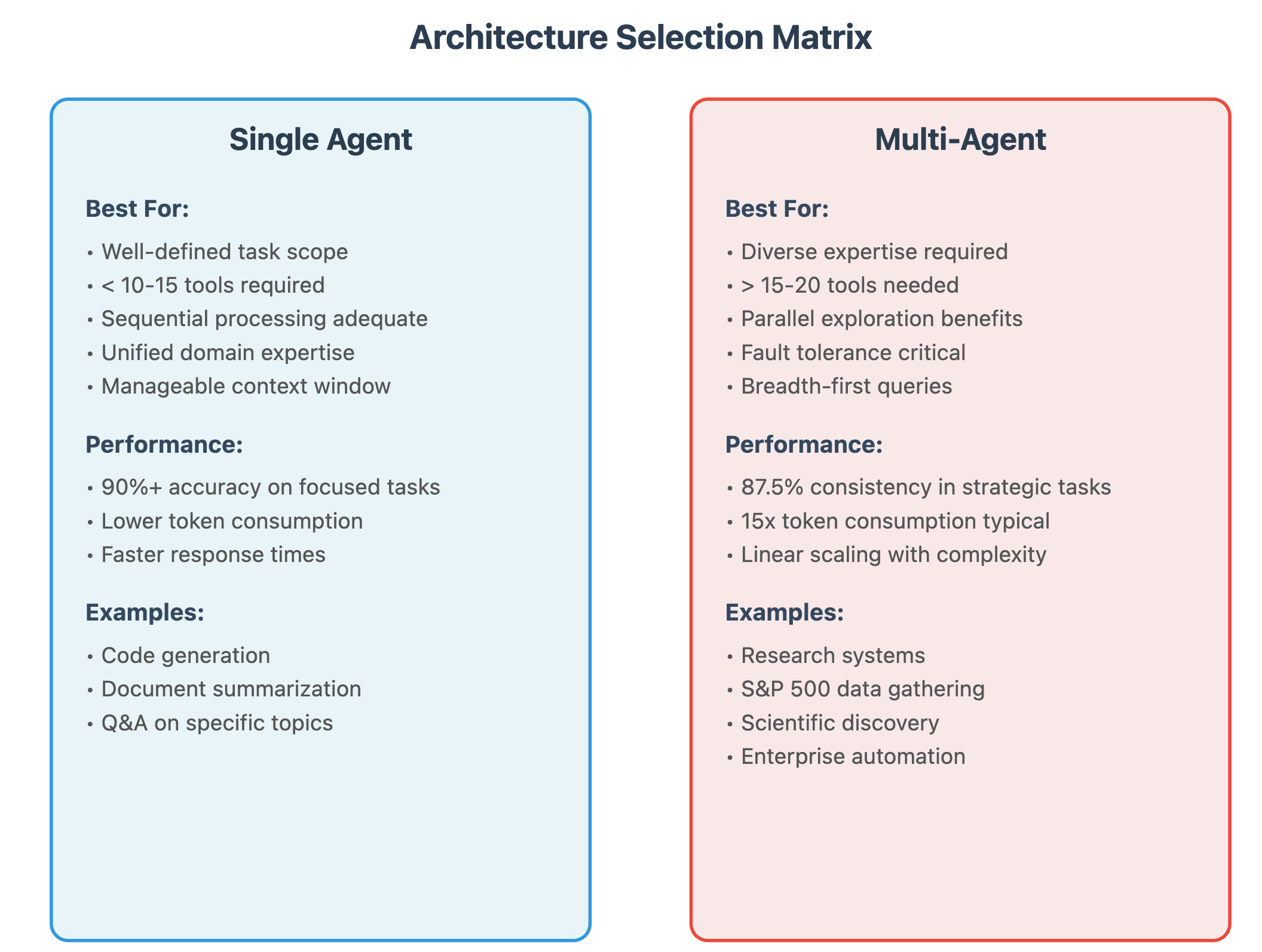
Single vs. multi-agent systems fundamentally determine your success probability, costs, and timeline.
- Single agents: 200-500ms response time, 1K-5K tokens per turn, 2-6 month deployment
- Multi-agent systems: 1-3 seconds response time, 3-15K tokens per turn (3-10x cost), 6-18 month deployment
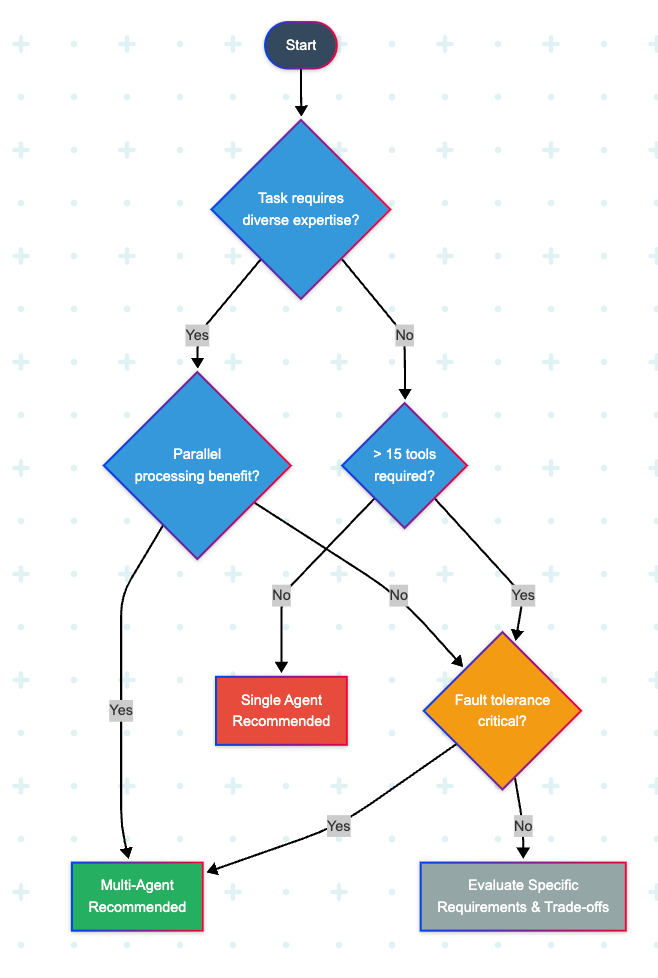
Decision rule: Choose single agents unless you absolutely need specialized expertise that justifies 3-10x higher costs and complexity. Most organizations overestimate their need for multi-agent systems.
2. Memory Architecture = Intelligence Level
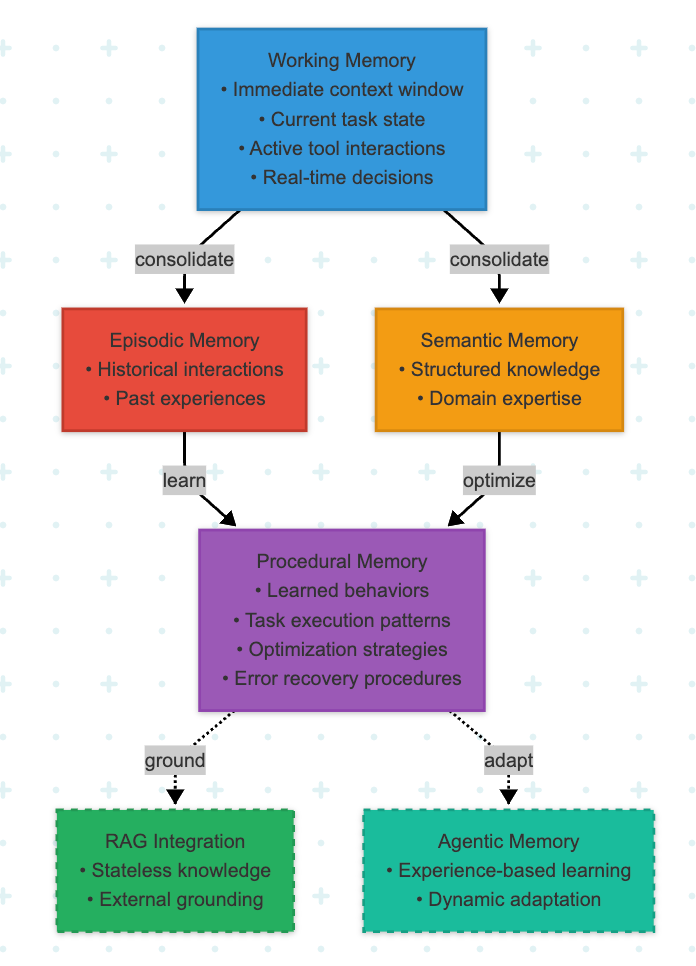
Your memory strategy determines whether you build a chatbot or an intelligent system.
- Working memory: Session-only, <100ms access, handles immediate context
- Episodic memory: Cross-session learning, 10-500ms access, enables experience-based improvement
- Long-term memory: Permanent knowledge, 50-200ms access, provides domain expertise
Critical vulnerability: Memory poisoning attacks show high success rates. Production systems require memory authentication, semantic validation, and temporal isolation.
3. Buy vs. Build Framework
The decision isn't about technology—it's about strategic importance and organizational capability.
Buy ready-made when:
- Low strategic differentiation potential
- Standard business processes (80% of use cases)
- Limited technical expertise internally
- Timeline pressure (14-32 weeks vs. 32-64 weeks custom)
Build custom when:
- High strategic importance + high differentiation potential
- Complex legacy integrations
- Unique compliance requirements
- Strong internal technical capabilities
Cost reality check: Ready-made licensing is only 30-50% of total first-year costs. Custom development ranges $100K-$1.5M+ but provides full control.
4. Failure Patterns Are Predictable
Technical and organizational failure modes follow clear patterns.
Technical failures:
- Memory poisoning and persistence attacks
- Goal drift through context pollution
- Infinite loops and resource exhaustion
- Multi-agent coordination failures
Organizational failures:
- Scope creep (MD Anderson's Watson expanded from leukemia to all cancers)
- Insufficient real-world testing (McDonald's 85% lab accuracy vs. viral failure videos)
- Poor change management leading to adoption failure
- Vendor dependency risks in volatile AI landscape
Market Reality: Success Stories vs. Spectacular Failures
Success Pattern (Wells Fargo):
- Privacy-first architecture processing data locally
- Poly-model, poly-cloud strategy preventing vendor lock-in
- Gradual deployment from internal tools to customer-facing
- 245.4 million interactions, zero human handoffs, zero data breaches
Failure Pattern (MD Anderson):
- $62 million loss ($39.2M to IBM, $23M to consultants)
- Scope creep from focused use case to multiple cancer types
- Training on hypothetical cases vs. real patient data
- Zero patients ever treated despite years of development
The pattern: Success requires narrow scope, gradual expansion, and architectural decisions that prioritize security and flexibility over features.
Technology Landscape: Ready-Made Solutions Maturing Rapidly
Customer Service: Zendesk ($1.50/resolution), Salesforce Agentforce (Flex Credits), ServiceNow ($2.85B Moveworks acquisition)
Email Automation: EmailTree.ai (80% automation first month), Microsoft Power Platform, Google Workspace AI
Document Processing: Nanonets, AWS Textract, Document AI (95%+ accuracy on standard formats)
Vertical Solutions: Healthcare (Nuance DAX), Legal (Harvey), Financial (Kasisto)
Pricing trend: Shift from seat-based to outcome-based pricing aligns vendor incentives with customer success.
Security and Compliance: The Hidden Complexity
AI-specific threats beyond traditional security:
- Prompt injection attacks exploiting natural language interfaces
- Data exfiltration through conversational responses
- Model manipulation and adversarial attacks
- Memory poisoning with persistent malicious instructions
Regulatory complexity: HIPAA, GDPR, SOX compliance requires custom controls that generic solutions often cannot provide.
Enterprise Implementation Timeline Reality
Ready-made solutions: 14-32 weeks total
- 4-8 weeks vendor selection
- 6-16 weeks configuration/integration
- 4-8 weeks training/change management
Custom development: 32-64 weeks total
- 8-16 weeks requirements/design
- 16-32 weeks MVP development
- 8-16 weeks production hardening
Resource requirements: Ready-made needs 3-5 specialists part-time. Custom needs 5-10 full-time developers plus specialists.
Financial Framework: TCO Beyond Licensing
Ready-made hidden costs:
- Implementation services: 50-100% of licensing
- Annual renewals: 15-25% increases
- Integration maintenance as systems evolve
- Vendor lock-in and switching costs
Custom development costs:
- Architecture/design: 10-15%
- Development/testing: 60-70%
- Integration/deployment: 15-20%
- Ongoing team salaries and infrastructure
Break-even insight: Ready-made wins on speed to value. Custom wins on long-term strategic flexibility and scale economics.
Monitoring and Observability: Beyond Traditional Metrics
Agent-specific KPIs required:
- Task completion rates and goal achievement
- Context retention and memory effectiveness
- User satisfaction and adoption rates
- Token consumption and cost efficiency
- Security event detection and response
OpenTelemetry GenAI conventions provide standardized monitoring across traces, spans, metrics, and events specific to agent systems.
Three Strategic Recommendations
1. Start Narrow, Scale Gradually
Follow Wells Fargo's pattern: Prove value with internal tools before customer-facing deployment. Define narrow scope with measurable success criteria. Resist scope creep that killed MD Anderson's implementation.
2. Invest in Architecture, Not Features
Technical debt is expensive in agent systems. Prioritize memory management, security architecture, and monitoring over flashy capabilities. Build abstraction layers that enable vendor flexibility.
3. Prepare for Organizational Change
Technology success ≠ business success. Invest equally in change management, user training, and adoption strategies. Most failures are organizational, not technical.
The Strategic Imperative
The window for competitive advantage through AI agents is narrowing rapidly. Early movers with proper execution will establish durable advantages. Late movers will face commoditized solutions and higher switching costs.
The choice isn't whether to deploy AI agents—it's whether to do it right the first time or learn expensive lessons through failure. This guide provides the frameworks to choose correctly.
The Definitive Guide to AI Agents in 2025: Technical Implementation, Strategic Decisions, and Market Reality
Introduction: Beyond the marketing hype to operational reality
The AI agent market has reached a critical inflection point. With the market valued at $5.4 billion in 2024 and projected to reach $50.31 billion by 2030, organizations face mounting pressure to deploy agents while navigating a landscape littered with spectacular failures and rare successes. This guide cuts through the marketing noise to provide the technical frameworks, verified case studies, and practical decision-making tools needed for successful implementation.
The stakes couldn't be higher. While Wells Fargo's AI assistant processed 245.4 million interactions in 2024 with zero human handoffs and no data breaches, MD Anderson Cancer Center lost $62 million on their IBM Watson implementation without ever treating a single patient. The difference isn't luck—it's understanding the technical complexities, architectural decisions, and implementation patterns that separate success from failure.
This guide provides three critical components missing from most agent discussions: verified case studies with real performance data, a comprehensive technical vocabulary for implementation decisions, and detailed analysis of when to buy versus build. The goal isn't to promote AI agents as a panacea, but to equip practitioners with the knowledge needed to make informed decisions and avoid costly mistakes.
Chapter 1: Market reality check - Verified success stories and documented failures
The Wells Fargo success pattern
Wells Fargo's Fargo virtual assistant represents one of the most successful enterprise AI agent deployments to date. The numbers are impressive: 245.4 million customer interactions processed in 2024, with zero human handoffs required and zero instances of sensitive customer data exposure to large language models. But the real story lies in their architectural decisions and gradual deployment strategy.
The key to Fargo's success stems from their "privacy-first" architecture. Rather than sending customer data directly to cloud-based LLMs, the system processes sensitive information locally, extracts relevant context, and only sends anonymized, structured queries to the language model. This approach required significant upfront engineering but enabled them to handle banking-grade security requirements while maintaining fast response times.
Their "poly-model and poly-cloud" strategy provides another crucial lesson. Instead of betting on a single vendor, Wells Fargo built abstraction layers that allow them to switch between different AI providers based on task requirements and cost optimization. This prevented vendor lock-in while ensuring system resilience—a critical consideration given the volatility in the AI model landscape.
The deployment followed a measured approach. They started with internal banker tools, proving the system's reliability and security in internal operations before expanding to customer-facing interactions. This gradual rollout allowed them to refine the system, build organizational confidence, and establish robust monitoring practices before scaling.
The IBM Watson healthcare debacle
The contrast with IBM Watson's healthcare initiatives couldn't be starker. MD Anderson Cancer Center's collaboration with IBM resulted in a $62 million loss—$39.2 million to IBM and an additional $23 million to consultants—without ever treating a single patient. The failure provides equally important lessons about what not to do.
The project began with a focused scope: helping oncologists treat acute leukemia by analyzing patient data and recommending treatment options. However, scope creep quickly expanded the project to multiple cancer types, dramatically increasing complexity without corresponding technical capabilities. Watson couldn't process unstructured medical records, failed to integrate with Epic's electronic health record system, and struggled with the nuanced decision-making required for cancer treatment.
More fundamentally, Watson was trained primarily on hypothetical cases and textbook examples rather than real patient data. When confronted with actual clinical scenarios involving complex patient histories, comorbidities, and edge cases, the system's recommendations often contradicted established medical practice or missed critical factors that experienced oncologists would catch immediately.
The technical problems were compounded by organizational issues. Hospital staff reported that Watson's integration requirements disrupted existing workflows, while the system's "black box" recommendations lacked the transparency needed for medical decision-making. Doctors couldn't understand why Watson made specific recommendations, making it impossible to build trust or validate outputs.
McDonald's drive-thru automation failure
McDonald's recent termination of their IBM-powered drive-thru AI system illustrates the challenges of deploying agents in real-world customer interactions. Despite IBM's claims of 85% accuracy rates, viral TikTok videos showed the system adding hundreds of McNuggets to orders, putting butter on ice cream, and being unable to handle simple corrections or special requests.
The technical root cause lay in the system's inability to handle interruptions and context switches. When customers tried to modify orders mid-conversation, the agent would often interpret corrections as additional items rather than replacements. This reflects a fundamental architecture problem—the system lacked proper state management and context understanding for multi-turn conversations with dynamic changes.
The failure also highlights the importance of real-world testing versus controlled environments. While the system may have achieved high accuracy rates in laboratory conditions with clear audio and scripted interactions, it struggled with drive-thru acoustics, background noise, accents, and the natural variability of human speech patterns.
The broader market context
These individual cases reflect broader market trends. Industry statistics show that 42% of businesses scrapped most AI initiatives in 2024, up from 17% in 2023. Only 1% of companies consider themselves "mature" in AI deployment, suggesting that most organizations are still struggling with basic implementation challenges.
The failure rate correlates strongly with implementation approach. Organizations that start with narrow, well-defined use cases and gradually expand show significantly higher success rates than those attempting comprehensive transformations from day one. Similarly, companies that invest in data quality and infrastructure preparation before deploying agents outperform those rushing to implement the latest models.
Chapter 2: The technical complexity vocabulary - Decision levers for agent architecture
Single versus multi-agent architectures: Performance and cost implications
The choice between single and multi-agent architectures represents the most fundamental technical decision in agent implementation, with concrete implications for performance, cost, complexity, and scalability. Understanding these tradeoffs requires examining specific metrics and use case patterns.
Single agent performance characteristics:
- Response latency: 200-500ms for typical interactions
- Token consumption: 1K-5K tokens per conversation turn
- Memory requirements: 2K-200K tokens for context windows
- Scaling limits: 10K-100K concurrent conversations per instance
- Development complexity: 2-6 months for production deployment
- Debugging difficulty: Moderate, with clear conversation flows
Multi-agent performance characteristics:
- Response latency: 1-3 seconds due to coordination overhead
- Token consumption: 3K-15K tokens per interaction (3-10x higher)
- Memory requirements: Complex state management across agents
- Scaling limits: Dependent on coordination bottlenecks
- Development complexity: 6-18 months for production deployment
- Debugging difficulty: High, with complex interaction patterns
Klarna's customer service implementation demonstrates single-agent effectiveness, handling 2.3 million conversations monthly. The system processes routine inquiries, account questions, and transaction disputes without human handoffs, achieving resolution times 70% faster than human agents while maintaining quality scores comparable to traditional call center metrics.
The technical architecture centers on a single, sophisticated agent with access to multiple tools: customer database queries, transaction processing systems, policy knowledge bases, and integration APIs for partner services. This approach minimizes coordination complexity while maximizing response speed and debugging simplicity.
Conversely, IBM's enterprise automation platform uses multi-agent systems to achieve 50% efficiency improvements in complex workflows. The architecture employs specialized agents for different aspects of business processes: data extraction agents, validation agents, decision-making agents, and action execution agents. While more complex to implement and debug, this specialization enables handling workflows that would overwhelm single agents.
Decision framework for architecture selection:
Choose single agents when:
- Tasks have clear boundaries and sequential workflows
- Response time is critical (under 1 second requirements)
- Token costs are a primary concern
- Development resources are limited
- Debugging and maintenance simplicity is important
- User interactions follow predictable patterns
Choose multi-agent systems when:
- Tasks benefit from specialized expertise
- Parallel processing can improve throughput
- Fault tolerance requires redundancy
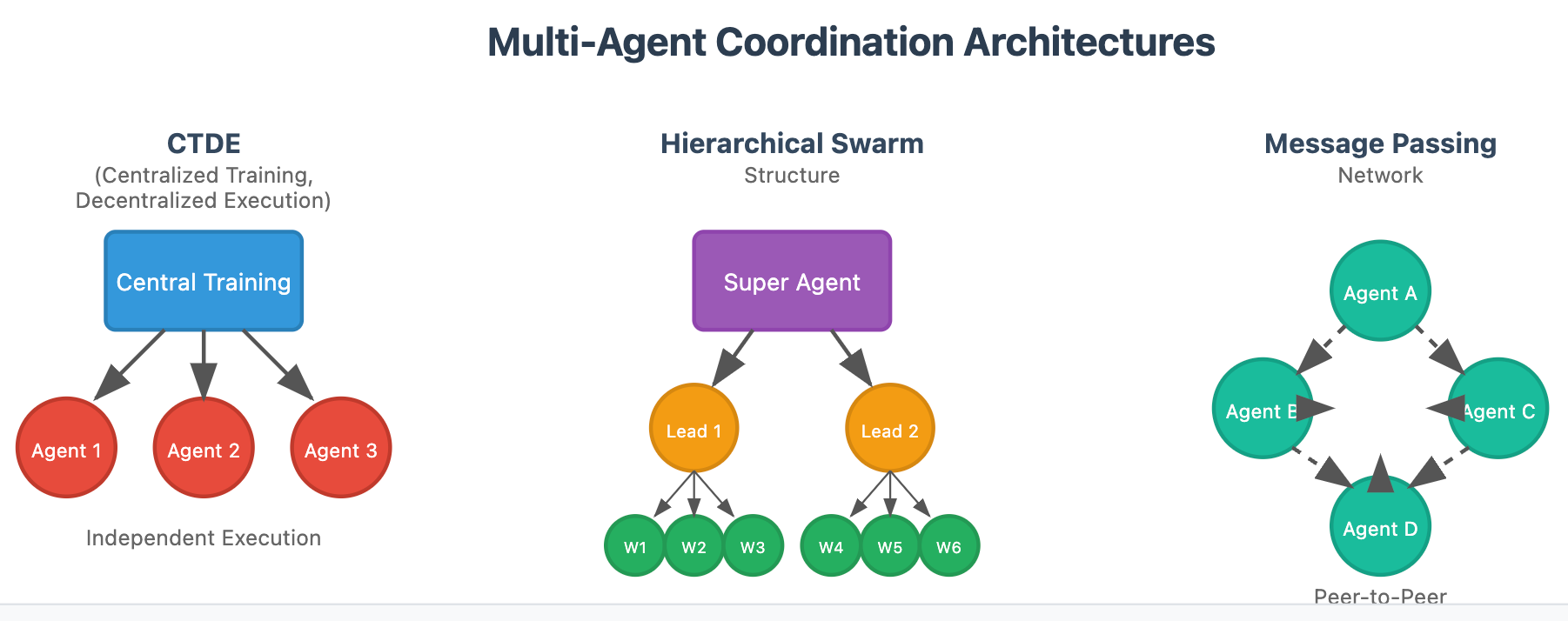
- Complex coordination is inherent to the workflow
- Scale demands exceed single-agent capabilities
- Long-term flexibility justifies higher complexity
Memory architecture: The foundation of agent intelligence
Memory architecture fundamentally determines an agent's capabilities, performance characteristics, and learning potential. Modern production systems require sophisticated memory management beyond simple conversation history, involving multiple memory types with distinct technical requirements and performance profiles.
Working memory specifications:
- Capacity: 2K-200K tokens depending on model
- Access latency: <100ms for context retrieval
- Persistence: Session-only, cleared after conversation
- Update frequency: Every conversation turn
- Storage medium: In-memory structures, GPU memory
- Use cases: Current task context, tool outputs, conversation flow
Working memory serves as the agent's immediate cognitive workspace, maintaining context for ongoing interactions. Effective working memory management requires careful prompt engineering to maximize information density within token constraints. Production systems use structured templates, compression techniques, and intelligent pruning to maintain relevant context while staying within limits.
Episodic memory specifications:
- Capacity: Unlimited, bounded by storage costs
- Access latency: 10-100ms for recent episodes, 100-500ms for historical
- Persistence: Long-term, across all sessions
- Update frequency: After significant interactions or outcomes
- Storage medium: Vector databases, relational databases
- Use cases: Learning from mistakes, pattern recognition, personalization
Episodic memory enables agents to learn from experience and improve over time. Vector database implementations using Pinecone, Milvus, or ChromaDB provide 10-50ms p95 latency for similarity search across billions of vectors. This allows agents to quickly retrieve relevant past experiences when facing similar situations.
Long-term memory specifications:
- Capacity: Petabyte scale for enterprise implementations
- Access latency: 50-200ms for knowledge retrieval
- Persistence: Permanent, with versioning and backup
- Update frequency: Continuous learning or batch updates
- Storage medium: Knowledge graphs, vector databases, structured databases
- Use cases: Domain expertise, procedural knowledge, factual information
Long-term memory stores accumulated knowledge and expertise. Knowledge graph implementations provide structured relationship modeling, enabling agents to understand complex domain relationships and make informed decisions based on comprehensive knowledge bases.
Memory integration patterns:
Successful implementations use hierarchical memory architectures where working memory maintains immediate context, episodic memory provides experience-based insights, and long-term memory supplies domain expertise. The key technical challenge lies in intelligent retrieval—determining what information to surface from vast memory stores for each specific interaction.
Advanced systems implement memory attention mechanisms that score and rank memory items based on relevance, recency, and importance. This enables agents to focus on the most pertinent information while avoiding information overload that could degrade performance.
Technical implementation considerations:
Memory poisoning represents a critical security concern. Academic research on agent vulnerabilities demonstrates high success rates for attacks where malicious instructions persist in agent memory systems. Mitigation requires memory authentication, semantic validation, and access controls that prevent unauthorized memory modifications.
Privacy and compliance add additional complexity. Financial services and healthcare implementations must ensure memory systems comply with data retention policies, geographic restrictions, and audit requirements. This often necessitates hybrid architectures with different memory tiers subject to different governance policies.
State management approaches: Stateless, session-based, and persistent architectures
State management fundamentally shapes system capabilities, scalability characteristics, and operational complexity. The choice between stateless, session-based, and persistent approaches involves tradeoffs between simplicity, functionality, and resource requirements.
Stateless architecture characteristics:
- Scalability: Excellent horizontal scaling, no state synchronization
- Fault tolerance: Automatic recovery, no state loss concerns
- Development complexity: Low, functional programming patterns
- Personalization: Limited to information in each request
- Transaction support: None, requires external systems
- Performance: Fastest, no state storage overhead
- Operational complexity: Minimal, no state management
Stateless agents treat each interaction independently, maintaining no information between requests. This approach offers excellent scalability and operational simplicity but limits functionality. Stateless systems work well for simple query-response patterns where context isn't critical, such as basic information retrieval or simple classification tasks.
Session-based architecture characteristics:
- Scalability: Good with session affinity, sticky session management
- Fault tolerance: Session loss on failure, requiring recovery mechanisms
- Development complexity: Moderate, session lifecycle management
- Personalization: Full context within session, limited across sessions
- Transaction support: Limited to session scope
- Performance: Good, with in-memory session storage
- Operational complexity: Moderate, session cleanup and timeout handling
Session-based systems maintain state for the duration of user interactions, enabling contextual conversations and complex workflows while avoiding long-term storage overhead. This approach suits customer service applications where conversation context matters but long-term memory isn't required.
Persistent architecture characteristics:
- Scalability: Complex, requiring distributed state management
- Fault tolerance: Full recovery with proper backup and replication
- Development complexity: High, distributed systems patterns
- Personalization: Complete personalization across all interactions
- Transaction support: Full ACID compliance capabilities
- Performance: Variable, depending on storage and caching strategies
- Operational complexity: High, requiring database administration
Persistent systems maintain complete state across all interactions, enabling sophisticated personalization, learning, and complex business logic. This approach supports advanced use cases but requires significant infrastructure and operational overhead.
State consistency and synchronization:
Multi-agent systems introduce additional complexity around state consistency. Distributed agents may operate on different versions of shared state, leading to conflicts and inconsistencies. Production systems address this through:
- Eventual consistency models with conflict resolution
- Event sourcing for full state reconstruction
- CQRS (Command Query Responsibility Segregation) patterns
- Distributed locking for critical sections
- Consensus protocols for state agreement
Performance optimization strategies:
State management performance directly impacts user experience and system scalability. Production optimizations include:
- Read replicas for frequently accessed state
- Write-through and write-behind caching strategies
- State partitioning and sharding
- Lazy loading for large state objects
- Compression for state storage and transfer
Tool integration and API management
Agent effectiveness depends heavily on tool integration capabilities. Modern agents require access to diverse external systems: databases, APIs, file systems, web services, and specialized software platforms. Managing these integrations while maintaining security, reliability, and performance presents significant technical challenges.
Tool categorization and specifications:
Data access tools include database connectors, file system interfaces, and API clients. These tools require robust error handling, connection pooling, and authentication management. Performance characteristics vary widely—local database queries may complete in 1-10ms, while external API calls can take 100-1000ms or more.
Computation tools encompass code execution environments, mathematical computing systems, and specialized processing engines. Sandboxing and resource limits become critical for security and stability. Container-based execution provides isolation but adds latency overhead of 50-200ms per invocation.
Communication tools enable agents to interact with external systems and other agents. These include messaging systems, notification services, and collaboration platforms. Rate limiting and backpressure handling prevent agents from overwhelming external services.
The Model Context Protocol (MCP) standardization:
The Model Context Protocol has emerged as a standardization effort for tool integration, providing consistent interfaces for common tool types. I wrote about it here. MCP servers handle specific domains like filesystem access, database queries, web browsing, and API interactions. This standardization reduces integration complexity and enables tool reuse across different agent implementations.
MCP implementations provide security through capability-based access control, where agents receive specific permissions for tool usage rather than broad system access. This principle of least privilege reduces attack surfaces while enabling functional requirements.
API rate limiting and quota management:
Production agent systems must handle API rate limits, quotas, and service-level agreements from external providers. Implementations require:
- Exponential backoff and retry logic
- Circuit breakers for failing services
- Request queuing and throttling
- Cost monitoring and budget controls
- Fallback strategies for service unavailability
Security considerations for tool access:
Tool integration expands the attack surface significantly. Security measures include:
- Input validation and sanitization for all tool inputs
- Output validation to prevent data exfiltration
- Audit logging for all tool usage
- Network segmentation and firewall rules
- Credential management and rotation
- Container isolation for code execution
Error handling and recovery mechanisms
Agent systems exhibit complex failure modes that traditional software doesn't encounter. Agents can produce syntactically correct but semantically meaningless responses, enter infinite loops, or make decisions that cascade into system-wide failures. Robust error handling requires multiple layers of detection and recovery.
Detection mechanisms:
Syntactic validation catches obvious errors like malformed JSON, invalid function calls, or constraint violations. These checks operate in real-time with minimal performance impact but miss subtle semantic errors.
Semantic validation examines response content for logical consistency, factual accuracy, and appropriateness. This requires domain-specific knowledge and often involves secondary model calls for validation, adding latency but improving reliability.
Behavioral monitoring tracks agent actions over time to detect patterns indicating problems. Metrics include response time distributions, error rates, user satisfaction scores, and resource consumption patterns.
Recovery strategies:
Retry mechanisms handle transient failures with exponential backoff and jitter to prevent thundering herd problems. Maximum retry counts prevent infinite loops while preserving system resources.
Fallback systems activate when primary agents fail. These may involve simplified agent responses, human handoffs, or alternative processing paths. Graceful degradation maintains partial functionality rather than complete service failure.
Circuit breakers prevent cascading failures by temporarily disabling failed components. Implementation requires careful tuning of failure thresholds, timeout periods, and recovery conditions.
Monitoring and observability:
Production agent systems require comprehensive monitoring beyond traditional application metrics. OpenTelemetry's GenAI semantic conventions provide standardized approaches for agent observability, tracking four key signal types:
Traces capture complete task execution flows, including all agent interactions, tool calls, and decision points. This enables understanding of complex multi-step processes and identifying bottlenecks or failure points.
Spans represent individual operations within traces, providing granular timing and context information. Span attributes include model parameters, token counts, cost data, and error details.
Metrics aggregate system performance indicators: response times, throughput, error rates, resource utilization, and business-specific measures like task completion rates or user satisfaction scores.
Events capture structured interaction data for detailed analysis. This includes user inputs, agent responses, tool executions, and system state changes. Event data enables detailed debugging and system optimization.
Production monitoring platforms:
Specialized platforms like Langfuse and Arize Phoenix provide deep insights specific to agent systems. These tools understand agent-specific metrics, provide conversation-level analysis, and offer debugging capabilities for complex multi-turn interactions.
Traditional APM tools like DataDog, New Relic, and Dynatrace have added AI-specific monitoring capabilities, integrating agent metrics with broader system observability. This holistic approach enables correlating agent performance with infrastructure metrics and business outcomes.
Security architecture and threat models
Agent security extends beyond traditional application security to include AI-specific threats like prompt injection, model poisoning, and data extraction. Microsoft's comprehensive taxonomy of agent failure modes provides a framework for understanding and mitigating these risks.
Input validation and sanitization:
Agent inputs require multi-layered validation beyond traditional SQL injection or XSS protection. Prompt injection attacks attempt to manipulate agent behavior through carefully crafted inputs that appear legitimate but contain hidden instructions.
Effective countermeasures include:
- Input parsing to separate user content from system prompts
- Content filtering to remove suspicious patterns
- Semantic analysis to detect manipulation attempts
- Rate limiting to prevent automated attack attempts
- User authentication and authorization
Output validation and filtering:
Agent outputs require validation to prevent data exfiltration, harmful content generation, or policy violations. This involves:
- Content classification to identify sensitive information
- Policy enforcement for appropriate responses
- Fact-checking against known information sources
- Bias detection and mitigation
- Compliance validation for regulatory requirements
Execution environment security:
Agents require secure execution environments, particularly when running code or accessing external systems. Container-based isolation provides process separation, resource limits, and network controls. Key security measures include:
- Minimal container images with only required dependencies
- Read-only file systems where possible
- Network segmentation and firewall rules
- Resource limits for CPU, memory, and storage
- Audit logging for all system interactions
Data protection and privacy:
Agent systems often process sensitive personal or business information. Protection requires:
- Encryption in transit and at rest
- Data minimization and retention policies
- Geographic data residency compliance
- Access controls and audit trails
- Anonymization and pseudonymization techniques
Wells Fargo's privacy-first architecture demonstrates effective data protection, processing customer information locally before sending anonymized queries to cloud services. This approach enables AI capabilities while maintaining strict data protection standards.
Chapter 3: Ready-made solutions versus custom development - The strategic framework
Market landscape of ready-made solutions
The 2025 ready-made agent market has matured significantly, offering production-ready solutions across multiple business functions. Understanding this landscape helps organizations identify when commercial solutions suffice versus when custom development becomes necessary.
Customer service and support platforms:
Zendesk's AI Suite, trained on 19 billion customer service tickets, now offers outcome-based pricing starting at $1.50 per successful automated resolution. This shift from per-seat to per-outcome pricing aligns vendor incentives with customer success while reducing cost unpredictability. The platform provides pre-built integrations with major CRM systems, knowledge bases, and communication channels.
Salesforce Agentforce represents another mature offering, recently shifting from confusing per-conversation pricing to flexible "Flex Credits" aligned with business outcomes. The platform leverages Salesforce's extensive CRM data for personalized customer interactions while providing no-code configuration tools for business users.
ServiceNow's recent $2.85 billion acquisition of Moveworks signals the market's consolidation around comprehensive platforms that combine conversational AI with enterprise workflow automation. These integrated approaches reduce implementation complexity while providing better user experiences.
Email automation and processing:
EmailTree.ai represents the specialized email automation category, delivering 80% workflow automation within the first month of deployment. The platform handles email classification, response generation, and workflow routing across multiple languages and business domains. Pre-built templates for common business processes enable rapid deployment without extensive customization.
Similar solutions include Microsoft's Power Platform AI capabilities, which integrate with Outlook and Office 365 for seamless workflow automation, and Google's Workspace AI features that provide smart compose, scheduling assistance, and document processing within familiar interfaces.
Document processing and analysis:
Specialized platforms like Nanonets, Document AI, and AWS Textract offer pre-trained models for common document types: invoices, contracts, forms, and identification documents. These solutions achieve 95%+ accuracy rates for standard document formats while providing APIs for custom integration.
The key advantage lies in pre-trained models that handle format variations, quality issues, and extraction complexity without requiring machine learning expertise. Implementation times range from days to weeks rather than months required for custom solutions.
Specialized vertical solutions:
Industry-specific platforms provide deep domain expertise. Healthcare solutions like Nuance DAX for clinical documentation, legal platforms like Harvey for contract analysis, and financial services tools like Kasisto for banking operations offer specialized capabilities that would be prohibitively expensive to develop internally.
These vertical solutions include regulatory compliance, industry-specific workflows, and domain expertise that general-purpose platforms cannot match. The trade-off involves less customization flexibility in exchange for faster deployment and proven compliance.
Total cost of ownership analysis
Understanding the true cost of ready-made versus custom solutions requires comprehensive analysis beyond initial licensing fees. TCO calculations must include implementation, customization, integration, training, ongoing support, and opportunity costs.
Ready-made solution cost breakdown:
Initial licensing typically ranges from $5,000-15,000 for basic deployments to $50,000-200,000 for enterprise configurations. However, licensing represents only 30-50% of total first-year costs.
Implementation services from vendors or partners add 50-100% of licensing costs, depending on complexity and customization requirements. Organizations with complex legacy systems or unique workflows face higher implementation costs due to integration challenges.
Ongoing costs include:
- Annual licensing renewals (typically 15-25% price increases)
- Support and maintenance fees (10-20% of licensing annually)
- Training and change management
- Integration maintenance as systems evolve
- Vendor dependency risks and switching costs
Custom development cost breakdown:
Initial development costs range from $100,000-1,500,000+ depending on complexity, team composition, and timeline requirements. This includes:
- Technical architecture and design (10-15% of total)
- Core development and testing (60-70% of total)
- Integration and deployment (15-20% of total)
- Initial training and documentation (5-10% of total)
Ongoing costs include:
- Development team salaries and benefits
- Infrastructure and operational expenses
- Maintenance and feature development
- Security updates and compliance
- Technical debt management
Break-even analysis framework:
The decision between ready-made and custom solutions often depends on scale and timeline. Ready-made solutions typically break even faster for standard use cases but may become more expensive at scale or for specialized requirements.
Break-even calculation factors:
- Implementation timeline differences (weeks vs. months/years)
- Opportunity cost of delayed deployment
- Scale-dependent cost structures
- Competitive advantage value
- Long-term strategic alignment
Feature gaps and customization limitations
Ready-made solutions excel at common business processes but struggle with unique requirements, complex integrations, and specialized workflows. Understanding these limitations helps set realistic expectations and identify when custom development becomes necessary.
Common limitation categories:
Workflow complexity represents the most frequent limitation. While ready-made solutions handle 80% of standard business processes effectively, they struggle with organization-specific workflows, complex approval processes, and multi-system integrations that don't follow standard patterns.
Data model mismatches occur when organizations have unique data structures, custom fields, or non-standard relationships that don't map cleanly to vendor-provided schemas. Workarounds often require data transformation layers that add complexity and potential failure points.
Integration constraints limit connectivity with legacy systems, specialized software, or custom applications. While major platforms provide hundreds of pre-built connectors, organizations with unique technology stacks may face significant integration challenges.
Compliance and regulatory requirements vary significantly across industries and geographies. Generic solutions may lack specific controls required for HIPAA, GDPR, SOX, or industry-specific regulations. Customization for compliance often exceeds standard platform capabilities.
Vendor lock-in considerations:
Ready-made solutions create various forms of vendor dependency that affect long-term strategic flexibility:
Data portability varies significantly between vendors. Some platforms provide comprehensive export capabilities while others make data migration difficult or impossible. Understanding export formats, API access, and migration tools becomes critical for long-term planning.
Feature dependency develops as organizations rely on vendor-specific capabilities that don't have direct equivalents in alternative solutions. Switching costs increase over time as workflows become deeply integrated with platform-specific features.
Pricing leverage shifts to vendors as switching costs increase. Organizations may face significant price increases with limited alternatives once they're deeply embedded in specific platforms.
Integration complexity grows as vendor platforms become central to business operations. Switching requires not just data migration but potentially rebuilding integrations, workflows, and user training.
Customization vs. configuration:
Understanding the difference between configuration and customization helps set appropriate expectations for ready-made solutions:
Configuration involves using built-in platform capabilities to adapt behavior without code changes. This includes setting parameters, creating workflows, and connecting to existing data sources. Configuration changes are typically supported by vendors and preserved through updates.
Customization requires code changes, custom integrations, or platform modifications that extend beyond built-in capabilities. These changes may not be supported by vendors, could break during updates, and often require specialized expertise to maintain.
The boundary between configuration and customization varies significantly between platforms. Some vendors provide extensive configuration capabilities that handle complex requirements without customization, while others require code changes for relatively simple modifications.
Implementation timeline and resource requirements
The timeline and resource requirements for ready-made versus custom solutions differ dramatically, affecting business outcomes, opportunity costs, and strategic positioning.
Ready-made solution timeline:
Evaluation and vendor selection typically requires 4-8 weeks for thorough assessment. This includes requirements analysis, vendor demonstrations, proof-of-concept testing, and contract negotiation. Organizations that skip thorough evaluation often face costly surprises during implementation.
Configuration and integration spans 6-16 weeks depending on complexity. Standard implementations with existing integrations can complete in 6-8 weeks, while complex enterprise deployments may require 12-16 weeks for full functionality.
User training and change management requires 4-8 weeks parallel to implementation. Organizations that underestimate change management often achieve poor adoption rates despite successful technical implementation.
Total deployment timeline: 14-32 weeks from project initiation to full production deployment.
Enterprise custom development timeline:
Requirements analysis and technical design requires 8-16 weeks for complex enterprise systems. This includes stakeholder interviews, technical architecture, integration planning, and security design. Rushing this phase typically leads to scope creep and rework later.
MVP development spans 16-32 weeks depending on complexity and team size. This includes core functionality, basic integrations, and initial testing. Organizations often underestimate integration complexity and testing requirements.
Production hardening requires 8-16 weeks for security testing, performance optimization, monitoring implementation, and compliance validation. This phase is often compressed but critical for production success.
Full enterprise deployment timeline: 32-64 weeks from project initiation to production deployment.
Enterprise resource requirement comparison:
Ready-made solutions typically require:
- Project manager (part-time throughout project)
- Business analyst (full-time during configuration)
- Integration specialist (full-time during technical implementation)
- Change management specialist (part-time throughout project)
- End user champions (part-time for training and adoption)
Custom development requires:
- Technical architect (full-time during design phase)
- Backend developers (2-5 full-time for development)
- Frontend developers (1-3 full-time for user interfaces)
- DevOps engineer (part-time for infrastructure)
- QA engineers (1-2 full-time for testing)
- Product manager (full-time throughout project)
- Security specialist (part-time for security review)
Risk factors and mitigation strategies:
Ready-made solution risks include vendor changes, feature limitations, integration failures, and adoption challenges. Mitigation strategies involve thorough vendor due diligence, pilot testing, and contingency planning.
Custom development risks include scope creep, technical challenges, team turnover, and timeline overruns. Mitigation requires disciplined project management, iterative development approaches, and realistic timeline estimation.
Both approaches face change management risks that can derail otherwise successful technical implementations. Organizations consistently underestimate the effort required for user adoption, workflow changes, and cultural adaptation.
Decision framework and criteria
Choosing between ready-made and custom solutions requires systematic evaluation of multiple factors including strategic importance, technical requirements, timeline constraints, and organizational capabilities.
Strategic importance matrix:
High strategic importance with high differentiation potential favors custom development. Organizations seeking competitive advantage through unique AI capabilities should invest in custom solutions that competitors cannot easily replicate.
High strategic importance with low differentiation potential suggests ready-made solutions. Core business functions like customer service or document processing may be strategically important but don't require unique capabilities for competitive advantage.
Low strategic importance regardless of differentiation potential typically favors ready-made solutions unless specific technical requirements mandate custom development.
Technical requirements assessment:
Integration complexity evaluation considers the number of systems, data formats, and workflow requirements. Organizations with complex legacy systems or unique technical architectures may find custom development necessary despite preference for ready-made solutions.
Scalability requirements affect long-term costs and technical feasibility. High-volume applications may justify custom development for performance optimization, while lower-volume use cases favor ready-made solutions.
Compliance and security requirements vary significantly between industries and use cases. Highly regulated environments may require custom development for specific controls that ready-made solutions cannot provide.
Organizational capability evaluation:
Technical expertise available internally affects feasibility and ongoing maintenance costs. Organizations with strong engineering teams may favor custom development for control and learning benefits, while those lacking technical capabilities should prefer ready-made solutions.
Project management maturity influences success probability for complex implementations. Organizations with proven track records managing large technical projects face lower risks with custom development than those lacking project management capabilities.
Change management capabilities determine adoption success regardless of technical approach. Organizations should honestly assess their ability to drive user adoption and workflow changes before committing to either approach.
Financial analysis framework:
Net present value calculations should include all costs over 3-5 year periods, accounting for opportunity costs, scalability requirements, and strategic value. Ready-made solutions often show better short-term NPV while custom solutions may provide better long-term returns.
Risk-adjusted returns consider implementation risks, vendor risks, and technical risks. Custom development typically involves higher risk but potentially higher returns, while ready-made solutions offer lower risk but limited upside.
Option value analysis considers the value of future flexibility and strategic options. Custom development provides more flexibility for future changes but requires ongoing investment, while ready-made solutions may limit future options but reduce ongoing costs.
Chapter 4: Common failure modes and proven mitigation strategies
Technical failure patterns
Agent systems exhibit unique failure modes that don't occur in traditional software applications. Microsoft's comprehensive taxonomy of agent failure modes identifies several critical categories that organizations must understand and mitigate.
Memory poisoning and persistence attacks:
Memory poisoning occurs when malicious instructions persist in agent memory systems, executing later when conditions are met. Academic research on these attacks demonstrates high success rates, making them a critical concern for production systems.
Attack vectors include:
- Injection of persistent instructions in conversation history
- Manipulation of episodic memory through crafted interactions
- Corruption of knowledge bases through seemingly legitimate updates
- Social engineering attacks that embed instructions in user-generated content
Effective mitigation requires multiple defensive layers:
Memory authentication ensures that only authorized processes can modify agent memory. This includes cryptographic signatures for memory updates, access control lists for different memory types, and audit trails for all memory modifications.
Semantic validation examines memory content for suspicious patterns, inconsistencies, or policy violations. This requires domain-specific knowledge to distinguish legitimate instructions from malicious injections.
Temporal isolation limits the persistence of certain memory types, automatically expiring potentially dangerous content. This reduces attack windows while preserving legitimate functionality.
Content sandboxing isolates memory content from execution contexts, preventing direct instruction execution from memory stores. This architectural approach limits the impact of successful memory poisoning attacks.
Goal drift and context window pollution:
Goal drift occurs when agents gradually deviate from their intended objectives through accumulated context pollution or token-level biases. This phenomenon manifests subtly, making detection challenging until significant deviation occurs.
Technical causes include:
- Rare token sampling that introduces unexpected content into context windows
- Context overflow that truncates important instructions while preserving noise
- Attention mechanism biases that focus on irrelevant information
- Cumulative prompt injection through multiple interactions
Detection mechanisms involve:
- Objective function monitoring to track goal alignment over time
- Context analysis to identify polluted or irrelevant content
- Behavioral drift detection through statistical analysis
- Output validation against expected goal patterns
Mitigation strategies include:
- Regular context window cleaning and instruction reinforcement
- Objective function reset mechanisms that restore original goals
- Attention mechanism debugging and adjustment
- Circuit breakers that halt execution when drift exceeds thresholds
Infinite loops and resource exhaustion:
Agents can enter infinite loops through various mechanisms: recursive tool calling, cyclical reasoning patterns, or stuck state machines. These failures consume resources while producing no useful output.
Common loop patterns:
- Tool calling loops where agents repeatedly call the same functions
- Reasoning loops where agents cycle through the same logical steps
- Error handling loops where failure recovery mechanisms themselves fail
- Memory retrieval loops where agents endlessly search for information
Prevention requires:
- Execution time limits for all agent operations
- Recursion depth limits for tool calling and reasoning
- Resource consumption monitoring and throttling
- Loop detection algorithms that identify repetitive patterns
Recovery mechanisms include:
- Automatic termination when limits are exceeded
- State reset to known good configurations
- Alternative execution paths when primary approaches fail
- Human intervention triggers for complex loop scenarios
Multi-agent coordination failures:
Multi-agent systems introduce coordination failures that single agents don't experience. These include deadlocks, race conditions, split-brain scenarios, and conflicting objective functions.
Deadlock occurs when agents wait for each other to complete tasks, creating circular dependencies that prevent progress. Prevention requires:
- Timeout mechanisms for all inter-agent communications
- Deadlock detection algorithms that identify circular waits
- Priority-based resolution when deadlocks are detected
- Alternative execution paths that bypass blocked agents
Race conditions happen when multiple agents modify shared state simultaneously, leading to inconsistent results. Solutions include:
- Distributed locking mechanisms for shared resources
- Event ordering and conflict resolution protocols
- Eventually consistent state models that handle conflicts gracefully
- Consensus algorithms for critical state changes
Split-brain scenarios occur when agent groups lose coordination and develop conflicting views of system state. Mitigation involves:
- Leader election protocols that maintain clear authority
- Quorum requirements for critical decisions
- Network partition detection and handling
- State reconciliation procedures for rejoining partitions
Organizational failure patterns
Technical failures often result from organizational issues rather than pure technology problems. Understanding these patterns helps organizations avoid preventable failures through better planning and execution.
Scope creep and requirement drift:
MD Anderson's Watson implementation demonstrates classic scope creep, expanding from acute leukemia treatment to multiple cancer types without corresponding technical capability increases. This pattern occurs frequently in AI projects due to inflated expectations and poor requirement discipline.
Prevention strategies include:
- Clear scope definition with measurable success criteria
- Change control processes that evaluate impact before approval
- Regular stakeholder alignment on priorities and constraints
- Phased implementation approaches that prove value incrementally
Insufficient testing and validation:
Organizations often underestimate the testing required for agent systems. Unlike traditional software, agents require testing for: accuracy, safety, edge cases, adversarial inputs, and emergent behaviors. McDonald's drive-thru failure illustrates the gap between controlled testing and real-world performance.
Comprehensive testing frameworks include:
- Unit testing for individual agent components
- Integration testing for tool and system interactions
- Adversarial testing for malicious inputs and edge cases
- Performance testing under realistic load conditions
- Safety testing for harmful or biased outputs
- User acceptance testing with actual end users
Change management and adoption failures:
Technical success doesn't guarantee business success without proper change management. Agent implementations often fail due to poor user adoption, workflow disruption, or cultural resistance.
Successful change management requires:
- Early stakeholder engagement and buy-in
- Comprehensive training programs for all user types
- Clear communication about benefits and changes
- Support systems for troubleshooting and questions
- Gradual rollout with feedback incorporation
- Success measurement and continuous improvement
Vendor management and dependency risks:
Organizations often underestimate vendor dependencies and associated risks. AI vendor landscape volatility increases these risks compared to traditional software vendors.
Risk mitigation strategies include:
- Multi-vendor approaches to avoid single points of failure
- Data portability planning and regular export testing
- Contract terms that protect against vendor changes
- Technical architecture that enables vendor switching
- Financial stability assessment of critical vendors
Security vulnerabilities and attack vectors
Agent systems face unique security threats that traditional security measures don't address. Understanding these attack vectors enables proper defensive planning and implementation.
Prompt injection and manipulation:
Prompt injection attacks attempt to manipulate agent behavior through carefully crafted inputs that appear legitimate but contain hidden instructions. These attacks exploit the natural language interface that makes agents accessible.
Attack techniques include:
- Direct injection of instructions within user input
- Indirect injection through documents or web content
- Social engineering to embed instructions in legitimate content
- Multi-turn attacks that build malicious context gradually
Defense mechanisms require:
- Input parsing to separate user content from system prompts
- Content filtering to identify suspicious patterns
- Prompt structure validation to detect manipulation attempts
- Response validation to catch unexpected outputs
- User authentication and authorization controls
Data exfiltration and privacy violations:
Agents with access to sensitive data face exfiltration risks through both accidental disclosure and targeted attacks. The conversational interface makes data leakage particularly dangerous since responses appear natural.
Protection strategies include:
- Data classification and access controls
- Output filtering to prevent sensitive data disclosure
- Query analysis to detect data gathering attempts
- Audit logging for all data access
- Privacy-preserving architectures that minimize data exposure
Wells Fargo's privacy-first architecture demonstrates effective protection, processing sensitive data locally and only sending anonymized queries to external models. This approach enables AI capabilities while maintaining strict data protection.
Model manipulation and adversarial attacks:
Advanced attackers may attempt to manipulate agent behavior through model-level attacks, including adversarial examples, model poisoning, and extraction attacks.
Defensive measures include:
- Input validation and sanitization
- Adversarial training to improve robustness
- Model monitoring for unusual behavior patterns
- Regular security testing and red team exercises
- Incident response plans for security breaches
Production monitoring and debugging strategies
Agent systems require sophisticated monitoring beyond traditional application metrics. We usually call these evals. The non-deterministic nature of AI systems makes debugging particularly challenging, requiring specialized tools and techniques.
Key performance indicators for agent systems:
Technical metrics include response time, throughput, error rates, and resource utilization. However, agent-specific metrics are equally important:
- Task completion rates and success definitions
- User satisfaction scores and feedback analysis
- Goal achievement measurement and tracking
- Context retention and memory effectiveness
- Tool usage patterns and efficiency metrics
Business metrics connect technical performance to business outcomes:
- Process automation rates and efficiency gains
- Cost reduction and ROI measurement
- Quality improvements and error reduction
- User adoption rates and engagement levels
- Competitive advantage and differentiation metrics
Debugging complex interaction patterns:
Agent debugging requires understanding multi-turn conversations, context evolution, and decision-making processes. Traditional debugging tools don't provide adequate visibility into these patterns.
Effective debugging approaches include:
- Conversation replay and analysis tools
- Decision tree visualization for agent reasoning
- Context window analysis and optimization
- Tool interaction tracing and performance analysis
- Memory state inspection and validation
Continuous improvement and optimization:
Agent systems require ongoing optimization to maintain performance and adapt to changing requirements. This involves:
- Regular performance review and bottleneck identification
- A/B testing for prompt engineering and model selection
- User feedback analysis and system refinement
- Cost optimization through efficient resource usage
- Security assessment and vulnerability management
Successful agent implementations establish feedback loops that enable continuous learning and improvement. This includes monitoring business outcomes, user satisfaction, and technical performance to guide ongoing optimization efforts.
Organizations must balance automation benefits with human oversight, ensuring that agents enhance rather than replace human capabilities. The most successful implementations combine agent efficiency with human judgment, creating hybrid systems that leverage the strengths of both.
The future of AI agents lies not in replacing human decision-making but in augmenting human capabilities with intelligent automation. Organizations that understand this balance, invest in proper technical foundations, and implement thoughtful change management will achieve the greatest success in their agent deployments.
Conclusion: The Window Is Closing
The AI agent market has reached its inflection point. We now have enough real-world data—from Wells Fargo's 245 million successful interactions to MD Anderson's $62 million failure—to separate the architectural decisions that drive success from those that guarantee expensive disappointment. The technical complexity vocabulary exists: single agents deliver 3-10x better cost efficiency than multi-agent systems for most use cases, memory architecture determines intelligence more than model selection, and security requires AI-specific defenses beyond traditional cybersecurity. The strategic frameworks are proven: buy ready-made solutions for standard processes, build custom only for competitive differentiation, and always start narrow before scaling.
But here's the uncomfortable truth: the window of opportunity is closing. The organizations succeeding in 2025 aren't those avoiding AI agents—they're those failing fast with clear ROI standards while others burn budgets on fundamentally flawed architectures. They understand that 42% of businesses abandoning AI initiatives isn't a sign of technology failure; it's evidence of strategic discipline and rising sophistication standards.
The window for competitive advantage through AI agents is narrowing rapidly. Early movers with proper execution will establish durable advantages that late adopters simply cannot replicate. The choice isn't whether to deploy AI agents—it's whether to do it right the first time or learn expensive lessons through failure. This guide has given you the frameworks to choose correctly. Now the question is: what are you going to do with them?
For more on AI, subscribe and share!
Resources:
Market Statistics & Research:
Wells Fargo AI Assistant:
MD Anderson Watson Failure:
McDonald's AI Drive-Thru:
ServiceNow/Moveworks Acquisition:
Klarna AI Assistant:
Zendesk Pricing:
Technical Standards:
Microsoft Security Research:
EmailTree.ai: